

Bird News

The Okavango Delta was by far my favorite spot in Botswana and maybe of our whole Namibia/Botswana trip. I am not sure that Paul Magid and Anita Botti would agree, but Flip Harrington and I loved it. Our first tented camp was very strange, and if this had been our only stop my opinion of Botswana and the Okavango Delta would have been very different! We were greeted by three dogs of various mixed breeds. There was a tank of tilapia fish next to the desk where we checked in. When we returned from our tents after stowing our gear, there was an otter in the hall of the dinning area eating a fish. We sat down at the table for dinner and the otter scurried around our feet. Then, as we were about to be served, a full-grown goat appeared in the kitchen and promptly climbed up on a box about three feet square! This is where the goat was fed its bottle when young and has definitely been imprinted. Get on box, get fed. After dinner we went into the “lounge” to find the goat on a soft chair “sitting” next to the owner watching satellite TV. Oh, boy!

Our adventures in Botswana will have to wait for next week as the birds take precedence.
Bird Sightings:
We appear to have a new early record for the sighting of an osprey over the Island. Will and Sue Geresy of Chappaquiddick spotted a very high flying osprey over Poucha Pond on Chappaquiddick on March 1. The bird was heading north and the Geresys heard the bird call once as it flew by.
Four intrepid travelers from the Vineyard met in Atlanta, Ga. and climbed on a plane to cross the Atlantic. Eighteen hours later, after a stop in Dakar, they arrived in Johannesburg, South Africa. They dropped their gear in their rooms, gathered in one room, turned on CNN and watched Obama’s inaugural address. Afterwards they supped on king klip, a delicious South Africa fish and tried South African beer and wine. A very civilized and relaxing evening as we figured our birding and game safari in Namibia and Botswana would not be so mellow. Little did we know.
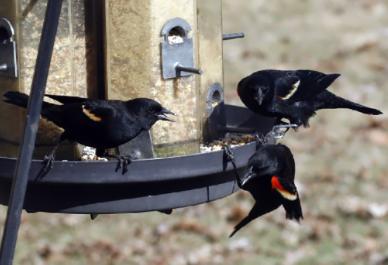
Migrating red-winged blackbirds have arrived! The red-wings that had left last fall are beginning to return after spending the winter in the southeastern United States. A sure sign of the coming spring even though it is still February. They announce their presence by their arrival at bird feeders, their brilliant red epaulets on their wings flashing and contrasting to the black everywhere else, and their singing from treetops. Soon they will be singing from our wetlands as the males set up their territories. The females, which are streaked brown sparrow-like birds, will arrive in another few weeks.
Sounds of water running in the gutters were unmistakable. It was the night of Feb. 7, and the skies were clear, so the source of the water was not a rainstorm. It was the sound of melting snow and ice draining off my roof; a welcome sound to my ears as it optimistically signifies that the winter’s deep freeze is over.
This meltwater is but one of the many signals of the coming spring.

It’s a good thing February is a short month, because it’s easily the dullest one in the birding year. With the great ponds mostly or entirely frozen, many of our ducks have had to press farther south. Meanwhile, snow storms and cold snaps have pruned the numbers of songbirds, either through mortality or by pushing these birds, too, farther south. A couple of recent outings ranked among the slowest days of birding I can recall.