
Nature & Science
Money doesn’t grow on trees. It does, however, grow from flowering plants -- if you know where to look.
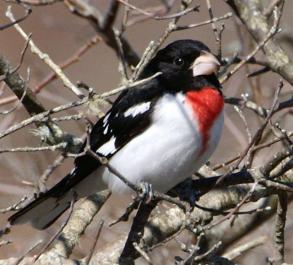
One would think the birds that return from their winter haunts in the south are mimicking our summer residents. One group of bird species arrives and immediately checks out last year’s nest, tidies it up, and proceeds to start a new family. This group is similar to our summer human residents who own a home here. Another flight of birds returns to the Island and looks for a fresh nest site and proceeds to build a new nest. These are akin to summer renters who often have to find a new house each season. And finally there is the bird species that drop in to visit the Island briefly and then fly north. These birds migrate through the Vineyard on their way to nesting areas elsewhere, mirroring the ways of the day trippers.
Land Bank Walk
On Sunday, May 6, at 1 p.m. the Martha’s Vineyard Land Bank staff lead a guided walk of Poucha Pond Reservation in Edgartown. Anyone interested should meet at the trailhead for Poucha Pond Reservation located off Wasque Road.
The gibbous moon dominates our sky this weekend. On Monday night, it appears near the bright red planet Mars and both are near the bright star Regulus. All three form a close triangle in the zodiacal constellation Leo. Regulus is the principal and brightest star in Leo. Up against the brighter Mars and the moon, Regulus is not so impressive.
You would have to be an ass to refuse a taste of donkey rhubarb.
Donkey rhubarb is delicious, though not a relative of the garden variety many of us know better. More commonly called Japanese knotweed, this wild plant rivals regular rhubarb for the perfect pie and, best of all, it is a truly free food, found all over the Island. It is just now ready for harvesting, but will not last long in its tender, edible stage.
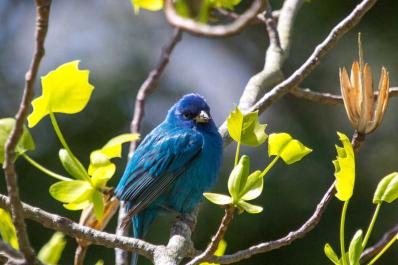
The Vineyard experienced a mini fallout last week. We are not talking nuclear, but bird! If there is a strong wind that comes from the southwest in the spring, birds coming up from the southern U.S. and Central and South America are carried on their way north at a good clip. Then if the wind comes around from the north, the birds basically hit a wall and stop. If the migrating birds are over the Island at that time they fall out onto same. The indigo bunting is the bird species that fell out in the largest number on the Island, scattering patches of electric blue from Chappaquiddick to Aquinnah!
Almanac
A comprehensive guide to weather and tides on the Island.
Vineyard Gardener
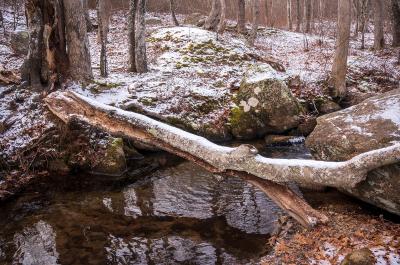
I guess this past week weather-wise is called a January thaw. We did not really experience it the last several years as December was unseasonably warm.
Farm & Field
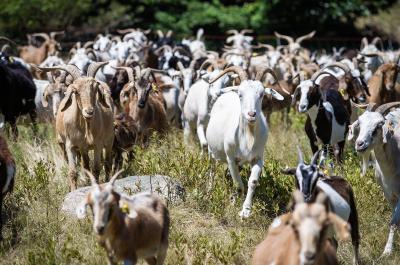
Beige and brown and tan and black, with horns spiraled or semicircular or in undulating waves, a legion of goats marched up the hill toward us, bleating in anticipation of fresh grass and leaves.