

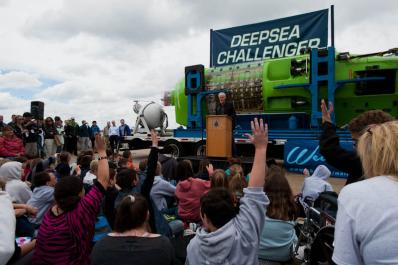
WOODS HOLE — Urging a group of Chatham middle schoolers to follow their dreams, filmmaker James Cameron handed the keys to the Deepsea Challenger, the only human-occupied vehicle able to reach the deepest parts of the sea, to the Woods Hole Oceanographic Institution in a ceremony Friday morning.
“The things you get excited about today, those will be some of the most important driving forces for you in the future,” Mr. Cameron told the gathering of 12 and 13 year olds who formed a semicircle in front of him.
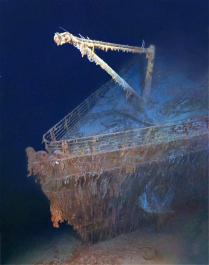
At Coffee Obsession in Woods Hole on Wednesday morning, Dr. David Gallo, director of special projects at the Woods Hole Oceanographic Institution (WHOI), thumbed through the pictures on his iPad. But they weren’t of family members or far-flung vacations. Instead he pulled up a high-resolution photo mosaic he took of the RMS Titanic, settled in its lonely repose at the bottom of the Atlantic.
With Cape Wind hoping to break ground in the coming years and a huge new swath of ocean opened for wind farm development south of the Vineyard, the impact of turbine noise on fisheries is still poorly understood.
“The long-term impacts of these wind farms are just totally unknown,” said Woods Hole Oceanographic Institution biologist Scott Gallagher this week.
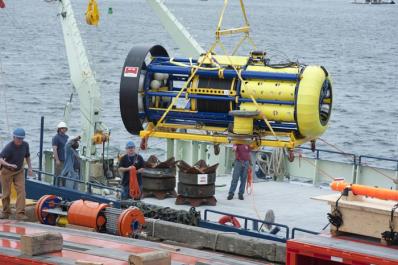
The waters south of the Vineyard will soon become among the best studied in the world. At the continental shelf break, some 80 miles south of South Beach where North America begins its descent toward the abyssal plain, a huge swath has been identified by scientists to be monitored, dissected and measured in resolutions and over time scales unprecedented in oceanography.
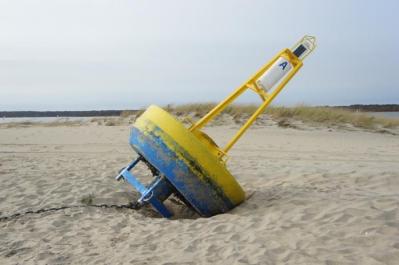
A scientific buoy was among the flotsum that washed up on South Beach when the remnants of Hurricane Irene passed over the Island two weeks ago. Susan Snider found the Woods Hole Oceanographic Institution buoy on last Sunday and submitted the photograph to the Gazette.
Janet Fredericks, an operations manager for the institution, wrote and said it was a guard buoy, a marker used to alert and keep vessels away from the underwater scientific gear beneath. The institution maintains a sub-sea observatory along with a shoreside weather observatory.

This month scientists from the Woods Hole Oceanographic Institution will descend on Edgartown with a sonar-equipped waverunner to map, in unprecedented resolution, the ever-shifting sands and currents of Katama Bay. While the bathymetry of the body of water, where change is a constant feature, is of special scientific interest to the Woods Hole scientists, the information is even more valuable for the surprising underwriter of the project: the U.S. Department of Defense.