


Susan B. Whiting
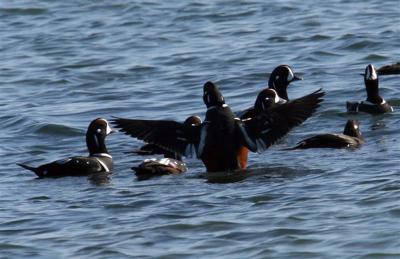
At Thanksgiving, I want to extend my thanks to the people who have made an effort to save or create the Vineyard habitats. Without the open spaces, marshes, meadows and woodlands, there would be no place for my favorite creatures, birds.

Little Tin Horn is the name that Eric Cottle gave the bird that seems to be gracing everyone’s feeders this season. Nothing sounds more like those penny whistle tin horns than the red nuts — (the name bird-watchers give the red-breasted nuthatches).
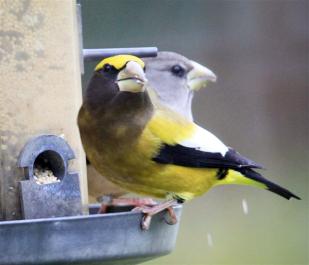
Beetlebung Corner is really the center of Chilmark. The library, the school, the community center, the town hall, two banks, a restaurant, a general store, a real estate office and the post office are all within a few steps. This is all well and good for humans. However, for the birds Beetlebung Farm, which provides fresh vegetables and flowers in the summer, is their main attraction. By now the vegetables have been harvested and most of the flowers gone. Luckily there are still a few hardy nasturtiums blooming and a very late visitor arrived on Nov. 2 to enjoy the nectar of these nasturtiums. Marie Scott and Suzie Bunker, both daughters of Ozzie and Rena Fischer, spotted the hummingbird and alerted their father and their brother, Bert.
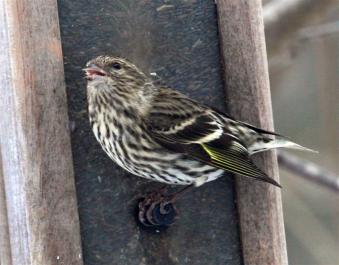
The bird sightings for the Island are confirming the prediction that there will be many winter finches flying south this fall/winter. Allan Keith shared with me a winter finch forecast for 2010-2011 which explains about the key crops that affect the finch movement. If white spruce, white pine, hemlock, mountain ash and white birch have poor seed production the finches will head south to find more feed.
Eek, what do I call this winter visitor — black chipping bird, white-bill, slate-colored snowbird, eastern junco, slate-colored junco or dark-eyed junco? Presently the ornithologists are calling the junco that visits the Vineyard most commonly the dark-eyed junco.

Once upon a time a small finch known as a linnet lived in the United States west of the Rocky Mountains. There were a group of sleazy pet dealers in California that went out and captured many of these linnets. These caged wild birds were shipped to New York to be sold in pet stores as “Hollywood finches.” This was totally illegal as the linnets, we know them as house finches, are protected by the Migratory Bird Treaty Act.