


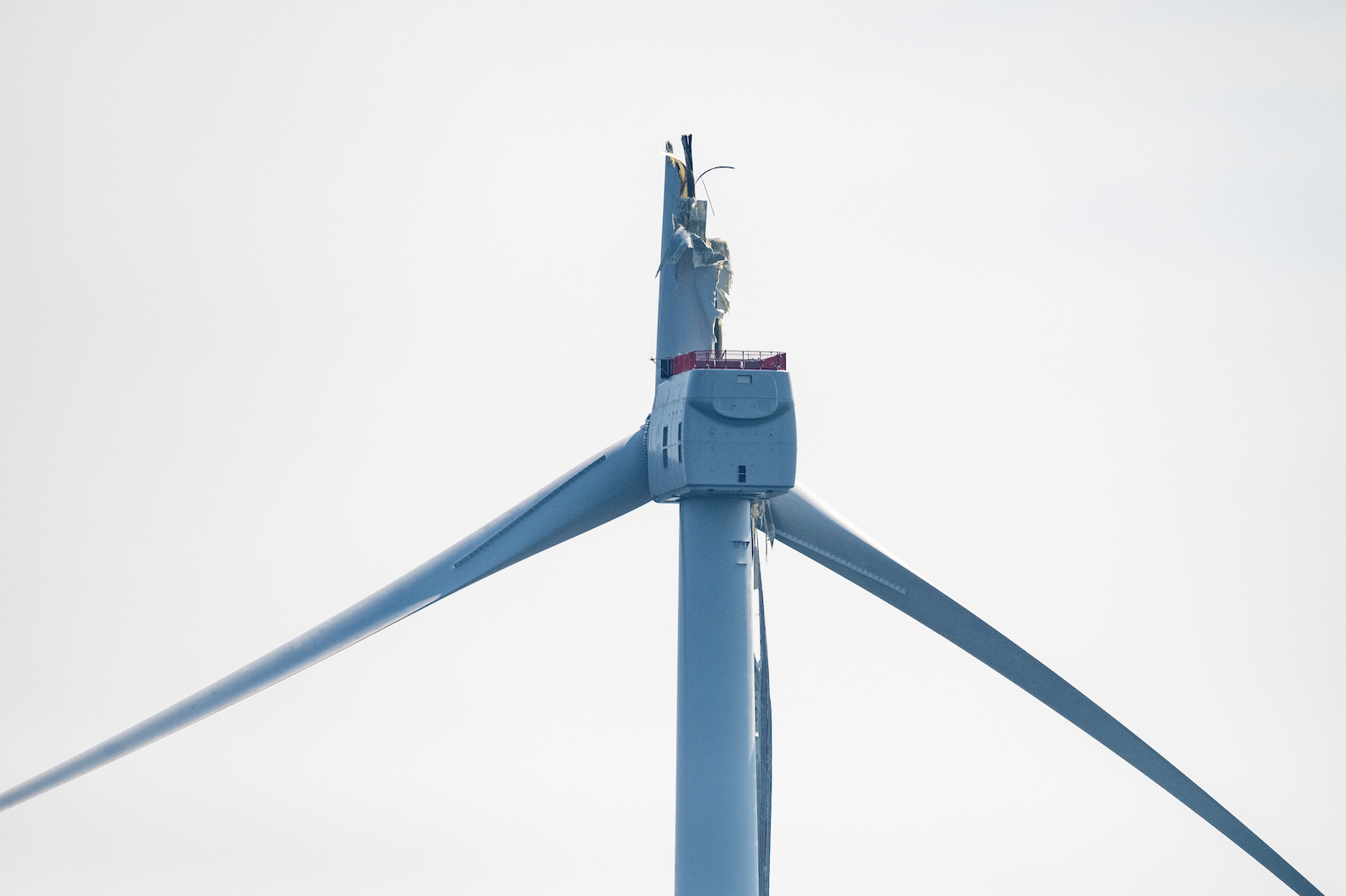
A week after debris from the broken Vineyard Wind turbine washed up on Edgartown beaches, state officials said they are investigating potential harm to the region’s seafood but don’t see a need to immediately stop eating shellfish.
A week after debris from the broken Vineyard Wind turbine washed up on Edgartown beaches, state officials said they are investigating potential harm to the region’s seafood but don’t see a need to immediately stop eating shellfish.
Representatives with the state Department of Environmental Protection and Division of Marine Fisheries, as well as several federal agencies that are involved in offshore wind energy, met with the Nantucket select board Wednesday to talk about the fallout of the turbine blade that collapsed into the ocean on July 13.
Though thousands of pieces of fiberglass and styrofoam went into the water, both state agencies told Nantucketers that they saw no need to halt shellfishing in the region, but remained committed to monitoring the situation.
Wendy Heiger-Bernays, the chief of research at the state Department of Environmental Protection, and Chrissy Petitpas, an aquaculture biologist at the state Division of Marine Fisheries, came before the board to give their thoughts on the potential harm to marine life.
After reviewing initial reports and data from the turbine manufacturer, Ms. Heiger-Bernays said the debris posed a threat to beachgoers and boaters, but it is unlikely to be a significant risk to aquatic organisms chemically-speaking.
That said, the department offered its expertise to help craft water quality studies and review any findings.
After hearing concerns about turbine pieces getting into nearby shellfish, Ms. Petitpas said fiberglass and microplastics have already been recorded in the food chain going back about a decade and this type of debris is commonly seen in areas near active boat yards.
“So it will be difficult to really assess the impact of these additional contaminants produced by this incident from the background,” she said.
That said, much of the research around the health risks associated with these particles in the environment is still in its early stage and there are no public health standards around it, Ms. Petitpas said.
DMF is consulting with U.S. Food and Drug Administration shellfish specialists and the state Department of Public Health, but didn’t advise any changes to shellfish harvesting and consumption as of right now.
The Bureau of Ocean Energy Management, Bureau of Safety and Environmental Enforcement, National Oceanic and Atmospheric Administration and U.S. Fish and Wildlife also had leaders at the select board meeting Wednesday to detail their patchwork approach to monitoring the broken turbine and how things will move forward.
Power generation at the turbines will remain shut down until BSEE concludes its investigation into the incident. The agency’s renewable energy operations director Cheri Hunter said the government is considering new safety protocols in the wake of the failure.
“BSEE is currently exploring requiring a plan, such as a marine debris recovery plan, as a component of the company’s safety management system,” she told the board.
Similarly, David Diamond, the Bureau of Ocean Energy Management deputy chief for Atlantic operations, said the agency is reviewing its procedures to see if any changes were needed to strengthen and build on the lessons learned in this breakage.
Though debris started showing up on the Vineyard last week, with confirmed pieces of styrofoam floating up on Wasque, South Beach and Norton Point — as well as further afield in Westport and Falmouth — most of the large pieces of fiberglass have been washing ashore on Nantucket.
GE Vernova, the manufacturer of the turbine, said Wednesday that it has upped its efforts to reinspect all of its blades after the break. Technicians are taking a second look at past scans of the 150 or so blades either on already built turbines or on ones ready to be installed, and new plans to physically inspect them have been put into place.
GE Vernova chief sustainability officer Roger Martella also said fiber optic sensors will be put into place to stress test blades, giving the company a heads up should another blade show signs of weakness.
The renewable energy company hopes to get the rest of the dangling blade off the turbine ahead of a storm headed for the region this weekend. But if it can’t, there are chances more debris could be headed towards the Islands.
“There is a possibility that the 22-meter per second projected winds could impact that, and then we would execute the recovery plans that we’ve been doing,” Mr. Martella said.
Comments
For now but what about 3 to 5
John osmers Martha’s VineyardFor now but what about 3 to 5 years when all the pieces they don’t pick up and the particulate debris/ fiberglass dust is spread through our water column and remember this is one blade on average 10% of blades fail if vineyard wind has 500 turbines that’s 1500 blades that’s 150 blades that will fail over 25 years stop them now
John,
Chris EdgartownJohn,
I understand your concern, but where do get data on 10% of blades failing? Is this from an average worldwide failure rate of similar fiberglass blades? In my opinion, the fallout from oil spills is a greater threat to aquatic and terrestrial life than wind turbines.
It doesn't seem to me that
MWG EDGIt doesn't seem to me that anyone who is against industrial scale offshore wind installation is in favor of oil and all of the problems associated. My gripe and the one shared by many of my peers is that this is a lesser of two evils situation that is on the table because of its scalability and marketability. Terrestrial wind installations are easier to maintain and in some cases easier to install, and don't have the downside of causing a massive moving debris field when they do fail.
Unfortunately terrestrial wind is less viable as a tradable commodity because of the many limitations placed upon real estate (as well as myriad other issues. It is disappointing that offshore wind has been chosen as the easy way to a green energy future, as opposed to an even greener and harder path. Decentralized and point of use energy production and storage is a much better solution than any large scale installations, it is just harder to achieve and much much harder to monetize. tldr: any threat to marine environment should be considered unacceptable
Vineyard Wind is cautioning
Enough Already Oak BluffsVineyard Wind is cautioning all of us not to pick up any of the pieces of this debris. Do not put in in your trash can, no not touch it and call their 800 number to alert their crews to come dispose of it! Doesn't this sound a bit scary? I never trusted this multi billion dollar big energy company. And we should all be ashamed that their profits from this project rest solely on the tax dollars they receive from hard working people. Shameful.
Add new comment