


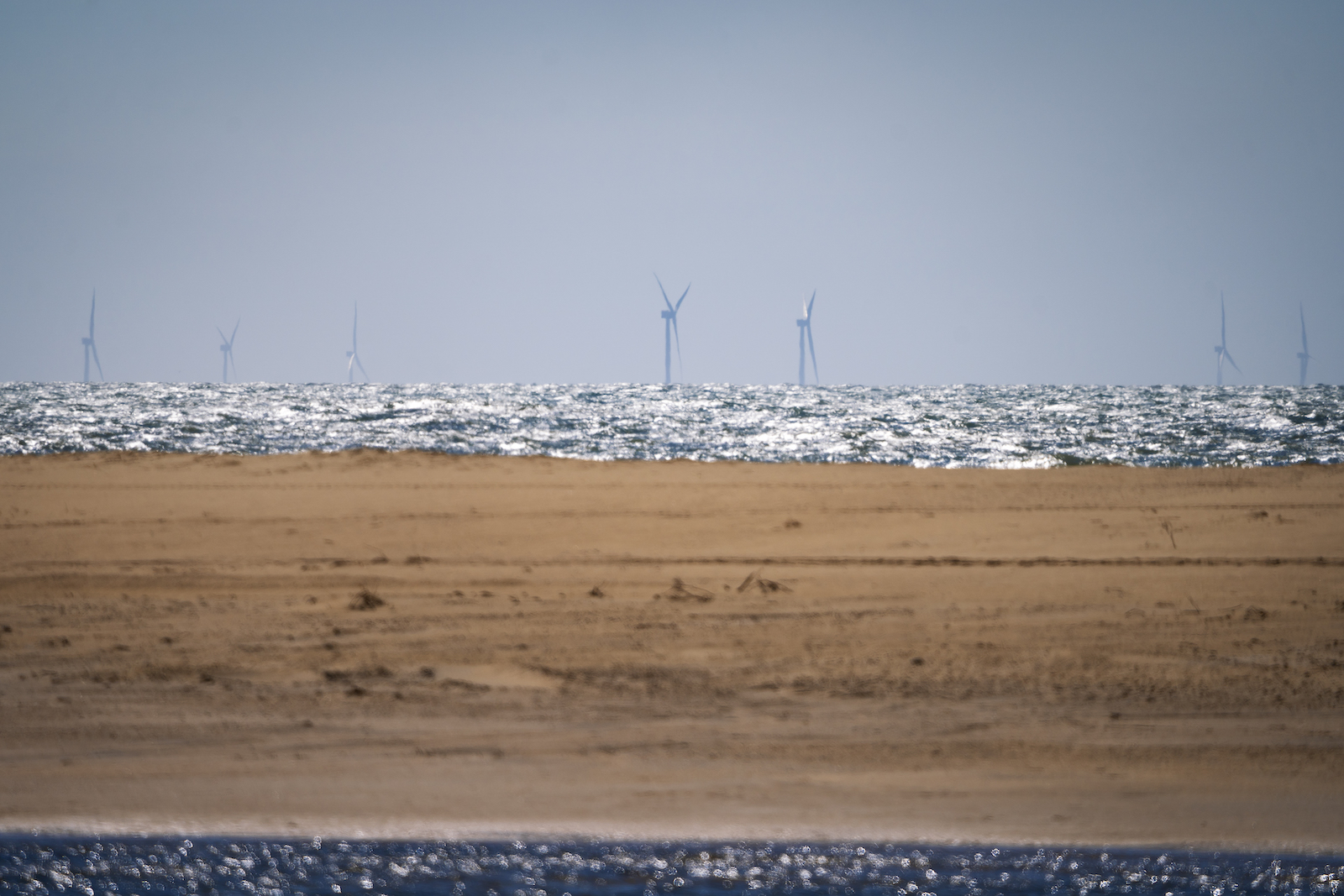
Vineyard Wind has now joined the legal battle against the Trump administration with a lawsuit that calls the stop work order placed on offshore wind construction unlawful.
Vineyard Wind has now joined the legal battle against the Trump administration with a lawsuit that calls the stop work order placed on offshore wind construction unlawful.
The offshore wind energy project, which is about 14 miles south of the Island and has an operations headquarters in Vineyard Haven, is suing the Department of the Interior and several other agencies and officials in hopes to restart construction of the 62-turbine farm.
With the case filed in U.S. District Court in Massachusetts, Vineyard Wind joins Revolution Wind in attempting to reverse the Dec. 22 stop work order from the Department of the Interior that halted all construction on offshore wind farms in the U.S. due to national security concerns.
In its 52-page complaint, Vineyard Wind, which is owned by Avangrid and Copenhagen Infrastructure Partners, argued that it had extensive consultations with the Department of Defense in years past and had come up mitigation plans for any potential interference to national security.
This new order, the company claims, is a pretext to meet President Donald Trump’s stated goal of squashing the offshore wind energy industry and has no real national security claim.
“Because the Order provides no reasoned explanation ground in facts available to Vineyard Wind and contradicts previous findings by [the federal government] that the Project does not threaten national security, the court should immediately enjoin it to prevent ongoing irreparable harm,” Vineyard Wind’s attorneys wrote.
Vineyard Wind is the first commercial-scale offshore wind project to get fully approved in the U.S. and it was hoping to start producing power from all 62 turbines at the beginning of 2026.
So far, the project has 61 turbines built and 44 are operational, generating about 572 megawatts of power, according to the lawsuit.
The Department of the Interior has said that the towering turbines, which measure more than 800 feet tall, could contribute to radar interference, but has been quiet on the exact concerns because they came up in classified material from the Department of Defense.
The day after the stop work order, Vineyard Wind said it had reached out to the Bureau of Ocean Energy Management to set up a meeting on potential mitigation strategies. The agency director and other officials agreed to meet with Vineyard Wind on Dec. 30, but they refused to identify the supposed threats or discuss mitigation measures, the lawsuit alleges.
If Vineyard Wind isn’t given an injunction, the company claims it will lose $2 million per day, and be beset with logistical pitfalls as the turbine installer boat it has contracted with is only available through the end of March.
Vineyard Wind acknowledged that the Department of Defense had reviewed the project in 2018 and concluded there would be minor impacts on operations. For instance, the Air Force had raised concerns that the turbines could affect the 104th Fighter Wing’s training activities in the area, but its concerns would be assuaged if the project could withstand supersonic over-pressures and potentially falling debris, Vineyard Wind’s lawyers wrote in the lawsuit.
The North American Aerospace Defense Command (NORAD) also worried that the project would interfere with its radar surveillance in Falmouth and on Nantucket, but those impacts could be mitigated to an acceptable level, the entities agreed, according to the lawsuit.
Vineyard Wind entered into an agreement with the Department of Defense and the Air Force in 2022 to ensure the wind farm could construct and operate, leaving the company confused by the new, undisclosed concerns.
In the lawsuit, Vineyard Wind notes several instances of President Donald Trump or other high-ranking officials calling offshore wind a scam, but rarely mentioning national security.
“For years, President Trump has been extremely transparent: wind energy is the scam of the century,” White House spokesperson Taylor Rogers said in one quote cited in the suit. “Reversing the Green New Scam was a very popular promise President Trump made on the campaign trail to the American people, who were tired of the Left’s radical and expensive climate agenda.”
The Department of the Interior did not immediately respond to a request for comment Thursday on the lawsuit.
A hearing date in the case has not been set yet. Vineyard Wind’s calls to reverse the stop work are similar to the ones made by Revolution Wind, which was allowed to continue construction with the blessing of a Washington D.C. federal court that had reviewed the classified materials from the government.
Comments
Could we please stay focused
don Keller VINEYARD HAVENCould we please stay focused ? This stop work order is supposedly about national security because
of possible undisclosed effects on military radar capabilities. The current administration,
which continually claims it is the most transparent administration we have ever had, is once
again telling us nothing. They offer no new information as to what is different now than when this issue
was thoroughly vetted, studied, researched and approved years ago. I know some people think they are
ugly and not a good idea for many reasons. But please, is there anyone who can address the current
"national security" issue ? I know there are many really smart people who have knowledge about all
sorts of things , like radar and national security issues. I would like some of them join in here
regardless if they think the mills are ugly or beautiful or financially viable or not.
It won't fly in court to say "they are ugly". I honestly would like some factual information from
anyone who knows something about this particular issue. Thanks.
A national security issue
Big ones vhA national security issue they don't mention would be attacks on turbines, substations, undersea communication cables ( this is happening in other contries often). Drones could have difficulty telling what they are which could lead to Compromising Operational Technology systems leading to grid instability or total shut down. These are some pretty good reasons. Yes they are ugly. Hacking is also a huge worry that nobody seems to bring up. Better get a woodstove carrol!
I'm so glad that Vineyard
Carol formerly ChilmarkI'm so glad that Vineyard Wind is suing to overturn this block in court. It's crazy - most of the turbines are already providing electricity to us! and the others are partially built. The block is obviously without merit - pretty sure the courts will rule in Vineyard Wind's favor, as they did for Revolution Wind.
Carol — a preliminary
Murray HarveyCarol — a preliminary injunction is not a ruling on the merits. It does not mean national security concerns were found invalid; it means the court chose to pause enforcement before fully adjudicating classified evidence.
Courts at this stage do not decide whether radar interference or operational risks exist. They weigh timing and asserted economic harm. That’s it.
Whether turbines are already built or producing power is irrelevant. National security risk does not disappear because infrastructure is expensive or inconvenient to stop.
This ruling settles nothing.
I’d be hard pressed to see
VoteI’d be hard pressed to see what the island population feels about the vineyard wind. From the debacle of the cable line, clearly visible on horizon, drama over Packer land purchase, marine terminal seldom used, blocked VH harbor view from seawall, monstrosity headquarter building, and let’s recall the drama of spring street workforce vineyard wind housing - one question remains: are we better off now?
We are not better off.
real swolle mvWe are not better off. electricity prices are going to be even higher. Marthas vineyard is heading in the wrong direction and it will never be what it used to unfortunately.
One way to approach the
Murray HarveyOne way to approach the current national security dispute is to separate three questions that are often collapsed into one: whether radar interference from offshore wind is possible, whether it was previously reviewed, and whether prior reviews automatically resolve all future concerns.
On the first point, there is little serious disagreement. Large offshore wind turbines are capable of producing radar clutter, target masking, and false returns. This has been acknowledged for years by the U.S. defense establishment, the federal energy agencies, and research institutions such as MIT’s Lincoln Lab. The question has never been whether interference is theoretically possible, but whether it can be mitigated to acceptable levels.
Vineyard Wind is correct that its project underwent extensive review and that mitigation agreements were reached with military and aviation authorities. Those reviews, however, were based on modeling, assumptions about operating conditions, and the scale of development anticipated at the time — not decades of operation amid increasingly dense offshore infrastructure. That distinction matters more than it may sound.
What has changed is scale. Offshore wind is no longer a single, isolated proposal evaluated in the abstract. It is becoming a clustered, permanent industrial presence in navigable waters that also serve military training, surveillance, and commercial traffic. Cumulative effects — overlapping turbine arrays, service vessel activity, cable corridors, and exclusion zones — introduce system-level conditions that were limited or nonexistent when early approvals were issued and cannot be fully captured through modeling alone.
A court allowing construction to resume does not mean national security concerns were disproven; it means legal standards for an injunction were met. Courts assess procedure and likelihood of success, not restricted technical assessments or long-term operational risk, including issues tied to surveillance systems operating out of places like Falmouth and Nantucket.
Focusing on national security does not require assuming bad faith by any party, but I think it does require being honest about uncertainty, scale, and permanence. Prior approvals were not blank checks once projects moved from projections on paper to fixed infrastructure in the water. If national security is the stated concern, then it deserves a real answer — not a hand wave and a reminder that approvals once existed.
Add new comment