

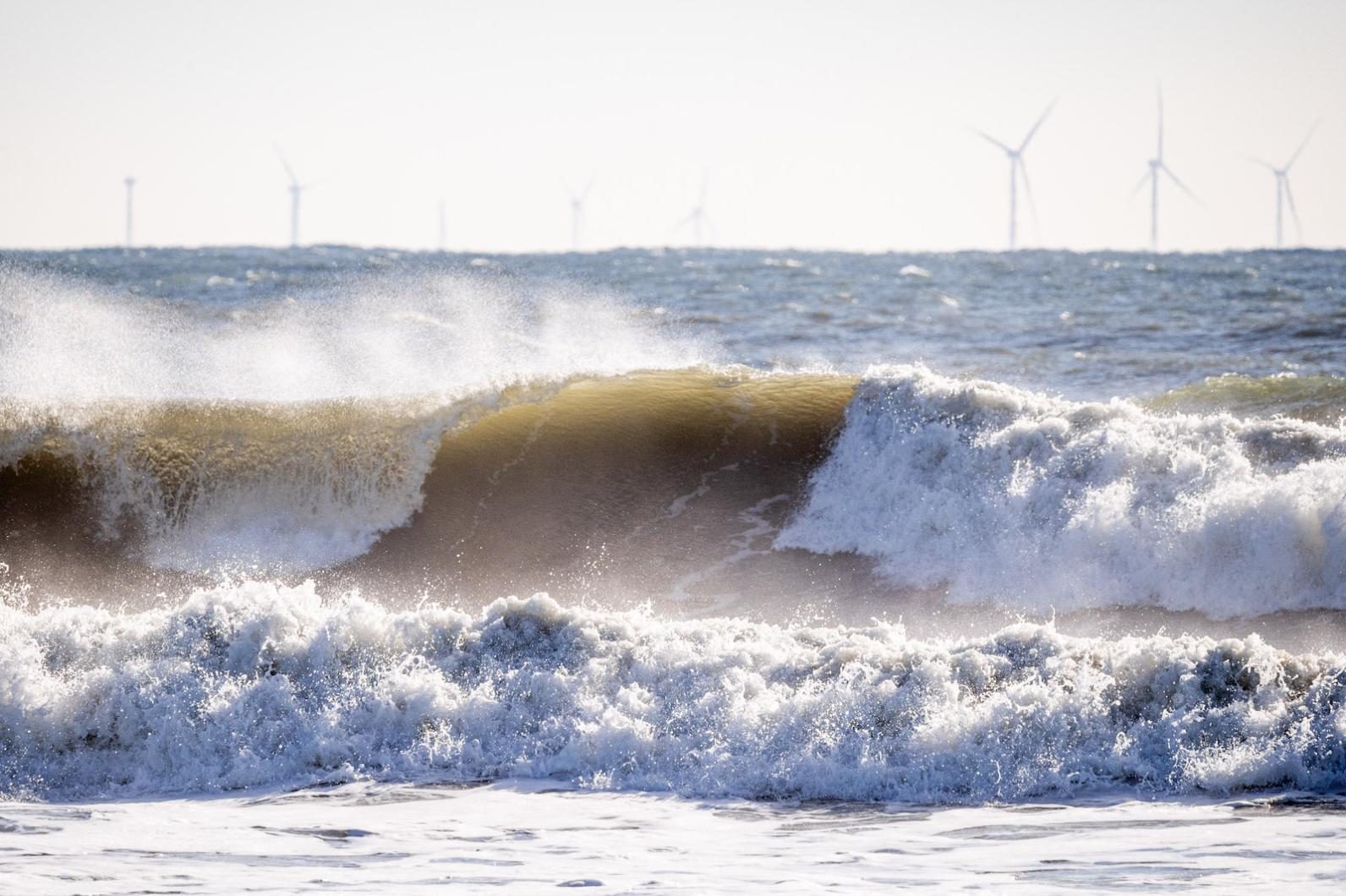

The Trump administration announced Monday that it is pausing the leases for several offshore wind energy projects under construction south of the Vineyard due to national security risks, the latest escalation from the President in his campaign against wind turbines.
The Trump administration announced Monday that it is pausing the leases for several offshore wind energy projects under construction south of the Vineyard due to national security risks, the latest escalation from the President in his campaign against wind turbines.
Vineyard Wind, Revolution Wind and Sunrise Wind were among the five leases that were halted after the alleged risks were identified by the Department of Defense, according to a statement from the Department of the Interior, the federal agency that oversees offshore wind energy projects.
“The prime duty of the United States government is to protect the American people,” said secretary of the Interior Doug Burgum in the statement. “Today’s action addresses emerging national security risks, including the rapid evolution of the relevant adversary technologies, and the vulnerabilities created by large-scale offshore wind projects with proximity near our east coast population centers. The Trump administration will always prioritize the security of the American people.”
Offshore wind energy has been in the crosshairs of President Donald Trump since his first day in office, when he signed an executive order that halted all permitting for offshore wind energy projects and ordered a review of any existing leases.
The Department of the Interior said Monday's pause would give time for the government to work with leaseholders and states to assess the possibility of mitigating the security risks posed by the projects.
The pause comes at a critical time for the renewable energy projects and could endanger billions of dollars of investments, as well as Massachusetts’ climate goals. Vineyard Wind, the 62-turbine project about 14 miles south of the Island, was nearing completion, was already generating power and, up until now, had avoided any of the administration’s swipes at offshore wind.
Revolution Wind had only just been allowed to resume construction in September after a judge overturned a stop work order from the Bureau of Ocean Energy Management (BOEM). It was in the advanced stages of construction, and hoped to start producing power in 2026.
The Trump administration had raised national security concerns around the project, but the order was overturned after Revolution Wind, a 65-turbine project off Aquinnah, argued the security claims were baseless.
In a statement, Orsted, one of the parent companies behind Revolution Wind and Sunrise Wind, said it had recieved a notice from BOEM on Monday ordering the projects to suspend all activity for the next 90 days, with the potential for a 90-day extension. Orsted is complying with the orders, and said it is evaluating all of its options to resolve the matter, including litigation.
The Department of the Interior said government reports have long found that the movement of massive turbine blades and the highly reflective towers create radar interference called “clutter.”
“The clutter caused by offshore wind projects obscures legitimate moving targets and generates false targets in the vicinity of the wind projects,” the Department of the Interior wrote.
A Department of Energy report from last year also stated that a radar’s threshold for false alarm detection can be increased to reduce some of the clutter, but an increased detection threshold could result in missing actual targets, according to the statement.
“Today’s action ensures the national security risks posed by offshore wind projects are appropriately addressed and that the United States government retains its ability to effectively defend the American people,” the department wrote.
In a lawsuit filed by Revolution Wind earlier this year, the company noted that previous security concerns from the Department of Defense, including potential disruption to air defense radar in Falmouth, were able to be worked through by several different mitigation strategies.
Monday’s announcement follows a court hearing last week where a Massachusetts federal judge issued a final ruling that struck down the actions stemming from President Trump’s executive order on offshore wind energy.
One of the main issues for the judge was the indefinite halt for agencies to deal with offshore wind project permits, breaking their statutory responsibility.
Massachusetts Gov. Maura Healey criticized the move by the Interior, saying it will push energy costs even higher and put people out of jobs.
“It makes absolutely no sense for the Trump Administration to halt construction on a project that is bringing more affordable energy to our region,” she said in a statement. “This puts people out of work during the holidays...Donald Trump should be embracing an all-of-the-above approach to American energy, not shutting down critical sources like wind.”
Green Oceans, a group that had petitioned the government with the Wampanoag Tribe of Gay Head (Aquinnah) to suspend offshore wind energy projects approvals, applauded the pause.
“The concerns are very real,” said co-founder Lisa Quattrocki Knight. “These turbines will interefere with radar and the interference makes it very hard to survey certain airspace.”
Much of the administration’s maneuvers around offshore wind have resulted in lawsuits.
The Conservation Law Foundation, which has been supportive of renewable energy projects, said it was reviewing the announcement and determining its next steps.
“This is a desperate rerun of the Trump administration’s failed attempt to kill offshore wind — an effort the courts have already rejected,” said Kate Sinding Daly, senior vice president for law and policy said in a statement. “Many of these clean energy projects passed years of rigorous review, were upheld in court, and are moving forward. Trying again to halt these projects tramples on the rule of law, threatens jobs, and deliberately sabotages a critical industry that strengthens, not weakens, America’s energy security.”
Comments
The most significant emerging
Susan Desmarais Oak BluffsThe most significant emerging security risk we face occupies our White House, if he’s not golfing in Florida?
God news! These projects are
Enough Already Oak BluffsGod news! These projects are a scam which costs taxpayers billions and will only increase our already high energy bills. Thank God will now have an administration that focuses on reality and does not cater to the Big Wind companies.
Big Wind?
High As A Kite Oak BluffsBig Wind?
It's Big Oil that opposes clean, renewable energy.
This is great news! A great
Mary EdgartownThis is great news! A great Christmas gift!
Thank you!
I agree!! Good news!!!
Island Girl Oak BluffsI agree!! Good news!!!
What a present!
YesWhat a present!
Be careful with this so
Peter Cronig Vineyard HavenBe careful with this so called good news. The ultimate motive of these people in power could be worse. If it’s found to there is an oil potential you may eventually see thousands of oil rigs with the same blinking lights and possible oil spills. It won’t be a vote of the people who will decide, it will just be an executive order.
Not concerned at all! We live
Wise Guy ChilmarkNot concerned at all! We live in a wonderful world where that sort of development generally occurs only where low-income or vulnerable people live. We can outsource the pain and pretend that our lifestyles are sustainable!
God bless Donald Trump!
Dan EdgartownGod bless Donald Trump!
Thank you!!!
Laura OBThank you!!!
Just spoke to my friends in
Paul Adler WTJust spoke to my friends in Hawaii. Our electric rate here is about .16kwh and they are at .60kwh, and projected to hit .96kwh in 4 years. We do need something to lower energy cost. Not sure it will be wind. But I suspect Trump owes favors to big oil or gas buddies, so he is halting wind.
You're getting a great deal.
John WB Oak BluffsYou're getting a great deal. We're paying $0.36 per kWh on Oak Bluffs when all the charges are added up.
Life's a Great Big Beautiful
Michael Dugan BostonLife's a Great Big Beautiful Beach. Let's get to enjoying them.
Paul-- your .16KWH is the
donald keller VINEYARD HAVENPaul-- your .16KWH is the generation charge. That comes from a mix of different sources. Individuals cannot purchase electricity directly from off shore wind farms. The average wholesale price that national grid pays for power is about .13 per kwh. Vineyard wind has signed the 20 year contract to sell at .09/KWH. of course, they have to mark it up, but at the moment, the cheapest wholesale electricity is coming from VW 1 . I am quite perplexed at people who claim wind power is the cause of increasing electricity prices. The real problem is the first law of economics-- supply and demand... https://www.bloomberg.com/graphics/2025-ai-data-centers-electricity-pri…
Don, you are mixing correct
Murray HarveyDon, you are mixing correct statements with conclusions that don’t follow.
First, Paul is right to reference retail electric rates. Households don’t pay “generation only” prices — they pay the bundled rate that includes generation, transmission, distribution, grid upgrades, subsidies, and contract risk. That is the number that matters to consumers.
Second, citing a single contract price from Vineyard Wind 1 does not prove wind lowers rates overall. VW1’s ~$0.09/kWh contract was signed years ago under very different financing conditions and is heavily supported by federal tax credits and long-term fixed pricing. New offshore wind contracts nationwide have been delayed, renegotiated, or canceled precisely because costs rose sharply. If offshore wind were consistently the cheapest source, developers would not be walking away from projects.
Third, the supply-and-demand argument cuts the other way. New intermittent generation requires massive investments in transmission, balancing resources, storage, and backup dispatchable power. Those system costs are socialized across ratepayers and show up in delivery charges, not the headline generation price you cite.
Finally, pointing to data-center demand (via Bloomberg) does not explain why regions with aggressive offshore wind procurement have among the fastest-rising electric rates. Multiple cost drivers can exist simultaneously.
In short: wholesale prices ≠ retail bills, one legacy contract ≠ long-term affordability, and system costs matter. That’s why it’s reasonable to question whether offshore wind will actually lower Vineyard electric bills — even if wind itself isn’t the only factor driving prices.
Great news for the
Wise Guy ChilmarkGreat news for the environment! Now we can instead get energy from offshore oil near the Guyanese coast. Never mind the tropical mangroves and pristine waters. So, I guess what I mean is great news for MY environment... or at least my view.
Oil is not the enemy.
Sara Piazza EdgartownOil is not the enemy.
Military intelligence and FBI
Cmd Lewis Ret. MenemshaMilitary intelligence and FBI should look into Revolution Wind's funding.
Great news!!!! This is a
Paddy EdgartownGreat news!!!! This is a Christmas Miracle!!!
While I've never thought that
Bill EdgartownWhile I've never thought that these wind farms were a great idea, they do produce some clean energy. This order should incent states which care about
clean energy to redouble efforts on solar and maybe even nuclear. Without a clean energy future, the world is doomed. Mr. Cronig's comment on oil rigs is exactly correct - then the blots on the horizon will also be ruining our precious beaches.
This sham of a “pause” will
Mark VHThis sham of a “pause” will not pass legal muster when challenged in court. The celebrations noted by others above shall be very short-lived.
I would not bank on that….
Jean ESQI would not bank on that…. Take them down !!
I appreciate the opposition
Where should the coal power plant get built then? Tisbury, MAI appreciate the opposition to the turbines. I would like to hear alternative proposals. Where should electricity for eastern Massachusetts get built? Do you prefer coal or oil power plants? Where would you like it? Solar alone is not enough. I doubt this flock of NIMBYs would favor nuclear.
I'm all in favor of nuclear
Enough Already Oak BluffsI'm all in favor of nuclear and perhaps we can stop wring our hands about transporting solid waste off island and build a trash to energy plant.
Maybe a small nuclear plant
tom BostonMaybe a small nuclear plant right in the heart of OB? Possibly right next to the Ocean Park Gazebo?
Good news. We need to refocus
John YoungGood news. We need to refocus our efforts on nuclear power, the true green energy.
John,
Mark VHJohn,
Would you be a proponent of having a nuclear plant on the island? If it’s as “green” as you think, I gather you should have no objection, right?
I worked for one of the
Carol formerly ChilmarkI worked for one of the largest nuclear utilities in the country for six years, in finance and regulatory affairs. Nuclear is a good transitional fuel, in that it does not emit CO2 or methane (that is, no air pollution that contributes to climate change). However, nuclear is the most expensive way to generate electricity - requires not only a very specialized piece of real estate with defensible land around it, but also highly trained staff 24/7 and highly trained security staff and electronics 24/7, as well as quite expensive fuel.
The cheapest way to generate electricity is solar photovoltaics. The second cheapest way is wind power. Neither requires staff (aside from minimal maintenance for wind); neither consumes fuel.
I realize that the wealthy Vineyard real estate owners with water views hate wind power because it's in their view. Please stop with the BS about how it's bad for the environment. It's not. And if built, basic economics (greater electric supply) will lead us to lower electric rates as well as greater reliability of electric supply and reduced contribution to climate change causing pollution.
Calling legitimate policy
Murray HarveyCalling legitimate policy concerns “BS” may feel satisfying, but it substitutes rhetoric for analysis. Offshore wind opposition on the Vineyard is not a monolith of “wealthy water-view owners,” nor is it a denial of climate science. It is a debate about siting, scale, cost, reliability, and risk — including national-security and radar issues now acknowledged by the federal government itself.
Yes, wind and solar have low marginal fuel costs. That is not the same thing as being “cheap” once intermittency, transmission, backup generation, grid hardening, and ratepayer subsidies are fully accounted for. Offshore wind in particular is among the most capital-intensive forms of generation ever attempted in New England, with escalating construction costs, heavy federal and state support, and long-term contracts that lock ratepayers into above-market prices. That is not “basic economics”; it is industrial policy.
Nor is it “BS” to note that reliability matters. Wind does not generate on demand, does not eliminate the need for gas or other firm generation, and does not automatically lower rates — a claim already contradicted by recent experience in the Northeast.
We should be able to discuss tradeoffs honestly, without caricaturing neighbors or dismissing complex concerns as bad faith. The real BS is pretending this is a simple story when it clearly isn’t.
What a Christmas miracle,
Mark EdgartownWhat a Christmas miracle, tear them down!
Amen
Harry here EdgAmen
The CCP builds many of the
Elizabeth EdgartownThe CCP builds many of the parts, as do other non US companies, in coal fired plants. They break, send disruptive sonar to marine life and are ugly as can be. South Beach is ugly now. Get rid of them. Thank you Donald Trump. Need to stop placing all the sins of the universe on this one guy's head - too easy and missing too many issues.
Warming seas, rising ocean
michael chilmarkWarming seas, rising ocean levels and intensifying storms, all related to global-warming and climate change, are eroding those beautiful South Beaches. I'll take turbines-in-the distance" views over houses on the edge of the dunes.
Naive to think Don's crusade is based on knowledge and facts - he operates on vengeance, vendetta and personal concerns.
All the naysayers to wind energy --- where do you propose these nuclear plant be built ? In whose backyard would they best be located ?
NIMBY on steroids, this is.
Hear, hear!
Wise Guy ChilmarkHear, hear!
I don't know if the windfarms
Bill New York & EdgartownI don't know if the windfarms are a good idea or not. I doubt any of us have the enough information to decide.
But I do know that the biggest investors in those windfarms are the Danes, and our current president is locked in a conflict with Denmark over Greenland.
I don't think the current administration gives a hoot about windfarms. It wants to hold them hostage and use them as leverage for negotiations over access to Greenland. As soon as the administration gets what it wants, like any successful racket, it will release its hostage, forget about the entire situation, and the windfarms will return to activity.
5 stars for best comment
C griffin Seattle, West Tisbury5 stars for best comment
Ok, whose Electric Bill has
Marie EdgartownOk, whose Electric Bill has benefited from these horrible windmills?? What a miserable scam…President Kennedy and for sure Brother Ted would never has let anyone touch our ocean….So Sad. I know we are suppose to hate President Trump and I certainly do not condone everything that he is doing but I thank him for trying to save our ocean and for trying to stop the drugs from entering our country and I could go on and on but you get the picture…Let’s give him time, I think the government is like the NFL it’s all corrupt…Dems and Republicans….Live and Love and try to protect….Merry Christmas and the best to all for the New Year…Go Patriots….LOL
My electric bill nearly
Sara Piazza EdgartownMy electric bill nearly tripled for the month of December
I can assure you, Sarah, that
donald keller VINEYARD HAVENI can assure you, Sarah, that your electric bill did not nearly triple because Vineyard wind 1 has 12 of their machines running and is selling power to Eversource at 9 cants per KWH, 4 cents below the average that Eversource pays other producers.
Sara, I think Don’s response
Murray HarveySara, I think Don’s response sidesteps the point. No one claimed Vineyard Wind’s twelve turbines tripled electric bills. Electric bills are not set by a single power purchase price; they reflect transmission charges, grid upgrades, capacity costs, balancing services, and long-term contracts approved years ago. Those costs are spread across ratepayers regardless of how many turbines are currently running.
Citing a “9 cents per kWh” figure addresses one narrow slice of a much larger system. Offshore wind brings interconnection and infrastructure costs that do not appear in that headline number but still land on customers’ bills over time.
More importantly, offshore wind was sold to the public as a way to lower electric costs. When residents experience sharp increases, it is reasonable to question whether that promise is being met — not to be told their experience is impossible. Rates can rise even when one input looks cheap on paper.
Energy pricing is cumulative and contractual, not transactional. The issue isn’t assigning blame to a single project; it’s transparency. If offshore wind is delivering savings, those savings should be visible to customers — not dismissed when people read their own bills and ask fair questions.
This was a money grab! Let’s
Kevin OBThis was a money grab! Let’s start getting them down!
Will that save money?
Albert GosnoldWill that save money?
A trash to energy plant is
Charlie Callahan So Boston/EdgartownA trash to energy plant is probably the best idea I've seen among all the comments. The EPA guidelines are so strict now that a smokestack emits almost no pollution. And that would provide power for almost no cost to homeowners
A trash to energy plant isn't
Harry EdgartownA trash to energy plant isn't a good idea. The amount of electricity generated versus the amount of pollution generated wouldn't make it viable. Plus I doubt we could generate enough electricity to power the island from such a plant. Burning anything won't reduce carbon in the atmosphere. The cost of getting approval, building and running a nuclear planr are just not there.
It makes sense. take a look
jackie stinks west tisIt makes sense. take a look at what russia has done to undeground cables in other countries.
I am truly saddened by the
Tim Johnson TisburyI am truly saddened by the amount of misinformation the anti-wind groups have placed in the heads of those who don't do the proper amount of research and thinking for themselves. Let me start will this thought. The Department of Defense had signed off on Offshore wind years ago when people we could science was still something to support. Vineyard Wind is also allowed to operate during this supposed 90 review. If the Turbines interfered with radar why would they allow the operation to continue? And why do Offshore Wind turbine operate all over the planet with no other countries reporting the issues that the anti-wind movement falsely claims
Labeling skepticism as
Murray HarveyLabeling skepticism as “misinformation” is an easy move, but it avoids engaging with the actual substance of the concerns. Regulatory approval is not a permanent scientific verdict; it reflects the information, assumptions, and threat environment at a particular moment in time. The Department of Defense signing off years ago does not mean conditions, technologies, or adversary capabilities have stood still since then.
The claim that continued operation disproves radar interference misunderstands how reviews work. Allowing limited operation during a defined review period does not equal a declaration of no risk; it reflects an effort to balance energy production with ongoing assessment. We do this routinely in aviation, shipping, and infrastructure — investigate while mitigating, not by flipping an instant on/off switch.
As for “other countries,” that argument cuts both ways. The United States has unique coastal population density, military installations, training corridors, and surveillance responsibilities that do not map neatly onto Europe or elsewhere. Different geography, different radar systems, different threat profiles.
Raising these issues is not evidence of gullibility or failure to “think for oneself.” It is precisely what independent thinking looks like: questioning large, complex infrastructure projects when new information emerges. Dismissing concerns as propaganda may feel reassuring, but it does not resolve them — it simply shuts down a debate that deserves more seriousness than slogans.
Thank you Donald Trump!!!
Roddy Seasonal VisitorThank you Donald Trump!!! Truly caring about our horribly wasted tax dollars. Common sense to the rescue. But this country will probably need at least three more consecutive Republican supermajority terms to fix all the liberal damage inflicted upon our once great country. Fingers crossed!
Power generation in the U.S.
Robert Skydell Antigua, GuatemalaPower generation in the U.S. is entirely private sector, meaning equity investors. Your tax dollars do not fund these wind farms.
Stop ruining our oceans and
Capt Buddy Vanderhoop AquinnahStop ruining our oceans and killing whales and destroying the fish habitat! Move the wind farms along the highways, where it’s not destroying the aquatic environment! It’s not green energy, they’re full of oil and run on diesel generators when there is no wind, How do you think that your electric bill is going to go down when each one of those monstrosities cost about $10 million dollars to construct, not to mention the cost of jet plowing the cables into the ocean floor. Not to mention the thousands of birds that they kill!!
Add new comment