


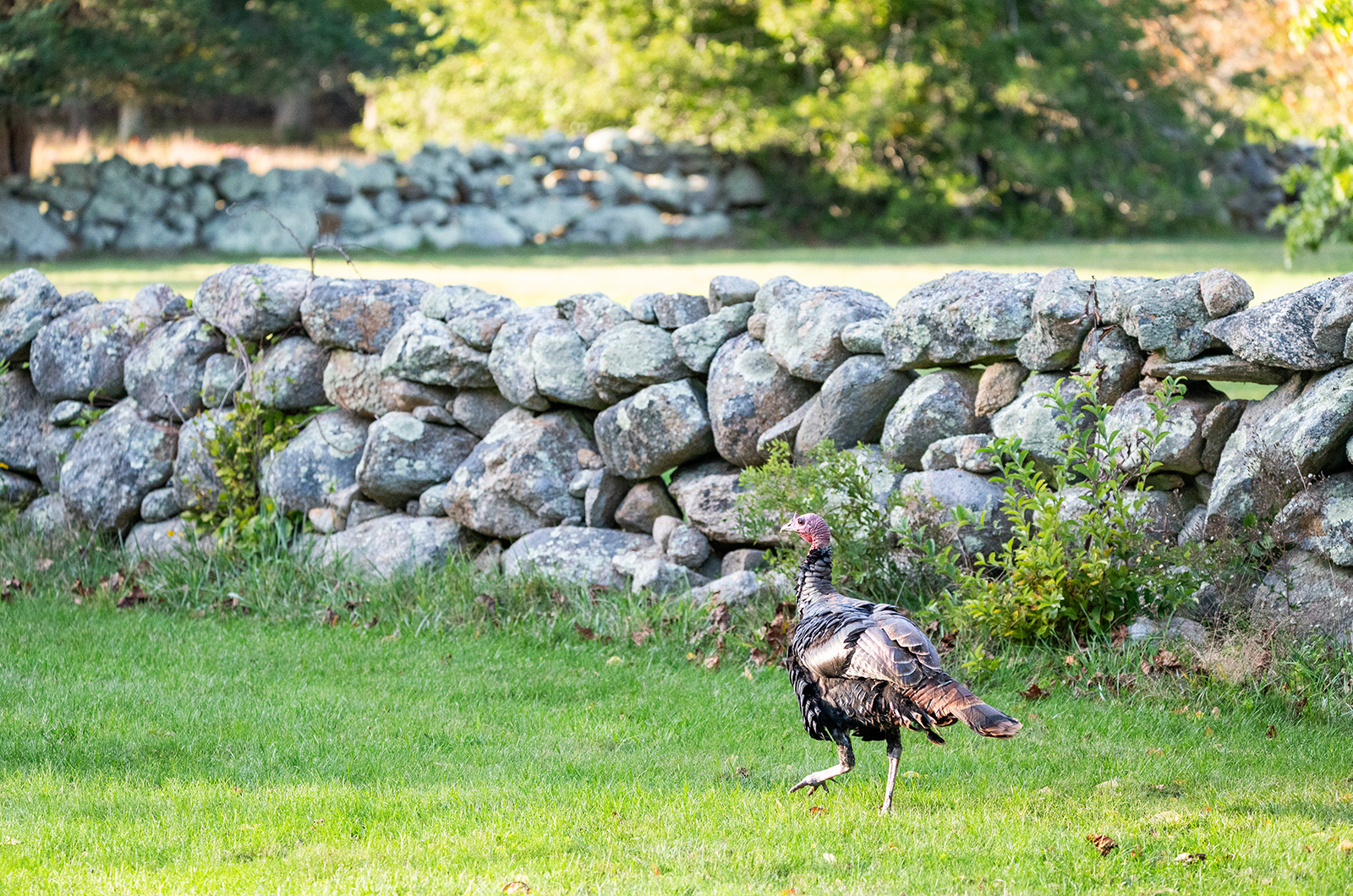
Though they may not be synonymous with an astounding tale of conservation like the osprey, or made it onto the iconic Vineyard secession flag from the 1970s like the gull, turkeys in recent decades have thrived on the Vineyard and become enmeshed in the daily lives of Islanders.
Around 4 a.m., a flock of turkeys returns to earth after spending the night in a tree in the woods of West Tisbury. It’s not a graceful journey back down to the ground, but it gets the job done, and the 20 or so birds head on their way, ready, with hundreds of other compatriots, for another day on Martha’s Vineyard.
Though they may not be synonymous with an astounding tale of conservation like the osprey, or made it onto the iconic Vineyard secession flag from the 1970s like the gull, turkeys in recent decades have thrived on the Vineyard and become enmeshed in the daily lives of Islanders.
Some people love to see the rafters (the term for a group of turkeys) roving about the roads and woods, and visitors get a kick out of the unexpected sight of the birds in such large numbers. Others have grown tired of the traffic jams they cause, their constant poking through gardens and, on occasion, their aggressive behavior come mating season.
A rafter scopes out the road near the airport.
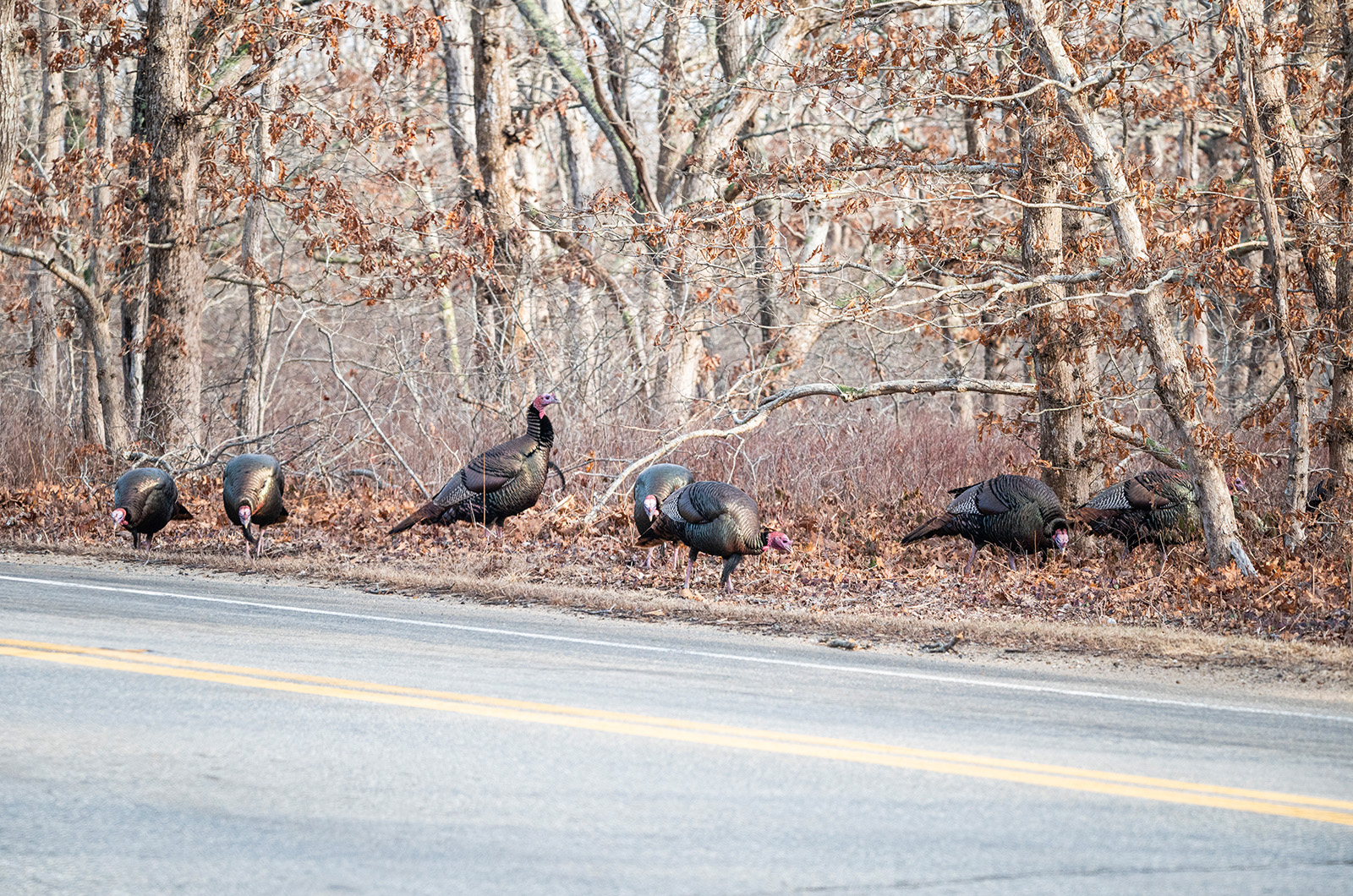
A rafter scopes out the road near the airport.
But one thing biologists and bird experts say for certain is that the turkey has made itself a comfortable home on Martha’s Vineyard, and like it or not, they are not going anywhere soon.
“Call them feral, call them wild, call them what you will,” said Suzan Bellincampi, the director of MassAudbon’s Felix Neck Wildlife Sanctuary in Edgartown. “I think they are here to stay.”
Though ubiquitous now in New England, the wild turkey was wiped clean off the Massachusetts landscape by 1851, a victim of hunting and settlers’ desire to clear land. The bird made a comeback starting in the 1970s, when state officials trapped and reintroduced them throughout mainland Massachusetts.
Though it’s hard to imagine the Island landscape without them, the surge of the birds on the Vineyard is a bit of a mystery. Records show that there has never been an official stocking by the state of the birds on the Island, although this has taken place on the Cape. This has led to different origin stories over the years. Many are murky at best, and experts say Vineyarders may never know the true answer.
“It’s kind of cloaked in secrecy and shadow,” said David Scarpitti, a turkey biologist with the Massachusetts Division of Fisheries and Wildlife.
In their book Vineyard Birds II, Susan Whiting and Barbara Pesch wrote that the turkey has been seen annually in the Christmas Bird Count since 1996, and the species may have first been introduced to the Island by the late beloved naturalist Gus Ben David. The women wrote that he brought them in the 1970s from Arkansas, but the flock was extirpated by the 1990s.
Some say the current crop of Island turkeys are more feral than truly wild, a mix between the wild species and the big white domesticated bird farmers stocked for Thanksgiving feasts. One prominent theory is the current population developed from turkeys that farmers brought to the Island.
“The down-Island population comes from domestic turkeys from Elisha Smith’s farm and the up-Island population comes from domestic turkeys [from] Craig Kingsbury’s farm,” Ms. Whiting and Ms. Pesch wrote. “No doubt they have interbred and are a hodgepodge.”
Though Mr. Kingsbury was known for having birds not usually seen on Vineyard shores, such as Silkie chickens and Egyptian geese, his daughter Kristy Henshaw couldn’t remember if her dad had ever nursed a turkey flock.
“I’m sure it happened but I don’t have an exact recollection of when or why,” she said. “We seemed to have absolutely everything except for penguins.”
Despite their mysterious roots, the birds have taken to the Vineyard, due to the ample habitat and food supply, as well as the lack of predators. Large flocks can be seen wandering through all six towns with wide impunity as adult birds have little to fear aside from hunters or frustrated drivers.
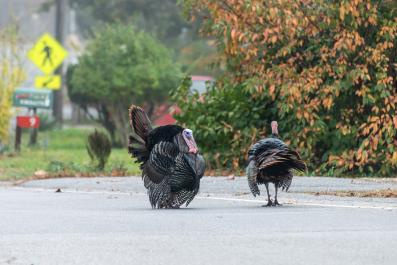
Watch out for toms come mating season.
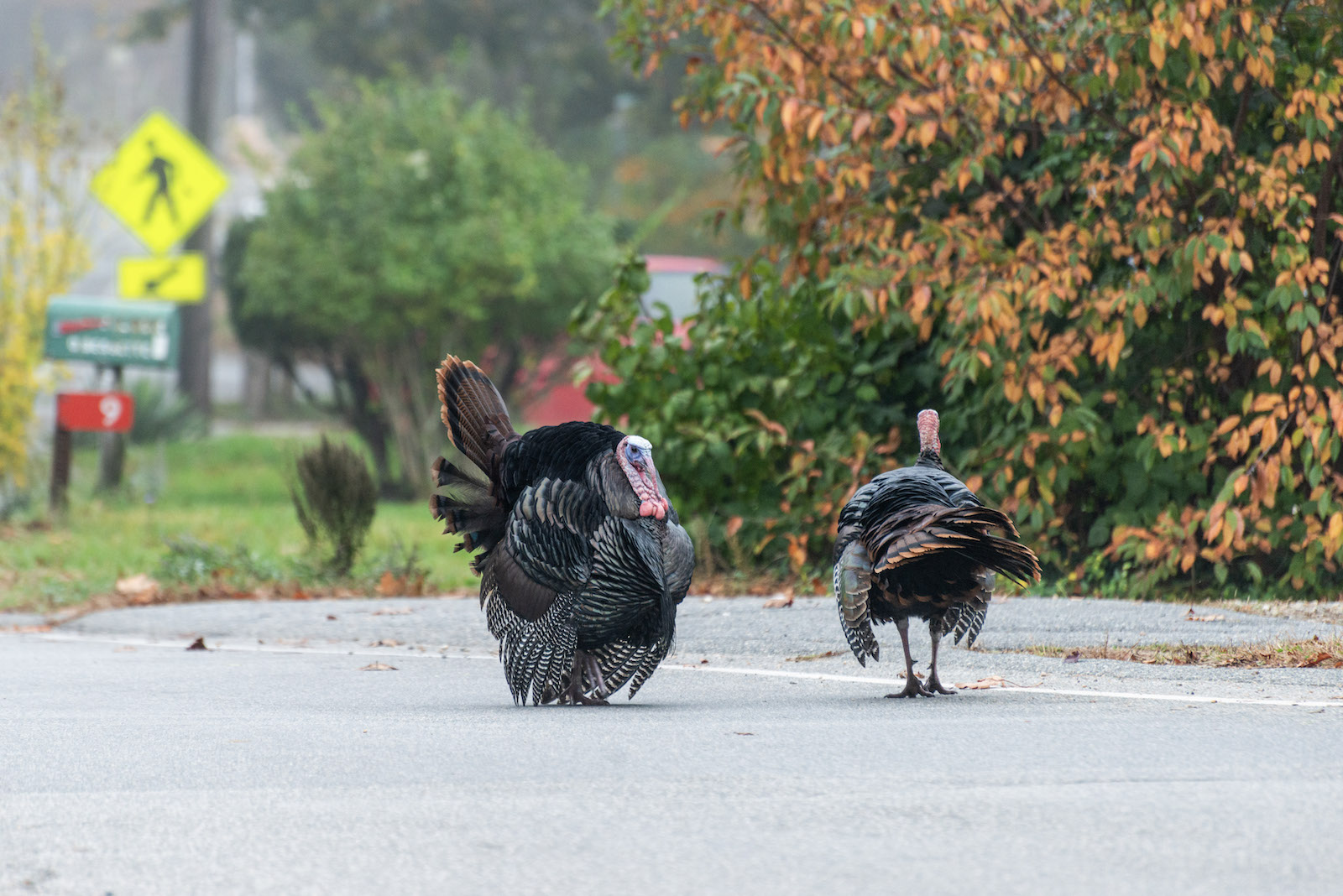
Watch out for toms come mating season.
Baby turkeys can be scooped up by birds of prey, but they quickly grow out of that stage to where there is little for them to fear.
The potential combination of being part domesticated — you can often see flecks of Butterball white in Island turkeys — and a life spent without having to look over their shoulders seems to have made Island turkeys a little more relaxed.
While the mainland is rife with videos of mailmen warding off turkeys and the birds taking offense at cars, the Island birds have a live and let live attitude, according to Mr. Scarpitti.
“Behaviorally, I think those birds are apt to be a little different because there’s limited predators for most of those birds, most of the time,” he said. “They’re not terribly wary overall.”
There are also fewer people here than in the suburbs of the mainland for turkeys to interact with, especially in the mating periods of early winter and early spring.
That doesn’t mean there haven’t been run-ins in the past.
In the 1990s an aggressive band of turkeys in Tisbury, reported by the Vineyard Gazette, leapt into the national spotlight. And the 2008 shooting of a reportedly out of control tom turkey in Chilmark by a police officer made it on National Public Radio, via Gazette reporter Sam Bungey’s Murder Most Fowl tale on This American Life.
“I’ve had accounts of people calling with aggressive behavior,” said Mr. Scarpitti. “It’s not like it never happens.”
Though there are an estimated 35,000 turkeys statewide, it’s not clear what the Vineyard’s portion is and no one is tasked with counting the roving bands. The 2024 Christmas Bird Count saw 252, but that likely doesn’t encapsulate the entire population. In 2017, Island naturalist Gus Ben David estimated that about 1,000 turkeys called the Island home, according to Ms. Bellincampi, and it’s likely that the numbers have grown in the ensuing years.
The potentially ballooning population doesn’t have biologists worried. There’s plenty of food around and there is no real downside to the population — other than they can get on people’s nerves.
“I don’t think the number of turkeys is really alarming to me,” said Matt Pelikan, a Vineyard naturalist and the director of the Martha’s Vineyard Atlas of Life. “I don’t think of them as being a particularly detrimental species.”
They can be a hit with tourists, who maybe didn’t expect to see the bird on a sandy vacation destination. One of Mr. Pelikan’s relatives visited from Las Vegas and he got a kick out of them.
“Every time he saw a turkey it was the craziest thing for him,” Mr. Pelikan said. “People do find them entertaining.”
The species thrives without predators around.
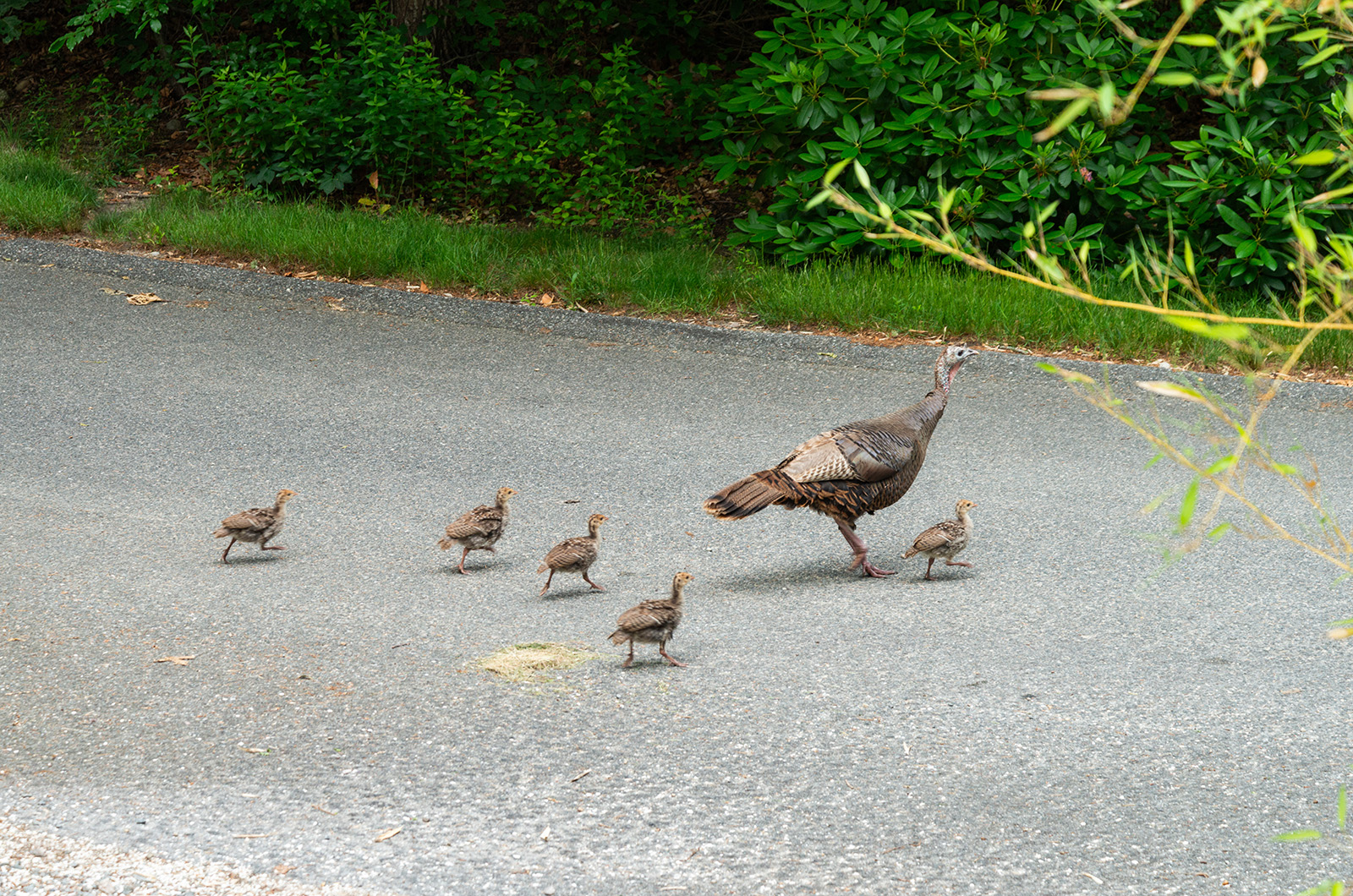
The species thrives without predators around.
One’s tolerance can be tested though. Islanders have reported drivers running over birds on purpose, and Mr. Scarpitti said the state gets nuisance calls every year.
“They can be a significant inconvenience,” he said.
Anyone hoping for hunters to make a real dent in the population will be let down. While they can be easy pickings for someone proficient with a bow, there hasn’t been much interest here in the two annual turkey hunting seasons, which take place annual in the spring and fall.
In 2016, only one turkey was reported taken by hunters in Dukes County. In subsequent years, the numbers have remained low. In 2024, 25 turkeys were hunted here, according to the state, a record going back at least a decade.
Still that won’t be enough to change much, though Mr. Scarpitti said he and others at the state have joked about creating an extra Vineyard turkey season due to the sheer number of birds.
“It’s a much bigger draw, deer season, to go on the Vineyard than turkey season,” he said. “I think it’s a tough sell.”
With Thanksgiving, the turkey population on the Island does soar, but the majority of those numbers sit on a table surrounded by stuffing and mashed potatoes. Back in the streets and fields, biologists say humans and turkeys will continue to cohabitate.
“These days on the Island, and really everywhere, the name of the game is learning to live with wildlife,” Mr. Scarpitti said.
For Ms. Bellincampi, making peace with the feathered flock isn’t too hard. Their beards, their snoods and the fleshy bumps on their heads and necks make them a sort of caricature that’s easy to be charmed by.
“They’re funny as hell,” she said. “They can eat anything, they kind of just do their thing and bumble through life being funky and cool.”
Comments
Aah, if we could only
ckeith ChilmarkAah, if we could only discover that these turkeys can help keep the tick count down, they would get SO MUCH love...
Happy Thanksgiving to all!
but alas, they do not
Cherie VHbut alas, they do not
Turkeys eat ticks.
Albert GosnoldTurkeys eat ticks.
Not as many ay as heath hens.
The heath hen went extinct due to a combination of factors, primarily intense hunting pressure that reduced their population on the mainland by 1870. The last remaining flock on Martha's Vineyard was then decimated by a combination of a devastating wildfire in 1916, an imbalance of males to females, predation from domestic cats, diseases, and inbreeding, with the last known individual, "Booming Ben," dying in 1932.
I'm sure ticks are on their
Chris ChappyI'm sure ticks are on their menu but it's probably hard to verify.
Go walk through the hay
Nick TisburyGo walk through the hay fields around the ag hall during the summer and you will see for your self!
We have a sizable flock (20+)
Carla Cooper EdgartownWe have a sizable flock (20+) that roosts in our trees every night. It’s a spectacle to watch them use our driveway like a runway, flapping and cackling up into the branches of the pitch pines. I wouldn’t mind them so much if they didn’t wander onto the porch and peck at the storm door, or try to roost on our solar panels, or poop on absolutely everything including our patio furniture. They’re kinda cute, kinda ridiculous and quirky. My cat loves them so I guess we’re stuck with them.
There are so many turkeys in
too late edgThere are so many turkeys in Katama that it is impossible to have a vegetable garden. they fly over the deer fence and eat everything. They even ate the cover crop of oats. and dug up my potatoes
I saw an albino one once near
Margot Labe MenemshaI saw an albino one once near the airport. If people ARE concerned by numbers, then perhaps celebrating the ever elusive coyote would be a good thing as well.
It would be good if the
Quitsa ChilmarkIt would be good if the confusion about the turkeys' status were clarified because it makes a big difference in the ability to control the population. There was a comment in a story a while back from a state wildlife official noting that they knew exactly where wild turkeys had been reintroduced and the island was not one of the locations and thus the turkeys we have are feral. That means they are not subject to the wild turkey bag limit of one per spring and fall season and you can kill them any time you want. Any who has hunted true wild turkeys would say the ones we have are feral. It is incredibly hard to get anywhere near a real wild turkey.
Is this genetic factors or
Nick TisburyIs this genetic factors or just because they are used to humans?
We've enjoyed the turkeys in
Bill EdgartownWe've enjoyed the turkeys in Katama for years but the population is growing too quickly. This past summer was the first time in 30 years we haven't had any eastern towhees in our yard so perhaps that's one of the downsides to the herds of turkeys - no more ground nesting birds.
Turkeys….are ground nesting
Nick TisburyTurkeys….are ground nesting birds
tif my dog gets ahold of one
michael kane edgartowntif my dog gets ahold of one of these vultures, there are going to be a battle and a lot of feathers....
I was told by our Island tic
david finkelstein West TisburyI was told by our Island tic biologists that the turkeys carry much more tics than they eat. Possibly related to the increase in the Lone Star.
David, this would be
Bill Simpson VHDavid, this would be important information if true. Do you have a source or can your verify this claim. There are a significant amount of people who say they eat ticks and are some how going to make a dent in the islands tick problem.
I was also impressed that the author didn’t find a way to squeeze “climate change” into this article like they did with the pine beetle one. Bravo for staying on topic.
All birds are tick hosts.
Albert GosnoldAll birds are tick hosts.
There is always a conflict
Lorraine EdgartownThere is always a conflict between nature and people. City people have a hard time understanding animals and nature. But, they often have undue input into regulation, etc. I am trying to encourage the guinea fowl population to increase, they love ticks, plus they are delicious. A bit difficult to raise, not as docile as chickens, but much tastier. Ordering guinea fowl online for the oven is ruinously expensive. Let's hear it for the guinea fowl.
"There are a significant
Sara Piazza Edgartown"There are a significant amount of people who say they eat ticks..."
There's your solution.
There are probably more ticks
Lea HamnerThere are probably more ticks on the turkeys than in their stomachs. The Lone Star tick is *called* the turkey tick down south. Patrick Roden-Reynolds of the MV Tick Program plucked several hunted turkeys this past year and all had lone star ticks feeding on them. They weren’t infested, but definitely had ticks on them. They are not a tick control solution.
Ginea hens are noisy...they
Patricia Force TisburyGinea hens are noisy...they run when cars go by...are pretty...I have never eaten one.
Add new comment