



Alpha-gal syndrome cases on Martha’s Vineyard continued to rise in 2025, with the number of positive tests for the red meat allergy in the first 11 months of the year nearly totaling the last five years combined.
Alpha-gal syndrome cases on Martha’s Vineyard continued to rise in 2025, with the number of positive tests for the red meat allergy in the first 11 months of the year nearly totaling the last five years combined.
Martha’s Vineyard Hospital performed 1,632 tests as of mid-November and so far 724 tests have come back positive. The allergy is passed on to humans by lone star ticks. The ballooning number of tests and increased awareness has cemented the Island as a poster child for the mysterious illness in the U.S., prompting calls for more research and resources.
The hospital announced the new testing figures this week, and health officials stressed the need for protective measures as the Island continues to outpace the rest of the state when it comes to rates of several different tick-related diseases.
| Alpha-gal testing/year | Tests performed | Positive test results |
|---|---|---|
| 2020 | 9 | 2 |
| 2021 | 78 | 32 |
| 2022 | 164 | 77 |
| 2023 | 382 | 140 |
| 2024 | 1,254 | 523 |
| 2025* | 1,632 | 724 |
*Source: Martha's Vineyard Hospital
“We can all agree that ticks and tick-borne diseases are a public health crisis on Martha’s Vineyard,” said Lea Hamner, a Chilmark-based epidemiologist for the Inter-Island Public Health Excellence Collaborative. “Martha’s Vineyard has been disproportionately affected by tick-borne disease for decades. Even in a high-burden state like Massachusetts, Martha’s Vineyard stands out as exceptional.”
Alpha-gal syndrome, which can cause people to be allergic to red meat and other mammalian products, such as dairy and gelatin, is relatively new to the Island but has quickly made itself a household name.
In 2020, there were just two positive tests administered at the hospital. That number rose to 32 in 2021, 77 in 2022, 140 in 2023 and then 523 in 2024. The amount of tests the hospital is processing has also skyrocketed, up from nine in 2020 to more than 1,600 this year.
Positive test results are not the same as individual cases of alpha-gal, as some people may take tests more than once, or be tested in other places. Still, the steep increase in positive results has been attributed to the spread of lone star ticks from the margins of the Island to every town in recent years.
“The increase in the number of lone star ticks and the spread across the Island has been a total game changer,” said Dick Johnson, who studied ticks on the Island for years while the head of the Martha’s Vineyard Tick Program.
When he started as the director in 2011, Mr. Johnson had never even heard of alpha-gal syndrome, and local researchers were only just starting to see the arrival of the lone star tick. While Islanders have been used to avoiding deer ticks in the Vineyard’s woods, lone stars present new dangers as they are able to thrive in an array of habitats, including manicured lawns.
“We used to say if you’re in your yard, you’re safe,” Mr. Johnson said. “Short grass is no longer a safe area.”
Though the new test result figures were eye-opening, they weren’t exactly surprising for him.
“We just have a lot more ticks here,” he said.
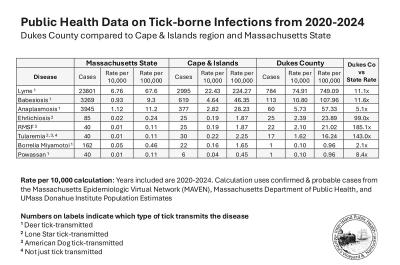
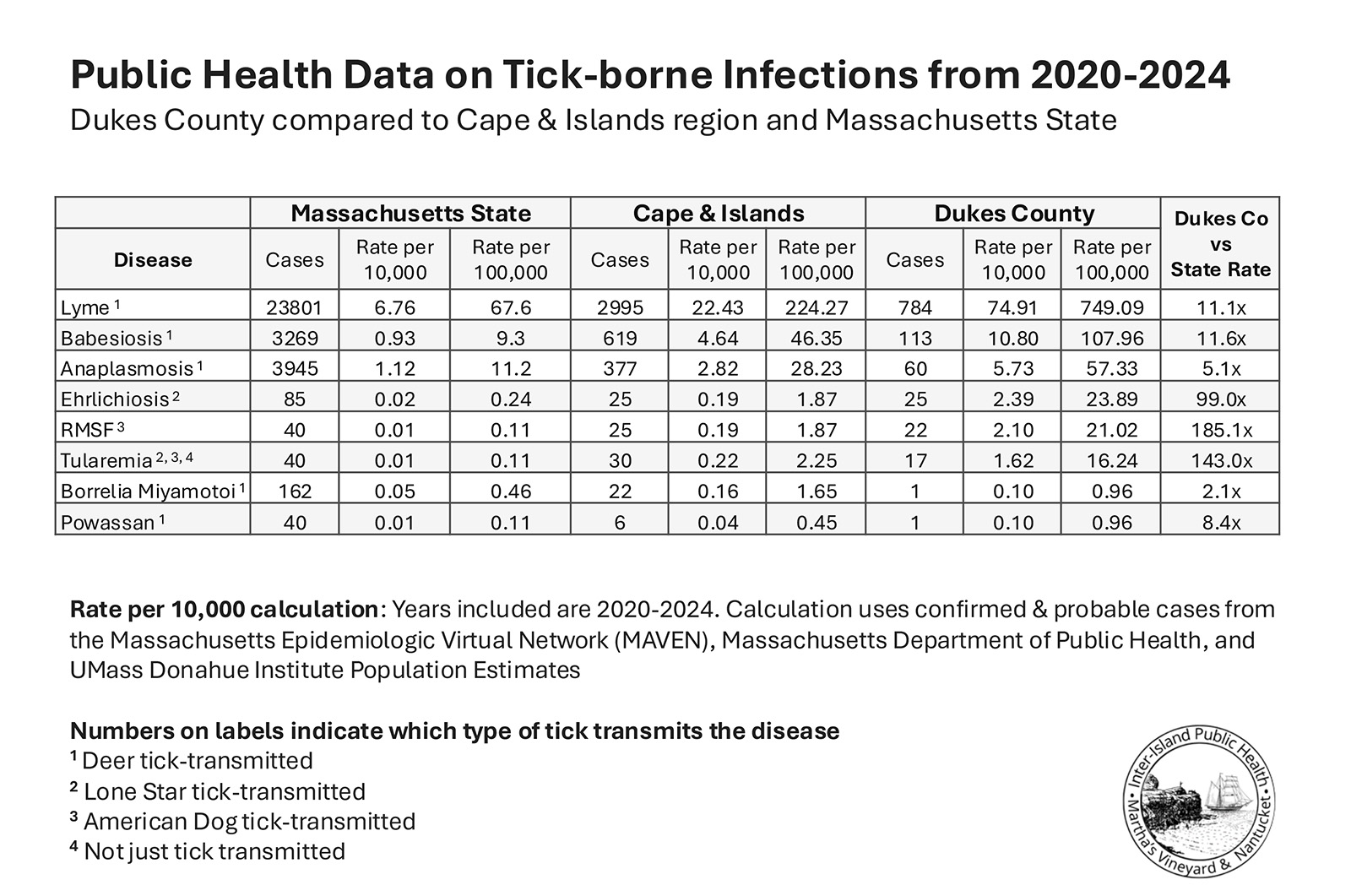
While alpha-gal syndrome has become a major concern for the Island and other places following the death of a New Jersey man last year, several other tick-related ailments on the Island outstrip mainland rates. Between 2020 and 2024, there have been 784 cases of Lyme disease in Dukes County, which equates to about 11 times the rate for the rest of the state.
The rate of babesiosis is 11.6 times higher than the state, tularemia is 143 times higher, and Rocky Mountain spotted fever is 185 times higher, according to data provided by the health collaborative and the MV tick program.
Ms. Hamner said the data is meaningful to compare the Vineyard to the rest of the state.
“The takeaway is clear...the burden here is extraordinary,” she said. “Every Islander knows this, but the data helps give numbers to what we know to be true. That data is critical as we move to action.”
The hospital highlighted the tick problem in its recent community health assessment, saying for every 100 visits to the emergency rooms on the Vineyard and Nantucket, at least one person was diagnosed with a tick-borne disease.
In response to the growing problem, the hospital is planning to form a tick working group to investigate alpha-gal, with the assistance of Massachusetts General Hospital researchers.
While that group is still forming, Islanders have also started to raise money to keep Ms. Hamner, whose grant funding recently ran out, working on the Vineyard’s tick problem. Island resident Ann Gibbons, an award-winning science journalist, has started a GoFundMe to cover Ms. Hamner’s salary, saying the Vineyard is the epicenter of several diseases.
“As a result, it is one of the best places for an epidemiologist to take scattered medical cases and field observations and turn them into action,” Ms. Gibbons wrote in the fundraising campaign. “By analyzing who is getting sick, as well as where, when and why they are getting infected, an epidemiologist can use that data to inform evidence-based prevention efforts, community education, and policies that save lives.”
As of Wednesday, the effort had raised $14,000 of the $18,000 goal.
With the rising cases, public health officials and biologists have worked to keep Islanders and tourists alike educated about the tick populations and the diseases they carry.
“Providing education is definitely a major need,” said Patrick Roden-Reynolds, the Island’s tick biologist, in an interview in late November. “We’ve been trying to scream from the mountaintops to be aware about this.”
For Ms. Hamner, preventing tick bites from happening in the first place remains critical.
“The most effective strategies are personal protection, wearing permethrin-treated clothing, wearing clothing that prevents ticks from getting to your skin,” she said.
Mr. Johnson, who is retired, suggested the Island consider ways to tamp down the deer population in order to cut off a vital food supply for ticks. Though that has been controversial in the past, he saw it as the only meaningful way to make a dent.
“We have to consider some different alternatives or it’s not going to get any better,” he said. “It’s going to get worse. Lone stars haven’t peaked yet.”
Comments
This is not going away, and
Tom EdgartownThis is not going away, and only going to get worse. Our food must be properly labeled.
Contact Bill Keating’s office to support the Alpha Gal Allergen Inclusion Act. Easy way is here. https://alphagalaction.org/take-action-on-the-alpha-gal-allergen-inclus…
I’ve been thinking about
Tom Engley West TisburyI’ve been thinking about switching to an Alpha-gal diet to be safe. I haven’t had red meat for about a month. It’s much more then red meat it’s many things. 40+% positivity is concerning to say the least. It’s real and here to stay. The map of area of cases is huge. Many states.
Tom, I hope you are wealthy.
EdTom, I hope you are wealthy. Our grocery budget quadrupled due to alpha gal. All that special soap, toothpaste, shampoo, bread, vegan milks, and myriad organic products because unless it is organic, anything with “sugar” listed in the ingredients is suspect. Good luck, and I hope you never need to go alpha gal based diet.
One would think the beef,
tom BostonOne would think the beef, pork and dairy industries would be all over this? It's not as if this is confined to MV. Why would these industries want to lose a significant proportion of their customers? It is likely to become a serious problem in large swaths of the country. They should be spending big money to find a solution IMO.
I have written comment after
Lorraine EdgartownI have written comment after comment for years about the tick problem. Finally, something in the works. Look at the chart, that is frankly alarming. This is a serious problem, I have friends whose health and lives have been altered for life from Lyme disease and ramifications. This started decades ago and nothing was done, which is simply unconscionable. Lives and livelihoods have been damaged and ruined.
Permethrin clothing doesn't
Ng TisburyPermethrin clothing doesn't work, I had new long sleeves, pants, and socks, and a lone star crawled through all of it and attached under my bra strap. I removed it within a couple hours at most, but became alpha gal allergic after 3 months. Fortunately I can still eat dairy, but I know people longing for a bite of pizza or ice cream. It's a life- changing allergy, fortunately we're blessed with fresh seafood here. Individual response is a band aid, the bigger issue is climate change. Winters here are warmer, so more ticks and mice are surviving in greater numbers. MV Hunt club, controlled burns, more free range guinea hens and quail might help, but in the long run probably vegan will be the new normal on MV. Let's share recipes
This should be approached
Gabrielle West TisburyThis should be approached like covid, a multifaceted, comprehensive approach. Firstly, tick testing for low cost, it is way too expensive and the results are at least 2x underreported. Second, conservation organizations should fund hunters to hunt. This could be an excellent opportunity for the hospitality sector to donate rooms to help fund this, as we have been called AlphaGal Island. Sponsor hunters and allow them to keep the meat.Work with butchers and restaurants offisland to sell at below market. Third, bring back the rat man to address rodents. Fouth, for a committee to host a tick related research conference. We need more funding and more research.
Add new comment