
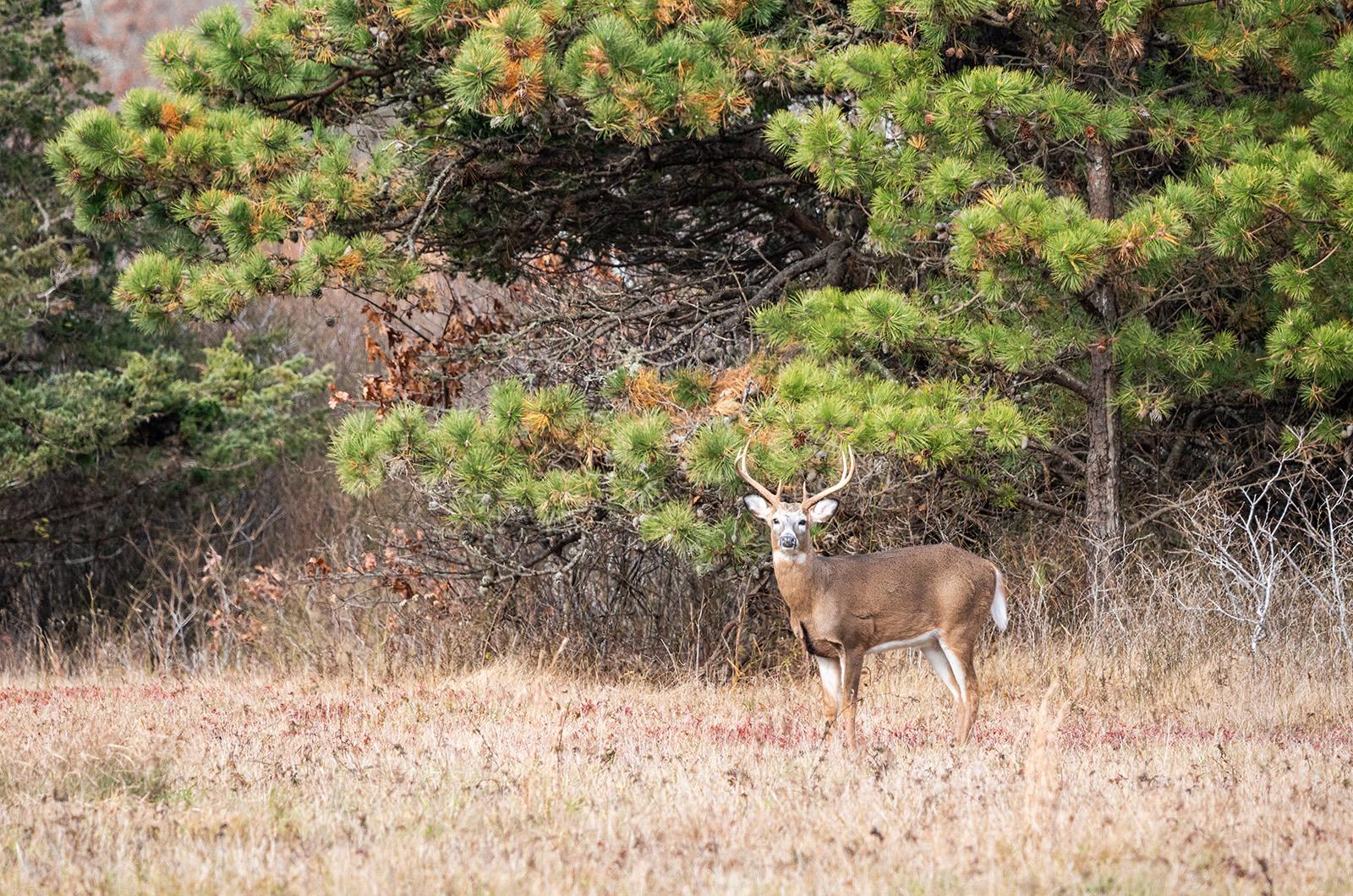
I recently helped “process," which is to say butcher, a Vineyard deer.
I recently helped “process,” which is to say butcher, a Vineyard deer. Not having had the opportunity before, I wondered on my way to the cold locker in the woods where the deer hung whether the work to come would be an ordeal of one sort or another. But perhaps because over the years I have cleaned my share of fish, spatch-cocked my share of turkeys, and even, a long, long time ago, helped a trapper in the Adirondacks skin and stretch a trap line’s worth of beaver and muskrat, the dissection was neither gruesome or monotonous.
Pulling back the hide, finding and following the lines of sinew and cartilage with a sharp knife, separating muscle from bone was instead a strangely beautiful, ancient feeling, ritualistic and reverential.
And when, exhausted, we finally put the last carefully shrink-wrapped parcel of just over 40 pounds of venison into the freezer, the overriding feeling was one of gratitude. To the deer itself, of course, and to the young hunter who invited me along to share the labor. But also to those previous generations of conservation-minded Islanders who gave their treasure, time and land, with the result that there is enough untrammeled space left on the Vineyard to produce such a surplus of local, organic, grass and acorn-fed wild protein.
Deer and their resident ticks carrying illnesses are the current topic of choice at many Vineyard dinner tables these days. Some are calling for drastic reductions, or even wholesale elimination, of the deer herd. There is no doubt that tick-borne illnesses are a very serious health issue. And there is no room in this essay to delve into the practicality of a deer cull, or what the “right” number of deer for the Island might be. But with federal food assistance being held hostage in Washington, and the Island Food Pantry already helping one in five Islanders feed their families, any conversation about drastic action must consider for a moment the role venison plays in many families’ food budgets.
Last year, Vineyard hunters harvested 798 deer, which is down somewhat from the 846 taken in 2023 and down even more from the record year of 2019, when hunters reported harvesting 1,119 animals. The average number of deer taken on the Island over the past 10 years is 830.
Using the National Deer Association’s estimates that the yield of boneless venison from a deer is 48 per cent of its field-dressed weight, and the Massachusetts Division of Fisheries and Wildlife’s estimate that adult white-tails in the state range between 80 and 160 pounds, it’s reasonable to assume that each deer harvested in the fall hunt provided someone with between 35 and 75 pounds of meat. Even using the small end of the range — say, 45 pounds of venison per deer — an average harvest of 830 deer contributes an astonishing 37,350 pounds of some of the highest quality, healthiest red meat available to our collective food supply. That’s somewhere over 75,000 main courses.
The same amount of organic grass-fed beefsteak, probably the closest nutritional equivalent to venison, which currently sells for between $20 and $30 a pound, would easily run to upwards of $750,000. Forty-thousand pounds of the cheapest meat I found on Island grocery shelves recently, bulk packaged chicken drumsticks at around $1.35 a pound, would set back those who depend on venison something in the neighborhood of $50,000. That much rice from Amazon costs... well, you get the picture.
This is not to imply that venison is free. It is not. Getting geared up to start as a hunter, whether by bow or firearm, is an expensive proposition. Properly storing and processing the fruits of a successful hunt requires space and refrigeration capacity that is out of the range of most residents, which is why facilities such as the community deer cooler run jointly by the Martha’s Vineyard Agricultural Society, Island Grown Initiative and the Dukes County Tick Program is so important.
Finally, as with fishing, hunting requires an investment of as many hours as a person can possibly commit to it. Cold hours, mostly, up in a tree at dawn or dusk. For make no mistake, the fact that drivers see (and sometimes hit) them along the roadsides does not remotely mean that white-tails, which evolved with humans as one of their primary predators, are easy to get with either gun or bow. But however one chooses to calculate the dollar value of the local venison harvest, 37,000 plus pounds is a lot of healthy food. Food that sustains someone, most likely a year-round Islander.
The significance of venison in the community food budget shouldn’t really surprise us. Archaeology on the Vineyard and elsewhere shows that for thousands of years venison was a principal source of protein for the people living east of the Mississippi River. Venison remained available on the Island for a generation or two after the arrival of European colonists in the 1640s, but deer were all but gone by the mid-1700s, due as much to deforestation as overhunting. With the decline of farming in the early 20th century, stretches of land began to recover, or revert, to forest and scrub, and the herd returned, presumably from deer that swam (as they still do) across Vineyard Sound from the Elizabeth Islands. In 1949, the first modern deer season on the Vineyard netted 27 animals.
In other words, for the vast majority of human history on the Island, wild venison has been a major nutritional resource, and deer hunting a part of the year-round culture.
Yet while the Island rightly celebrates, cherishes and supports with nonprofit donations its other traditional wild resource industry — commercial and recreational fishing — more often than not deer are portrayed as a nuisance and a health threat, and hunters as some quaint fringe. This despite the fact that most fish species are in constant danger of being over harvested, while deer are generally believed to be over abundant.
The reason is the ticks, of course, and, to a lesser degree, gardens. Everyone who spends more than a short time on the Island has either suffered or knows someone who is suffering from one or more of the illnesses that ticks carry. Tick-borne illnesses are a definite and growing issue, and the measures that make them largely preventable — permethrin-treated clothing and hyper-vigilance — are as annoying as seatbelts and bike helmets were once considered to be. More solutions are needed.
The rub is that sharing a landscape with wild animals is inconvenient, and ours is a technological culture that values convenience very highly. Convenience is the opposite of complexity, however, which nature adores, and which dooms any simple and quick solutions. Deer are an important vector for ticks but by no means the only ones: squirrels, rabbits, skunks, rats, raccoons, feral cats, birds, the list goes on and on.
Nor are the tick-borne diseases that seem of late to have displaced housing, affordability, suburbanization, nitrogen loading, the roundabout, and even possibly the Steamship Authority in the pantheon of Island crises, the only diseases out there. Bats and raccoons can be rabid. Rabbits can carry tularemia. Mice can have hantavirus and rats the plague. Birds can carry bird flu, mosquitoes West Nile virus, and oysters can give you vibrio. And it was Homo sapiens, whose summer mating colony on the Island swells to a density of nearly 1,500 per square mile every August, who brought Covid into our midst.
None of this is to make light of either the seriousness of the tick-borne illnesses or the suffering of their victims. There are many things we can and should do to encourage hunting and thereby reduce the deer population. Among them, as journalist and hunter Nelson Sigelman has written well about in this newspaper and online, are opening more of our conserved and private lands to hunting and further subsidizing the processing and storage of the venison. To which might be added venison festivals, CSAs and a deer derby.
What we must not do is let our fears and our cultural predilection for quick and expensive fixes get the better of us. For one, they typically fail. More important is that sustainably harvesting wild resources has less environmental impact than even the greenest of agricultural and animal husbandry practices. It is the original permaculture, an option that feeds people, preserves wild places and creates a multi-generational constituency with a vested interest in maintaining that preservation.
The Fisherman’s Preservation Trust is making the Vineyard a leader in the development of new models of sustainable, local commercial fishing. The Agricultural Society and Island Grown Initiative have long been doing the same for local farming. In the same spirit, the Island, with our healthy deer population and generous supply of conserved land, has a unique opportunity to do something similar for wild economics.
With enough patience and creativity we can show that what’s ancient — deer and humans thriving together on the Island — is innovative.
Paul Schneider lives in West Tisbury.
Comments
Excellent article Paul
Chance Perks NEW BEDFORDExcellent article Paul
Excellent, thoughtful,
Lorraine EdgartownExcellent, thoughtful, serious, factual article, Mr. Schneider, thank you. I grew up in the country and in the city, so I have a balanced philosophy. Your article covered important issues. In another comment to the Gazette, I have called for a serious gathering of serious experts in this field right here, on the island. We are known nationally and internationally for this problem. My immunologist, off island, immediately did blood tests for me when I told him I live part time on M V island and have done so for decades and decades. We are recognized for this and it is time we gather the serious people in a room and fix it. IMHO.
I learned so much from this
Gabrielle West TisburyI learned so much from this article, thank you!
That is the best way to put
brian h Athearn west tisburyThat is the best way to put that! Well worded Mr. Schneider.
Add new comment