
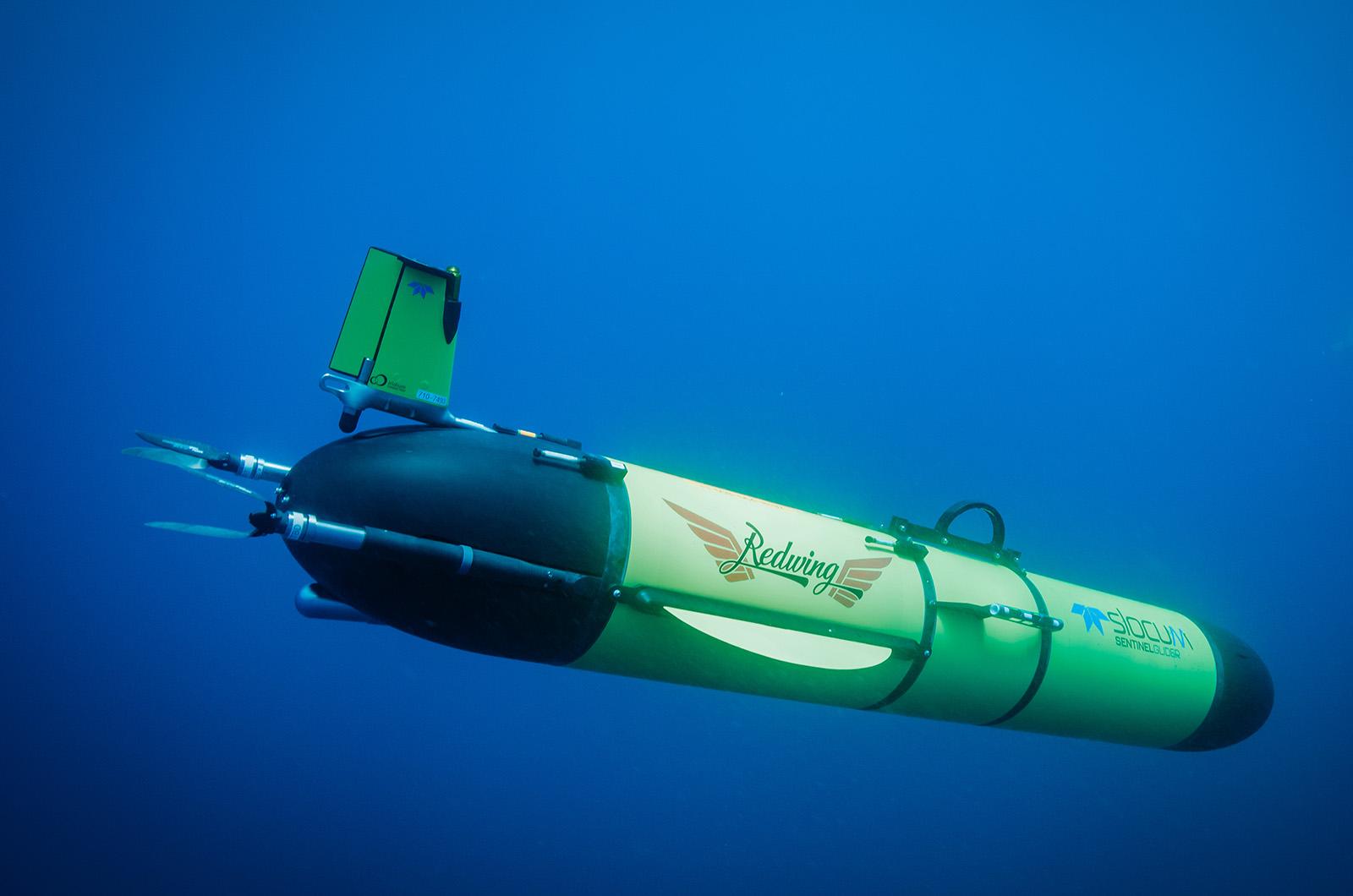
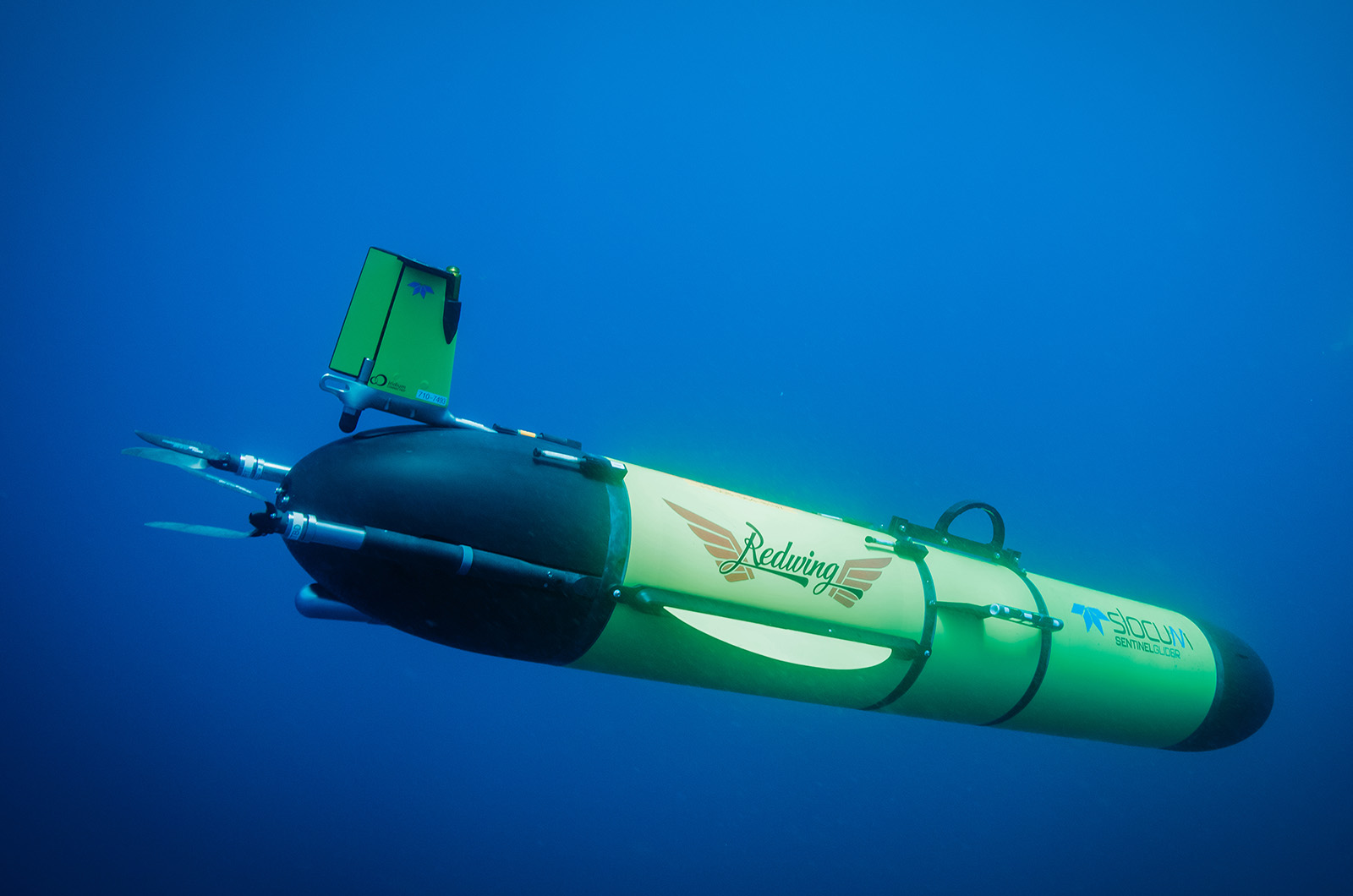
The Sentinel Slocum Glider “Redwing” will set off on the first leg of its multi-year trip around the world from the Woods Hole Oceanographic Institution (WHOI) Friday.
Woods Hole sees a constant stream of ferries and boats traveling to and from its shores each day. But on Friday, the town will provide a launchpad for something a little more unusual: an autonomous underwater vehicle that scientists hope will be the first of its kind to circumnavigate the globe.
The Sentinel Slocum Glider “Redwing” will set off on the first leg of its multi-year trip around the world from the Woods Hole Oceanographic Institution (WHOI) Friday. The project is a collaboration between Rutgers University and marine technology company Teledyne Marine.
For about 25 years, Teledyne’s Slocum Gliders have been used for “persistent ocean monitoring” — a way to consistently harvest oceanographic data without the physical presence of humans or research vessels. The vehicles move through the water independently by adjusting their buoyancy, thrusting in a zigzag pattern from one destination to the next. Redwing is a scaled-up version of the classic Slocum, designed for endurance.
WHOI owns the second-largest glider fleet in the world and has long been using Teledyne’s Slocum Glider model to harvest data for climate and marine research. WHOI Chief Innovation Officer Leslie-Ann McGee emphasized that hosting the Redwing launch is an opportunity to show the world that progress is possible at the intersection of science and industry.
“It’s really emblematic of what’s possible when research institutions, industry and academia come together to try to develop technologies that solve complex global challenges,” Ms. McGee said.
Redwing measures ocean salinity, depth and temperature, helping scientists predict severe weather events and study trends in the planet’s climate cycles. Every six to 12 hours, Redwing will pop out of the water to communicate its findings with satellites in outer space, which will then be accessible to scientists for interpretation.
Shea Quinn, a product line manager at Teledyne and the project lead for the Sentinel mission, said Redwing’s stamina will allow it to go where few have gone before, giving scientists revolutionary access to oceanographic data.
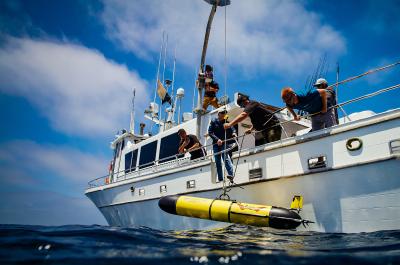
Crew during a previous test launch.
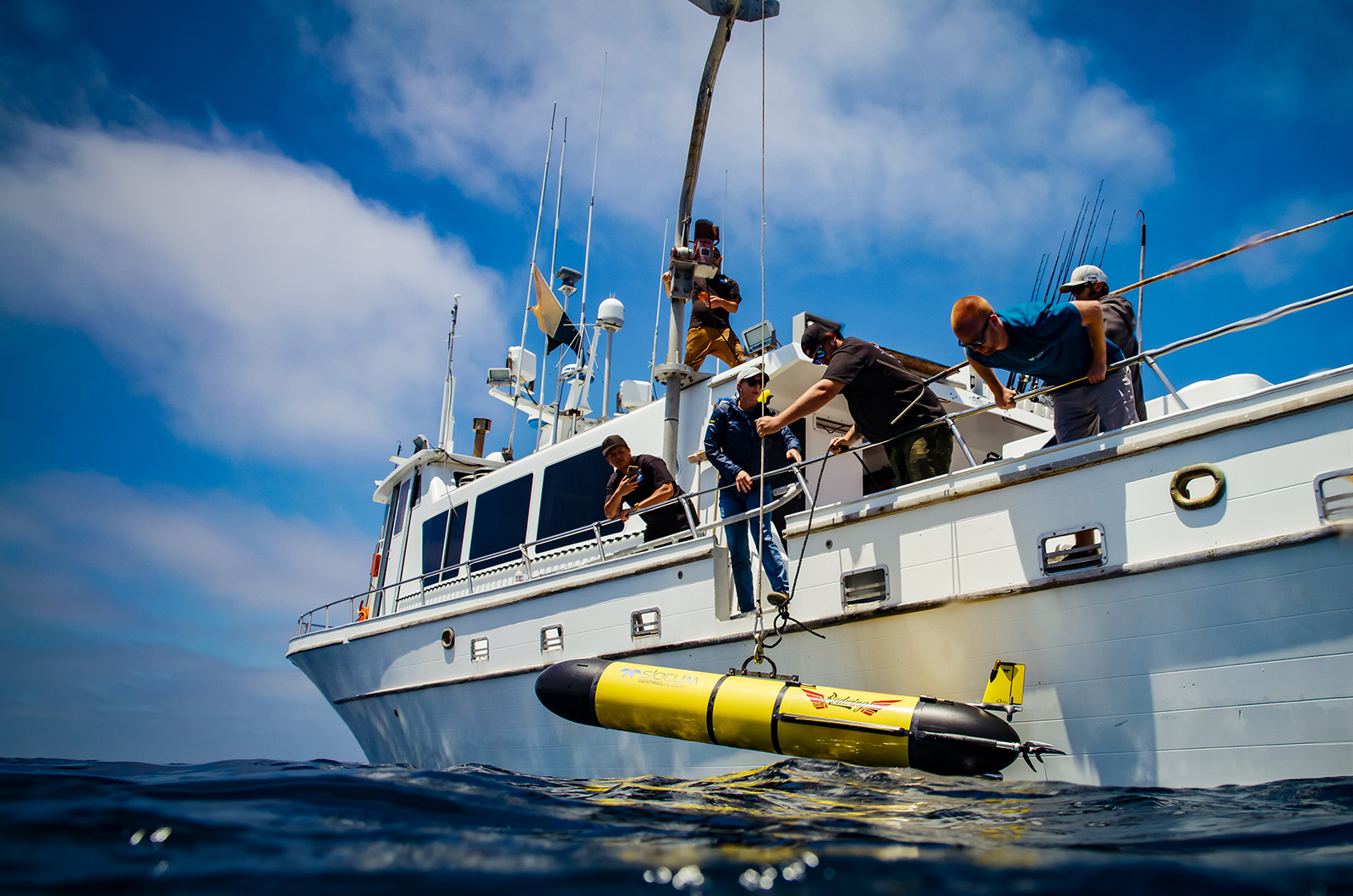
Crew during a previous test launch.
“We’ll be crossing oceans and sampling in areas that have either never been sampled before or have been severely under-sampled,” Mr. Quinn said.
Mr. Quinn added that Redwing can track marine life by pinging creatures tagged by other researchers. Because Redwing is charting under-sampled territory, he said the glider could potentially make some massive discoveries about marine animal behavior, including migration.
“What we’re really hoping is that we might pick up pings in the middle of the ocean,” Mr. Quinn said. “It’s going to be like searching for a needle in a haystack, but if there’s something that comes through in the middle of the Atlantic for a great white shark that was tagged in South Africa, that might tell us some really interesting stuff about their migration patterns.”
Redwing’s journey will take place in stages, and will be a joint effort from the international scientific community. After Woods Hole, its first stop will be the Canary Islands off the coast of Africa, where scientists at a glider facility will perform general maintenance, replace its batteries and launch it on the next leg of its journey. Then, it travels to Cape Town, South Africa, West Australia, New Zealand, the Falkland Islands, Brazil and the Caribbean before returning back home to Woods Hole. Researchers hope Redwing’s travel time will rival explorer Ferdinand Magellan’s 1,082-day trip around the globe between 1519 and 1522.
The use of glider technology to harvest undersea data has a storied history, thanks in large part to an educational program at Rutgers University.
Since 2007, professors and oceanographers Scott Glenn and Oscar Schofield have been partnering with Teledyne to give undergraduates the opportunity to contribute to glider missions in a classroom setting. The duo helps students prepare gliders for launch, track their progress and interpret their data. In 2009, they helped students spearhead the first successful trans-Atlantic glider mission from the United States to Spain.
They emphasized that work of the undergraduates makes missions like Redwing possible.
“They take what they’ve learned from their textbooks, and here’s where they apply it in the real ocean,” Mr. Glenn said.
Mr. Schofield added that not all the students who worked on Redwing and other glider projects are science majors, with usually about 20 per cent coming from different academic disciplines. One student who will be speaking at Friday’s event majored in anthropology.
“If you get people from other focuses to not be scared of data and also [to] leave class with a little more ocean literacy, when they go off to their future positions, they carry that knowledge,” he said.
One could say “education” is Redwing’s middle name. Redwing is an acronym for “Research and Education Doug Webb International Glider,” honoring Doug Webb, who started the company known today as Teledyne and pioneered glider technology. Mr. Webb died last year.
Mr. Webb was an invaluable partner for many years, Mr. Glenn said.
“His motto is kind of the motto for the mission, which is: work hard, have fun and change the world,” he said. “He’s essentially been family.”
Getting Redwing ready for launch has been a years-long process. Mr. Quinn said researchers have been conducting practice runs with the vehicle off the coast of San Diego for months, which has provided valuable information about how it behaves in deep water and how to maximize its efficiency. He expressed gratitude to Mr. Glenn, Mr. Schofield and their students at Rutgers.
But even the best-laid plans, and the best-built gliders, can meet challenges in the ocean’s depths, said Mr. Schofield.
“I’m really confident in the technology, but it could be eaten by a shark two days in,” he said. “That’s what oceanography is. It’s high-risk.”
But he and Mr. Glenn believe that making scientific progress means embracing failure and success equally — and doing so in front of the entire world.
“We’ll encounter challenges along the way, but we’re pretty good at problem solving,” Mr. Glenn said. “We prepped as best we as could, and now it’s time to go.”
Comments
Fantastic., exciting, so good
Lorrarine EdgartownFantastic., exciting, so good to see serious people doing serious work. Please publish updates, if any, so we can follow along.
Please publish any links that
Woodrow W. Williams Vineyard HavenPlease publish any links that they mighr have on YOUTUBE etc so we can follow them!
Thanks,
~W.W.W.~
Woodrow, links on youtube
Lorraine EdgartownWoodrow, links on youtube would be terrific, good idea.
Add new comment