


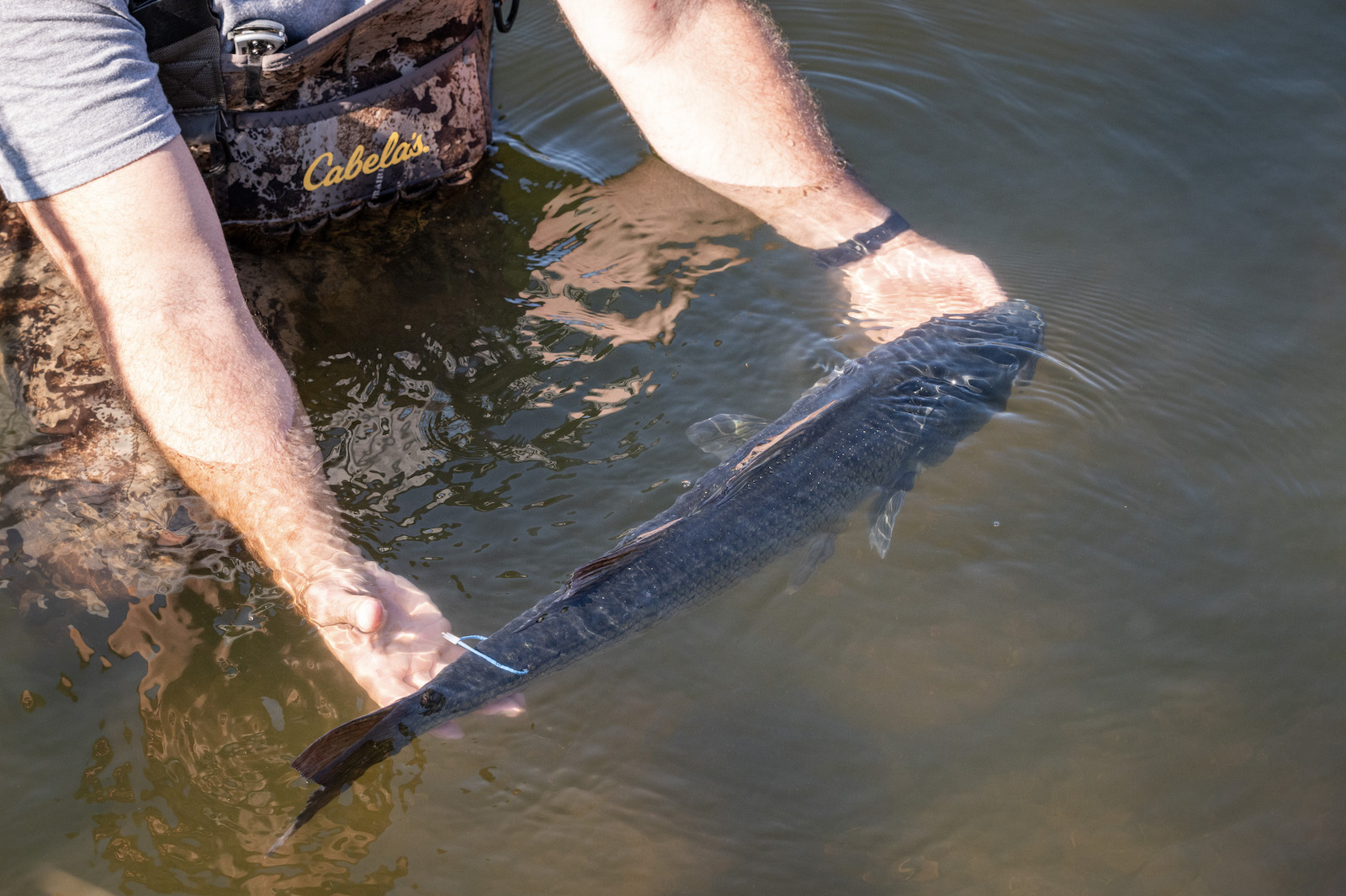
Island fishermen are hoping that regulators will take steps to protect the fragile striped bass population after several proposals were aired for public comment last month.
Island fishermen are hoping that regulators will take steps to protect the fragile striped bass population after several proposals were aired for public comment last month.
The Atlantic State Marine Fisheries Commission, a regional fishing body that oversees stripers and other species, is worried that the bass stock is not recovering fast enough, leading to potential quota cuts for commercial fishermen and seasonal closures for recreational anglers.
In general, Massachusetts fisherman have been pushing for the interstate commission to take more stringent measures to protect the popular fish.
“I’m to the point where something has to be done,” said Ron Domurat, an avid Edgartown fisherman. “I think [seasonal closures is] probably the only thing you can do right now short of a total moratorium.”
The commission has laid out several potential strategies to protect the species, including a 12 per cent cut in the commercial quota across the eastern seaboard, new tagging requirements for commercial harvesters and a standardized measurement system for fish in all of the Atlantic states.
Of the most interest for Island fishermen was the potential seasonal closures. The commission, which is taking comments through the end of the month, has floated a plethora of different options for recreational fishermen to do their part.
The proposals would either halt harvesting stripers or even fishing for them in general for different time periods from May through October in an attempt to cut down on recreational harvesting by 12 per cent.
This is the first time the striped bass board has considered these types of closures, according to Emilie Franke, the fishery management plan coordinator at the commission. If enacted, exact dates for the closures would need to be decided on by the board.
The big concern for regulators and fishermen is that the last strong class of striped bass have now grown to the size where they can be legally harvested. If that class is depleted, there are few robust fish classes behind it to bolster the population.
The female spawning biomass is about 50 million pounds below its target, while harvests increased in recent years. The commission had hoped to rebuild the stock by 2029, but the likelihood that the goals will be met is growing slimmer.
“There’s this concern about the weak year classes coming up soon,” Ms. Franke said. “These measures are designed to increase the probability that we get there.”
Striped bass are a prized catch on Martha’s Vineyard, and are the namesake of the annual Martha’s Vineyard Striped Bass and Bluefish Derby. But because of their precarious status, the fish have not actually been a part of the tournament since 2020.
Jaime Boyle, an Island fisherman and a member of the American Saltwater Guides Association board, has urged the commission to take action and was supportive of a seasonal closure.
Though he runs a charter fishing business on the Island, he still pushed back on another proposal from the commission that would allow for-hire fishing businesses to have a wider range of fish that they and their customers could keep.
Under one proposal, charter outings could keep fish between 28 and 33 inches — two inches more than recreational fishermen. Mr. Boyle would rather see everyone fall under the same rules.
“I don’t think they should widen the slot for charters,” he said.
The commission last year considered taking further measures to protect the struggling species but, after hours of debate, decided to keep the status quo. This irked many Island fishermen, who saw the lack of action as an abdication of responsibility.
“Fisheries managers present data that shows a need for decisive action, then take half-steps to placate and balance all their various stakeholders and interest groups,” said Nelson Sigelman, a fisherman and an outdoors writer. “Will we have to wait until the striped bass resource is so depleted that the fishery will close? If so, let’s do it sooner rather than later and start the rebuilding now.”
The commission is planning to decide on proposals in October, and will hold several hearings throughout the northeast. Hearings in Massachusetts are scheduled on Sept. 25 in Woburn and Sept. 30 at Massachusetts Maritime Academy in Bourne. A virtual hearing for Massachusetts anglers also will be held on Sept. 29.
Peter Sliwkowski, the owner of Larry’s Bait and Tackle in Edgartown, said that fishermen who come into his shop have seen the big striped bass, likely members of that last large class. But the fishermen are aware that something needs to be done to ensure the continuance of the species.
He just hoped that the cuts fall evenly across the different fishing communities.
“Anglers are fine with clearer rules and even tighter limits if that’s what it takes, but they want it to be fair,” Mr. Sliwkowski said. “Right now it feels like the cuts always land hardest on the recreational side. People would like to see more restrictions on the commercial side too, with consistency and transparency across the board.”
Comments
How about stopping all
Tom Bolinder Bourne MaHow about stopping all commercial fishing? I feel for those who fish for a living, but keeping fish over 35”, 15 a day per boat, kills the breading fish. If you want a season for recreational people I’m all for it. Includes charters, sorry guys.
I’m old and on the way out. This was the absolute worst year ever. Remember when the minimum size was 36” the fish came back like gang busters. Enforcement should also be stepped up in areas where lots of people gather and keep everything they catch. Love these fish hope they never disappear for good.
Thanks right lines everyone.
How about just fish for sport
K. Wiley Orleans maHow about just fish for sport? Take a pic and throw them back.
How come no mention of
Charlie Callahan So Boston/EdgartownHow come no mention of killing back the seals on the cape.They say there are over 100,000 seals on the cape and they weigh about 200lbs each and each one can eat their weight per day in striped bass,which is one of their favorite foods,that equates to TWENTY MILLION POUNDS OF BASS PER DAY,not even counting all the lobsters they eat,another favorite. And then there are the hundreds of great whites who also like bass. Those are the real threats to the bass not the fishermen. There was no problem in the 70's when seals had a bounty on them and then the tree huggers were whining about killing the poor seals. And there were no great whites around cause there were few seals which are a favorite food of the great whites.And no shortage of lobsters either.So put the blame where it really belongs,and not on the fishermen. The seals probably eat more bass in the summer in one day than all the fishermen combined catch all year
I’m with Charlie. Seals are
Mitch YarmouthI’m with Charlie. Seals are great and all but those things are eating machines. Open a commercial market for those guys and see the results almost immediately is my guess.
Seals eat 4-6% of their body
Nestor Makhno TisburySeals eat 4-6% of their body weight in a day, not 100%
Seals are the problem and no
Michael skipper Pennsville njSeals are the problem and no reproduction in the cheasapeake in the last 7 years
I'm surprised the Gazette
tom BostonI'm surprised the Gazette would publish this post. It is absurdly inaccurate. To wit: the estimate of seals on the Cape is 30,000-50,000, not 100,000. Further, they do not eat their body weight in a day. Not remotely close. Additionally, bass are not their favored food but if they were bass would hardly comprise 100% of their diet. Way, way, way less. So your estimate of seals eating 20 million pounds of bass per day on the Cape is embarrassingly wrong.
I agree there are too many seals on the Cape and they should be culled but to put the declining bass population singularly on seals is simply inaccurate. The biggest issue is the Chesapeake estuary. The mortality rate of fry fish has spiked considerably. Those bass tend to migrate to NE. Conversely, The Hudson River estuary has experienced prolific spawning which is why the NY/NJ areas are teeming with bass, including cows.
Agreed, on all points.
Mr. B, ChilmarkAgreed, on all points. Thanks for thinking.
You sir hit the nail on the
Eric C Somerset Ma.You sir hit the nail on the head. It's time to let the Native Americans thin out the seal population!
Good point about the seals.
William Sapula CharlestownGood point about the seals.
We have been reduced to a 4
Matt Born AquinnahWe have been reduced to a 4 week season to catch Striped Bass. Basically the month of June. The schoolies are basically no longer in the island tidal ponds. The iconic species that defines this island fishery is no longer here for most of the year and could be disappearing forever. Obviously there should be a moratorium on all taking of striped bass (recreational and commercial) and that should have happened years ago. However there is a larger set of issues that have removed this species from our shores and it is some combination of human activities (warmer waters, over harvesting, forage removal, pollution of key breeding areas)…..I’m not smart enough to know which or what else. This is hard to watch.
If there is a ban on fishing
Tom Engley West TisburyIf there is a ban on fishing stripers only the people who follow the rules will follow the rules. It’s the people who don’t follow the rules that will keep fishing for stripers in the season. If you go down to the fishing pier, it’s pretty much free rein down there. It’s upsetting.
Tom, it is true that some
tom BostonTom, it is true that some folks do not follow the rules. That's true for all rules, not just those that apply to fishing. But the vast majority of people do follow the rules and given that, a ban would help immensely. When the bass stocks were in serious decline in the 80s, the fishing bans help bring back the stock despite some who likely cheated.
Here in Texas and many n
Ronald King Canyon LakeHere in Texas and many n other states,stripers are farmed for tier row, fingerlings are stocked in lakes and rivers. Why doesn't the Atlantic fishery, borrow millions of fongerlings from these states and help replenish the north east water ways? Seems we should all contribute.
GAME FISH!!! Pure and Simple!
DJ Redneckerson Atlantic Ocean AreaGAME FISH!!! Pure and Simple! Look at the Gulf states and how they reversed the collapse of Red Drum (Redfish)… GAME FISH, ZERO commercial harvest!! DUH!!!
Amend the marine mammal
Chris OrleansAmend the marine mammal protection act to allow the Harvest of seals this will take some of the stress off of The Fishery
I think that all Eastern
Steven Fraiman Long Island NYI think that all Eastern Seaboard states should have the same quotas and slot requirements for recreational and commercial fishing for striped bass. I also believe the same holds true for fluke/summer flounder.
Why is this so complicated?
Chris New JerseyWhy is this so complicated? First, stop the over-harvesting of Menhaden by Canadian owned company (Omega). That’s a Stripers main food source. Fishers up and down mid-Atlantic states already see the decline of this vital link in the food chain - and it impacts other animals, like Ospreys, too. So, we’re allowing starvation, but expecting a population increase. Next, close the season for a month in specific funnel areas (Raritan Bay, for example) where Striped Bass congregate in huge numbers and are just suffocated by 50 or 100 large boats with 25-50-100 fishers reeling in breeders all day long, to be laid out on deck, mishandled and dumped back in after five minutes out of the water. Mortality rate is probably 50% or higher. Last, sadly, most Commercial, Charters and Rec. fishers aren’t going to police themselves, they don’t think long-term, so the council needs to close the season in know areas (widely known funnels or choke points) where the bio-mass gets slaughtered. After the fish spread out, open the season back up. Give the Stripers a chance to migrate and hopefully, breed. Try this for one year or two. But…if nothing else, at least stop the widespread killing of Bunker, their food source (and every other animal’s food source).
Bunker have become rare
Bingo, agree 100 percent Norwalj ctBunker have become rare around here, seals and now porposes are here.
Seals used to be rarely seen, now they are a commom site.
1. Stop the bunker boats for fertilizer
2. Cull the seals
3. Uniform regulations
4. Uniform designation of stripers as a game fish. No commercial fishing
5. Eliminate fish traps in long island sound. Currently they are allowed.
6. Eliminate the draggers in long island sound. There are two working the 11b and 28c area.
7. I LEFT THE MOST IMPORTANT FOR LAST... ENFOREMENT... GET MORE AGENTS OUT THERE. AND STRICT PUNISHMENT FOR VIOLATERS.
I HAVEN T BEEN CHECKED IN MANY YEARS AND HAVEN T SEEN ANY AGENTS OUT THERE,
The state and feds have to coordinate strict enforcement and severe penalties.
Maybe its time for a
MATT CHILD OF GAY HEADMaybe its time for a discussion about a legal seal harvest season.....
Give the fish some space and
Jimmy TGive the fish some space and food to rebuild. Stop the commercial Menhaden industry.
First we must end the
Garrett Buzzards bayFirst we must end the commercial watermen welfare system. Commercial fishermen are still killing cow stripers and giant breeding tunas. They are also allowed to keep tiny 12.5 Sea bass and Tautog???? End ALL commercial striped bass fishing first. Then Make striped bass a Gamefish.
Put an end to commercial
Jason Currier MainePut an end to commercial harvest of all striped bass. And make the regs the same for all eastern seaboard states. Its too difficult to try and make any headway with rebuilding the stock of a fish that is quickly able to be harvested as soon as it crosses state lines. Personally, I would be in favor of making stripers a game fish - no live bait, single hook only, catch and release only for all.
https://podcasts.apple.com/us
Clark Goff Jr NC/Chilmarkhttps://podcasts.apple.com/us/podcast/the-orvis-fly-fishing-podcast/id2…
This is a very good Orvis Podcast about Chesapeake Bay and the challenges there including the Canadian Company fishing out a lot of the Menhaden which the stripers rely on. Also discusses the tough spawns over recent seasons.
What can we do today to help
DanWhat can we do today to help alleviate pressure on Striped Bass?
-Target other species?
-Mash hook barbs?
-Fish with larger lures?
-Club the seals?
Something needs to be done rt
John Ryan Plymouth mass.Something needs to be done rt away or they will be gone. Back to 36 inches, regulate seal harvest, get rid of draggers for bunker. Be back in no time like the 90s.
Add new comment