


Island doctors, researchers and biologists are redoubling tick education efforts amid the growing concerns about the disease-carrying arachnids.
Island doctors, researchers and biologists are redoubling tick education efforts amid the growing concerns about the disease-carrying arachnids.
The need for further public outreach to help protect the community was echoed throughout the inaugural Tick Talk conference hosted by Martha’s Vineyard Medical last weekend. Experts and people who have suffered from tick-borne illnesses spoke to a sold-out crowd at the Katharine Cornell Theatre, hammering home on the need to protect oneself.
“Check for ticks and advocate for yourself if you have unexplained symptoms,” said Georgi Prevosti, who has suffered from Lyme and other tick-borne illnesses, resulting in neurological lapses. “Or if you’re deep in the fight against Lyme now, this is hope that you’ll join me on the other side, along [with] thousands of others who have healed.”

Dr. Gerry Yukevich and Dr. Kathleen Koehler.

Dr. Gerry Yukevich and Dr. Kathleen Koehler.
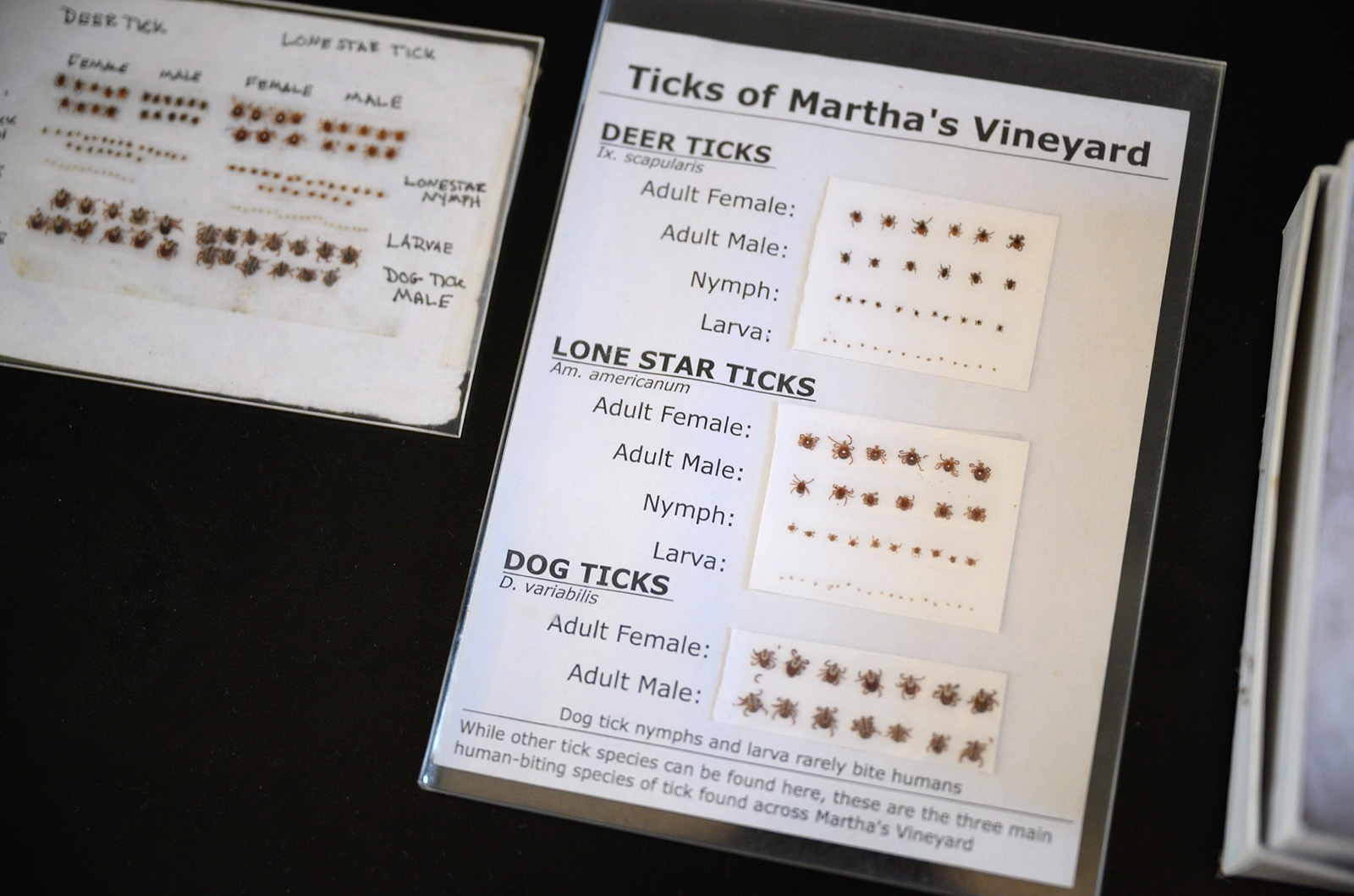
Ticks have been an Islandwide concern for years. Lyme disease, which is transmitted by deer tick bites, is still the most common tick-borne ailment here, though much of the concern recently has stemmed from the rise of the lone star tick since 2020.
Lone stars are the main cause of alpha-gal syndrome, an allergy that can cause people to have reactions to red meat and other mammalian products, such as dairy and gelatin. Cases of alpha-gal have skyrocketed in recent years, with more than 400 individual positive tests at Martha’s Vineyard Hospital last year.
Medical experts worry that they are not getting the necessary information about tick protections to the public, especially to people who work outside, said Aubrey Stimola Ryan, a physician’s assistant at the hospital. She wants to see more information put out through public forums and on public health websites.
“There’s some information on the Martha’s Vineyard board of health page that might be available to view, but letting people know where to find that information is a problem,” she said. “It’s been sitting there, so I think that kind of outreach is really critical here.”
Additional concerns about detection also stem from the color of someone’s skin. Doctors often have a harder time distinguishing some of the hallmark signs of tick-borne illnesses, such as the bull’s-eye rash, in people with darker complexions, said Kelley Ellsworth, a physician’s assistant at Martha’s Vineyard Medical. According to a study conducted by Dr. Dan Ly of UCLA, with data taken in 2015-2016, approximately 34 per cent of Black patients had neurological complications in the later stages of diagnosis, compared to 9 per cent of white patients.
How this affects the Island’s Brazilian community, especially those who are in careers that require a significant time outdoors, is something that medical professionals need to be aware of, according to Ms. Ellsworth.
“I really worry about how many people are going undiagnosed and untreated, and how this is going to impact them in the long term,” she said. “So I think it’s really important that we educate the people who own these landscaping companies, so that they can educate their staff and make sure that they’re on the lookout for these tick-borne diseases.”
When a patient comes in concerned about a tick bite, medical practitioners go through a checklist to determine how to proceed with treatment. With most ticks, the go-to treatment is doxycycline.
Because the symptoms often vary and are vague depending on the tick, the best thing for a person to do is be proactive and to advocate for themselves. That makes education all the more important, said Ms. Stimola Ryan.
“It is unfortunate that we’re still in a position where our patients [have] to advocate for ourselves and ask those questions,” she said. “The more pressure we put, the more information we’ll get out there.”
Patrick Roden-Reynolds, the Island's tick biologist.
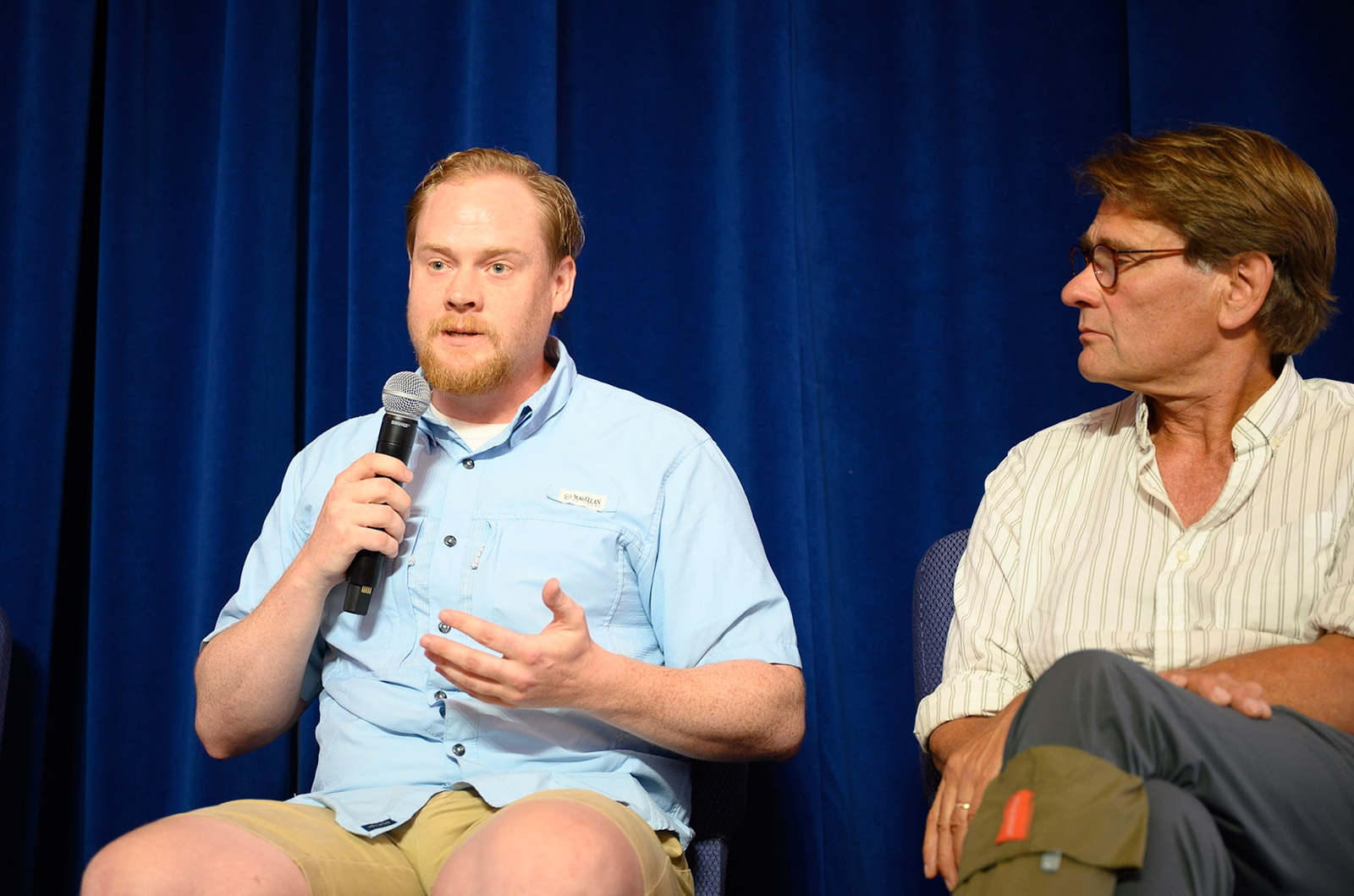
Patrick Roden-Reynolds, the Island's tick biologist.
However, not every tick bite causes a tick-borne illness. Allergist Ed Caldwell encourages people to only go to the doctor if they are bitten by a tick and they have symptoms. Otherwise, scare tactics could cause more harm than good.
“Wide-ranging testing is not helpful and [it is] unnecessary and probably not safe... you may have an EpiPen and use it inappropriately,” he said.
Being proactive also comes from protecting oneself. Actively using permethrin spray or wearing permethrin-treated clothing is perhaps the most important thing a person can do to protect themselves, according to Patrick Roden-Reynolds, one of the Island’s leading tick experts who runs the Martha’s Vineyard Tick-Borne Illness Reduction Initiative.
When he’s out doing field work and yard surveys, Mr. Roden-Reynolds wears permethrin-treated clothing. As someone who is outside and actively looking for ticks, he’s only been bitten twice by ticks in the last four years.
“I want to at least give you a little hope and optimism that if you dress appropriately with a full-treated outfit... I feel comfortable going where I want, doing what I want,” he said.
As Islanders try to get a better handle on the Vineyard’s ticks, Isobel Renai, a postdoctoral fellow at Harvard University, has been tracking what international scientists are doing to study ticks. While international conferences about tick-borne diseases have been occurring since the 1990s, the information is only just starting to become widely available to researchers.
“A lot of this information and the research that was done and published during these conferences have never been publicly available to anybody,” Ms. Renai said. “I’m fortunate that I’m being sent to a lot of these resources, and I’m trying to get more digitized in one place.”
Though education is essential, tick experts are also trying more direct efforts to combat ticks.

Aubrey Stimola Ryan urges for more public education on ticks.

Aubrey Stimola Ryan urges for more public education on ticks.
Dick Johnson, former director of the Martha’s Vineyard Tick-Borne Illness Reduction Initiative, said while there is no one-size-fits-all solution, preparing legislation to allow for easier access to deer hunting would be the most effective way forward.
Reducing the deer population, which both deer ticks and lone star ticks feed on, has been eyed as a critical way to cut down the number of ticks. Mr. Johnson has urged the state to lengthen the hunting season and make it easier for people to use crossbows, a more accurate hunting tool.
“We’re never going to eliminate deer. They’re a native species. They belong here, but we need to get them down,” he said. “That’s not going to be easy, but it’s at least a goal.”
Experts agreed that everyone needs to work together and combine their strengths for a path forward to battle this problem. That effort will have to be large for a fruitful solution.
“There’s a lot we have to learn,” Mr. Johnson. “It’s going to take staff. It’s going to take money and people and love.”
Comments
Instead of paying these so
Charlie Callahan So Boston/EdgartownInstead of paying these so called experts thru the nose there are a few simple things that can be done and u don't even need a high schooldiploma to do it,like I don't have. I have commented before about thisand maybe the gazette doesn't like it,but too bad. First they could have controlled ground burns in the state forest,people could get permits if they have long hoses and do it on their own properties.Second reintroduce Guinea hens to the island they eat millions of ticks. And third have a year round open season on deer,both bucks and does. These college boys with their theories ,reasons,etc etc are doing nothing to slow the progression of ticks,when these three things won't eliminate them,but it would probably reduce their numbers way down. I did a burn on my little lot and have seen maybe 10% of the amount I used to see.
Changing the hunting season
Mr. B ChilmarkChanging the hunting season will have no meaningful effect. Making killing the deer more efficient will equally do nothing. People on the Vineyard only hunt to fill their freezers. The only way to reduce the deer population effectively and quickly is to offer a bounty to island residents for every deer killed during the hinting season--with a limit of X per driver's license, the check to be mailed at the end of the season to the island address on the driver's license. Local problem to be solved by local residents with the reward to remain on the island.
This is an excellent idea!
Mr. T ChilmarkThis is an excellent idea!
I'd to add to Roden-Reynolds
KMurphy ChilmarkI'd to add to Roden-Reynolds statement about the most important thing you can do. Is to also be aware, dont go in the woods thinking you won't get ticks. Expect them. Take steps to prevent them of course, but also check and check yourself and your pets often.
Has there ever been
seasonal mvyHas there ever been discussion about birth control for the deer so they do not reproduce at the current rate? Put out apples with some sort of contraceptive?
Bald Head Island, NC has used
Sue Larsen ChilmarkBald Head Island, NC has used a contraceptive program.
https://villagebhi.org/deer-management/
Agreed with Charlie Callahan!
G. Green ChilmarkAgreed with Charlie Callahan! Thank you,Charlie. So illuminating and frustrating ,with the increase of ticks and sad stories of victims ,how ineffective some people have been on this topic. The natural and immediate solutions on tick reduction are as simple as Charlie outlines.
I would add quail(devour ticks) to the guinea hen surge,and a year round reduction of not only deer but also raccoons,mice and skunks. Up island farmers used to comment that they could roll in MVI fields in the fifties and sixties because the ground nesting birds ate all the ticks. Then,somehow in the seventies,raccoons and skunks were introduced,and they ate the ground nesting birds and their eggs.
Hoping the elected officials on MVI recognize the urgency of this growing problem and take action on tick reduction immediately.
Use permethrin treated socks
AmyUse permethrin treated socks with pant legs tucked in.
It would be helpful if
EdIt would be helpful if scientists were able to complete a study to determine wether the benefits of tick eating birds outweighs their significance as a host for feeding ticks? Maybe during the next administration? Science will provide answers and hopefully guide us toward helpful tick mitigation. Without data we are just guessing.
Education and awareness
Anonymous West TisburyEducation and awareness should begin with our youth. It would be helpful to teach lessons to students as young as preschoolers to be aware and how to identify.
Add new comment