


Select Board Backs Katama Meadows Deed Restriction Mix
Situated on a 54-acre parcel off Meeting House Way, the Katama Meadows development is attempting to withdraw its application to the Martha’s Vineyard Commission to allow for a redesign targeting Islanders in the “missing middle” income bracket.
The Edgartown select board voiced its support for a redesign of the controversial Katama Meadows development at a meeting Monday.
Situated on a 54-acre parcel off Meeting House Way, the Katama Meadows development is attempting to withdraw its application to the Martha’s Vineyard Commission to allow for a redesign targeting Islanders in the “missing middle” income bracket.
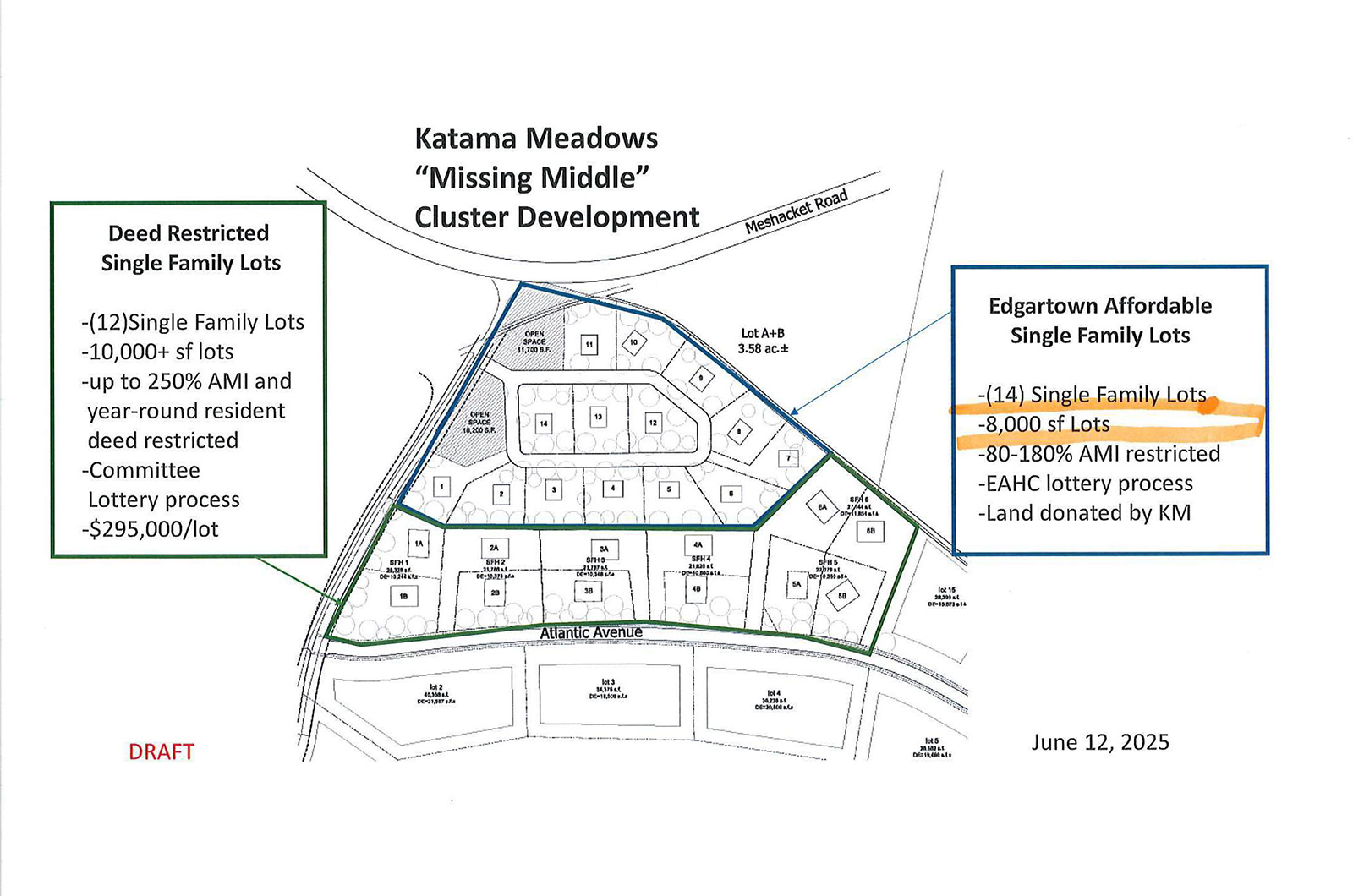
Attorney Robert Moriarty presented the new design to the select board Monday. Utah-based developers Douglas Anderson and Richard Matthews propose 26 single-family home lots to be sold at market rate, 14 lots that would be donated to the town’s affordable housing trust and 12 lots for people earning up to 250 per cent of the area median income.
He said the 12 community lots follow a model developed by attorney Rob McCarron near Jergnegan Pond, and the wastewater commission previously signed off on the original Katama Meadows proposal in March.
The new proposal has 26 market rate units and 26 deed-restricted units.
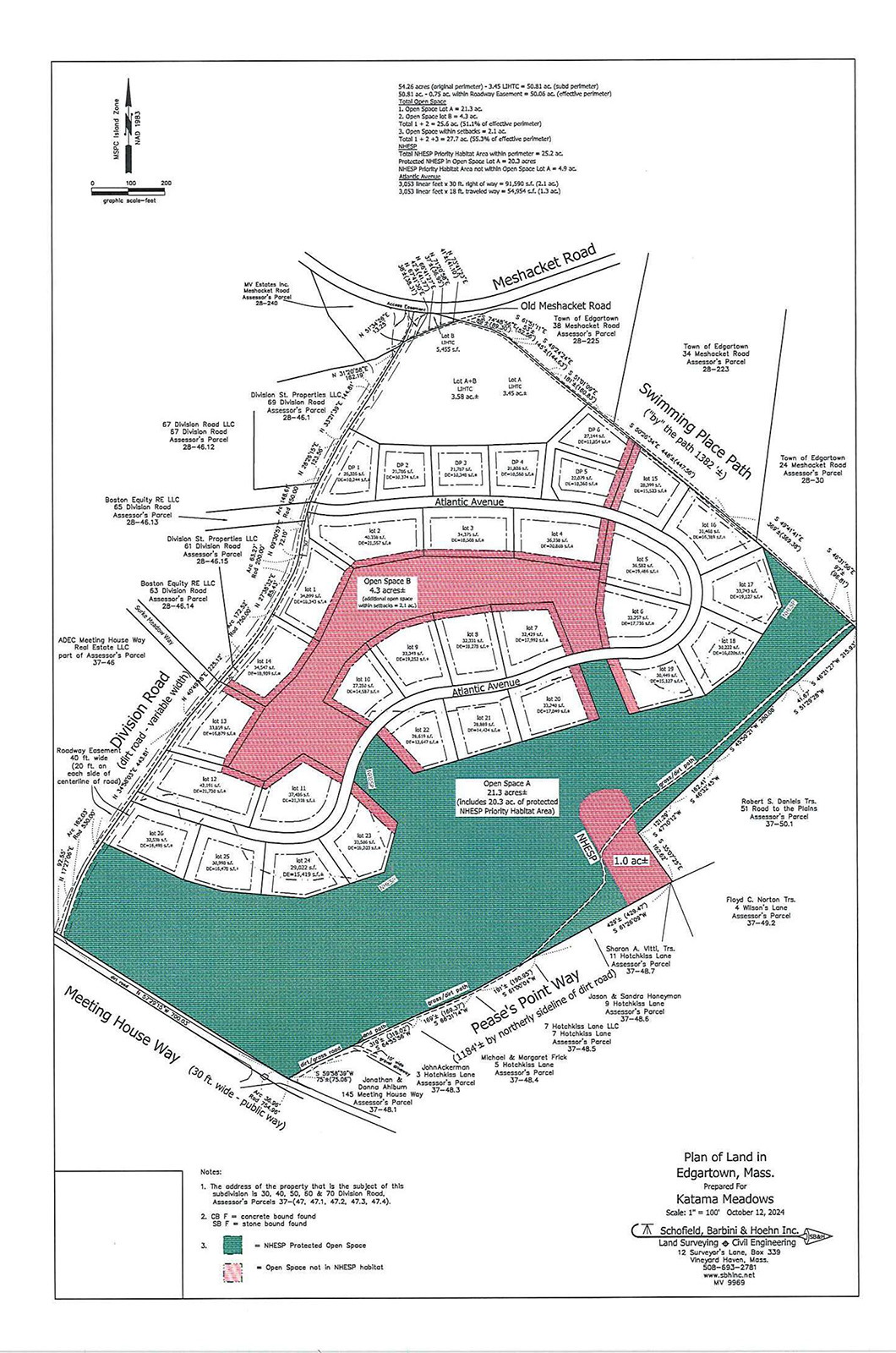
The new proposal has 26 market rate units and 26 deed-restricted units.
Under the new design, the developers would donate 14 lots touching Meshacket Road to the town under the requirement they be used for year-round affordable housing. The lots would only transfer ownership if the project is approved by the MVC and the Edgartown planning board.
The select board was considering accepting the donation at its meeting Monday. Affordable housing committee member Melissa Vincent told the board her committee supports the new plan, but it would be premature to accept the gift prior to the project getting necessary approvals.
“I’m not sure that the decision of whether this project goes forward or not should rest on whether we accept 14 affordable house lots today,” Ms. Vincent said. “I think that rests at the commission level and at the planning board level.”
The select board agreed to hold-off on accepting the 14 lots, but decided to write a letter to the MVC voicing its support of the affordable housing committee’s desire to move forward with the new plans.
Ms. Vincent told the board that finding housing for the “missing middle,” a growing population of residents who earn too much to be eligible for affordable housing but not enough to afford a home on the Island, is a priority for the committee. She said the ongoing Meshacket Commons project will provide 36 rental units for lower income earners and the Katama Meadows redesign will give them a destination point.
“If [Meshacket resident’s] income levels rise, because they now have an affordable, stable place to live, they can save some money and [when] one of [the Katama Meadows] lots becomes available, there’s an opportunity for them to buy into that where a homeownership opportunity didn’t exist before now,” Ms. Vincent said.
Select board member Art Smadbeck said he supported the committee’s position.
“We know that you guys are struggling to find places to have these affordable housing units,” he said.
Some people raised concerns about the plans for the project. This is the fourth iteration of a subdivision proposed by Mr. Anderson and Mr. Matthews. Katama Meadows’ precursor Meeting House Way was initially proposed in 2018 and was denied by the Martha’s Vineyard Commission in a 10-4 vote, largely because it wasn’t within the character of the Island and didn’t meet the needs of the Vineyard’s housing crisis.
Edgartown planning board member Julia Livingston voiced her worrries about the latest design and said it wasn’t fully baked.
She thought it was wrong for the developers to place restrictions on the 14 lots that would be donated to the town. Ms. Livingston, who also chairs the climate committee, said the environmental concerns aren’t addressed in the new plan.
“From an environmental point of view, this doesn’t make it better,” Ms. Livingston said. “From a traffic point of view, it’s not better. And the fact is, it’s doing nothing for our low-income community anymore.”
Great Pond Foundation executive director Emily Reddington echoed Ms. Livingston’s environmental concerns. She said the nitrogen load in the pond’s watershed is at a tipping point and threatening the growth of eelgrass, a protected species that is just beginning to grow back after a massive die-off in 2022.
“Even though this project is hooked up to wastewater, the affordable houses [and] the regular cost houses, would add to that problem, and we’ve already reached the tipping point,” Ms. Reddington said.
Mr. Smadbeck said Monday’s meeting was focused on the attainable housing aspect of the redesign and overall concerns about the project could be worked out when it goes in front of the MVC and planning board.
“These people, right now, don’t qualify for Meshacket and some of the other places,” Mr. Smadbeck said. “This fills a need for the nurses and firefighters and policemen and the people who serve the community.”
Comments
I always find it interesting
Mark Acker EdgartownI always find it interesting how our Town boards and MVC decide on these grand projects based on who benefits. Always the wealthy are discriminated on, sometimes the middle class, but rarely the needy. Boards and Commissions are suppose to protect our environment, health, and safety. But it always seems like economic status is their primary goal. Actually giant homes iare much better, environmentally, for the Island. Less of everything,
Add new comment