


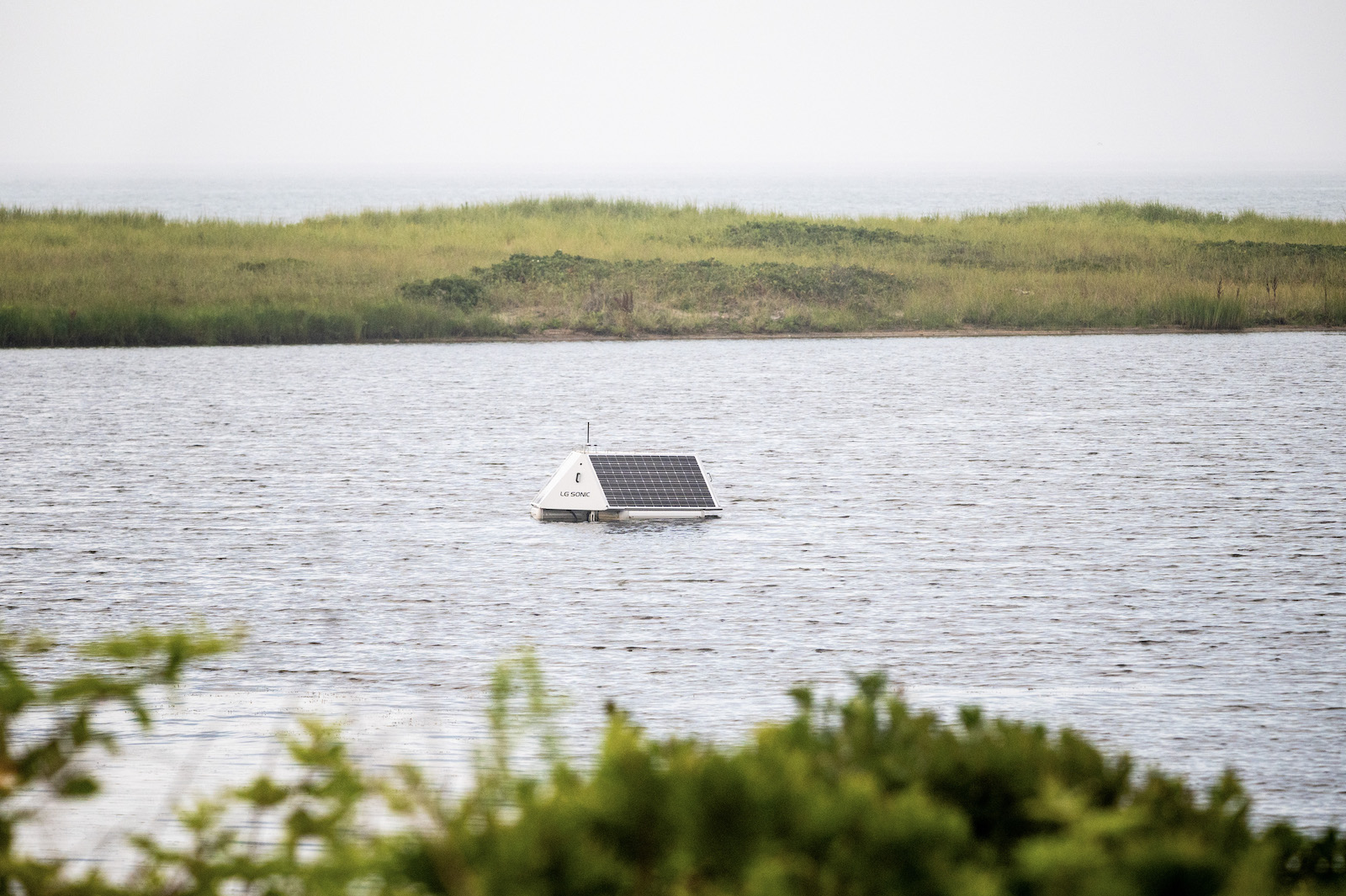
Chilmark Pond has a new helper to monitor and preserve the approximately 200-acre waterbody that has been plagued by toxic bacteria blooms for the last several years.
Chilmark Pond has a new helper to monitor and preserve the approximately 200-acre waterbody that has been plagued by toxic bacteria blooms for the last several years.
The Chilmark Pond Foundation last week deployed an ultrasonic machine, the LG Sonic MPC-Buoy, in the middle pond after getting approvals from the town’s conservation commission in March. The buoy, a hexagon-shaped machine, shoots out sonic waves to prevent cyanobacteria blooms from forming.
After putting the buoy in the pond on July 23, Chilmark Pond Foundation program director Emily Reddington said she hopes the foundation can use the real-time data from the buoy to help improve the pond’s health.
“The buoy is in place and it is collecting data every 30 minutes and transmitting it so we can see the data in real time on our computers,” she said. “It’s a great first step.”
The pond lies along Chilmark’s south shore, splitting into three areas — upper, middle and lower Chilmark Pond. One of 16 great ponds on Island, it is fed by Mill Brook and Fulling Mill Brook.
Comparing the new data with the research that the foundation has been collecting the last few years will be essential to determine the buoy’s effectiveness.
“In order to measure impact, before, during and after launch, we’ll have to see how the cyanobacteria population and the rest of the phytoplankton do,” Ms. Reddington said. “Is it consistent? Does it follow the same trend of previous years or is there an inflection point where it decreases?”
The buoy was determined by the foundation to be the best option to improve the pond because of the ease of installment and its proven success in other places. The sonic waves emanated from the buoy disrupt algae buoyancy, sensing when blooms are rising to the surface. The waves ensure that the algae can’t get the sunlight needed to photosynthesize, leading them to sink to the bottom and die.
Ms. Reddington did warn that results may not be seen instantaneously.
“We don’t know if it’s during the first year we see impact or the second year,” Ms. Reddington said. “There’s a lot to learn.”
Chilmark Pond has seen high levels of nitrogen for many years, though toxic blooms have been a common recurrence recently. When present at high levels, these groups of single-celled photosynthetic organisms are toxic to humans and dogs.
This year, there have been blooms since early July in the middle part of the pond.
The pond started seeing drastic changes in water quality in the 1980s when human development increased. In 2014, the Massachusetts Department of Environmental Protection determined that the nitrogen levels were at their limit, reaching high volumes where the water was deemed unhealthy.
This buoy is the first of its kind to be deployed in the state and the foundation is hoping it is a jumpstart to preservation efforts for ponds on the Island.
“If it proves effective, it could prove to be a solution to many ponds on the Island and in the region,” Ms. Reddington said.
Comments
One potential mitigating
John VHOne potential mitigating solution would be for the town to ban the application of any lawn fertilizers on any properties within relative proximity to the Pond.
So simple. Why not do it?
Mr. B. ChilmarkSo simple. Why not do it?
Thanks
Rose E Powers BOURNEThanks
Add new comment