

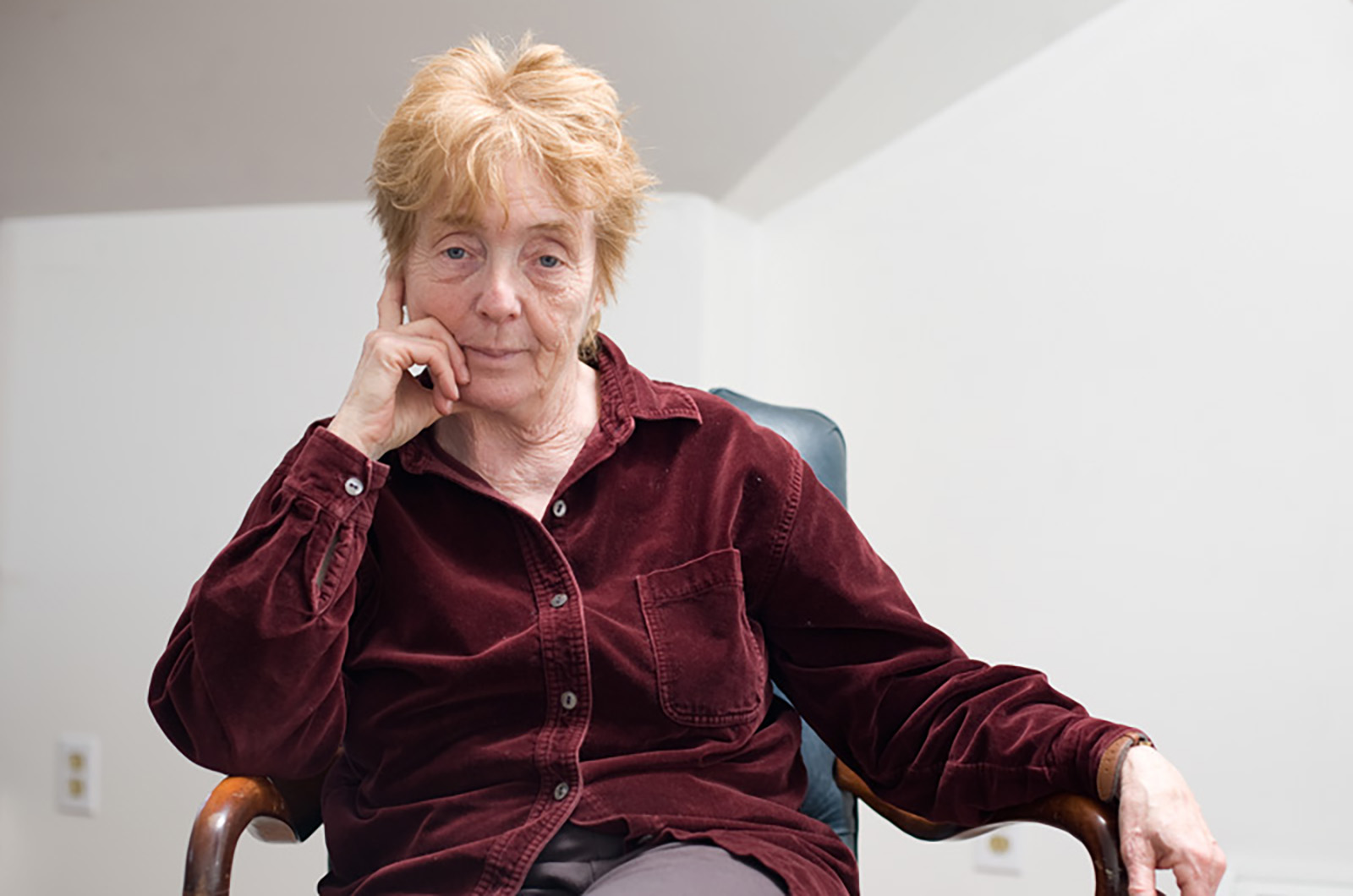
Fanny Howe, an award-winning poet who preferred the quiet life to center stage, died on Tuesday, July 8.
Fanny Howe, an award-winning poet who preferred the quiet life to center stage, died on Tuesday, July 8. Ms. Howe was a longtime West Tisbury resident but in recent years had moved back to Cambridge, where she had grown up.
Her death at age 84 followed a brief illness and hospitalization in Cambridge, her daughter Danzy Senna confirmed.
Ms. Howe was a regular presence on the Island, giving readings and attending the First Congregational Church of West Tisbury, but liked to stay out of the limelight. She even preferred publishing in small presses, the better to stay true to her vision of how her poems should be published.
“I can just sort of hand the manuscript over and say, this is it and don’t interfere,” she remarked in an interview with the Vineyard Gazette in 2013.
This all changed, however, in 2009 when she was awarded the Lilly Prize from the Poetry Foundation, which came with a $100,000 check, one of the largest literary prizes in the nation.
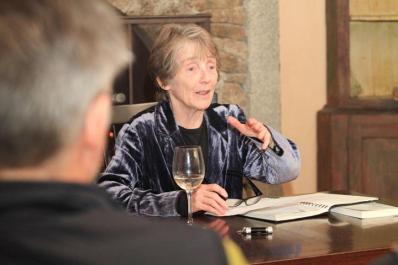
At a Speakeasy event at State Road in 2012.
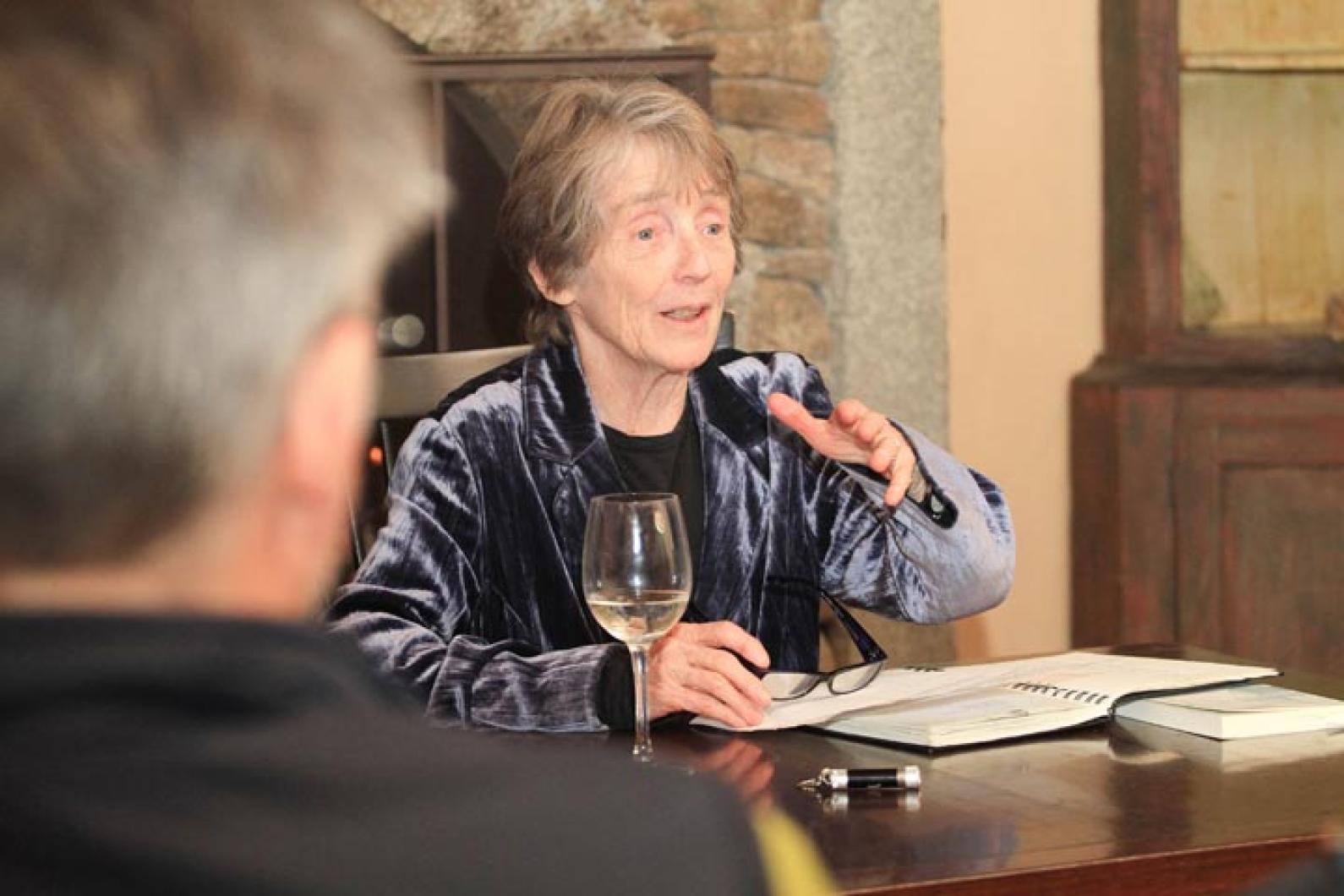
At a Speakeasy event at State Road in 2012.
In announcing the award, Christian Wiman, then the editor of Poetry magazine which the Poetry Foundation publishes, described Ms. Howe as: “A religious writer whose work makes you more alert and alive to the earth. She is an experimental writer who can break your heart. Live in her world for a while, and it can change the way you think of yours.”
The award and the subsequent acclaim came as a complete surprise to Ms. Howe.
“I am in total shock,” she told the Gazette at the time. “I had heard of the award and knew John Ashbery, who was a previous recipient, but it’s as if a plane fell on the house, it’s so unexpected.”
Ms. Howe was born on Oct. 15, 1940 in Buffalo, N.Y. Her family then moved to Cambridge, where her father, Mark DeWolfe Howe, was a law professor at Harvard. Her mother, Mary Manning, was an Irish-born playwright and actress who founded the Poets’ Theatre in Cambridge.
During her career, Ms. Howe authored more than 20 books, which in addition to poetry included essay compilations, novels and young adult fiction. She was a professor of literature and writing at the University of California at San Diego, and lectured at Columbia University, Tufts, Boston College and MIT. In addition to the Lilly Prize she received the National Poetry Foundation Award, the Pushcart Prize for fiction and the Lenore Marshall Poetry Prize from the American Academy of Poets.
Her book of poetry, Second Childhood, was a finalist for the National Book Award in 2014.
Ms. Howe was a longtime Vineyarder, spending a part of nearly every summer on the Island for over five decades. Her three children, Lucien, Danzy and Maceo Senna, grew up coming here, as did her six grandchildren.
“When I was an adolescent, my mother started writing young adult books each year — a kind of pulp fiction she did on the side of her more serious literary writing — so that she could afford to rent us a week or two rental on Martha’s Vineyard,” her daughter Danzy wrote in an email to the Gazette. “We’d go to Oak Bluffs and us kids would wander Circuit avenue and the Inkwell, trying to get into trouble."
“She had an open-door policy — our friends were always invited,” she continued. “She was relaxed and extremely open hearted and welcoming. The Vineyard was also the only summer place that we all felt comfortable as a racially mixed family. Decades later, we never stopped coming to Martha’s Vineyard. Her six grandchildren have all developed a similar love and attachment to the island and it will always and forever more be connected to their love of 'Nani,' as they call her.”
In an interview with the Gazette, Ms. Howe described her writing process this way: “I have always been a kind of scribbler writer, like if I had been a painter, I would have been a sketch artist. It’s the next thing to being insane, something just comes to my mind and I write it down. It’s almost like hearing voices.”
She likened the practice to jazz music.
“I would say that’s the most like it in contemporary life, it’s improvisatory, it’s sort of mystical, you can’t be sure of where it’s going,” she said.
In addition to finding creative inspiration on the Vineyard, Ms. Howe would continue to plumb her Irish heritage, often staying in a monastery in Limerick, Ireland. Her book The Lyrics, was written mostly in Ireland.
At a reading in 2012 with her daughter in law, Jennifer Tseng, she described the experience at the monastery as “the strangest phenomenon... gravity and me are agreeing for the first time.”
The reading took place at State Road Restaurant as part of an ongoing Speakeasy event to support the West Tisbury Library. It was one of many causes Ms. Howe championed on the Island.
In response to being referred to at times as an experimental poet, Ms. Howe told the Gazette that she never tried to be difficult with her work.
“It’s just that the music is more important than the sense,” she said. “I often depart from the melody to do something else and then return. I let the sound carry the poem.”
She suggested that readers of her poems, “not try to understand it, just listen to it.”
Just before her death, a trip to the Vineyard was planned, Ms. Senna wrote.
“Sadly, my husband, Percival, and I were supposed to be picking her up in Cambridge in a few weeks to bring her to the Island to accompany us and our boys. She was so looking forward to it and my heart aches that we won’t have that time again.”
Excerpted from Second Childhood
I decided to stop becoming an adult. That day I chose
to blur facts, fail at tests, and slouch under a hood.
School was my first testing ground. I misunderstood
lessons, assignments, meanings of poems and stories,
and misinterpreted the gestures of characters in
novels. I was awestruck by geology but mixed up the
ages of rocks. I stared and giggled, and refused to
take orders and was punished.
Throughout my life I have remained vague and
have accepted the humiliation it brought, almost
as if stupefaction was a gift. I willfully repeat
my mistakes over and over and never learn from
experience.
Every day has been a threat to this attitude so I avoid
obligations. For example, last night I dreamed I was on an airplane
that was open to the sky and a storm was coming
from a hive of stars, and I wanted to sit beside my
daughter to watch the wind as we strapped ourselves
tight to the invisible seats and stayed awake in the air.
If we had been grown-ups, we wouldn’t have been
able to see the stars or the storm. We would have
perished.
So my commitment to childhood has once again been affirmed.
Read the signs, not the authorities.
You might think I am just old but I have finally
decided to make the decision to never grow up, and
remain under my hood.
We are like tiny egos inside of a great mountain of air.
Pressed upon by the weight of ether, we can barely
breathe.
Comments
I am saddened to read of
Beth KramerI am saddened to read of Fanny’s passing. She was a generous, warm and talented woman with a beautiful sense of humor. Thank you for including one of her poems so those who had not read her works have a chance to meet her
I too am very sad to hear of
Kate Warner West TisburyI too am very sad to hear of Fanny’s passing. She was a wonderful neighbor and friend for many years.
Always such a spark of bright
Harriet WTAlways such a spark of bright light, Fanny was a treat to know even slightly.
Add new comment