

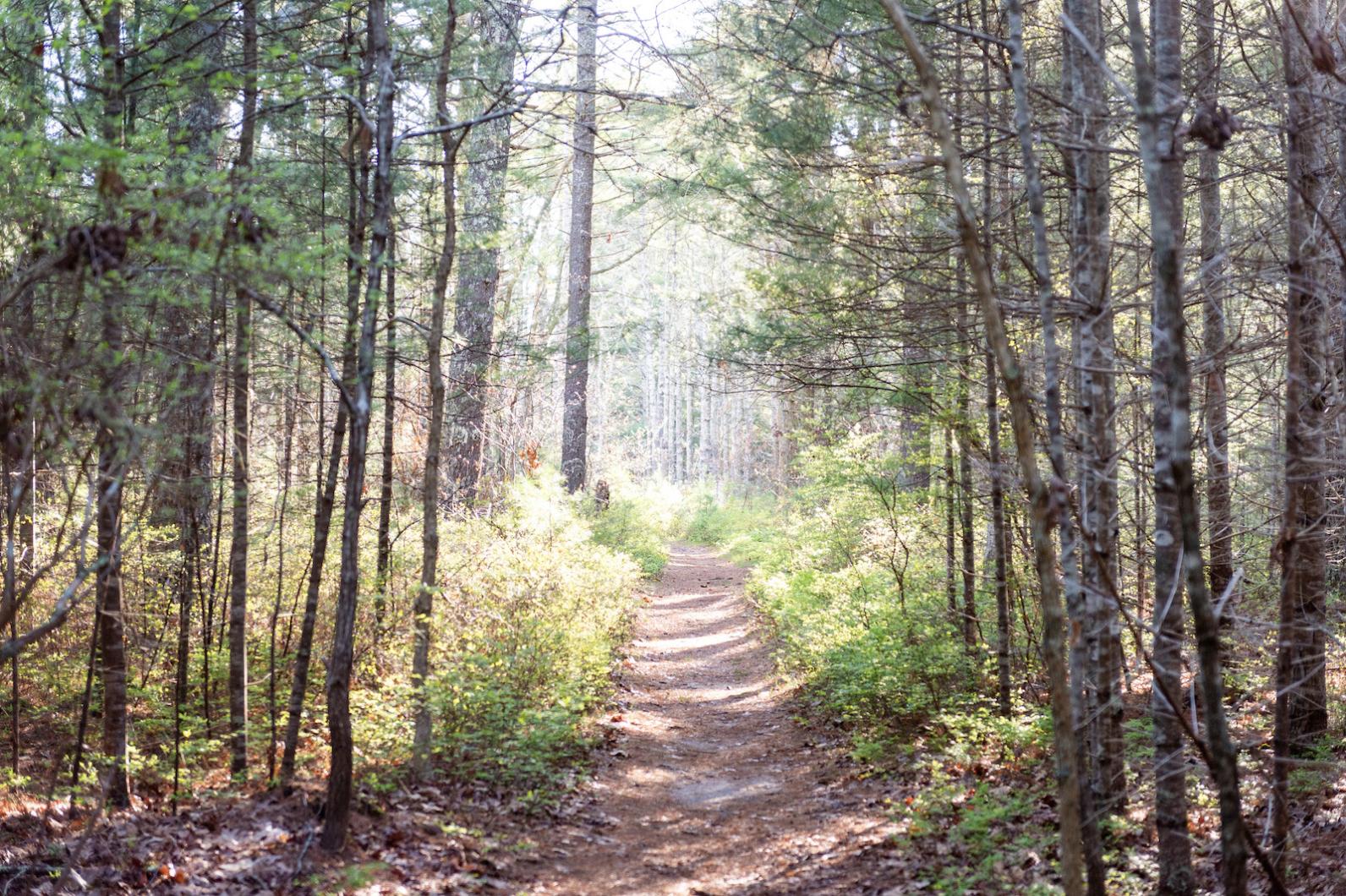

The Massachusetts Department of Conservation and Recreation is proposing a slower rollout of its plans to cut 175 acres of white pines in the Manuel F. Correllus State Forest after pushback from Islanders.
The Massachusetts Department of Conservation and Recreation is proposing a slower rollout of its plans to cut 175 acres of white pines in the Manuel F. Correllus State Forest after pushback from Islanders.
The state had initially considered cutting 79 acres across two parcels in the southeastern corner of the forest as part of the first phase of the cutting project, but last week submitted a new plan that shrank the first phase to 52 acres.
“We didn’t want to take too much of a bite off,” Paul Gregory, a forester with DCR, said at a meeting of the Martha’s Vineyard Commission state forest task force Tuesday. “We wanted to see how it goes first, with this level of acreage.”
Despite cutting 27 acres less in the initial stage, DCR is still planning to cut 175 acres of white pine overall in the coming years in order to allow the native sandplain grassland habitat to thrive in the forest. Island ecologists, firefighters and conservationists have backed the plan, saying it will help the globally rare habitat while also cutting down the fire risk posed by the large pines.

Buffers have been built in around trails in the proposed cutting areas.
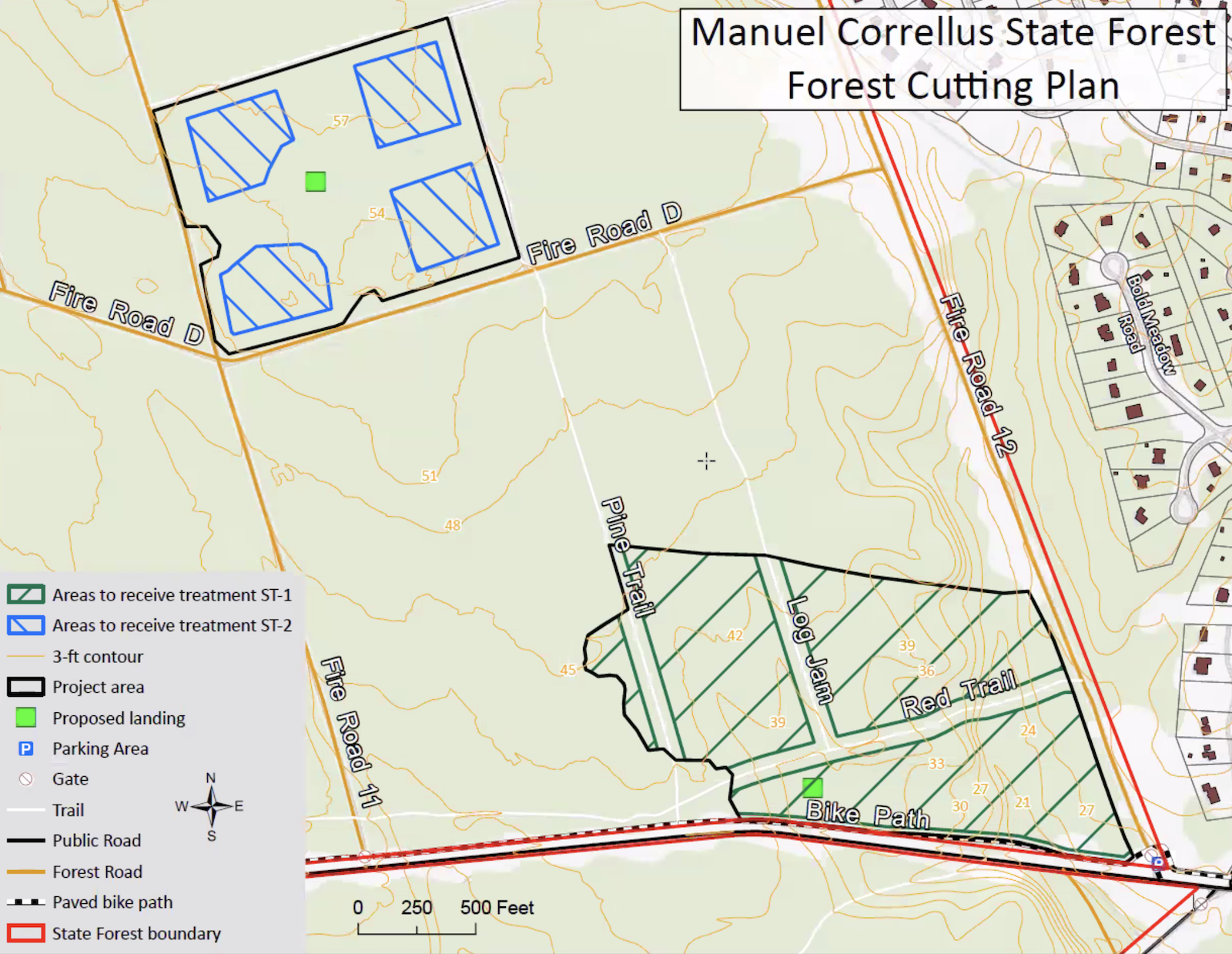
Buffers have been built in around trails in the proposed cutting areas.
Not everyone is on board, though. Public comments sent to DCR about the controversial project have overwhelmingly been in opposition to the cutting and asked for more time to consider the impacts. When the comment period for the project closed in March, more than 90 of the 123 comments submitted were in opposition, and many don’t see the logic in cutting down trees in a forest.
The white pine trees were planted in the forest in the early 1900s, part of an ill-fated attempt to start a lumber industry on the Vineyard. Since then, the trees have taken over swathes of the forest, choking out the shrubs, scrub oak and pitch pine habitat that several rare species rely on.
“Non-native species were planted in this area over the last hundred years, making the forest and its wildlife vulnerable to serious wildfires, pests, and disease, especially as climate change worsens,” DCR said in a statement last month. “The goal behind this project is to remove those non-native trees and restore native-barrens oak woodland communities, creating a healthier ecosystem and reducing wildfire risk.”
The plan is required by the state’s Natural Heritage and Endangered Species Program to make up for past clearings in the forest. DCR’s service forester, along with Natural Heritage, will now review the plan, a process that could be wrapped up in a few weeks, Mr. Gregory said.
The Edgartown conservation commission will also be sent a copy of the plan to comment, though it has no approval power.
Most of the change in the plan is a result of new buffer zones along the trails and paths in the southeastern section of the forest. If approved as presented, buffer zones of about 50 feet will flank the trails in the two parcels marked for cutting, according to DCR. That is being done in part to help educate the public about the habitat work.
“We thought adding some of the buffer would be helpful, but it also will serve, more importantly, as a great educational moment for everyone to see the difference between the non-native conifer plantations over the restoration of the native barren oak woodland communities,” said AJ Tourigny, the ombudsman at DCR.
DCR and the MVC’s state forest task forest are planning to host a meeting next week to gauge the public interest for using the trees that would be harvested. Dan Doyle, the special projects planner at the MVC, said the change to a smaller initial cutting could make it easier for Islanders to handle the amount of timber being produced.
“All along, we’ve been saying this, the smaller [the] acreage, the better chance we can actually put some of the...timber to use because we don’t have a huge storage facility,” he said.
DCR expects about 201,000 board feet of white pine, and 2,613 tons of wood chips would be produced as part of the initial cutting, according to the agency’s application.
The state hopes to learn from the preliminary cuttings, which are planned to start in four three-acre parcels near fire lane 11 in Edgartown. DCR would still need to apply for the further tree cutting of the required 175 acres.
Mr. Gregory with DCR expected work would take place in the winter or the spring, though that would be up to the state forester and Natural Heritage. The initial phase is estimated to cost about $50,000.
DCR did not determine if the buffers along the trails would be permanent, or if they would just be in place during the preliminary cuttings.
“That will all depend on the response of the community and how they feel the project is going,” Mr. Gregory said.
Several members of the public attended Tuesday’s meeting and voiced some reservations over the project.
“I have this feeling that the white pine, particularly, is considered almost like poison ivy on someone’s property,” said Island resident Michael Blanchard.
Jeremy Houser, the director of science and policy for the Vineyard Conservation Society and a member of the forest task force, pushed back on that notion, though. There is no ill will against white pines, he said, but the Island is one of the last refuges for the sandplain grassland.
“No one at DCR, no one at Natural Heritage, no one on the task force believes that white pines are bad or this work is motivated by a distaste for white pines,” Mr. Houser said. “It’s ecological restoration. They can’t be in the same place; the native habitat that we want to see there can’t coexist with white pine plantations.”
Comments
Mr Houser writes:" ...the
JR West TisburyMr Houser writes:" ...the native habitat that we want to see there..." Who is this 'we?' and why do they get to choose? Such arrogance.
After deliberations for
M ChilmarkAfter deliberations for months (if not years), DCR decides to take down the oldest white pine plot without any consideration that this is one of the most used and favorite areas of the public. Out of 715 or 175 (still unclear) acres of possible plantations to experiment with, they chose the one that is the most far along in its evolution back to "native", has the most diversity, and stores the most carbon. Makes you wonder if any of these "experts" have ever walked in the area or actually made the time to talk to the people using the forest? This is a slap in the face of those who will be forced to pay for all of this and the future continued expensive maintenance of beating back nature into early successional habitat (which still has no plan....seems to be a make it up as we go along sort of thing), No baseline Flora and Fauna study has been conducted so the determination of the "success " of this project will be purely subjective.
Interesting the push-back on
JJ VHInteresting the push-back on trying to be more environmentally correct and friendly. Non-native plants and species are being removed to bring back what's thought the be the native landscape. Is this any different than what the Land Bank does when they remove houses and other things when they "acquire" land? Of course, they have a taxpayer funded monopoly....
I've seen these forest go from growing, linearly planted, non-native trees to massive areas of blighted and dead forest with a very high fire risk.
As for the wood chips, what a great way for the island landscapers and residents to island-source wood chips for landscaping projects and path coverage! As for the 201K board feet, another great island-sourced resource for home construction, building, and even boat building. Perhaps G&B would benefit from this resource and help identify how it should be milled and stored for their use on current and future boat building projects.
No one likes to see forest left clear-cut and raw but if you truly are a conservationist and want sound solutions, this sounds like a reasonable and thoughtful option. I also see potential for island-sourced wild blueberries and huckleberries, which are much tastier and better than many other blueberry varieties.
Add new comment