


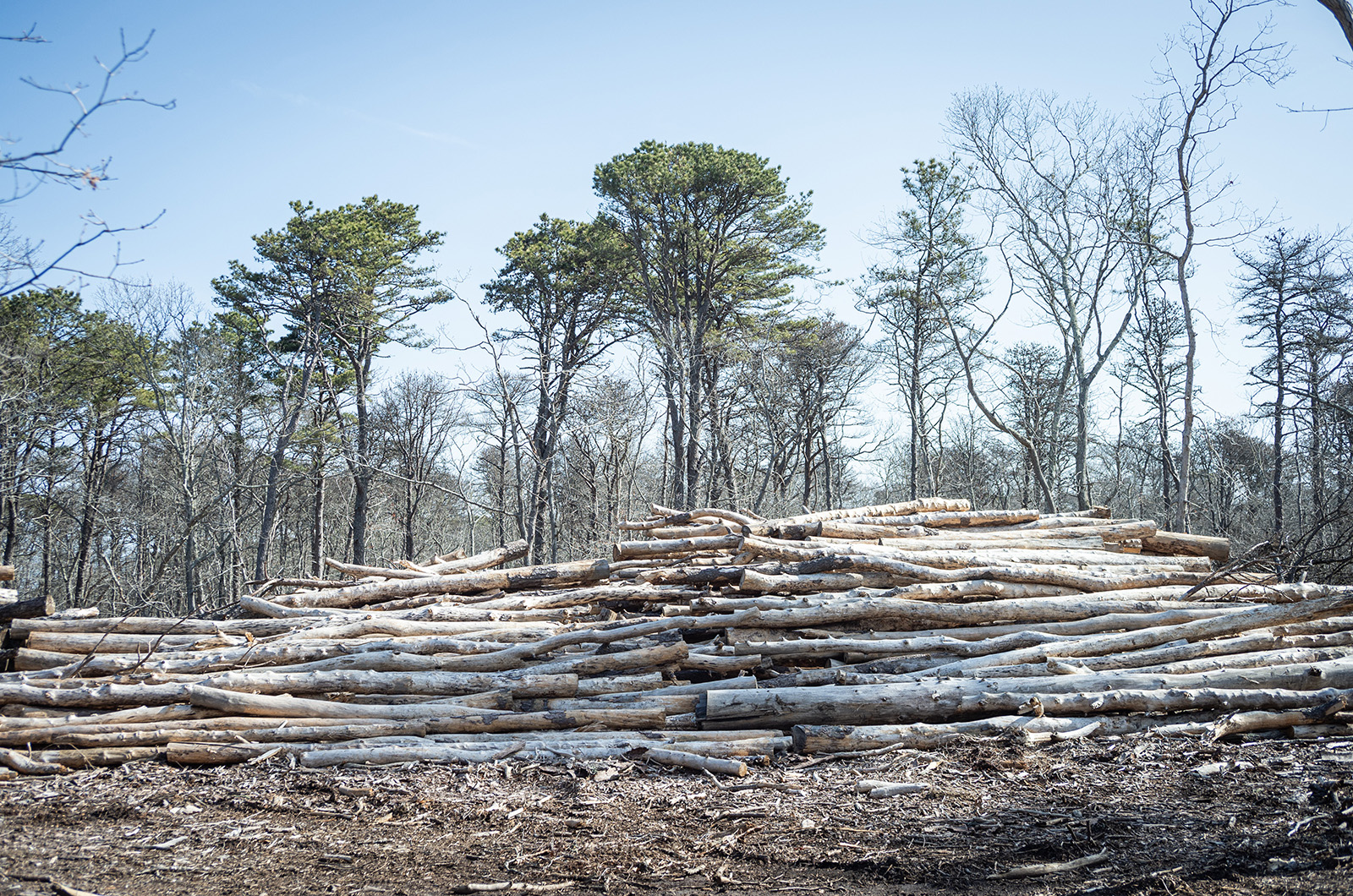
The southern pine beetle has devastated parts of some of the Island's forests. Conservation groups are in the early stages of fighting back.
Piles of fallen pines lie on the floor of what was once a flourishing green forest at the Sheriff’s Meadows Foundation’s nearly 70-acre Phillips Preserve in Vineyard Haven.
On a recent morning Adam Moore, the executive director of the foundation, approached a pine tree still standing. Sap oozed out of the bark, dotting the trunk.
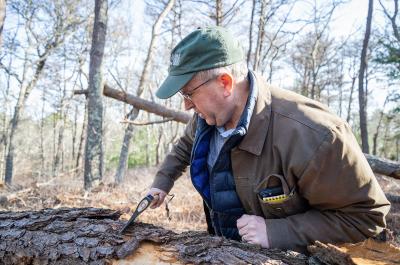
Sheriff's Meadow director Adam Moore has created a management plan to address the infestation.
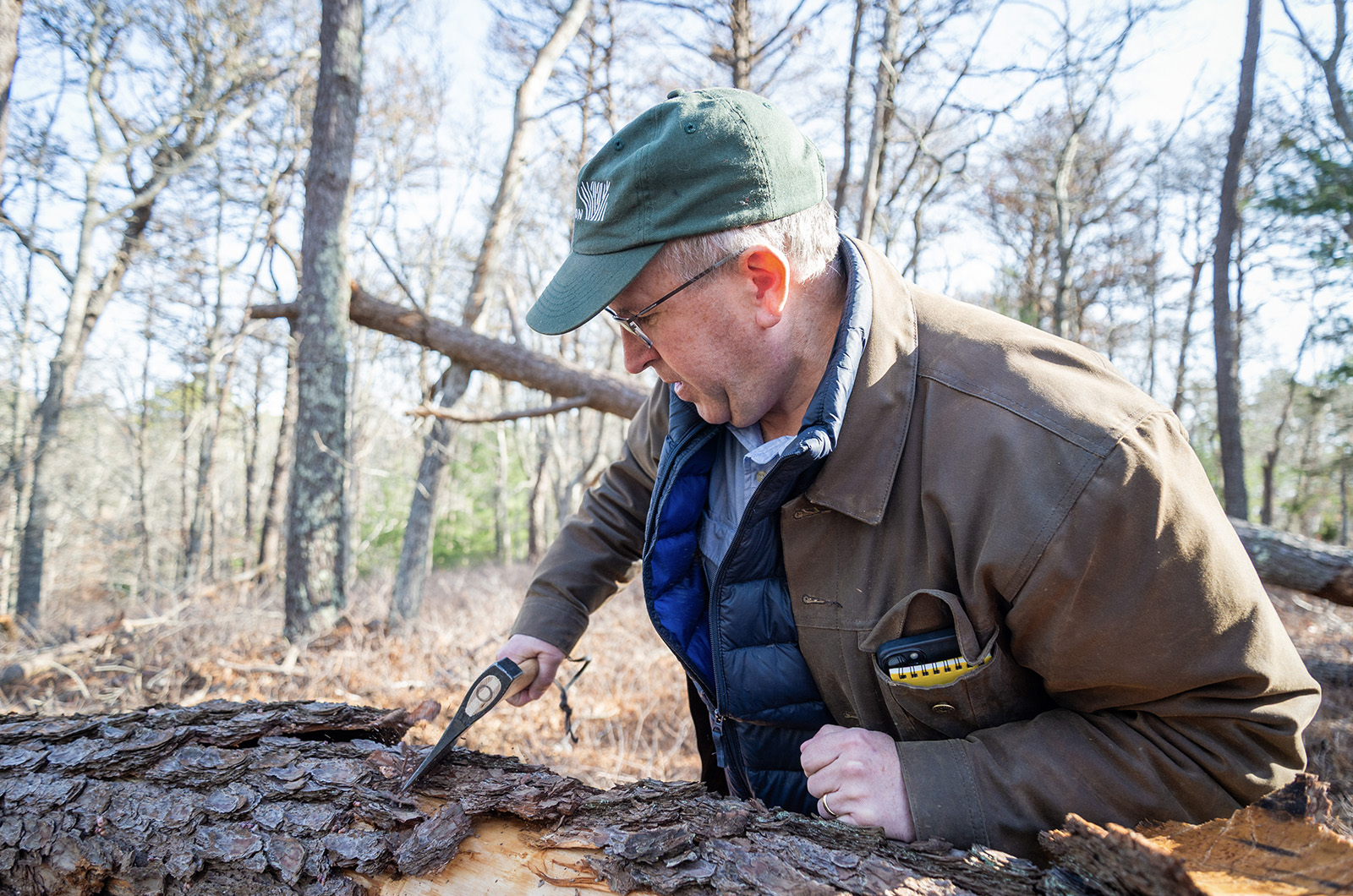
Sheriff's Meadow director Adam Moore has created a management plan to address the infestation.
“It’s such a magnificent tree that’s dead now . . .” he said. “Once they get to that stage, there’s nothing you can do.”
The conservation property near West Chop is infested with southern pine beetles, a species native to the South that has migrated to the Island in recent years as the climate has grown warmer. Each beetle is no bigger than a grain of rice, but the damage done by hundreds of thousands poses a threat to Island pitch pine forests, both in this preserve and elsewhere.
Many of the Island’s conservation groups are in the early stages of fighting back against the beetles. Mr. Moore said the foundation needed to cut down 2,000 infected trees across 35 acres of the Phillips Preserve.
And he believes the infestation is rapidly headed down-Island.
“I think I’ve seen two trees on the east side of the Lagoon, which, to me, says this season we’re going to see them in Oak Bluffs and then in a year or two we’ll see them in Edgartown,” Mr. Moore said.
The beetles fly from tree to tree, moving through the woods at a rate of 10 feet per day. They bury themselves in the bark of pitch and white pines, cutting off the trees’ water supply and killing them within six weeks. Once-green pine needles turn a dusky shade of orange, eventually falling to the forest floor.
“You’re dealing with a force of nature [and] that’s the first thing to learn when working with the southern pine beetle — humility,” said Mr. Moore, who has a long background in conservation and forestry land management.
The visible clear cutting raised some eyebrows on the Island over the winter, but Mr. Moore said he wants the community to know that little could be done to save the pines, and that the foundation did not cut them down willy-nilly. Each of the infested trees was carefully marked before it was cut down, part of a management plan that aims to preserve the health of the forest.
The infestation brings other hazards. Once the pines become weakened by the beetles, their branches tend to fall, posing a risk to walkers on the property’s trails. And withered trees could become a tinderbed in the event of a forest fire. Some of the dead pines that aren’t close to the trails and not in dense areas continue to stand. The property has many oak trees as well, which are unscathed by the beetles.

Sap oozes from a tree infected by the beetles.
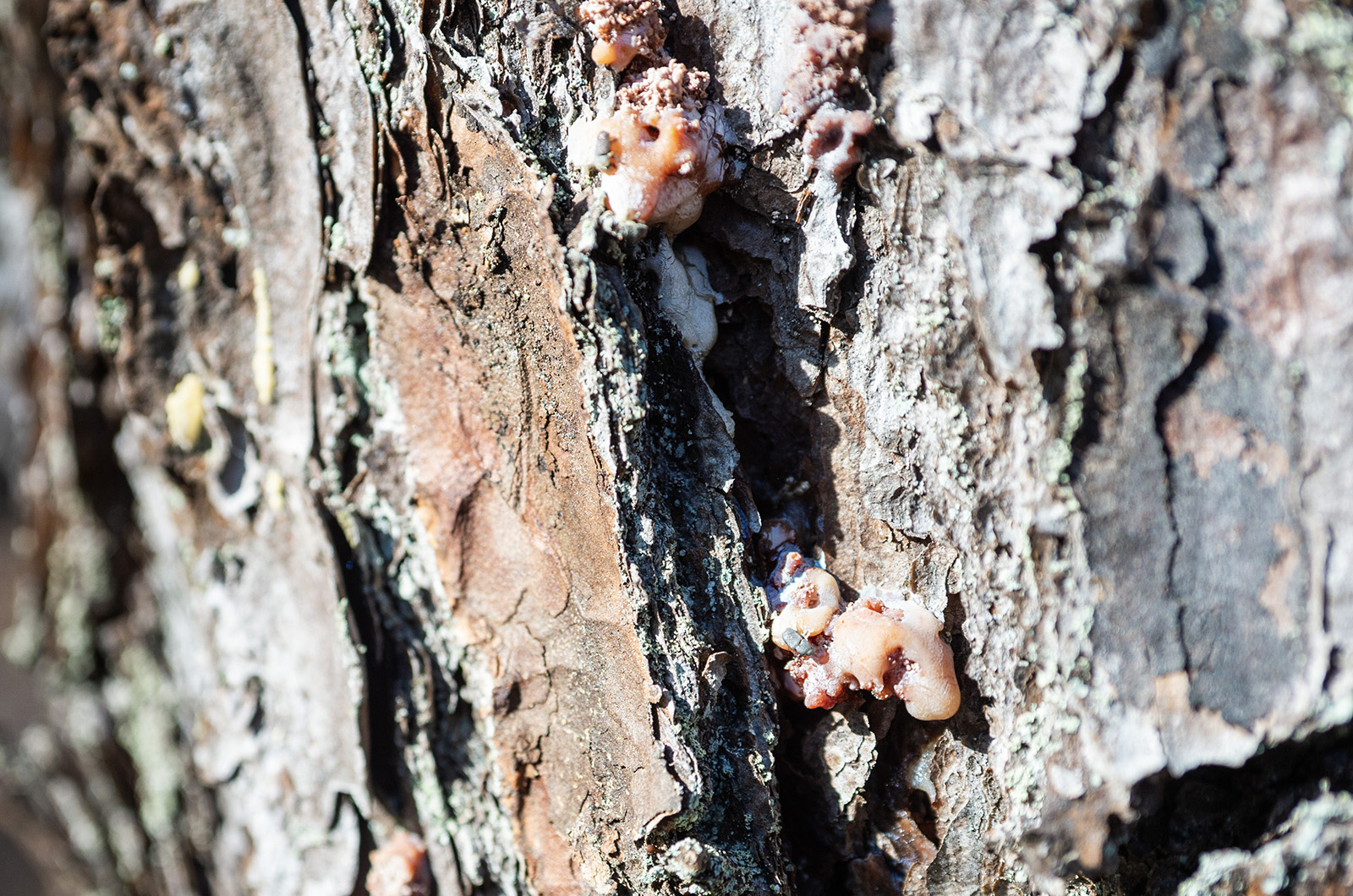
Sap oozes from a tree infected by the beetles.
Sheriff’s Meadow is trying to make the best out of a difficult situation, Mr. Moore said. For the first time in history, the state has permitted an organization to use an air curtain burner, which heats the logs until they become biochar, a 90 per cent carbon charcoal that is useful for composting. The foundation plans to sell some of the biochar to Island farmers.
At another Sheriff’s Meadow property, Caroline Tuthill in Edgartown, the foundation has begun cutting down and trimming pines in preparation for a beetle infestation. Areas with dense pockets of pitch pines, which are more susceptible to the beetles and more predominant than white pines, are more at risk than areas with thinner stands.
“If you have a thinner stand, even if you do have an outbreak in it, it’s less likely for the [southern pine beetle] population to move completely through it,” said Nicole Keleher, the forest health director for the Massachusetts Department of Conservation and Recreation. “So even if you do lose some trees, you’ll still have a pitch pine forest and it helps a little bit more with promoting regeneration.”
Ms. Keleher said the beetles have already made their way to the Manuel F. Correllus State Forest, with the first signs of infestation appearing in 2023. There are about 500 infested pines on the west side of the 5,000-acre forest that occupies the center of the Island, and protects its sole source aquifer.
She said cold winters can help knock down the southern pine beetle population.
“It’s not a death sentence to all of our trees, and it’s not something there’s nothing we can do about,” Ms. Keleher said. “It’s just something we will need to take a more active role in management.”
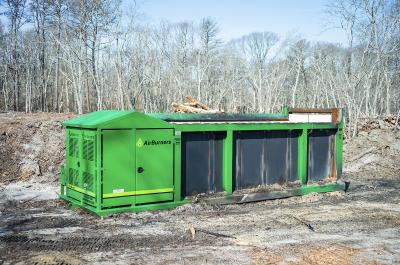
Management plan includes converting pine logs to biochar.
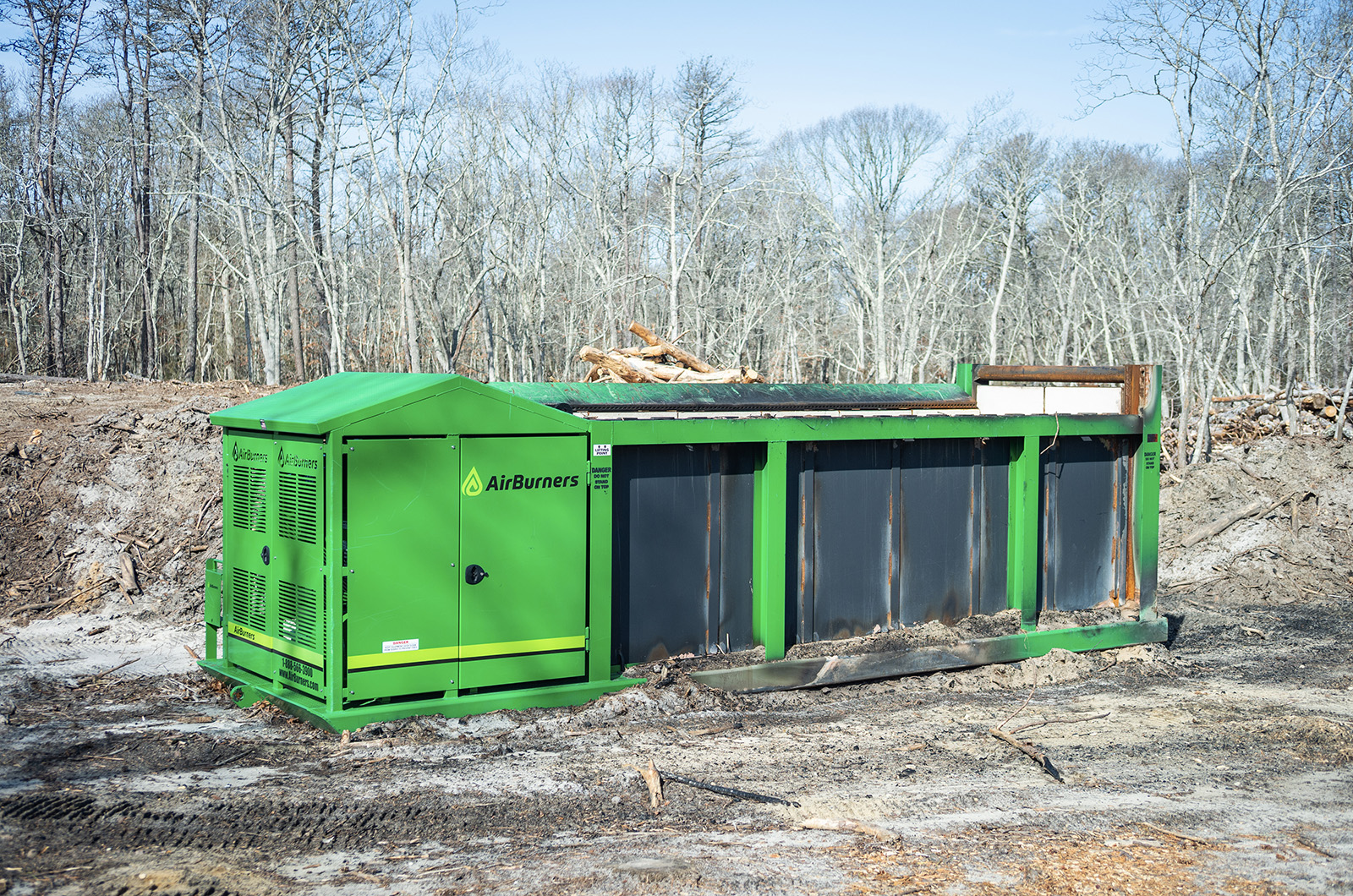
Management plan includes converting pine logs to biochar.
But management is expensive and Ms. Keleher said securing funding has proved an uphill battle at times.
“We have tried pursuing federal grants to help do some of our monitoring and assessment work,” she said. “But there are some challenges with the future of federal funding.”
Sheriff’s Meadow received a $75,000 grant from the state Fish and Game Department for the preventative work at Caroline Tuthill and another $75,000 in 2024 for the cutting at Phillips Preserve. Mr. Moore said the total cost of the operation at the Phillips Preserve totalled about $300,000.
Gene Albanese, the senior ecologist for Mass Audubon, said Felix Neck Wildlife Sanctuary in Edgartown is working on a cutting plan. He said they haven’t detected the beetles yet, and the property has fewer dense stands of pitch pine compared to other areas.
At the annual town meeting this year, Oak Bluffs voters approved allocating $50,000 to go toward southern pine beetle management. Tony Lima, chair of the parks department, said the beetles are already in town on private and conservation land.
Hiawatha Park, Washington Park, across the street from the old Ocean View restaurant and smaller parcels scattered throughout Worcester avenue in particular have dense pockets of pitch pines.
“As far as parks go, we’re probably going to be okay,” Mr. Lima said. “We do have a decent diversity of tree species around.”
He said he drafted the article to be all encompassing, so if an infestation occurs near roads, the money can be used by the highway department.
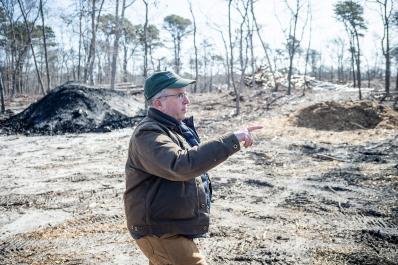
Mr. Moore has a long background in conservation land management, including forestry.
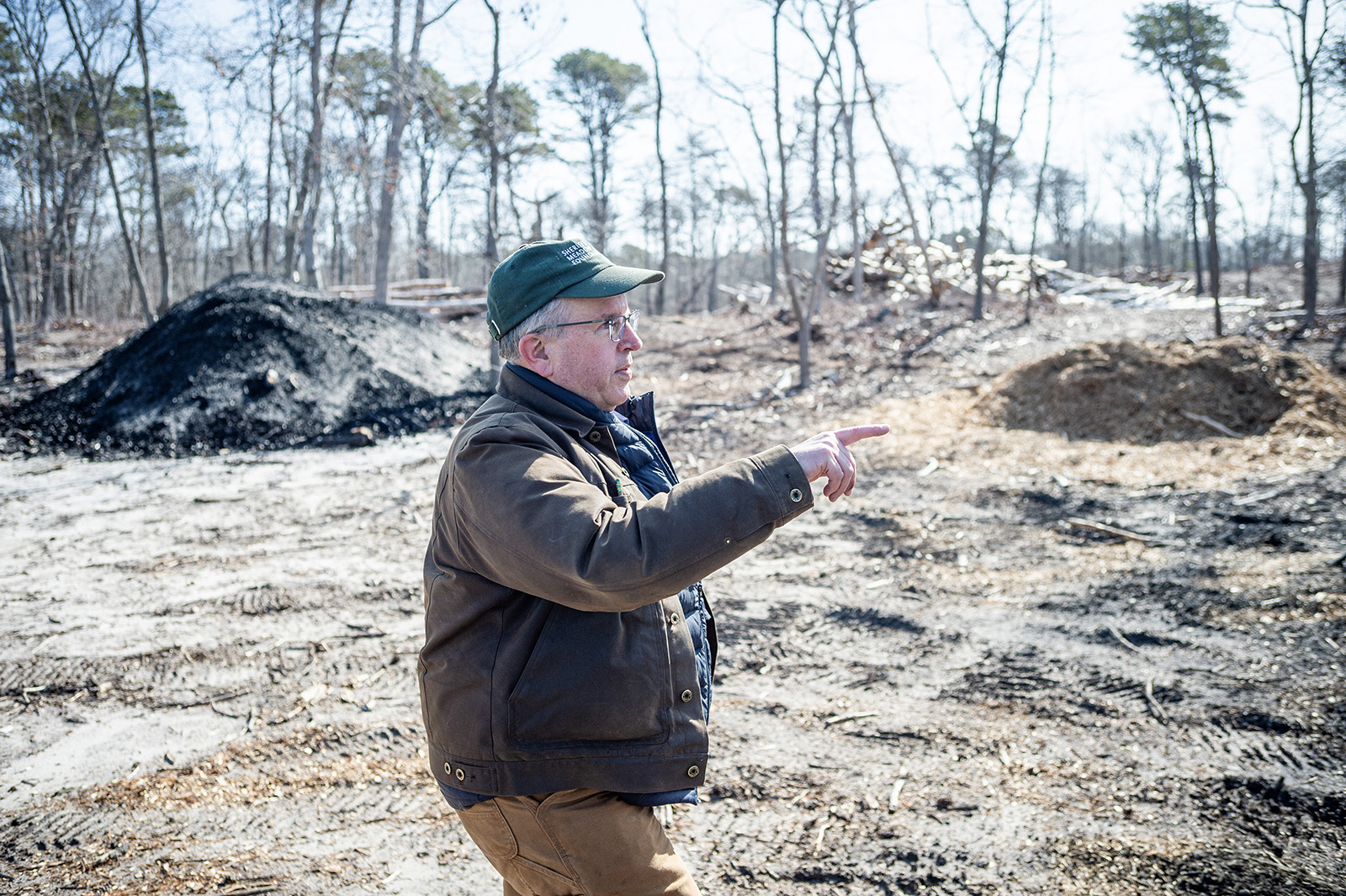
Mr. Moore has a long background in conservation land management, including forestry.
“It’s kind of a crapshoot,” Mr. Lima said. “You could have areas that are hit hard and areas that get passed over. It’s all just kind of the way the wind blows.”
The Trustees of Reservations said they have not detected the Southern pine beetle at any of their properties on the Vineyard — for now.
“The odds of an infestation are growing,” said Darci Schofield, the Trustees’ Director of Islands in an emailed statement. “We are proactively investigating strategies and best management practices to preserve the pitch pines of beloved Wasque.”
Mr. Moore, who is a licensed forester, said over time the Island’s forests could slowly change to become dominated by oak trees. White pines are not native to the Island, though they have come and gone throughout history.
The fate of the Island’s pitch pines is not sealed.
“This is our hope for the future,” Mr. Moore said as he bent down to gently hold a sapling growing on the forest floor of the Phillips Preserve.
The soft green needles in the palm of Mr. Moore’s hand symbolize the beginning of a decades-long regeneration process, where the pitch pines will thrive once again.
Comments
Great Man Adam Moore. This
Tom Engley West Tisbury.Great Man Adam Moore. This beetle will kill every pitch pine on MV.
Fallen pine? Looks like they
Johanna HFallen pine? Looks like they were chopped down.
Tell me you didn't read the
HaTell me you didn't read the article without telling me you didn't read the article
First, I urge every reader to
Jonathan P West TisburyFirst, I urge every reader to go to the Phillips Preserve and witness for yourself the devastation - not from the beetles, a force of nature, but from the policies of Sheriff’s Meadow. Ask yourself what is going to be done with the piles of trees - will they be milled? burned? chipped? Ask what will regrow here, and when, and how will Sheriff’s Meadow respond. For me, these beetles, that were able to cross an ocean to get here, are not as big a problem as those that decided that ‘we had to destroy the village in order to save it.’ The beetles represent a facet of climate change; the decimation of Phillips represents the arrogance of humans in the face of that change: “we caused it but watch! my chainsaw will fix it.”
I have been working in that
Tom Engley West Tisbury.I have been working in that area for 55 years. I currently caretake the old Phillips property on the sound. 100 plus trees had to be cut on 23 acres. The tops of the pitch pine are dangerous fire and falling. I’ve spoken to Adam Moore about the process of burning the tops and letting the rest decay over time. Other trees will fill in over time. It looks better everyday. And there is more work to be done. Anyone want to build a large log cabin maybe for affordable housing. I stand by Adam Moore.
Well said.
Johanna HynesWell said.
Clearly you didn't read the
HaClearly you didn't read the article but did you also not skim the picture of the giant biochar burner? Dude, the trees were going to die within the year and it will only cause the beetles to spread further. Chopping down and burning the trees will slow the beetles progress and turn the trees into an incredibly stable form of carbon that can be used to enrich soil for generations. The experts know more than you.
After visiting the site 3
Jonathan West TisburyAfter visiting the site 3 times and reading the article twice I have the following questions: what was the fuel cost to run the ACB? How much biochar was produced? Where is it now? Why is SMF, an avowed conservation organization (read their Mission Statement) buying logging equipment? Can the phrase 'slow the beetles progress' be quantified? measured? Proven? The only thing that will slow or deter these 'forces of nature' is long, hard, cold winters, which we don't have any more. Human folly, of course, is not in short supply.
If they had any brains they
Charlie Callahan So Boston/EdgartownIf they had any brains they would have a controlled burn before a few trillion of the beetles decide to move on and ruin the all the pie trees on the island. But that would be the smart thing to do and that's not how things are done on MV.
First of all I do think that
Nathan Vineyard HavenFirst of all I do think that they are doing the best they can to control these little beasties . I do question Adam Moore's statement concerning the White Pines on MV : Mr. Moore, who is a licensed forester, said over time the Island’s forests could slowly change to become dominated by oak trees. White pines are not native to the Island, though they have come and gone throughout history." -- If they've come and gone throughout history aren't they indigenous/native ? There is even an study by Harvard concerning the dig at Stonewall beach and it states that the preserved remains of Pinus strobus are 10,000 yrs old. " These findings confirm that Martha's Vineyard , like other parts of southern New England , was dominated by P.strobus forest ."
10,000 year old pinus strobus
Tom Engley West Tisbury10,000 year old pinus strobus could have traveled , pushed along by the ice sheet.
Dead and dying trees are
John MuirDead and dying trees are habitats for many creatures. They are nicknamed "wildlife hotels". Cutting them down and straightening things up, like it's your living room, makes for a dead and sterile environment.
A further comment, foresters
John MuirA further comment, foresters in northern California learned decades ago to leave the snags - dead and dying trees - alone because they are so good for the wildlife. Before this, government grant programs had been paying to make the forests look clean and orderly. Same thing with the creeks, people thought trees which had fallen into creeks needed to be removed. It must have just seemed like common sense to tidy up the streams. But fallen trees in streams are especially good. Now we have the same kind of government grant programs appearing in MVY.
The air curtain burner is an
Maggie, Biochar Vision Fellow Martha's Vineyard CommissionThe air curtain burner is an incinerator that turns logs into emissions/ash. An estimated 2% becomes biochar.
After reading the comments
BillAfter reading the comments and working with Adam on this project, I feel it was necessary to put some information foreword. The reaction of SMF was very appropriately to an outbreak such as this. If you look at Long Island, there are roughly 40,000 trees dead and decaying because immediate action was not taken. These beetles travel so quickly and there is no way of telling if an area is infected until the tree shows stress signs. What Mr. Moore and his team did was a proven method of thinning to slow the spread. Unfortunately this process is shocking to the eye and expensive. The ACB was a pilot project to introduce a way to 1. Stop the spread of beetle via chipping and hauling. 2. Eliminate the highly flammable and unsafe fuels resulting in fire protection for the island. 3. Reduce the amount of trucking and hauling off Martha's Vineyard. 4. Produce a product (char) that can be returned back to the soil and promote new growth. I stand behind Adam and hope everyone else does as well. The only thing that will help with this serious issue is education, public support and of course funding. SMF is a great organization with an equally great staff.
A little information on the Air Curtain Burner (ACB). The machine burns roughly 1 gallon of fuel an hour vs 4-6 gallons an hour to chip. The emissions released is 80% cleaner than burning the material in piles and it is consumed 40% faster. Roughly 80 tree tops a day were consumed (if chipped that would be 2 tractor trailer loads going over the ferry per day). Produced was 4-5 yards of char per day (a pickup truck load). This is not only a cost saving process but it is a much greener fashion than the standard way of disposing of large amounts of organic vegitation.
Add new comment