


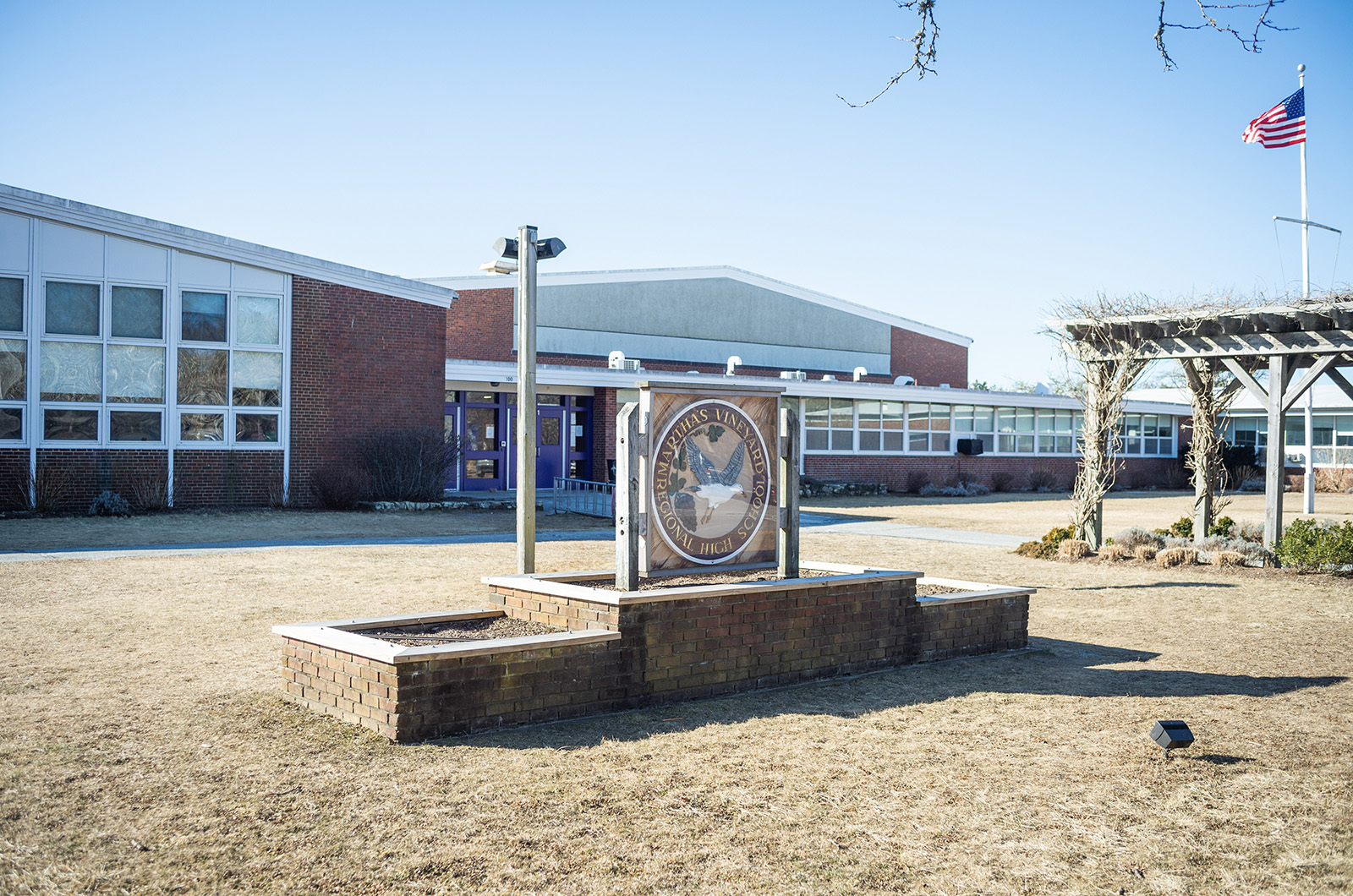
The Martha’s Vineyard Regional High School building committee is narrowing down its design options for a new or renovated school.
The Martha’s Vineyard Regional High School building committee is narrowing down its design options for a new or renovated school, with the goal of seeking Island voters’ permission next spring to borrow money for the long-sought construction project.
Next month, the committee is due to select a single design concept — out of more than a dozen it has been considering — for review by the Massachusetts School Building Authority (MSBA).
The state agency, which is funded by a share of sales taxes, has provisionally agreed to reimburse close to one-third of most construction costs for a high school project that meets MSBA standards.
Tappé Architects is now preparing cost estimates for the building committee’s top eight design concepts, for discussion at the next biweekly meeting April 1. The finalist concepts range widely in design, from basic renovations of the existing facility to brand-new multi-story buildings with varying orientations and access routes.
“Everything is on the table,” said Sam Hart, the high school’s administrator for the building project.
Members of the public can review and discuss the design options with building committee members at two outreach meetings on March 27 — from noon to 2 p.m. at the Tisbury Senior Center and from 4 p.m. to 6 p.m. at the Oak Bluffs Library.
On March 26, architects from Tappé are scheduled to meet with high school students and faculty, including members of the school’s career and technical education department.
The cost estimates from Tappé are due March 28, said Mr. Hart. Past estimates have run into the hundreds of millions, leading the committee to scale back the proposed size of a new or expanded school.
The MSBA’s program rules require the building committee to winnow its options down to one of each of the three types — renovation-only, renovation with additional construction and an all-new school — before choosing which one of the three the state will review.
Three of Tappé’s finalist designs represent a combination of renovations and additions, three are for a completely new school, and two concepts would simply renovate the existing school, which opened in 1959 and was refurbished in the 1990s, when the performing arts center was added.
The renovation-only options would keep the school at its current size of 165,000 square feet, which Mr. Hart said does not meet either the high school’s educational program — a document on record with the MSBA — or the state education department’s standards for instructional space.
“Based off of DESE [Department of Elementary and Secondary Education] requirements for safe instructional space for students... every single one of our classrooms is deficient,” Mr. Hart said
Science classrooms, for instance, are required by DESE to be at least 1,440 square feet, with laboratory space, he said.
“All of our science classrooms are deficient by about 300 square feet,” Mr. Hart said.
Tappé’s other six design concepts expand the school size to 211,000 square feet. Mr. Hart said this is about 48,000 square feet less than the nearly 260,000 square feet in earlier designs, which were based on the school’s educational program and state standards for classroom space.
After a preliminary estimate last fall indicated a school of that size could cost up to $427 million, school administrators and the building committee worked to scale back the project, he said.
“We homed in on the ed program and space needs [and] we refined it down,” Mr. Hart said.
“That number can still be looked at,” he added. “There is some wiggle room, but if we do go below what DESE requires... you just have to defend it to MSBA.”
With cost estimates in hand, the committee is set to make the three selections April 1 and pick its top choice on April 15, Mr. Hart said.
“It doesn’t lock anything in,” he said, noting that the conceptual design will still be subject to change and that Island voters will have the final say.
If the chosen design is approved at the MSBA’s quarterly meeting in May, the next step in the process would have the committee working with Tappé and the school’s project management firm, CHA, develop it into a full project that can be brought to the annual town meetings in spring of 2026.
The road to this point has been a long one already. Martha’s Vineyard Regional High School began applying to the MSBA program nine years ago, Mr. Hart said, before finally winning acceptance in 2023.
To meet MSBA and DESE requirements, the Island’s six towns had to revise and update the regional cost-sharing agreement for the high school’s operating costs, hammer out a new formula for funding the capital project, agree to preliminary funding for a feasibility study and form the school building committee, which began its meetings 18 months ago.
Chaired by Oak Bluffs select board member Dion Alley, the committee includes officials from every town as well as members of the public. Its job is to develop the high school project with CHA and Tappé — while keeping costs within reach for the Island community, Mr. Alley said.
“We are continuing to work with the towns to refine what our budget can be,” Mr. Alley said. “We have to find a project that allows us to live within our means.”
The high school building committee meets alternating Tuesdays at 5:30 p.m. in the high school library, with online participation.
Comments
We all need to do what we can
Support for our kidsWe all need to do what we can to support our kids. The numbers this group are proposing are way out of scale for our community.
The following suggestion is
Chuck Hodgkinson West TisburyThe following suggestion is not an indictment or criticism of the high school's performance. It is merely an observation seeking the effect a school facility might have on MCAS scores. I realize we no longer use this measure to evaluate learning performance but, statewide data may provide some insight into the impact a new facility has on learning.
The high school did not perform well on this year's reported MCAS testing. I believe the overall score was something such as 26% meeting or exceeding the requirements.
Conversely, the Tisbury School achieved one of the highest overall MCAS scores among all schools on the island with 66% meeting or exceeding the requirements. Here's the paradox...the Tisbury School's scores were achieved in spite of a substandard learning environment of mobile trailers for the past two years of school construction.
Before we commit to a significant investment, is there a way to quantify the potential impact of new facilities on MCAS scores using high school data across the Commonwealth? Could we correlate MCAS score changes before and after renovations among schools receiving MSBA grants versus a control set of those schools that did not renovate their facilities during the same time frames?
Thank you.
Will a new High School
James Oak BluffsWill a new High School Building Increase our score in the DESE accountability System. We have been in the "requiring assistance or intervention" zone for years. An answer from the current administration would help ease the pain of the massive tax burden this will cause.
https://reportcards.doe.mass.edu/2023/07000505
These numbers that they’re
Paul Oak BluffsThese numbers that they’re talking about are insane. And you want me to support a school of this magnitude and you couldn’t let our kids have an artificial turf field? Good luck with that. I will never support this.
Flashy buildings do not an
Lorraine EdgartownFlashy buildings do not an education make. Compare the cost of a public education per pupil now and fifty, eighty years ago. My family member, a J D and a PhD and a public school Superintendent, and I, surmised from records, that my public education cost about $500.00 per pupil, per year. Now, compare the results: A stark difference in courses and results. Many of us were reading at college level in grade school. That is not an exaggeration. I do not understand people who are not alarmed by our public education system not educating students for the technological society in which we live.
Education is usually the
Paolo AquinnahEducation is usually the costliest item on a town’s budget. And it should be, given the importance of education and personal development of our children. It is money well spent. At the same time, as others have commented, if there are deficiencies in the learning process, no matter what the cause, they, too, need review, renovation, and upgrading. I support a new facility along with an internal investigation of the teaching methodology.
One commentor said flashy
Charlie Callahan So Boston/EdgartownOne commentor said flashy buildings do not make a good education and she was 100% right. We don't need a $400,000,000 school for a tiny island with 15000 people. Build it modular for probably 1/2 the price and spend more on trade courses and other things kids need. The trade classes I was told don't even include teaching kids sheet metal,oil burner service,boiler installation and plumbing. I find that hard to believe that those classes are not offered. Spend some of that money on important things and not on aesthetics that people can ooh and ah about. Who cares what a new school looks like except the parents,kids could care less what it looks like.
Add new comment