

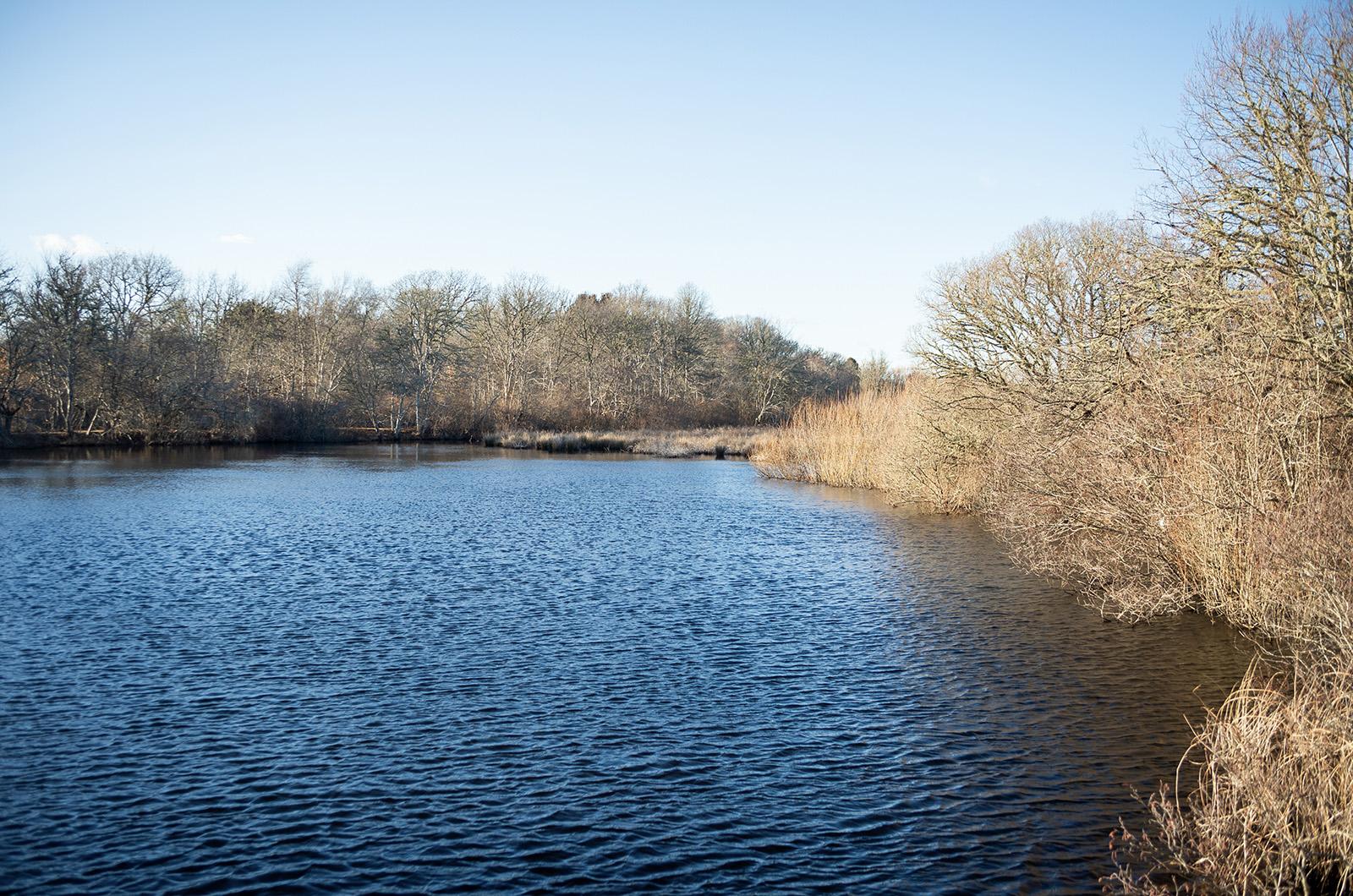
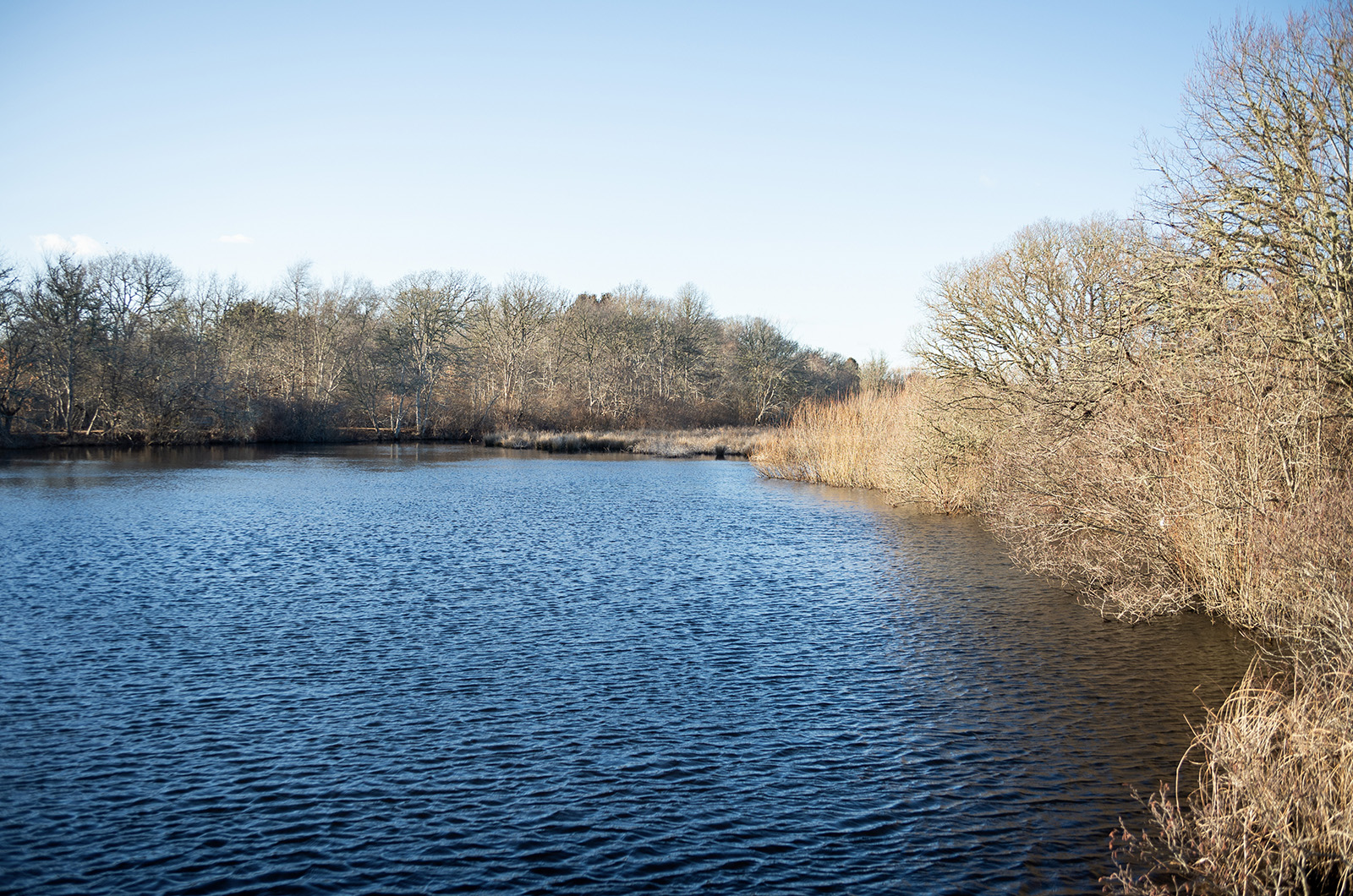
As West Tisbury considers the future of the Mill Pond, a group of Islanders is highlighting the pond’s history and deep connections in the community.
As West Tisbury considers the future of the Mill Pond, a group of Islanders is highlighting the pond’s history and deep connections in the community.
The Friends of Mill Pond, a group that has advocated for the pond’s preservation for the past 13 years, is hosting a series of events to showcase the pond. The celebration started on Saturday, when the West Tisbury Library exhibited artistic works focused on the pond, and delved into the pond’s past.
The events come after a town committee recently found that the pond’s dam is causing high water temperatures and low dissolved oxygen rates, causing concern about the pond’s future. The committee has raised the prospect of removing the dam’s spillway weir boards, which would drain the pond.
The idea was alarming to many at Saturday’s event, who believed the pond should be saved, and the friends group is encouraging voters in West Tisbury to create a new mill pond preservation committee at the spring town meeting.

The Mill Pond was a muse for many artists.

The Mill Pond was a muse for many artists.
Bow Van Riper, the Martha’s Vineyard Museum research librarian, gave a talk about the history of the pond Saturday and said knowing the past can help guide the future.
“I remain convinced that we’ll do better in making [a decision] if we have a firm understanding of how we got to where we are,” Mr. Van Riper said.
The exact origins of Mill Pond are unknown, but relate to the Island’s colonization. While exploring the land and looking for resources to exploit, the European colonizers moved to what is now West Tisbury because they were attracted to its fast moving streams.
“[Water] is far greater and more versatile than human or animal muscle can provide,” Mr. Van Riper said. “It doesn’t have to be fed. It doesn’t get tired, [and] it doesn’t go on strike.”
Most notably, Mr. Van Riper said the colonizers ventured to what was referred to as the Old Mill River, a stream system that starts in Chilmark and extends roughly five miles along North Road and State Road until it flows into a cove at Tisbury Great Pond. Mill Pond is the last pond along the system.
There is a mill across the street from the pond that has been home to the Martha’s Vineyard Garden Club for more than 80 years. Referred to as the Old Mill, Mr. Van Riper said nobody knows the exact date it was built, although records reference it dating as far back as the 1700s.
The facility was used in the 1800s to process large amounts of wool, branded as Vineyard Satinet. Wool making was one of the Vineyard’s largest industries at the time.
The Old Mill was powered by water. While there’s no written record of the date Mill Pond’s dam was built, Mr. Van Riper said a map of the area from 1850 shows a body of water where the Mill Pond sits. The next earliest map, drawn in 1830, does not.
The Old Mill building has been in town for centuries.
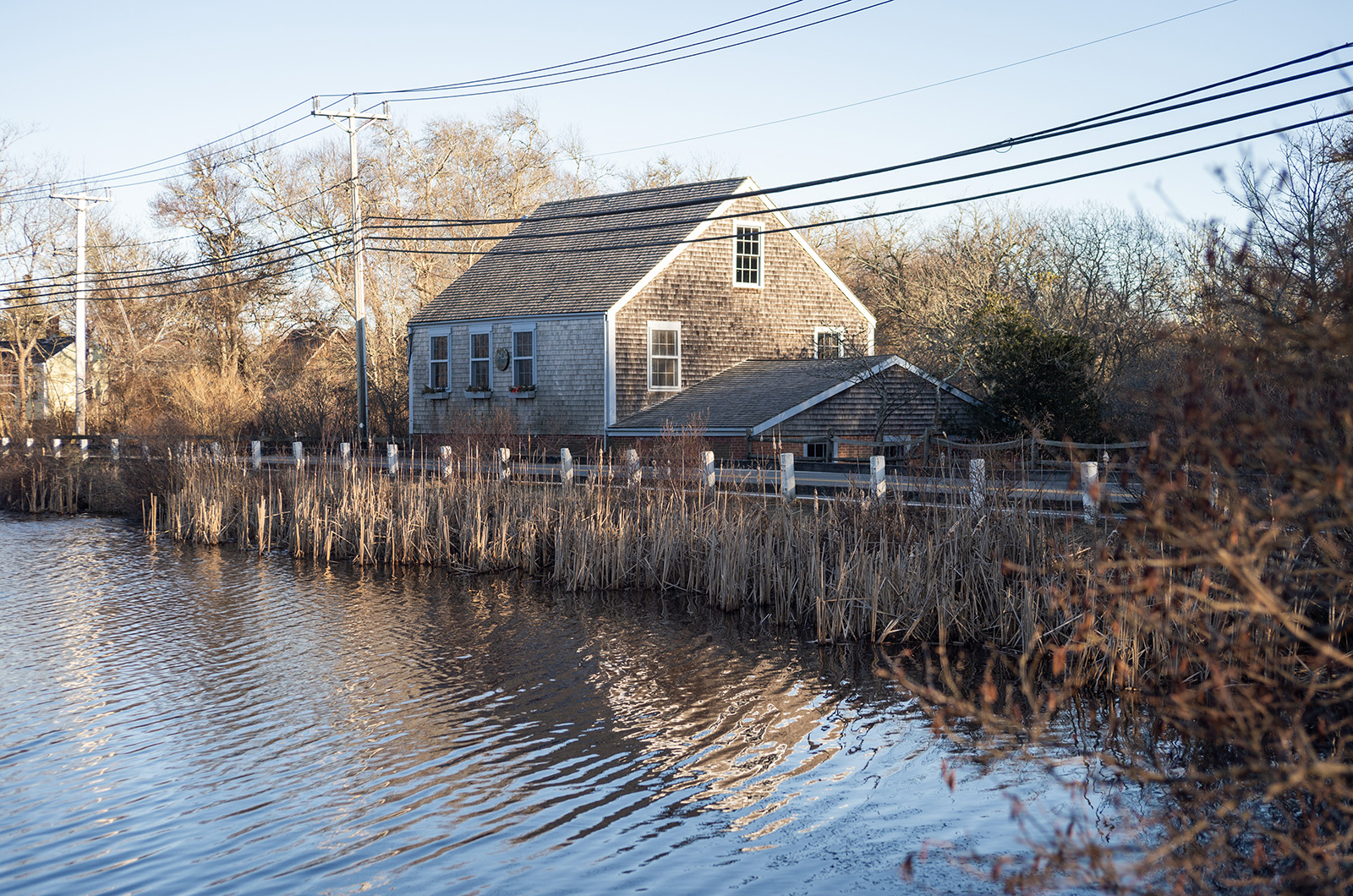
The Old Mill building has been in town for centuries.
“If there was a dam at some point prior to 1830, and thus a backed-up Mill Pond… I have never seen any evidence — visual, textual or otherwise — that would confirm that,” he said. “I remain convinced that if there was a dam there, prior to, say, the mid-1840s, the evidence for it has been lost.”
Mr. Van Riper said the dates point almost certainly to the identity of the dam builder: Captain Thomas Bradley of Holmes Hole. He bought the Old Mill for $1,800 in 1845 and presumably used the pond water to provide additional power.
Mr. Bradley rose through the ranks of the merchant shipping world, retired and became wealthy in his middle age.
“He was the second richest man on the Island,” said Mr. Van Riper.
He ran the mill for 14 years then sold it to a retired sea Captain, Henry Cleveland, who ran it for 15 years. In 1874, Mr. Cleveland sold the mill to his son-in-law, Thomas Campbell.
Around the same time, in 1869, the first transcontinental railroad was completed off-Island. This meant that the big woolen mills on the mainland could source their wool in greater quantities and lower prices from farms in the west that had more land than the Vineyard to raise sheep.
“What’s more, the expansion of the textile factories on the mainland [made] it impossible for people like Campbell… to be able to produce cloth at a competitive price,” Mr. Van Riper said.

Kanta Lipsky shows off her book, which is set at the Mill Pond.

Kanta Lipsky shows off her book, which is set at the Mill Pond.
Mr. Campbell closed the Old Mill only a year after he bought it. At the time, many mills were shutting down and the Vineyard’s economy began to change.
In the late 19th century and early 20th century, the Vineyard started to become a popular summer destination for wealthy travelers. The Island’s quiet, rural and un-urbanized landscape became marketable and a valuable commodity in the budding resort economy.
Just as Edgartown leaned into its whaling heritage to charm tourists, West Tisbury focused on its agricultural roots. Mill Pond was at the center of it all, Mr. Van Riper said.
“The Old Mill became regarded as a quaint relic of a bygone era….” he said. “The way [Mill Pond] nestled in the bend of the road became an integral part of West Tisbury’s image of itself.”
Several Vineyard women began to run an old tea house beside the pond, where travelers venturing up-Island could enjoy refreshments like strawberries cream, lemonade, coffee ice cream and nut bread.
In 1948, the descendant of Mr. Campbell, who inherited the Old Mill, donated Mill Pond to the town. His name was Donald Campbell and his one stipulation was that the town maintain the pond.
Mr. Van Riper said the stipulation was made with no deep understanding of pond ecology and what maintaining the pond would involve. He added that while today’s Islanders can’t remember a time before Mill Pond was created, it should not be regarded in its current configuration as a natural feature.
“We’re all prisoners of our own present, to some extent, and the Mill Pond has now been around for so long that it’s easy to forget that it was created at a specific time, by a specific person, for a specific purpose,” Mr. Van Riper said. “The time, the person and the purpose have all long since faded into history.”
At the end of the lecture, people gazed at early photos of the pond posted around the room.
The Friends of Mill Pond group also spent the past six months collecting 45 artworks with the pond as their muse, and even found preserved wool made in the Old Mill.
The works depicted the pond in nearly every season. Many showed a pair of swans gliding through the water and others highlighted its beauty during sunset.
The Friends of Mill Pond plan to have more events throughout the month, including poetry readings and talks about the pond.
Suki de Braganca, one of the founders of Friends of Mill Pond, has been coming to the Vineyard for the past 70 years. When she was a child, she caught her first fish standing on its shore and holds memories of feeding breadcrumbs her grandmother saved to the pond’s swans.
She said Mill Pond’s importance to the town goes beyond beauty and aesthetics. In her eyes the pond is a precious asset and distinguishes West Tisbury from the other Island towns.
“This is one that I think is critical for upcoming generations,” she said. “I hope they have the same memories [that] I have and have shared with my children as they were growing up.”
Comments
History is important but so
jcHistory is important but so are healthy ecosystems on the island. We’ve known for a long time (the DER study linked below is from 2014-16, almost a decade ago!) how destructive small, legacy dams can be to watershed ecosystems, so here's hoping the town of West Tisbury has the good sense to follow the science in deciding what's best for the entire ecosystem / Mill Brook watershed (and the taxpayers that live around and use it today and tomorrow) instead of keeping a dead pond around or by kicking that can down the road another ten years creating yet another committee that decides to keep a dead pond around. Climate change is real. The Mill Pond is dead, long live the Mill Brook! |DER study: https://www.mass.gov/info-details/small-dams-have-large-impacts-on-wate…|
Agreed.
Mr. B ChilmarkAgreed.
Please restore this historic
C Burnham FloridaPlease restore this historic body of water to what it once was - clear and beautiful!
Pump oxygen into the pond
John Molinari Santa Fe / OBPump oxygen into the pond like a fish tank/farm?
The historic Mill Pond,
Elise Green ChilmarkThe historic Mill Pond, gifted to the Town of West Tisbury in 1948, is teeming with life and would be even more so if properly stewarded…
Deeper depths and better flow would create the needed aeration (good point John!) and coolness.
DRAIN THE SWAMP!
JIMMYDRAIN THE SWAMP!
It's time to pull the plug on
Sandra W. Harrington WTIt's time to pull the plug on all of these man made ponds, they used to serve a function for commerce, back when the environmental damage wasn't understood, or was usurped by the need for a mill. These days they perform no function other than heating the water and destroying the ecosystems downstream, all for someone's view?! These dams need to come down.
That's a very thoughtful
James ChilmarkThat's a very thoughtful article and one of my favorite quotes of Mr. Van Riper is, "“We’re all prisoners of our own present". This applies to so much on MV as we are continually faced with changes that confront our values and ideals of what is Martha's Vineyard and how to preserve what we love as we move into tomorrow. So if we imagine for a moment that the dam is gone, what does it look like, what are we gaining and will we really restore the watershed or just make it a little better, because we may never be able to "restore" it to what it was. Maybe floating a GPS thermometer down the whole watershed recording changing temperatures in the summer could help understand probably outcomes.
The attack against the pond
Jack D Historic District, WTThe attack against the pond by radical environmentalists is nothing short of offensive and sensationalist. The pond is a symbol of the town and a matter of pride across the island. James makes a salient point about restoring the watershed. Studies have shown the primary issue lies upstream and attempting to turn back the clocks on the watersheds temperature is both foolish and reckless.
I love Mill Pond too, but it
Meredith West TisburyI love Mill Pond too, but it's also important to consider the ecological benefits of returning the area to pre-colonized times: summary version here: https://www.thecooldown.com/outdoors/dam-removal-northeast-ecosystems-r… More detail here: https://e360.yale.edu/features/northeast-dam-removals
To restore Mill Brook’s water
Nancy West TisburyTo restore Mill Brook’s water quality is it considered necessary to eliminate the other ponds and dams along Mill Brook as well, or will removing the dam at the Mill Pond only be sufficient to restore the Mill Brook? Has anyone asked that question? Is there a clear answer? It seems like a reasonable question to ask, but I don’t recall anyone asking in the many news stories that have been published.
Maybe reporters need to dig a little deeper?
https://vineyardgazette.com
jchttps://vineyardgazette.com/news/2025/02/25/study-finds-mill-pond-tempe…
Add new comment