

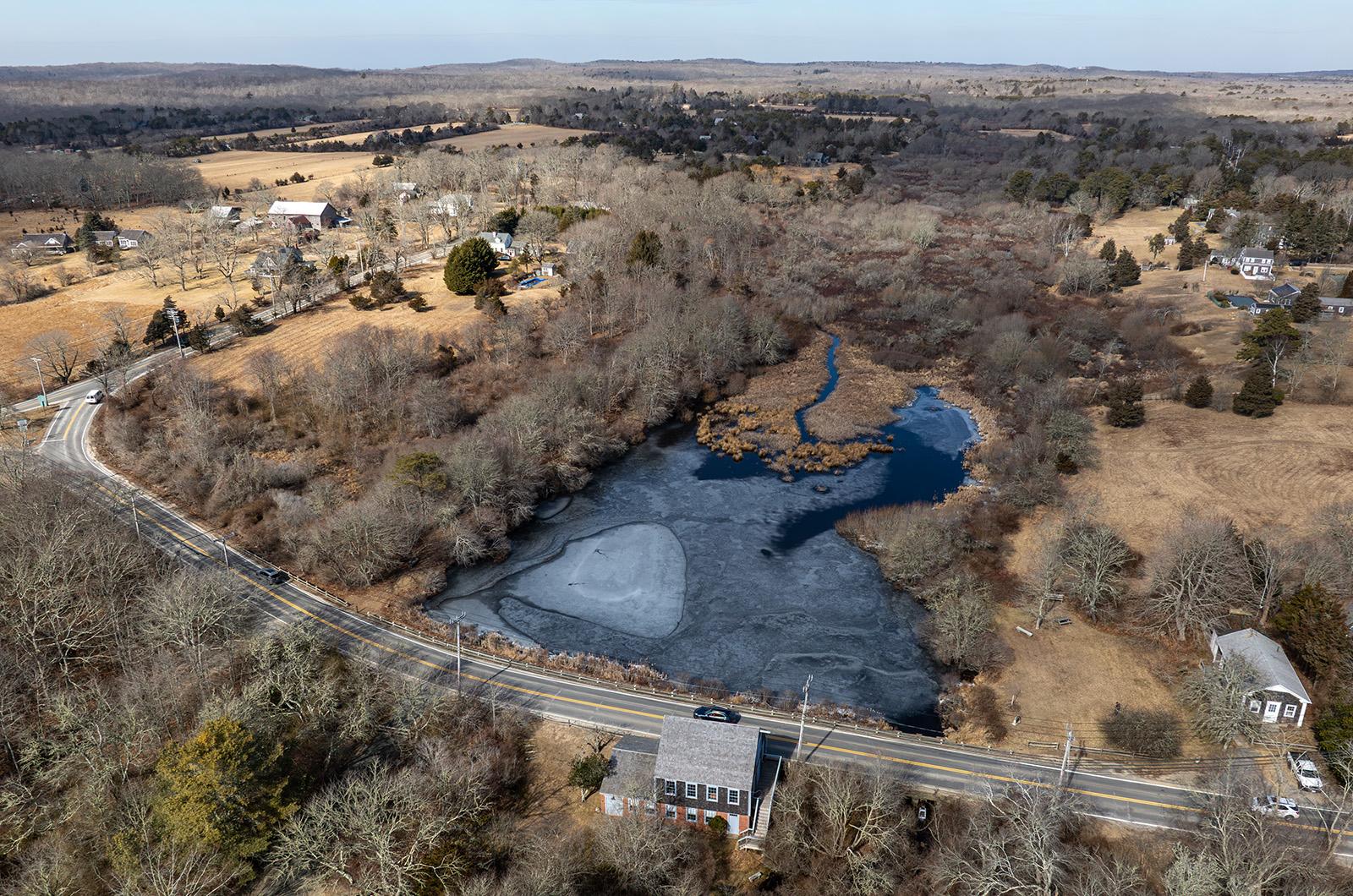
A new multi-year study to determine the health of the Mill Brook in West Tisbury has found the system is struggling, prompting consideration of how to aid the nearly 3,000-acre watershed that feeds Mill Pond.
A new multi-year study to determine the health of the Mill Brook in West Tisbury has found the system is struggling, prompting consideration of how to aid the nearly 3,000-acre watershed that feeds Mill Pond.
The town’s Mill Brook watershed management committee presented its findings to an audience of more than 50 people at the West Tisbury library Sunday. The committee largely focused on the Mill Pond along Edgartown-West Tisbury Road, saying it suffers from high temperatures and low dissolved oxygen levels, making the pond inhospitable for native fish and aquatic insects.
“These are really ecologically important and rare species, and habitat quality is clearly very impaired.” said committee member Julie Pringle, who is also a deputy shellfish constable for Edgartown.
The Mill Brook is one of the largest freshwater ecosystems on the Island and is home to brook trout, brook lamprey, American eel and herring. It starts in Chilmark and extends roughly five miles along North Road and State Road until it flows into a cove at Tisbury Great Pond.

Julie Pringle goes through the data.
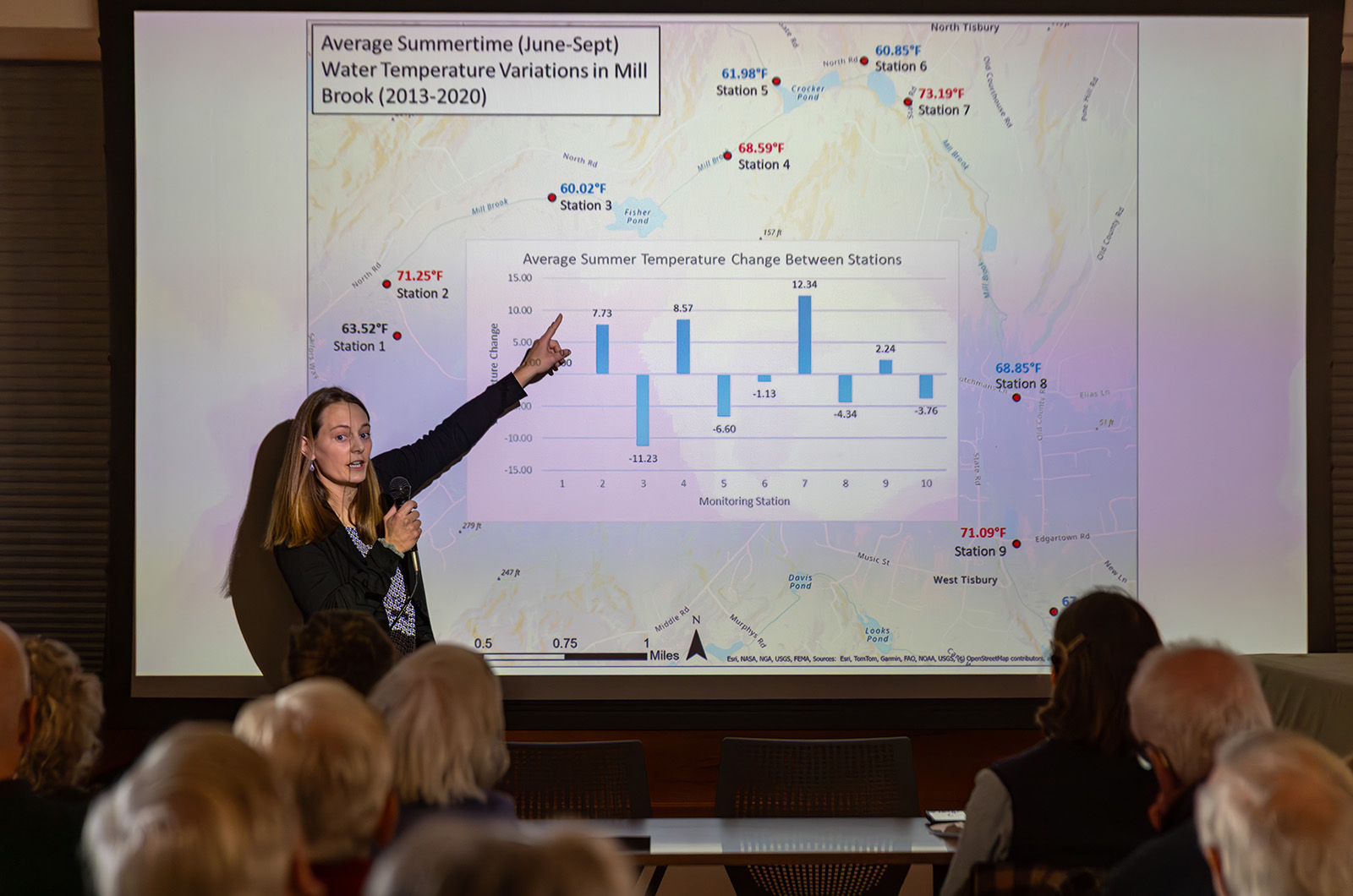
Julie Pringle goes through the data.
A handful of dams create man-made ponds throughout the brook, the last of which is Mill Pond. The pond hosts endangered water-willow stem borer moths which were discovered during a rare species survey conducted in 2021.
The Mill Brook committee formed in 2014 to collect data for management decisions. Sunday’s event was held to go over the new research, collected from 2021 to 2024.
At the onset of the work, the committee set up nine sampling stations along the stream and measured for nutrients, water temperature, pH, dissolved oxygen and conductivity. It continuously measured temperature at six of the stations and dissolved oxygen at Mill Pond.
Water temperatures at the pond regularly exceeded 68 degrees, the upper limit for cold-water fisheries, for nearly the entire period between late June 2023 and mid-September 2023. Temperatures peaked at 84 degrees.
Entomologist Greg Whitmore studied the species along the brook. His report noted a shift from cold-water fauna to warm-water fauna due to impoundments raising the water temperature.
“The temperature increase has a clear negative impact on temperature-sensitive species of macroinvertebrates,” Mr. Whitmore wrote. “Those species adapted to coldwater streams are not able to survive the temperature increase induced by the ponds.”
Members of the committee pointed to the dam at the Mill Pond as the culprit. The committee told the audience on Sunday that dams negatively impact water quality and habitat, which is reflected in high temperatures, low dissolved oxygen and a decrease in biodiversity.
The committee said that the Mill Pond impoundment blocks fish and wildlife passage and is creating excess heat that’s degrading the water quality and habitat.
Removal of the dam has been highly debated by the town for over a decade. It would restore the stream’s natural flow, but drain the existing pond, which has been a fixture in town for hundreds of years.
The committee presented two options for possible town management of the pond.
The first would remove spillway weir boards instead of the entire dam, which runs beneath Edgartown-West Tisbury Road. The boards currently hold the level of water in the pond.

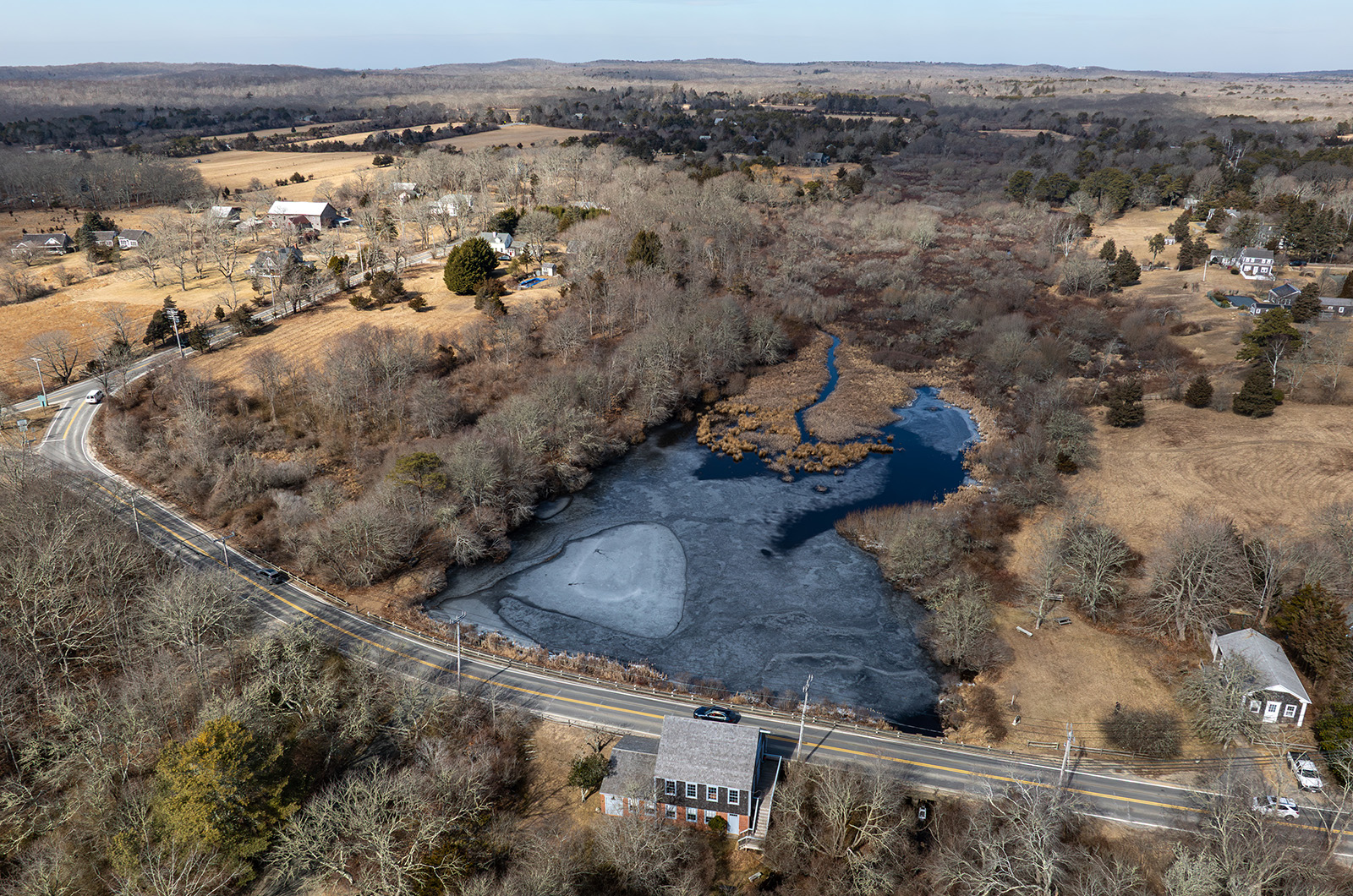
The Mill Pond is man-made and has been in West Tisbury for hundreds of years.

The Mill Pond is man-made and has been in West Tisbury for hundreds of years.
Removal of the spillway weir boards would drain Mill Pond, restore the natural streamflow, allow for fish and wildlife migration and help mitigate high temperatures.
The second option suggested building a by-pass that would cut-off Mill Pond’s access to the stream, separating the two. The pond would be fed by groundwater and the stream would run around it on a natural track.
A similar stream by-pass was built in the Child’s River in Falmouth. The committee said it’s an option that would benefit the ecosystem while preserving the Mill Pond.
At the end of the meeting several members of the public expressed interest in working together to solve the issue. Others were concerned about the future of the Mill Pond.
Sean Conley, the chair of the West Tisbury Historic District Commission, said Mill Pond’s removal would be disgraceful. He said the town should focus on other ponds along the brook that also have high water temperatures.
“It’s already too warm before it gets to Mill Pond,” Mr. Conley said. “So why should we destroy the beautiful Mill Pond until you opt to get the other people on board?”
The committee said the town can only make decisions for the Mill Pond because it doesn’t own the others.
“I think the point is not to throw up our hands and say ‘why bother?’ I think the point is to do what we can, whenever we can, and this is a situation where we can do something and make a massive improvement,” said committee chair Prudy Burt.
Comments
I could not disagree more
Ebba Hierta EdgartownI could not disagree more with Sean Conley's assessment. What is truely disgraceful is the decision to ignore the ecological health of this critically engangered watershed, to ignore science in favor of a fleeting opinion on what is pretty. In the opinion of many, a restored river system would be beautiful to behold. The aesthetic opinion of a few who prefer to look at this nearly dead pond should not prevail over the incontrovertible fact that the dam is extremely harmful to our environment.
I have seen several small
Marie TisburyI have seen several small ponds with fountains. Inexpensive and keeps the water circulating.
Unfortunately it doesn’t seem
AM 02539Unfortunately it doesn’t seem to be that simple, as the temperature likely wouldn’t be helped meaningfully by that change, and the temperature seems to be what is starving native life.
I am in favor of letting the
Mt. B ChilmarkI am in favor of letting the waters flow down in to TGP. Open up the watershed.
Some people have a
Sean Conley West TisburySome people have a misconception about Historic Districts and Historic District Commissions. The Historic District Commission is not here to "prettify" or "beautify". The point of the Historic District is to continue that direct connection with our past and heritage so that our heirs can also have that connection. If beauty comes from that, it is a happy by-product. If someone cannot see and feel the importance of the Mill Pond and what it represents, I cannot make them see and feel it.
The island has been inhabited
Elisha Wiesner ChilmarkThe island has been inhabited for over 10,000 years. The mill pond is 300 years old and has not served any purpose for the past 100 years. It’s essentially a tepid puddle at this point. I fail to see how this connects us to our past. If anything, removing the damn and letting it go back to being a natural stream would connect us to far more of our past than a pointless pond.
100%! Mill Pond is dead, long
jc100%! Mill Pond is dead, long live Mill Brook!
Keeping the Mill Pond should
Thomas S Hodgson West TisburyKeeping the Mill Pond should be a priority. It's a visual "anchor" for the town. It holds memories for many. It's a beautiful place. To see it for the first or for the ten thousandth time is refreshing and nourishing to the spirit. To those who say the pond has no purpose, isn't beauty by itself a worthy purpose?
The Mill Pond is not the "culprit" when it comes to the warming of Mill Brook. Removing it would do little or nothing to improve the situation. The upstream ponds --- Littlefield's Pond, Berresford's, Priester's, Crocker's, and Fisher's, are all upstream contributors to warming, and if removing ponds will help, those are the ponds to address first. Removing them in chronological order, youngest/newest first, would be a logical way to proceed.
If ponds are going to be kept, altering their dams to release water from their lower, cooler layers should not be rocket science. Ponds could be filled from their downstream ends, rather than upstream. This could be done by moving brook channels so that their main flow is in a (shaded) side channel, thus going directly to the lower part of each pond. This would help cut down on the solar heating effect. Another strategy would be planting trees to shade parts of the Mill Brook system that currently are directly exposed to the sun. (One example would be Littlefield Pond, now without shade of any kind.)
The article mentions making a brook "bypass" to the side of the Mill Pond. Such a channel/bypass already exists, and has existed for many years. It begins just downstream of Scotchmans Lane. That diversion supplies water to Courtleigh's Pond, which is a few hundred feet south of the Garden Club. At one point in time it also supplied consistent water flow to Parsonage Pond. Restoring Parsonage Pond would be an addition major benefit to the Town. Relatively little work would be required to adjust water flow in this area.
The Mill Pond Committee acknowledges that removing the Mill Pond would do little. The logical takeaway from that fact is that leaving the Mill Pond as it is is a sensible and viable course of action.
We've known for a long time
jcWe've known for a long time (the DER study linked below is from 2014-16, almost a decade ago!) how destructive small legacy dams can be to watershed ecosystems, so here's hoping the town of West Tisbury has the good sense to follow the science in deciding what's best for the entire ecosystem / Mill Brook watershed (and the taxpayers that live around and use it today and tomorrow) instead of keeping a dead pond around because of how a few folks 'feel' about what it 'respresents.' What's next? Not opening the breach? C'mon.
|DER study: https://www.mass.gov/info-details/small-dams-have-large-impacts-on-wate…|
Whoa, what a comprehensive
Elise Green ChilmarkWhoa, what a comprehensive years-long study - clearly many many hours went into this report! If only these things were just about the science, but as in life, there is so much more than meets the eye. A deeper pond, a better maintained pond - that is properly stewarded to graciously honor and thank the 1948 Campbell family donors - can provide the nice cooler depths in which trout flourish. This is good for the human population that generationally enjoys fishing along the banks of the Mill Pond as well as provides an open body of water as a home for the other non-fish habitat, thus positively affecting the larger biodiversity that is overlooked in the watershed study.
The historic West Tisbury streetscape beloved by the entire island - who doesn’t slow down and turn their head as they approach the Mill Pond vista? - is iconic and in my opinion the gateway to Up Island. THAT is its intrinsic value and we could all (not unlike the efforts to save the Aquinnah Lighthouse) band together to make this an Island-wide effort to help our neighbors in West Tisbury preserve and protect a cherished and welcome historic vista.
One more timely topic - given the recent devastating fires in LA, with limited access to bodies of water, and even though West Tisbury apparently already has a larger holding tank for the town, it never is enough, right? A clean, clear, deeper water source along an accessible roadway would seem to make a lot of sense.
Love the civil dialogue on this important topic!
Well said!! Couldn’t agree
C. BurnhamWell said!! Couldn’t agree more!
Much gratitude to the members
Dan Kiernan ChilmarkMuch gratitude to the members of the Mill Brook Committee for gathering all of this useful information about our aquatic habitats. 84 degrees is way too hot for a pond and will lead to lower and lower dissolved oxygen levels. I think this is an obvious example of the importance of leaving nature alone. Remove all of the dams. Nature knows best.
Add new comment