



The Marine Biological Laboratory and Great Pond Foundation are collecting water samples along Edgartown Great Pond in hopes of unlocking the source of nitrogen that has been polluting the pond.
On a cold morning this week, a team of scientists hammered a pole into the ground along the shores of Edgartown Great Pond and pulled up enough murky groundwater to fill a test tube.
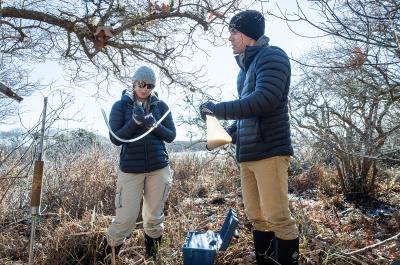
Kelsey Chenoweth and Owen Porterfield aid in the research.

Kelsey Chenoweth and Owen Porterfield aid in the research.
Though the act was small, the researchers from the Marine Biological Laboratory in Woods Hole and Great Pond Foundation hope it can unlock the source of nitrogen that has been increasingly choking the 890-acre coastal pond along the Island’s south shore.
For the next several months, the team will be collecting groundwater samples from all around Meshacket Cove and Slough Cove in a hurried search for nitrogen plumes.
The Island’s great ponds have seen high levels of nitrogen for years and warnings over algal blooms have become regular events. While Edgartown Great Pond is not the most polluted pond on the Island, Great Pond Foundation executive director Emily Reddington said she’s seen a rapid decline of its ecosystem.
“There used to be hundreds of acres of submerged aquatic vegetation, mostly eelgrass, some widgeon grass,” Ms. Reddington said. “In 2022 we went from having almost full coverage of the pond . . . to just little, tiny pockets.”
Two years ago, the foundation and MBL traced most of the nitrogen influx to wastewater. But where that was coming from was still in question, with the possible culprits ranging from the town’s wastewater plant to the hundreds of unsewered homes flanking the pond.
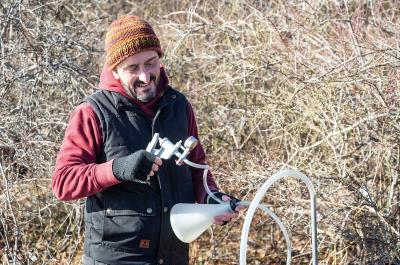
Javier Lloret with the Marine Biological Laboratory.
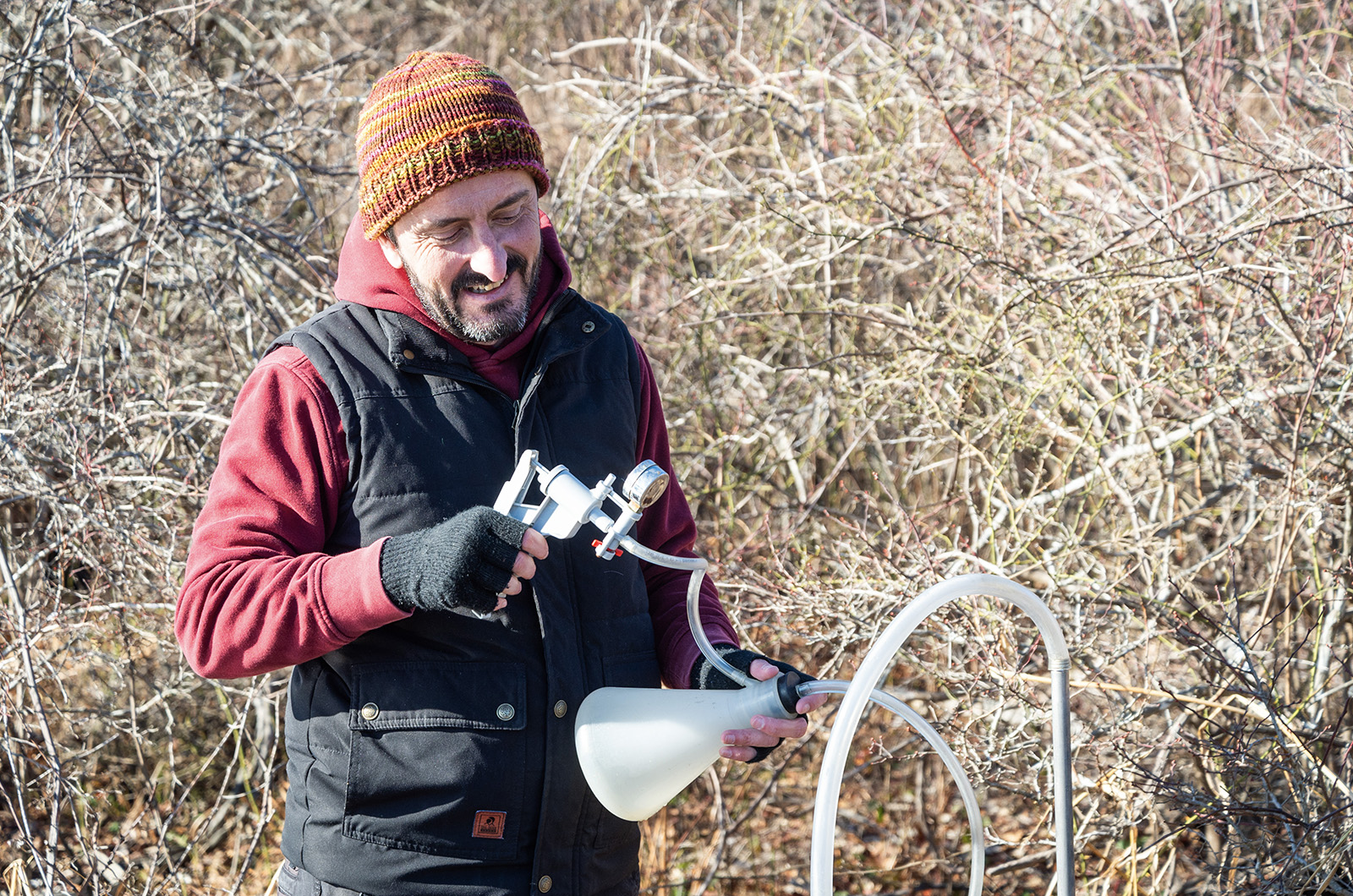
Javier Lloret with the Marine Biological Laboratory.
The new research from the Marine Biological Laboratory and the Great Pond Foundation looks to track the groundwater through the watershed to pinpoint its origin. So far, according to MBL scientist Javier Lloret, upwards of 70 per cent of the nitrogen in Edgartown Great Pond is entering at Meshacket Cove and Slough Cove.
Increased human development along the Island’s watersheds has contributed to pollution in all 16 ponds.
“The rain falls on the land and it carries all the nutrients and all the things that we put in that water, including the fertilizer, outflow of our septic system and the fertilizers that we put on the land,” Mr. Lloret said while pumping groundwater from Meshacket Cove Tuesday. “Any kind of pollution that is in the atmosphere settles down on the surface of the soil, and the rainwater carries it into the ground.”
When nitrogen enters a pond, it feeds the algae, which then can create harmful blooms that make ponds unlivable for plants, fish, shellfish, marine mammals and birds. These blooms can also make the ponds unswimmable for homeowners who hold the pond — and their property values — close.
The groundwater samples will help inform researchers on nitrogen-loaded “hot-spots” in the pond linked to septic systems, agricultural runoff and other sources, so they can prevent any further pollution. The study is an iterative process, with each round of sampling helping to better identify the nitrogen source.

Emily Reddington, the executive director of the Great Pond Foundation.

Emily Reddington, the executive director of the Great Pond Foundation.
Mr. Lloret will be analyzing the samples for the next several months and constructing a model informing the foundation on where the plumes of nitrogen are located in comparison with the land uses.
Within the Meshacket Cove watershed is a town wastewater treatment facility, which Ms. Reddington said is a likely source of nitrogen.
Bill Burke, the facilities manager for the Edgartown wastewater department, said the state requires that the facility only discharge a maximum of 2,200 kilograms of nitrogen per year. In 2023, the facility only discharged 587 kilograms, he said.
Mr. Burke added that the town treats all the wastewater that comes to the facility and has a nitrogen removal rate of more than 90 per cent.
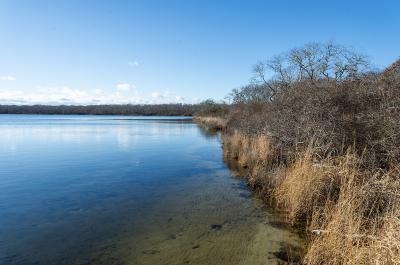
The pond has seen nitrogen enter the pond at Meshacket Cove and Slough Cove.
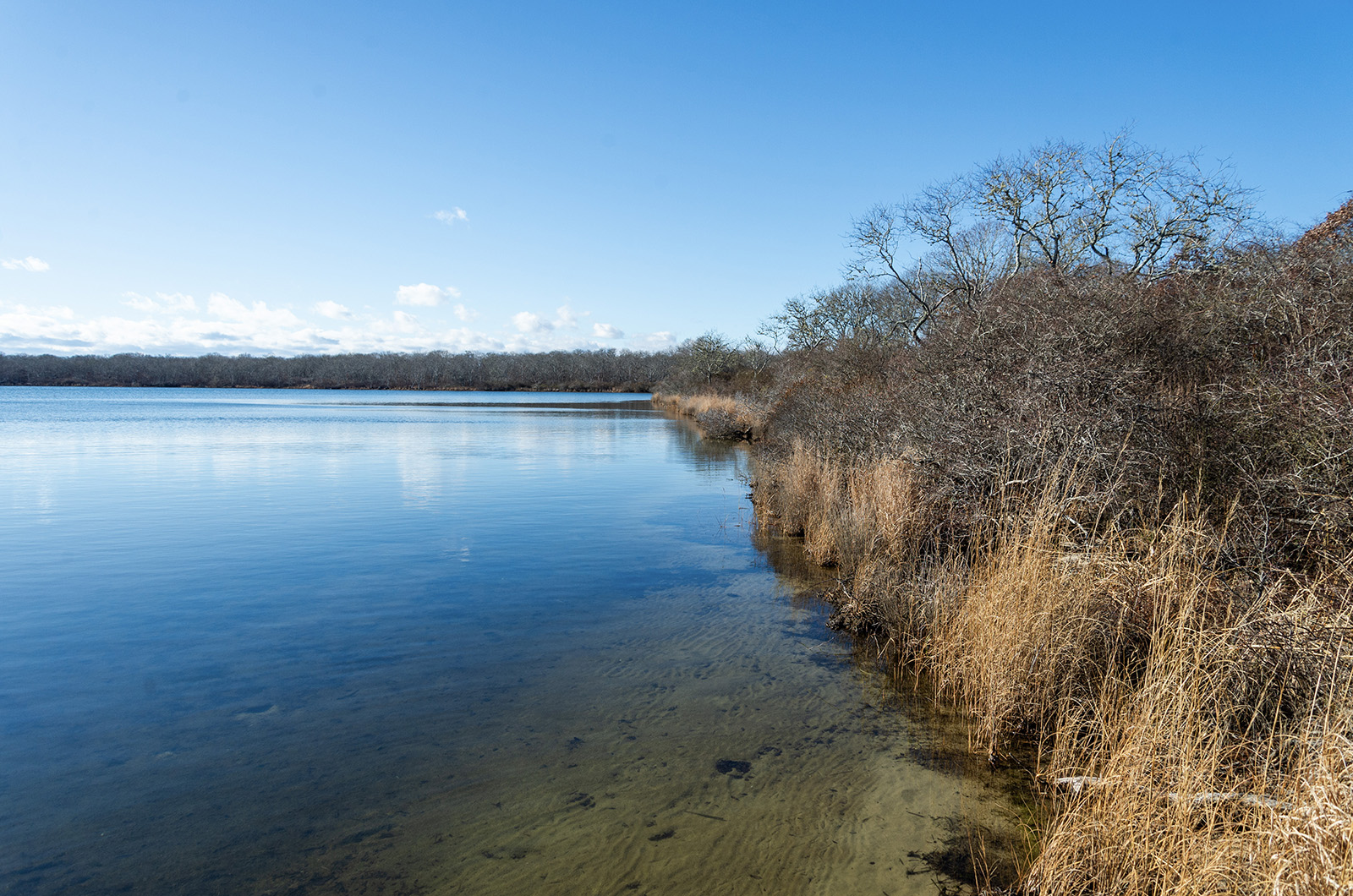
The pond has seen nitrogen enter the pond at Meshacket Cove and Slough Cove.
Ms. Reddington said homeowners can take precautionary measures to help as the research is ongoing. The tall grasses absorb excess nitrogen from the ground and use it for their own growth, she said. If people planted more of this type of vegetation, more nitrogen would seep into their roots instead of leaking into the pond.
“This is a place people turn to to feed themselves in different ways, whether it’s their bodies, their minds or their spirits,” she said. “I think it’s impossible to overstate the importance of living water to the Island community.”
Comments
Let me solve this for you:
ClarkLet me solve this for you: geese poo + lawn fertilizer
Geese eat the grass (doesn't have to be near by), geese fly and land near the ponds, and defecate.
A very small contribution at
Jamie West TisburyA very small contribution at best. Our ponds have many large estates and homes waterside, that receive lots of fertilizer applications that leach into the water. While geese do do what you are saying, I hardly think that is creating large agal blooms in the islands Great Ponds.
Check the septic system
Val MainlandCheck the septic system pumping records that are often kept at town health departments. If not already in place, develop a requirement for regular, frequent pumping and system inspections, along with record monitoring. For septic systems that have active, mechanical working parts, develop a requirement for professional maintenance. Require a robust buffer between lawns and waterways, and restrict the use of nitrogen and phosphorus fertilizers in all sensitive areas. Work to change the culture of admiring beautiful lawns to one of embracing a beautiful ecosystem.
When will studies and
John ChilmarkWhen will studies and remedial action be scheduled for Chilmark, Upper Chilmark and Upper-upper Chilmark Ponds? For sure, geese ARE part of the problem.
Any yet a nearby nitrogen
Dee OuchmanAny yet a nearby nitrogen harvesting golf course was shot down to leave more room for mansions.And so it goes...
Nitrogen pollution is a
Emily Reddington Great Pond FoundationNitrogen pollution is a shared challenge in many of the Island's ponds. A parallel study is being done in Chilmark Pond, in all three regions of the pond, supported by Chilmark Pond Foundation and Chilmark Association. We know from our colleagues at the Marine Biological Laboratory that birds tend to contribute <1% of the excess nitrogen. There are a couple of reasons for this, 1) birds often consume nitrogen and deposit nitrogen in the same ecosystem, and essentially recycle it and 2) the amount of nitrogen from wastewater, fertilizer, and atmospheric deposition tends to far outweigh the contribution from birds. However, if the pond is very, very, small and the density of birds is very very high, birds can have a greater contribution of nitrogen percentage-wise. We are grateful to the Gazette for their continuing coverage of pond health, and to the Town of Edgartown to their proactive approach to nitrogen remediation.
It is way past time to get a
Lorraine EdgartownIt is way past time to get a handle on this problem. People who demand putting green lawns, throwing fertilizers on anything that is green, garden proud landscaping nonsense, all part of the problem. I see this in other states, the city people move out to the lakes, demand putting green lawns, run off into beautiful pristine lakes, and soon the loons and the flora and fauna that thrive on clean water, are all feeling the pinch of chemicals. I follow these issues in several states and it is heart breaking.
I have relatives who have
Gary Off IslandI have relatives who have owned a lake house in NH since the 50's. There are hardly any lawns, mostly just tree lined shores. Every year for the last 4 years they have had cyanobacteria blooms, and so had a survey done similar to the one described in this article. Everyone assumed the major contributor was going to be from outdated septic systems, but the results of the test showed the 10 largest contributing locations were from rain runoff. The rain would wash pine needles, leaves etc into the lake where they decompose. A different environment here, but let's see what the results of the test show. The results might be surprising. Or maybe not.
Yeah, nice job getting the
Salamandero EdgartownYeah, nice job getting the nitrogen out of the water, water treatment people! And I agree!
Time to ban nitrogen
Binny VHTime to ban nitrogen fertilizer and required upgraded septic systems with regular maintenance near ponds.
Many great ideas… we need to
Hesther OBMany great ideas… we need to do more yo be green! Wins mills is a must we need more. More solar panels and charge if stations.
Stop putting any sort of
Alec Walsh ChilmarkStop putting any sort of fertilizers on your lawns, inorganic or organic. They both contain nitrogen.
Green Lawn = Brown water!
Absolutely right to test the
Mr. B ChilmarkAbsolutely right to test the water in the streams flowing into the pond(s). Tisbury Great Pond, for instance, has a huge watershed. Lots of septic systems up there. Lots.
The Island of Martha's
Marty Milner TallahasseeThe Island of Martha's Vineyard has always been a bellwether of the future for America. It magnifies the human testing of natural environment limits because of its size, water table and varying population. This work on testing and possibly human impact, will impact many other communities. In order to protect and include the human impact threats to the water table are very serious. Science must contain and exclude political and financial influence and focus on data and trends.
Add new comment