


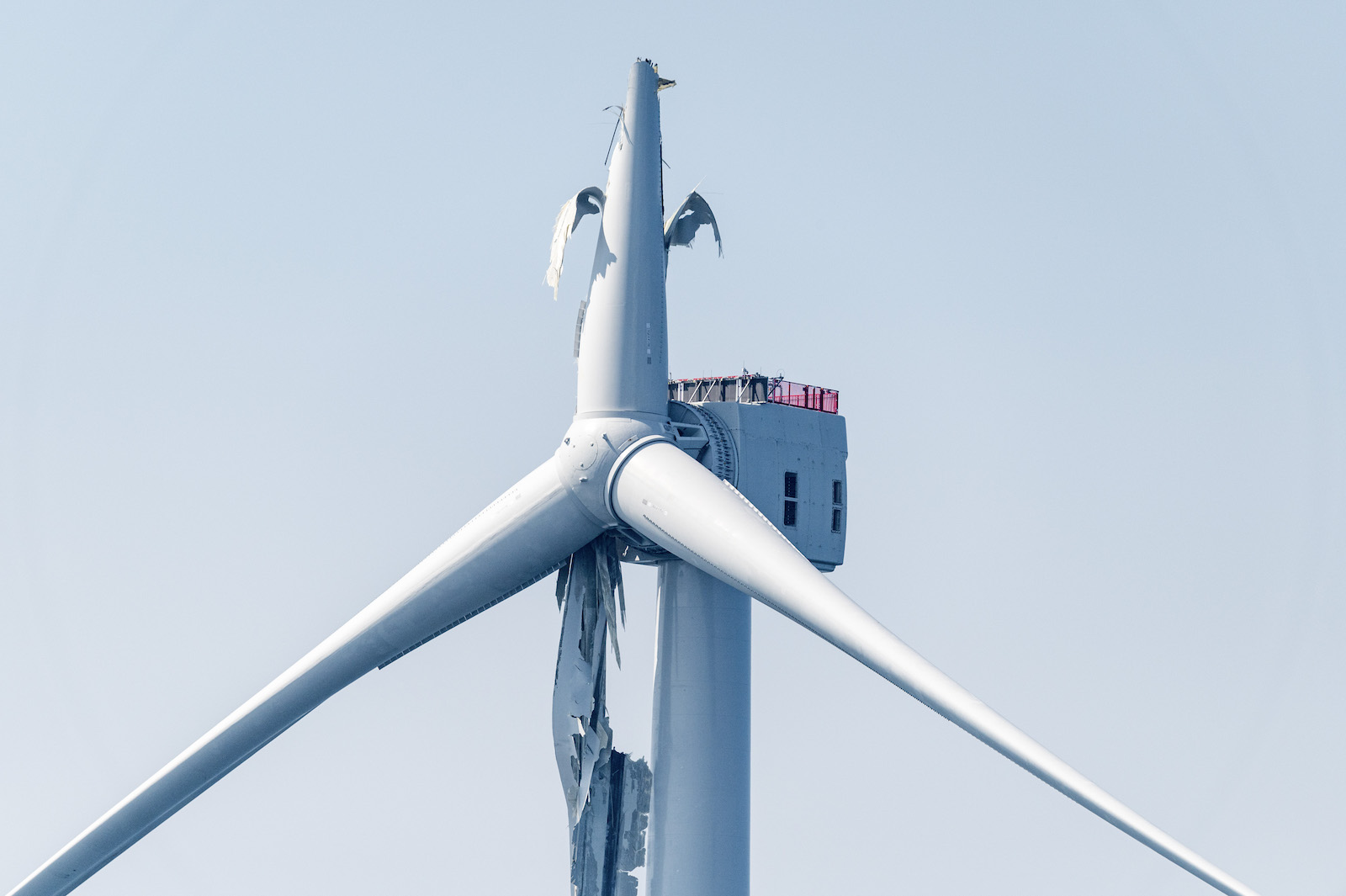
GE Vernova, the manufacturer of the blade that doubled over in July and poured down into the sea, had vessels at the malfunctioning turbine Sunday with the goal of retrieving the large pieces of the 305-foot blade.
A recovery effort commenced this weekend to collect the pieces of a broken Vineyard Wind turbine that snapped off and sunk to the ocean floor this summer.
GE Vernova, the manufacturer of the blade that doubled over in July and poured down into the sea, had vessels at the malfunctioning turbine Sunday with the goal of retrieving the large pieces of the 305-foot blade, according to the town of Nantucket.
The town, which has been providing regular updates on its communications with GE Vernova, said a first piece of debris was successfully lifted and no pieces broke off. The recovery was expected to continue Tuesday and a vessel was going to be on standby to collect any debris that floated away.
The broken turbine is about 20 miles away from the Vineyard, at the southernmost point in Vineyard Wind’s lease. The water depth is between 120 and 160 feet.
GE Vernova Tuesday said it had done a survey of the seabed in August and was following a plan it had previously outlined to officials.
The company had hired Resolve Marine, a salvage outfit that worked on the Key Bridge collapse in Baltimore, to aid in the plan. Officials previously said they would review ultrasound photos of the blades and internally reinspect the blades, but the company did not go into detail about the seabed recovery.
“There are multiple components of this plan, and our teams continue to focus on prioritizing safety and quality in collaboration with our customer and all relevant authorities as we execute the Action plan,” the company said in a statement Tuesday.
Vineyard Wind declined to comment on the restoration, referring further questions to GE Vernova. The Bureau of Safety and Environmental Enforcement, the federal agency that oversees offshore wind energy projects, said Tuesday that it is continuing its investigation but referred the Gazette to GE Vernova for details on the cleanup.
The project, which hopes to have 62 wind turbines spinning off the Vineyard’s southern shore, started producing power from a handful of turbines in February this year, but had to stop once the blade broke. GE Vernova said the problem in the broken blade was due to “insufficient bonding” that should have been caught in the quality assurance program.”
The company did not respond to a query asking whether any other blades planned for the project had been found to have defects.
BSEE allowed construction to resume in July, though blade work is still on hold.
The broken blade caused thousands of pieces of fiberglass and styrofoam to go into the ocean. While some of the debris washed up on the Vineyard, a majority showed up on Nantucket beaches, galvanizing the neighboring island.
Last week, the town said it was hiring a nationally recognized damages expert to evaluate the short-, medium-, and long-term effects on the Nantucket environment and economy and would demand compensation for the failure.
“Our goal remains to protect Nantucket’s irreplaceable historic and environmental landscapes,” Brooke Mohr, the chair of the Nantucket select board, wrote in a letter posted on the town website. “If and when these future farms are constructed and eventually decommissioned, we want to be sure the government and companies responsible have the capacity to ensure we are not harmed.”
Comments
We need a signed agreement if
Ken Edg.We need a signed agreement if it happens again the operation gets shut down.
How exactly would your signed
Toby Oak BluffsHow exactly would your signed agreement work???
Unbolt them all and re
Still time to go backUnbolt them all and re-evaluate this experiment. The Ocean is a formidable environment and worthy of deference.
Agree.
Islander Too! TisburyAgree.
Wrong turn. Go back.
RE "poured down into the sea"---solid items do not "pour."
They crack, break off, and fall.
Once they hit the water they start to break up and then disintegrate.
These large pieces pose a hazard to marine life such as whales and also ships.
Plus they wash ashore on beaches.
Then, through wave action, some debris gets reduced to smaller and smaller pieces until some portion of the material is small enough to be ingested by marine life.
Enjoy your meal!
I have written numerous
Paul Adler WTI have written numerous letters to Vineyard Wind seeking explanations on various concerns that have been raised. So far no response. Either a very poor public relations department or they are hiding something?
The reality is that the
Middle Roader ChilmarkThe reality is that the Federal and Commonwealth governments are conducting a huge experiment in our formerly pristine and productive waters by pushing the rapid deployment of hundreds of these turbines without any real scientific basis for evaluating their impacts. This is just one example of highly visible "unexpected" harm that can result. The greatest damage is likely to what we can't see: marine life of all kinds ranging from tiny crustaceans to whales. The environmental assessments upon which the permit approvals were granted are pathetic attempts to justify a conclusion that was predetermined. A high school senior would have gotten an "F" for similar low quality work. On top of all, we get to pay huge profits to the Danish owners for two decades.
You raise two issues that
Robert Skydell Antigua, GuatemalaYou raise two issues that need to be addressed. All power generation in the United States is supplied by the private sector. The government is not in charge of either generating or supplying electricity. If the company that does supply that electricity is foreign owned, then so be it. Many energy companies operating in the U.S. are foreign owned. As far as offshore wind farms being experimental, that is hardly the case. Offshore wind projects are quite common, have been around for decades, and have generated a wealth of data from viability to environmental impacts to both avian and marine animals. The malfunction of a blade that apparently had a manufacturing defect should not considered proof positive that the entire project should be halted. Did we halt the transportation of oil in barges and tankers after a single oil spill or even many major incidents even in our waters? No, we did not.
Add new comment