

A study published earlier this month in the entomology journal Insects delves into how lone star and deer ticks have co-existed since the rapid rise of lone stars, and what it could mean for the future.
When lone star ticks descended upon the Vineyard about a decade ago, researchers wondered if it would lead to a decrease in the Island’s deer tick population. But after years of surveys, biologists have found that despite the rapid spread of lone star ticks across all six towns, deer ticks have persisted here.
Islanders now have to be on the lookout for two species that carry with them disease and other maladies.
“We just have more of both,” said Patrick Roden-Reynolds, head of the Island’s tick program, who recently co-wrote a study on the tick populations. “It just elevates our public health burden.”
The study, published earlier this month in the entomology journal Insects, delves into how lone star and deer ticks have co-existed since the rapid rise of lone stars, and what it could mean for the future.
Lone star ticks were first found in the southeastern U.S., but the species has crept northward as the warming climate has made more places hospitable for them. Dubbed lone star for the bright white spot on the back of adult females, the ticks gained a solid foothold on the Vineyard around 2014.
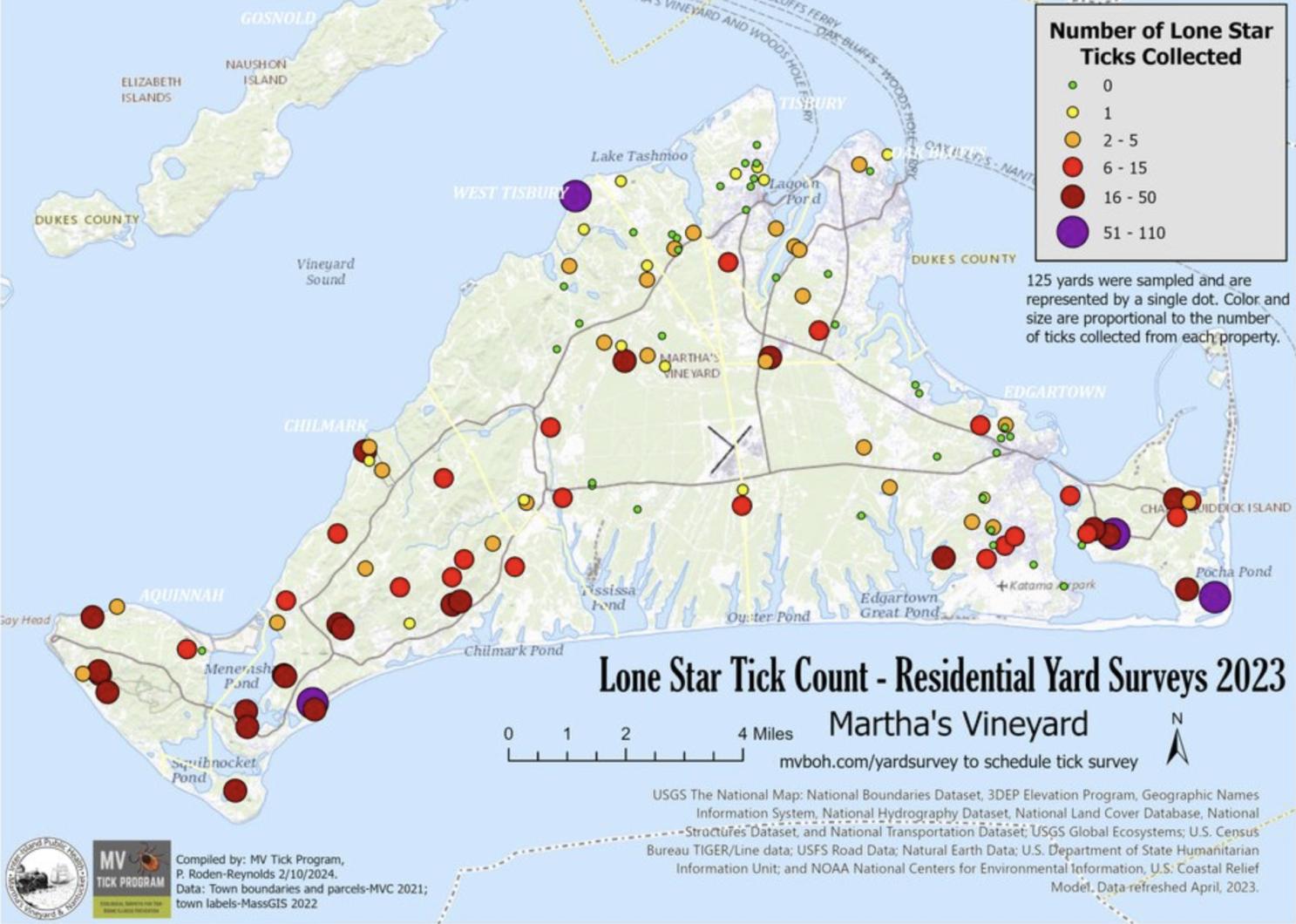
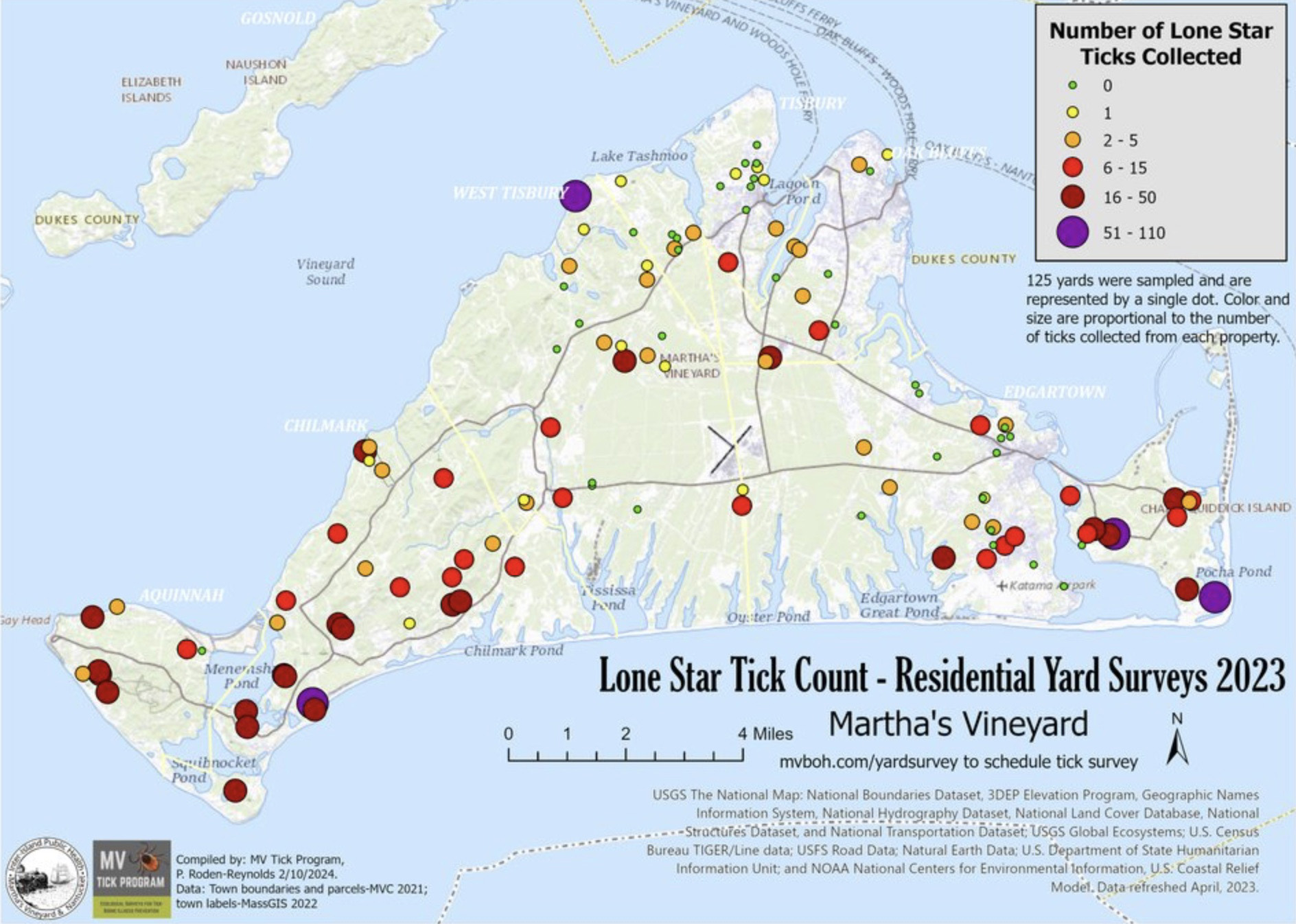
In recent years, they have spread from the Island’s edges — Aquinnah, Chilmark and Chappy — to every town. This summer, the ticks and their larvae are believed to be behind a host of bites and rashes that have sent dozens to the hospital.

Lone stars track their food down, unlike deer ticks who lie in wait.
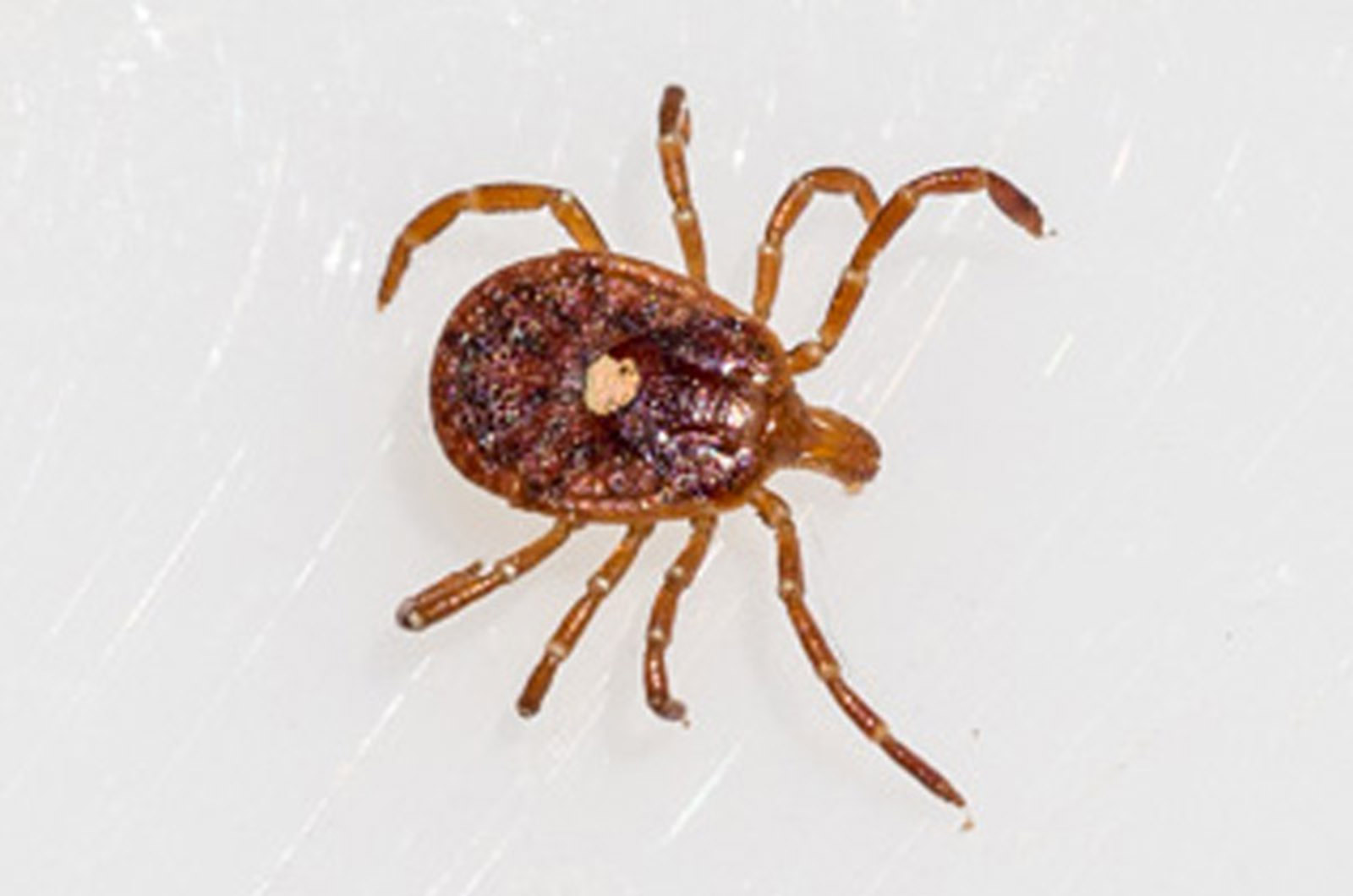
Lone stars track their food down, unlike deer ticks who lie in wait.
Mr. Roden-Reynolds, who worked on the study with Dick Johnson, Allison Snow and Stephen Rich, said when a species enters a new area, they can often displace a similar species in the region. In other parts of the country, studies have shown that lone star ticks have far outnumbered deer ticks where their range overlaps, but there is little research about whether the populations decline directly because of the lone stars.
The Vineyard research, which included more than 1,200 surveys going back to 2011, captures the lone star ticks creeping into the Vineyard and shows they are, at least for now, happily sharing the Island with deer ticks. That could change at some point in the future, but Mr. Roden-Reynolds believes there is more than enough space for the two species here.
“We still have that question, but as of now it remains to be seen if lone stars become the most dominant and common tick,” he said.
Both species bring health concerns. Deer ticks can carry pathogens for Lyme disease, babesiosis and anaplasmosis, while lone stars can spread alpha-gal syndrome — which can cause people to become allergic to red meat and other animal products.
The Vineyard has the highest rate of Lyme disease in the state and Mr. Roden-Reynolds said Lyme remains one of the most prevalent tick-borne illnesses on the Vineyard, despite rising reports of alpha-gal and lone star larva bites this summer.
“Even though people are struggling with this new tick . . . the deer ticks are still out there and are abundant,” he said.
Lone stars could have some advantages over deer ticks when it comes to spreading on the Vineyard in the coming years. For one, they are habitat generalists — able to live in the woods (the deer ticks preferred habitat) as well as lawns. Lone stars also reproduce in higher numbers than deer ticks, meaning their population can become established fast.
Lone stars are also more aggressive. While deer ticks lie in wait for prey to come by, lone star ticks seek out their food, attracted to the CO2 emitted by hosts. Both species primarily feed on the Island’s abundant deer.
Despite the high numbers of ticks, Mr. Roden-Reynolds doesn’t think either species is lacking in potential sustenance.
“There should be plenty of blood, plenty of meals for everyone,” he said. “You would think deer could support both kinds.”
There is one new wrinkle that could forecast the diminishing of deer ticks, though. Preliminary research out of Pennsylvania State University shows that when deer ticks fed on deer after lone star ticks, the deer ticks were not attached to the deer as long and came away with less blood, Mr. Roden-Reynolds said. It is believed that lone stars can trigger an immune-response in deer, making it harder for deer ticks to feed.
More work needs to be done in the field to figure out if deer can become resistant to deer ticks following lone star feeding, researchers said.
For human interactions, because lone star ticks are spread across the Island, it is more likely that people will encounter them in the future, making them a rising threat.
“You had to go under the forest canopy to encounter deer ticks,” Mr. Roden-Reynolds said. “Now lone stars, I think, more people are apt to encounter them.”
Dick Johnson, the Island’s retired tick biologist who contributed to the research, said knowing that both deer ticks and lone star ticks are in high numbers means Islanders need to protect themselves when they go outside.
“Suddenly you have lots of these ticks that are aggressive in places they weren’t before,” he said. “I think it’s going to be a shock for lots of people.”
Old habits of only doing tick checks when walking in the woods need to be augmented with permethrin-treated clothing and other preventative measures, Mr. Johnson added.
“People really need to start paying attention,” he said. “They aren’t just in Aquinnah and Chappy.”
Comments
My wife and I were at our
Chris EdgartownMy wife and I were at our place in Edgartown past couple of weeks. She sat in the grass to do some weeding in the yard. I did some mowing. We both had not used any repellent that day because we hadn't seen a single adult tick and hardly any mosquitos. Well, next day, lots of pimply bites, really itchy, mostly lower extremities and torso. She found a lone star tick larva (really tiny) the next night (used a portable cell phone microscope to really see it). Soooo...even if you do not see adults, use DEET and/or permethrin at all times.
I spend hours roaming the
Charlie Callahan So Boston/EdgartownI spend hours roaming the state prk in the summer looking for deer antlers and all summer I only had one tick on my sneakers. I spray them with witch hazel,they hate the smell.Permethrin is a pretty heavy duty pesticide,I spray my foundation with it in the spring,it kills termites and ants and it smells like Chlordane which has been illegal for 50 years
Islanders need to be aware of
Thomas S Hodgson West TisburyIslanders need to be aware of at least three tick species, not just two. The article fails to mention the dog tick (Dermacentor variabilis), which can carry both tularemia and rocky mountain spotted fever.
We are in the geographic range for the brown dog tick, though I've never seen one.
As if this wasn't enough, it's possible to likely that in the near future we will see the gulf coat tick and the asian longhorn tick arrive on Martha's Vineyard. Both of these ticks are extending their range northward.
It is deeply troubling that
Jennifer SquibnocketIt is deeply troubling that the lone star tick seeks you out, as became apparent at the beach where, after diligently avoiding the touch of any swaying dune grass against our bodies or beach bags on the path to the beach, we settled on towels and chairs below the high tide line, only to find a lone star tick on our beach chair and another on a towel. It was clear the ticks had come for us after we arrived there, attracted by our CO2. I bought a cedar spray to use around our outdoor seating. Does anyone know if it works?
Jennifer, I have heard that
AlissaJennifer, I have heard that cedar oil does work, and that it is the only oil that does work. My husband works outside and sprays his clothes with permethrin every 6 weeks. He has never found a lone star tick on his treated clothes unless he forgot to re-spray on time. He has AGS already, but maybe spray chairs and towels to prevent it for you. The only thing toxic about it can be the binder that makes it stick to whatever it is sprayed on. The permethrin itself is not toxic.
Permethrin is my product of
Victor Colantonio EDGARTOWNPermethrin is my product of choice. It paralyzes all stages of lone star nearly immediately. It comes in concentrated gallon jugs for garden & yard spraying. It can be diluted for laundry uses (for ticks left on your clothing and to impregnate clothing for lasing protection. And, it comes in a topical 5% cream by prescription.
Permethrin is non-toxic, a natural occurring derrivative from certain chrysanthemum flowers. It causes ticks, lice & fleas to become paralyzed. Permethrin dates back to ancient Persia, 400 BC.
Permethrin is a man-made
Prudy Burt West TisburyPermethrin is a man-made synthetic insecticide. In addition to ticks, it kills all of our native bees, pollinators and butterflies, and is toxic to cats. It is particularly lethal in aquatic environments, killing macroinvertebrates (aquatic insects), fish and other aquatic species. People should only be using this insecticide to treat their clothes; this is what I do. As a landscape gardener and property manager here for 40 years, I have been treated for Lyme disease several times, and have now tested positive for AGS, as have several members of my family. Treat permethrin and other pyrethroids like the lethal products they are. Any landscape professional who tells you this is 'safe' to spray throughout your property is either misinformed or making money.
I believe you’re thinking of
Dana Nunes MVI believe you’re thinking of Pyrethrum, which is derived from chrysanthemums. Permethrin is a human-made synthetic chemical. Very effective, but don’t confuse the two.
Do not underestimate the life
Victor Colantonio EDGARTOWNDo not underestimate the life changing impact of Alpha Gal Syndrome, AGS. It is a life-threatening, likely a life-long condition that has no cure or treatment. It is delivered by blood meals in each stage of the loan star tick life cycle, larvae, nymph and adult. Lone star aka 'turkey ticks' are named for their preferred blood meal host. Without a cure or treatment, people with AGS carry EpiPens at all times to deal with anaphylaxis, a potentially deadly allergic reaction to mammalian meats, animal by-products and dairy.
The CDC warns AGS anaphylactic shock can occur in seconds, minutes or up to 6 hours after ingesting. How serious? MV hospital warns against even taking medicine in capsules made of gelatin.
The EpiPen will give 10 minutes to get help, two pens gives 20 minutes for EMTs or the ER.
Lone star ticks have created a very serious, potentially deadly, situation that endangers public health way beyond Lyme and other treatable tick borne illnesses. Because AGs has no cure or treatment we need ... No, we require systemic protocols that harnesses CDC, FDA, Pharma and Massachusetts agencies to fund methods to counter the current and growing danger to public health.
One wonders to what extent AGS may be an unintended consequence of the Commonwealth's extraordinarily successful turkey repopulation program. Let's fix this!
I ran the Martha’s Vineyard
Dr Enid Haller West Tisbury/ VermontI ran the Martha’s Vineyard Lyme support group for 13 years and my husband daughter and I still suffer from chronic Lyme
Please understand this is a very serious problem on the Vineyard
It is known as “ground zero” for Lyme
Please watch a documentary on Lyme I helped produce called “the Quiet Epidemic “
It will help you to understand the problem we have.
Add new comment