

There has been a rash of complaints across the Island.
There has been a rash of complaints across the Island.
Itchy bumps are appearing on Islanders and visitors alike and many folks want to know why. The social media pseudo-scientists think they have the answer, though I believe their diagnosis “mite” be a mistake.
The word on the screens is that we have an oak leaf itch mite infestation and that these little louts are causing all of the irritations (skin and otherwise). Not so fast, I say. Pyemotes herfi, or oak leaf itch mites, are an introduced species that have not yet been reported in New England.
Oak leaf itch mites arrived from Europe in the late 1990s and were detected in Kansas in 2004. Since then, they have been reported in Illinois, Nebraska, Ohio, Oklahoma, Missouri, Tennessee, Texas and Pennsylvania, though I could not find any sources that confirm their existence in Massachusetts. Nor could officials I reached out to.
Phu Mai, director of communications for the Massachusetts Department of Agricultural Resources, responded to my query saying: “We are not aware of any recorded presence of Pyemotes herfsi (oak leaf itch mite) anywhere in New England including Massachusetts.” Oak mites feed on midge fly larvae often found on pin and other oak trees, and can rain down in masses of 400,000 microscopic mites per day.
They also are known to feed on cicada eggs, so are being noted when periodic cicadas emerge. The mite mystery deepened as I searched for other mites that might be causing the calamine-requiring calamity. Perhaps it was a confused creature consensus and there was another mite to blame.
A mite that is found in Massachusetts is the oak spider or oak red mite, Oligonychus bicolor. This species can be problematic if you are a plant, but cannot bite humans, so are not responsible for the reports of the little blisters that accompany the scratchy skin.
Next up are chiggers, another species notable for leaving bumps and causing immense itching. They generally reside south of New England, however, Dr. Sam Telford, professor with the Department of Infectious Disease and Global Health at Tufts University, has recently confirmed the likelihood of chiggers in New England and is working on publishing his findings. But their presence is very localized and scientists suggests that chigger distribution would be rare/scattered in our region and very questionable on the Cape & Islands.
So what species is left? Unfortunately, the worst (and possibly most dangerous) of the itch-makers.
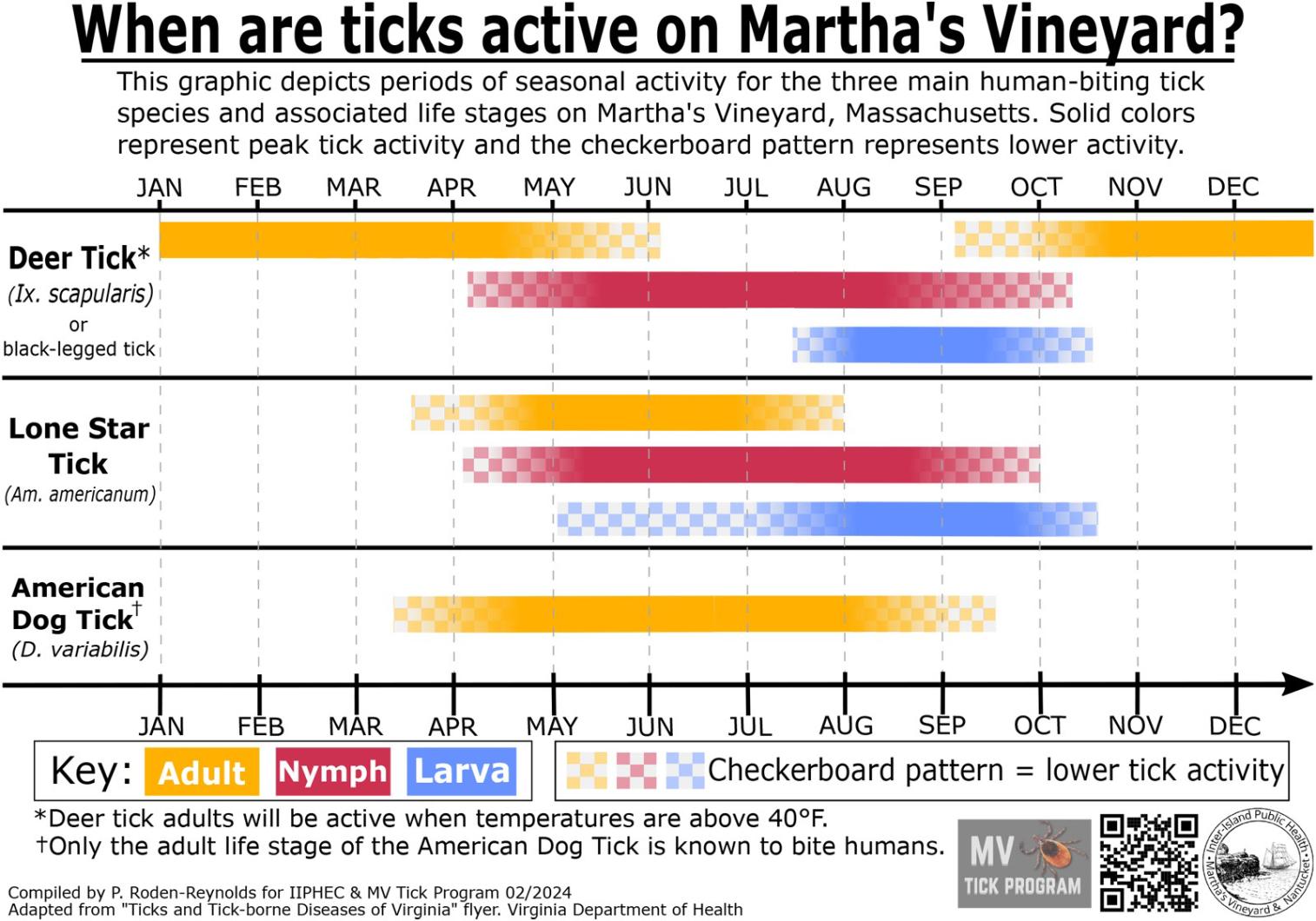
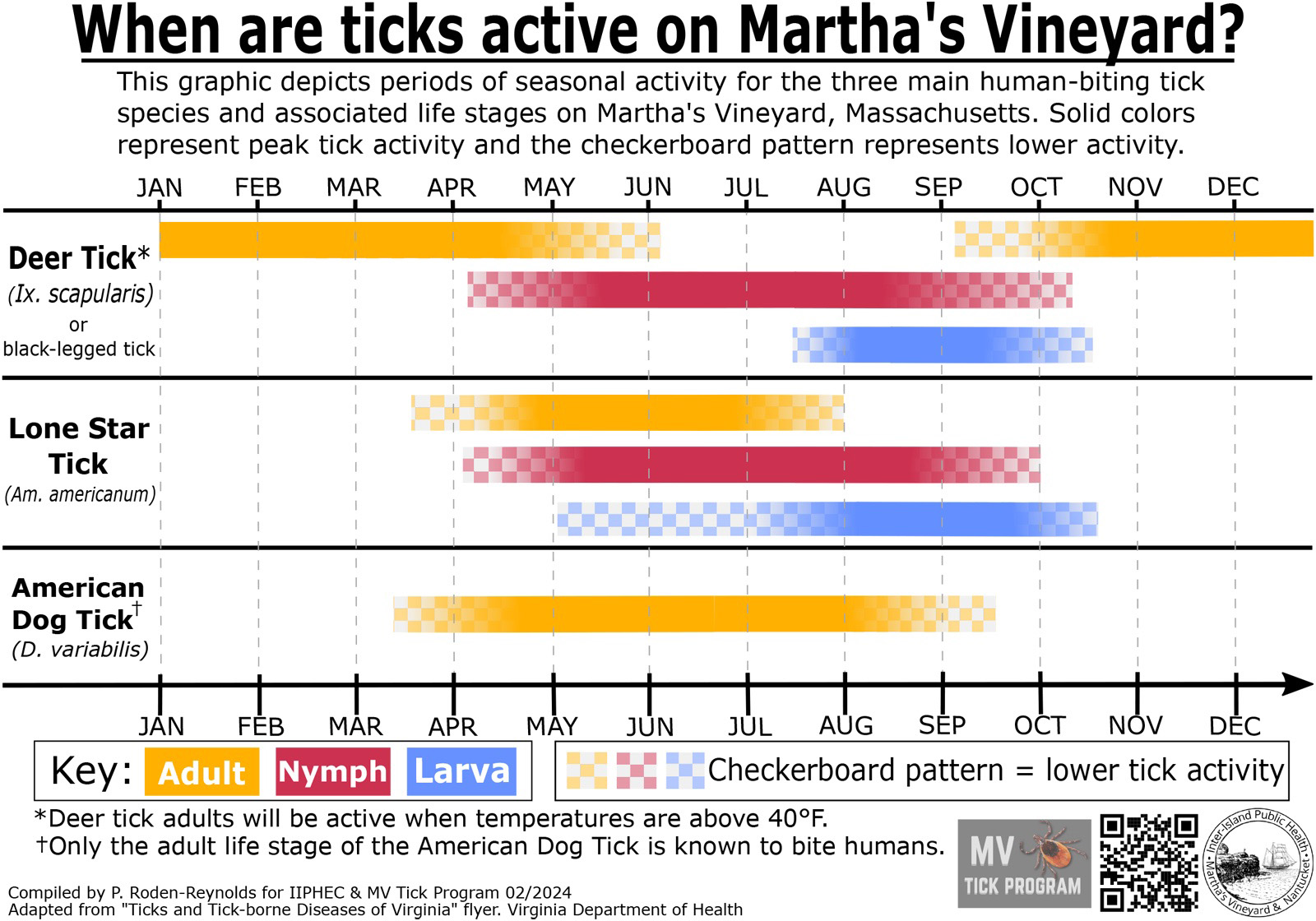
Lone Star ticks have been dramatically increasing on the Island, and the late summer and fall is the top time for their larval stage. Yes, the dreaded tick bombs are most likely the cause of the itchiness and irritation.
Patrick Roden-Reynolds, our Island tick expert and officially the biologist for the MV Tick program, agrees with my assessment that the likely culprits are Lone Star tick larvae. He notes that August and September are peak larval season, and while deer tick larvae can also bite, if you are seeing many bumps and bites (from a few up to 100) anywhere from the torso down, but usually on the ankles and groin, you’ve likely been the victim of those Lone Star larvae. Remember that the aforementioned oak leaf itch mites fall from the trees, so their bites are found above the waist on the neck, shoulders, arms, and chest, while Lone Stars come from the ground up.
And those Lone Star tick, nymphs and larva bites can cause sensitivity to alpha-gal and can lead to alpha-gal syndrome (AGS). Alpha-gal syndrome is an allergy to any mammal products (think meat and dairy plus many products and medicines with mammal-based ingredients) that can cause the skin irritation, stomach issues, and go as far as causing anaphylactic shock. Patrick adds that “larvae may pose a unique risk to AGS because you are likely to get MANY bites at once, but again there is no hard evidence to confirm. There is still no concern for contracting an infectious disease from Lone star larvae bites like Ehrlichiosis or Tularemia.”
If you or your family have the itch, be sure to get tested for alpha-gal and other tick-borne diseases. While I am not a doctor, my own itchy bites had me initially scratching my head, but now that I know the cause, I can only share that I am quite ticked off (if not mit-ily mad) and I blame those sons of itches.
Suzan Bellincampi is director of the Felix Neck Wildlife Sanctuary in Edgartown, and author of Martha’s Vineyard: A Field Guide to Island Nature and The Nature of Martha’s Vineyard.
Comments
My husband came home from our
Joni Staigers Haley New Boston, NHMy husband came home from our week on the Vineyard with a rash. Does anyone know what the antidote or cure is? How long does it last?
Never saw what bit/ stung me,
Cally G EdgartownNever saw what bit/ stung me, but received 25 or more bites all around both ankles around August 1st. Probably happened while dog walking on bike path off of Old County Rd. The result was raised red ultra itchy bumps. Have lasted now for a month. Still intensely itchy.
I find it odd the author
Marc G BostonI find it odd the author never mentions whether people who have been bitten have actually seen an insect on their bodies, clothing, bedding etc. I suspect they don’t. I could never find one when I received dozens of bites that itched fiercely for over a month while on Chappy in Sept a few years ago. Google indicates that mature lone star ticks would be easily visible and that the larvae are the size of a grain of sand therefore also visible, whereas oak mite larvae are virtually invisible. So I’m left skeptical of the Gazette author’s conclusion.
I agree with Marc that part
Deborah J Mayhew West TisburyI agree with Marc that part of the mystery is that while many people have reported being bitten by lone star nymphs that they see, probably just as many of us never have seen our biters. I have been getting new bites weekly since July, and have never even once seen anything. Perhaps we have more than one source of this torture.
Loan star larvae are very
Victor Colantonio EDGARTOWNLoan star larvae are very very tiny and nearly invisible (no color), nearly impossible to see with the naked eye. They bite and drop off unlike nymphs and adults that engorge. Author Bellnicampi hit the nail on the head. BTW, there are no oak mites in New England. Conclusion: lone star tick larvae.
Does the standard tick
John EdgartownDoes the standard tick repellent containing Permethian work with Lone Star ticks - - if not are there any other preventiative steps besides long pants and long sleeves ?
Both my husband and I were
Carolyn M Guilford CTBoth my husband and I were bitten over our entire body, but mostly on our feet and lower legs during our 10-day stay at our house in Chilmark at the end of August. We initially thought it was poison Ivy, but a pharmacy worker at Conroys suggested Chiggers. She said she’d seen over 150 people come in with similar complaints over the past few weeks. Three weeks later and we’re still very itchy. We got a precipitous cream recommended by Conroys, but it honestly did very little.
Definitely sounds like lone
Liz Vineyard HavenDefinitely sounds like lone star larvae bites. Itching for a month is not unusually but varies from person to person.
I’m sure there are many
Jeannie C. Vineyard HavenI’m sure there are many variations of this affliction, but I had mysterious, red, itchy bumps from my neck to my ankles so can’t figure out whether the falling mites from the trees or the crawling ticks from the ground would be more to blame. Three of four humans in my house were ravaged. I was sure my landscaper husband had brought the invisible creatures into our bed since I’m not outside as much as he is but now that everyone is itching I’m looking elsewhere for an explanation. Weird!!
What a great piece of writing
Cheryl Eppel West TisburyWhat a great piece of writing! And also very funny! Thank you for your wisdom and humor about everyone’s least favorite subject!
While I respect the author's
Caroline ChilmarkWhile I respect the author's position, I would have to say it is incorrect. This is at least the third year we have had oak mites on the island, and for those of us who have been attacked by both Lone Star nymphs/larvae and oak mites, the difference is extremely visible: the Lone Star nymphs/larvae, while ALMOST impossible to see, are actually visible before they burrow, and the oak mites are not. The time-delayed small raised blister from the oak mites is also distinct from the instant red ring the tick nymphs/larvae offer many individuals. Although the itch is chigger-like, the insect is NOT chiggers. I agree with the author's conclusion--if you don't know what it is, and you are on-island, it makes sense to assume the worst and test for tick diseases, but just because oak mites "haven't been reported" (by whom? we ARE reporting them!) as being carried to New England yet, does not mean they are not here. I remember the bad old days when Lyme disease also wasn't "reported" as being in Europe or even widespread in New England--now we know better. It's good to have attention drawn to this problem, but let's not be dismissive of citizen science (which we count on for all kinds of observations) as pseudo-science.
All of these bite issues are
Mike B UpislandAll of these bite issues are ticks and mostly lone star nymphs. The most important thing you can do is clear the trees/brush/long grass around your house and do not walk into high grass/brush. Spray your property periodically with things that work (not organic). Treat your clothes with permethrin. Shower frequently during the summer and particularly after you feel like you might have been exposed. Nature cops be damned…..protect your self and your property. This is a major public health issue on the island and it does not get enough focus from the town/state governments or the pharmaceutical companies.
Add new comment