

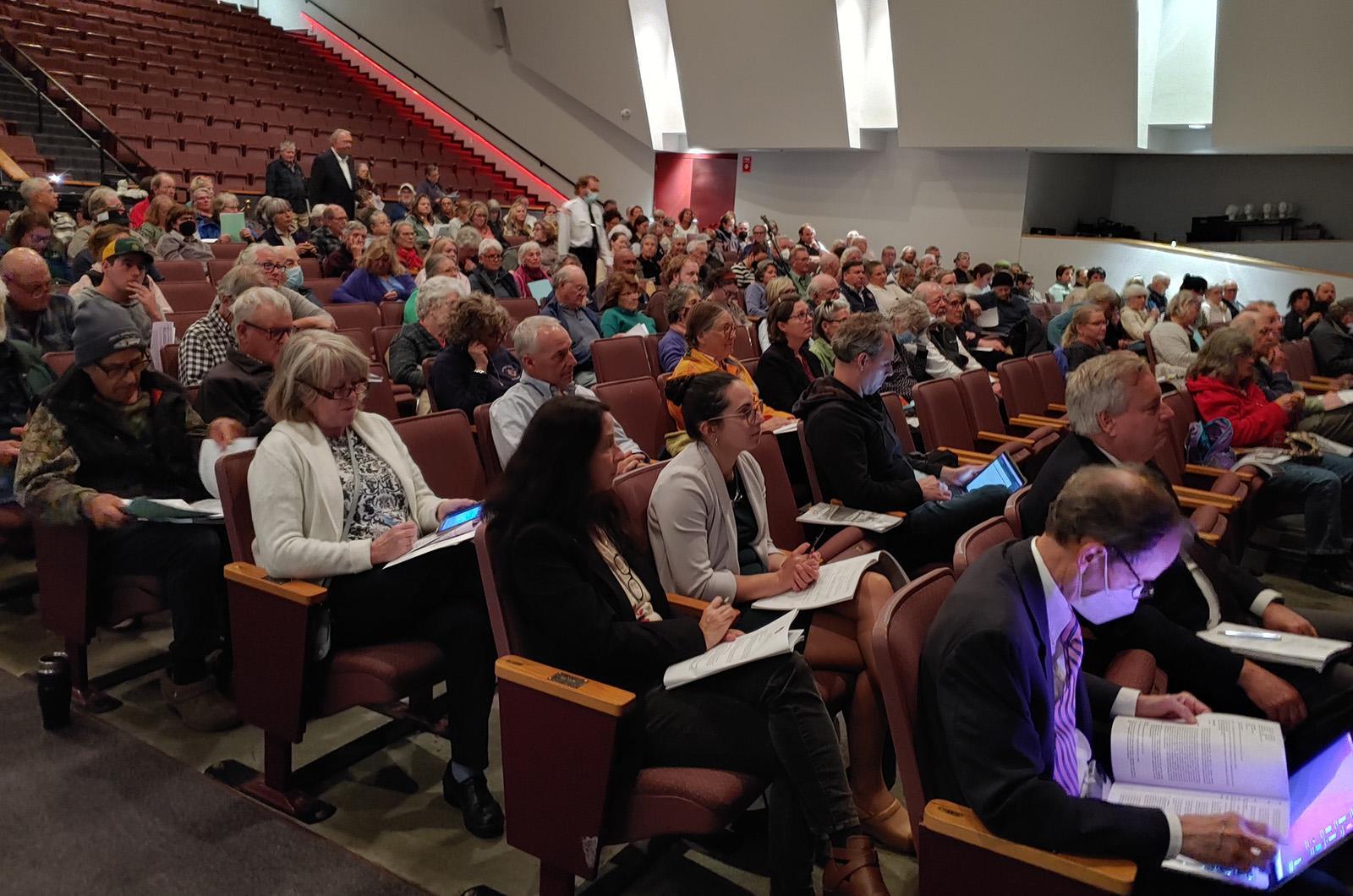
Voters will consider a zoning bylaw that puts limits on trade-related activities in residential districts when Tisbury town meeting opens on May 28.
With the Tisbury School rebuilding project on schedule for occupancy this fall, voters are making what’s expected to be their last trek to Oak Bluffs for the annual and special town meetings May 28.
Tisbury has been renting the Martha’s Vineyard Performing Arts Center for its town meetings since 2022, when work began to dismantle and rebuild the school where voters have met for generations in the gymnasium. State lawmakers granted permission for the switch through this year.
Because of scheduling conflicts at the performing arts center, which is part of Martha’s Vineyard Regional High School, the 2024 town meetings come more than 13 months after last year’s.
This annual town meeting warrant is likely to bring less drama than in 2023, when voters engaged in contentious discussions over the regional high school budget and an unsuccessful zoning bylaw amendment that would have applied limits on trade-related activities in residential districts.
The bylaw amendment is back this year, shorn of a weight limit on parked trucks that was one of the sticking points in 2023.
The amendment now limits business-related parking to two vehicles and one trailer no longer than 30 feet, all three of which must be parked entirely on the property at all times.
Applying to business owners and tradesmen alike, the proposed new language also removes an existing ban on outdoor storage of materials, replacing it with a requirement that the materials be screened from abutters’ views.
The amendment addresses other activities more specifically: It prohibits outdoor dry cutting of stone and masonry and outdoor spraying of paint “or other compounds, beyond household use,” in accordance with the zoning bylaw on noise, illumination and odors.
In the the town’s groundwater protection district, the proposed bylaw requires a permit from the planning board to store toxic, hazardous or flammable materials “in quantities greater than those associated with normal household use.”
The bylaw changes were written by the planning board as an effort to accommodate the building, landscaping and artisan trades while retaining the character of residential neighborhoods. Tisbury’s finance and advisory committee has unanimously recommended the changes.
Voters on Tuesday also will be asked to approve the town’s $40 million operating budget for the coming fiscal year, which begins July 1, as well as appropriations for capital projects ranging from $5,000 for a town tree farm, to be planted by landscaper and former select board member Tristan Israel, to $80,000 for a comprehensive assessment of the town’s technology systems. The budget increased by 2 per cent over last year.
This will be Tisbury’s first annual town meeting since longtime moderator Deborah Medders retired last year. Donald Rose was elected to replace her.
It will also be the last annual for town administrator John (Jay) Grande, who has announced he won’t seek another term when his contract expires next March.
Mr. Grande still has at least one special town meeting to look forward to in the off-season, as Tisbury seeks to move forward with its town hall building project.
Tisbury’s town election takes place June 11, with only two contested races on a ballot of 14 seats.
Tisbury School committee chair Amy Houghton is defending her committee seat against planning board alternate Lora Ksieniewicz, and incumbent constable Mark Campos faces challenger David Kann.
The May 28 town meetings begin at 7 p.m. in the performing arts center.
Election hours on June 11 are noon to 8 p.m. at the public safety building on Spring Street.
Comments
The reshaping of this failed
Not thought out! TisburyThe reshaping of this failed article from a year or two ago should still fail.
Little input from us in the trades and NO empathy on our struggles to find adequate space to park, live or survive. We love it here yet the Town of Tisbury and their Bylaw tweaks keep making it more and more difficult to stay in Tisbury. We don't have these type of issues in other towns.
Already parking in Tisbury is
Really? TisburyAlready parking in Tisbury is tight. It has not gone unnoticed by those who live here that Tisbury has methodically removed parking from our town over the past several years. This will push the trades vehicles out onto the streets and they will be competing for rare parking spaces with residents who also need the parking spaces. Their vehicles tend to be bigger and harder to safely navigate around especially when parked on these narrow in-town streets. Let them park on their own property. Look at Spring St, Williams Street and Center Street at night. There are a lot of trades vehicles. If the owners pay taxes to the Town, the Town should let them park their trades vehicles on their own property. Tisbury wants to micro manage the trades-people who are tax paying, homeowners and residents of this town and then allow a corporation to have a 9-car parking lot on a "single family" R-10 residential property. Where are the restrictions on that? How is a 9-car parking lot that comes to the property line on three sides "retaining the character of residential neighborhoods". it does not. It obliterates the character. Especially if you have to live near one of these commercial properties that is hiding behind "single family residential zoning" and operating under masked foreign held LLC's. Do we have separate enforcement for LLC's, corporations, and yet another for our year-round tradesmen and another for year round citizens? Really?
While there may be cause for
John VHWhile there may be cause for some regulation of commercial activities in residential neighborhoods, bans by vehicle count is not a good approach. Some businesses have multiple vehicles for different rolls, and are not necessarily used all the time for work. Some vehicles are registered commercially for insurance reasons and because they are occasionally used for work and owner is following Mass DOT regulations. And I also agree with above comment made by Really? There are a lot of places that are likely occupied beyond capacity with cars parked all around house, whose comings and goings are more disruptive to neighborhood tranquility than a tradesman with a few employees keeping regular business hours.
Add new comment