


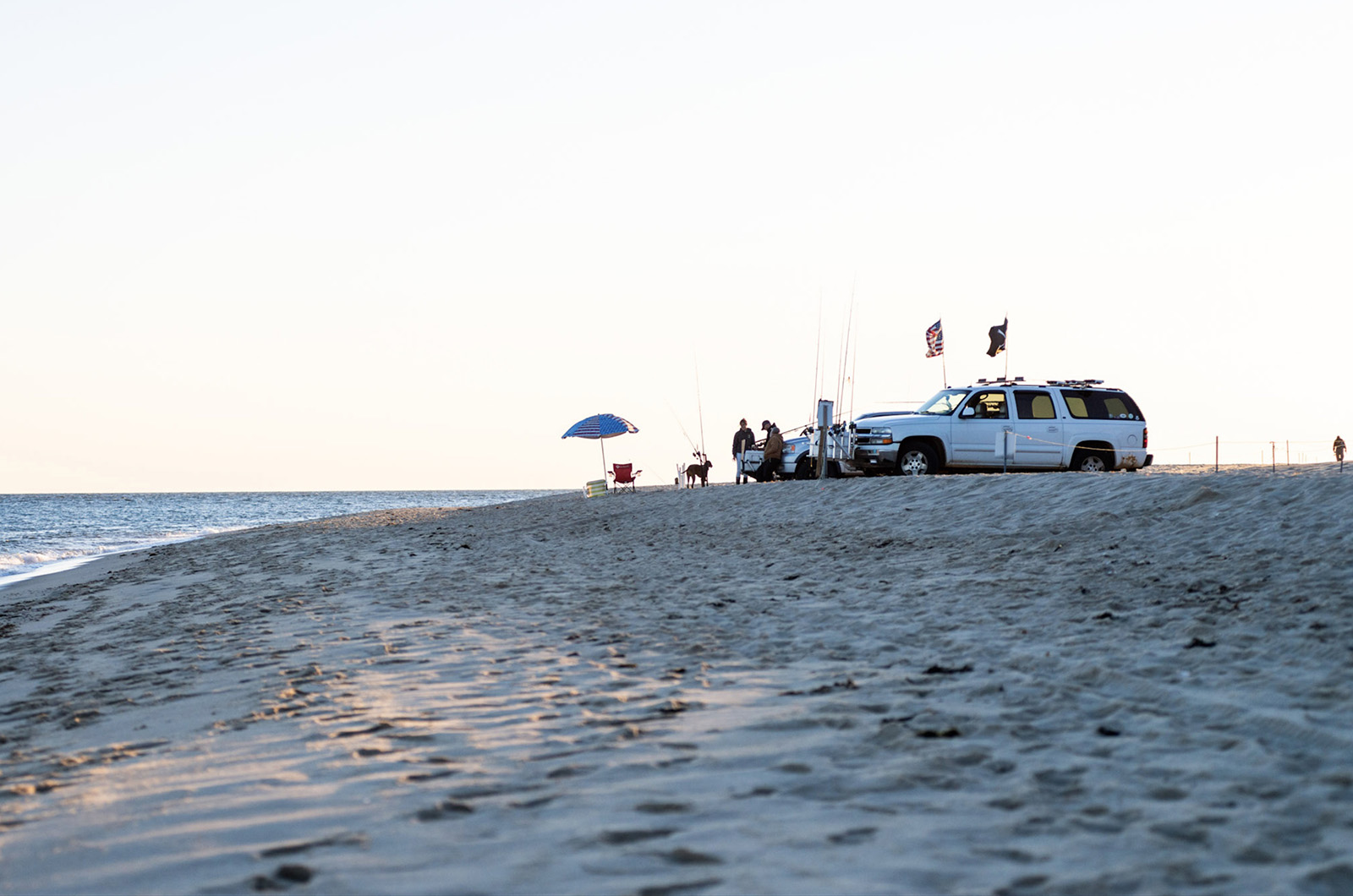
This week, The Trustees of Reservations, the nonprofit that manages the 16 miles of Chappy trails, publicly objected to proposed regulations from the Edgartown conservation commission, saying the rules are not aligned with state environment law and instead were formed with local politics in mind.
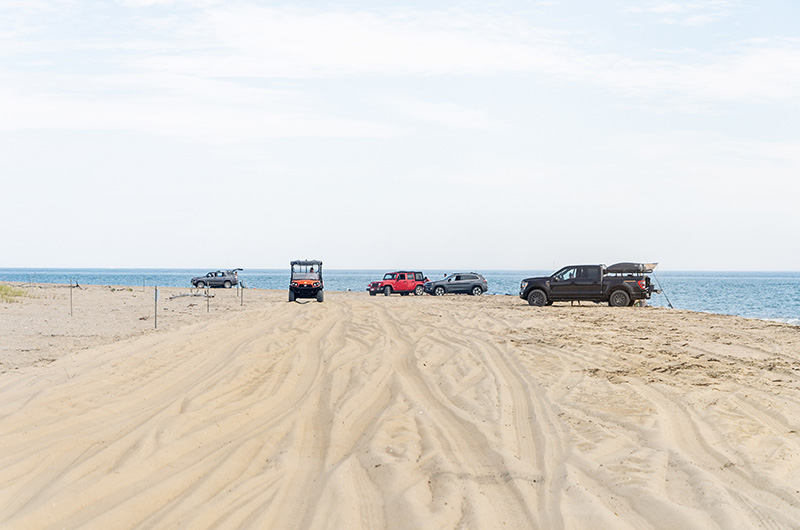
Just weeks ahead of the unofficial start to summer, Chappaquiddick’s oversand vehicle trails are looking a lot more like battle lines.
This week, The Trustees of Reservations, the nonprofit that manages the 16 miles of Chappy trails popular with beachgoers and fishermen, publicly objected to proposed regulations from the Edgartown conservation commission, saying the rules are not aligned with state environment law and instead were formed with local politics in mind.
“That has nothing to do with the ecology and the protection of the beach, that has to do with what the landowners want,” Trustees president Katie Theoharides said in an interview with the Gazette.
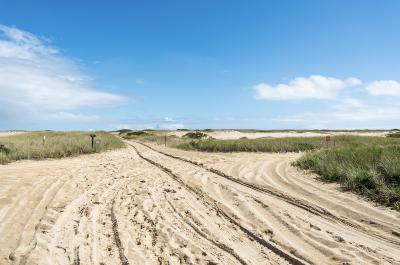
Vehicle access to Cape Pogue has been contentious for years.

Vehicle access to Cape Pogue has been contentious for years.
Ms. Theoharides said her organization plans to push back on proposed vehicle limits from the conservation commission, as well as protest the commission’s ban on vehicles driving past the Cape Pogue lighthouse to a stretch of shoreline prized by fishermen. If necessary, the Trustees is also willing to take its concerns to the state in order to seek overriding approval, she said.
These protestations, echoed by the Trustees in letters to the town, indicate that the conservation commission’s draft regulations unveiled late last month will not be the end of a long-running, contentious fight over access to Chappaquiddick’s pristine shore and leave some beachgoers hoping for a denouement.
“This has been a long, bruising fight and we just have to move forward,” said Jonathan Herman, a member of the Martha’s Vineyard Beachgoers Access Group and seasonal Chappy resident.
At the Edgartown Conservation Commission’s April 24 meeting, commissioner Geoff Kontje outlined draft regulations that would allow 30 vehicles at a time on Cape Pogue and 200 across the Trustees’ Leland and Wasque properties. The contested trail from the lighthouse to the Gut, which is currently the subject of a lawsuit between neighbors and the Trustees, would be off limits.
The conditions came after more than two years of back and forth about how the Trustees would manage the beaches on Chappy.
At that meeting, Mr. Kontje expressed hope that the new rules could settle the issue and get people out on the beaches for the season.
“We’re into the fishing season now, just at the very beginning of it, so I think this is a good time to consider voting on this,” he said.
But the limits have also drawn opposition from several groups, including fishermen and Chappaquiddick homeowners, in addition to the Trustees.
The Trustees had proposed 300 vehicles across all the properties, and it remains against setting separate limits for the different properties.
Officials with the Martha’s Vineyard Striped Bass and Bluefish Derby were also concerned by the limits on Cape Pogue.
“The Derby respectfully requests that the vehicle capacity limit be increased to 50, which would more accurately reflect the capacity of Poge assuming an ocean facing travel (with parking) corridor,” derby committee chair Phil Horton and derby director John Piekos wrote in a letter to the conservation commission.
But Cape Pogue residents have felt the vehicle caps are too high, potentially leading to worsening conditions along the shore.
Katie Theoharides.
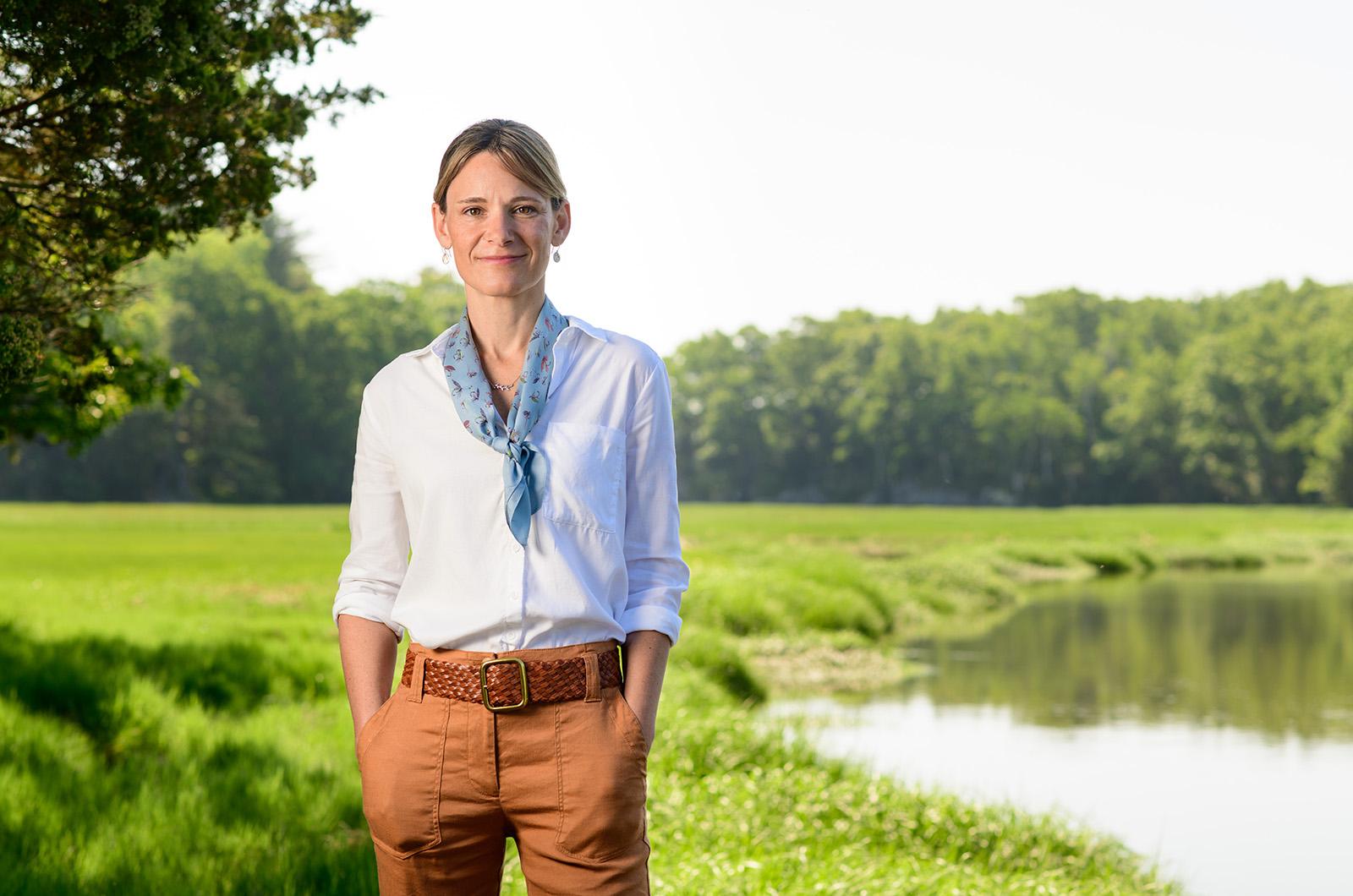
Katie Theoharides.
“There is no room for 30 cars to play north of Tom’s Neck,” resident William Gazaille wrote in a letter to the conservation commission. “Allowing so many cars to recreate on a resource with no room for them invites people to drive off the established trail and damage the resource.”
The Trustees have said the busiest day on Chappaquiddick recorded about 300 vehicles, and the organization would be requesting changes to the conservation commission’s caps. Ms. Theoharides said she would be open to limiting access to 200 vehicles across all properties, getting rid of the proposed bifurcated limits proposed by the conservation commission.
Ms. Theoharides’ previous job was as the state secretary of energy and environmental affairs in the Baker-Polito administration. She contends that the new regulations by the conservation commission are not based in scientific fact, or backed by the state Wetlands Protection Act, but instead prioritize the interests of private landowners on Chappaquiddick and would limit public access to the beaches.
“The commission wrote this order of conditions not based on science of the Wetlands Protection Act, but really based on politics,” she said.
Rachel Self, another Cape Pogue resident who has pushed against the Trustees plan, contended that the Trustees have never provided credible evidence to justify its plan for the beaches.
“[The Trustees] has numerous experts in the field available to them,” she wrote in a letter to the conservation commission. “Scientists, environmental engineers, biologists and coastal engineers on the payroll and even on property on Martha’s Vineyard. Why hasn’t the applicant provided a single person who could offer credible, reliable evidence on the non-adverse impacts of recreational OSVs on the resource at any of the hearings?”
The conservation commission also proposed a condition where the Trustees would have to appear before the commission monthly to report on how operations on Chappaquiddick were going. The commission sought reports on vehicle counts, the number of staff and trail closures.
In general, the Trustees’ argued the town was overreaching in its proposed regulations, stretching beyond the confines of state law into nitty gritty details such as where fees were collected and signage. The Trustees attorney also said that while open lines of communication were welcome, the law has no requirements for any such monthly meetings.
As evidence of conditions aimed at appeasing homeowners, Ms. Theoharides pointed to Norton Point, where the conservation commission put only five conditions on Edgartown’s plan to run its oversand vehicle program. But the commission’s proposed conditions for the Trustees amount to nearly 30.

The conservation commission meets again next week.
The conservation commission meets again next week.
If the conservation commission insists on what the Trustees considered overreaches, Ms. Theoharides said the Trustees could seek a superseding determination from the state Department of Environmental Protection on the issue — vaulting over the conservation commission’s authority.
The nonprofit felt that the issues would be better addressed in a joint agreement outside of the regulatory conservation commission process guided by state law.
“Again, we appreciate the Commission’s efforts to accommodate multiple interests,” the Trustees’ attorney wrote to the town. “But that may be the source of the problem: an order of conditions is not the place to balance multiple interests, but only those interests protected by the Wetlands Protection Act and its regulations.”
The conservation commission is set to take up the draft regulations at its May 15 meeting. Mr. Kontje declined to comment on the Trustees’ statements, saying he didn’t think it was appropriate with the hearings ongoing.
Conservation commission permissions aside, the conditions of the beach have also shut down travel on bayside trails for months, and the town has raised concerns about the condition of the Dike Bridge bulkhead, potentially threatening access to all of the beaches.
Several residents on Chappaquiddick said the Trustees have not maintained the area and said the town should pull back and look at the overall health of the beaches.
“This entire dispute before this commission will become moot when Mother Nature weighs in,” David Tyler, owner of a home on the Cape Pogue Gut, wrote to the commission.
The Trustees may also need to go to the planning board to reapply for a special permit, as well as deal with the ongoing lawsuit with Cape Pogue residents, which has a hearing scheduled for June.
Mr. Herman with the beachgoers group hoped that the conservation commission would keep the current rules, which allow vehicle access to Leland, Wasque and up to the Jetties, in place if the battle rages on.
But he wished everyone would take a breath and let the historical vehicle access continue in whatever shape the shifting sands allow.
“This can’t stay in limbo forever,” Mr. Herman said. “We have to just move forward, whatever it’s going to be.”
Comments
The separate limits for
Brian B. ChappyThe separate limits for Leland and Cape Poge could be a problem if Leland is completely closed for shore birds. In that sense a unified limit seems more favorable, but 200 is way too low. It should at least be the 230 combined number proposed by the Conservation Commission, or better yet, 300, which is still much lower than the capacity of the beach under the state beach management guidelines.
Please keep up the good fight
Chappy BeachgoerPlease keep up the good fight Trustees. The Cape Poge residents won’t stop with just blocking OSVs. They ultimately want to block all access. Case in point, a few years ago they succeeded in prohibiting anchoring in Cape Poge Bay, effectively making the area off limits to boats too.
It’s a good thing anchoring
R Scott Patterson EdgartownIt’s a good thing anchoring banned in the pond. It’s hell on the eel grass which is essential for a healthy pond.
Comparing Norton to Cape
Apples to Oranges EdgartownComparing Norton to Cape Pogue is comparing apples to oranges. Comparing the Town's management ability to the trustees management ability is comparing Apples to compost. The Town wouldn't need to put so many conditions on the trustees if they had any history of compliance or ability for follow-through. Comparing trustees beach management to Norton Point Beach Management is in a word: Absurd. Norton has always been recreational in purpose and is much larger. It also is public land. Cape Pogue has always been a wildlife refuge first and is much smaller than Norton. It is all private land. Norton has a full staff and a full budget for proper management. The trustees s in a multimillion $$$ structural deficit, laying off staff, and is continually quoted as needing to "scrape through the sofa cushions" for anything. The Town has been doing an awesome job managing Norton. When one is succeeding you don't need to give them further instructions. The are already getting the job done. When one is failing and undisciplined, a sterner hand is necessary.
The Trustees keep complaining
JH ChappyThe Trustees keep complaining the rules are different for them. If the trustees find this all so hard they should just give their land to the town. At least the town will up keep it for the people and the money stays here.
I must reiterate once again
TTOR Member ChappyI must reiterate once again that it's a fallacy to believe that The Trustees takes money away from the island. The organization actually manages the island resources and programs at a loss. Resources from off island come into the island to help sustain these special places. We actually derive benefit from their scale and breadth of mission. And everyone highlights how well Norton was managed by the town last year, but we also have to point out that there was likely less overall access under town management. I believe there were less cars allowed onto the beach, it's closed during the off-season months, dogs are now restricted, etc.
TTOR uses the money it takes
Skip Tomassian EdgartownTTOR uses the money it takes in on other projects. Once upon a time I was a member of “The Friends of The Trustees” Foster Silva managed the beach and collected the sticker money and we kept it Edgartown Bank. The Trustees got their knickers in a twist and made us turn the account over to them. It’s been on the downslide ever since and Pogue is severely mismanaged. Under no circumstances should you ever believe a thing they say. Plumb Island and Cape Pogue are the two biggest money makers for the trustees. They are not going to let go of those dollars they spend elsewhere. There were about 5 “Friends” all good people. Just hearing the name TTOR disgusts me
The Trustees did a much
Ally Bries KatamaThe Trustees did a much better job of managing Norton Point than the town does. Under Trustees management, Norton Point was open 24/7/365 and dogs were allowed year round. Under town management, Norton Point is only open to OSVs during the peak season and only from 9 to 5. Also, dogs are now prohibited on Norton Point during the peak season. I wish people would appreciate all the good the Trustees do on island.
“There is no room for 30 cars
Nick WT“There is no room for 30 cars to play north of Tom’s Neck,” resident William Gazaille wrote in a letter to the conservation commission. “Allowing so many cars to recreate on a resource with no room for them invites people to drive off the established trail and damage the resource.”
Unless I’m misunderstanding the geography, there’s two miles of beach between Tom’s Neck and the lighthouse. Does Mr. Gazaille actually believe that’s not enough room for thirty cars or is the “30” a typo?
This will be the summer of
Local ChappyThis will be the summer of shear pen pond.
Land or by sea
We will be there !!!
We are all interested in the
Charles Hoopes ChappaquiddickWe are all interested in the sustainability of the Chappaquiddick barrier island beaches. We all recognize the difficult and inevitable conflict between the preservation of access and the overutilization of resources. A statement as to how many vehicles can be physically located within a geographic zone - defined as "quota" in the 1994 Massachusetts Beach management recommendations - does not address the biological impact of OSV volume or define an ecological carrying capacity for beach resource utilization. While there is no debate that OSVs impact beach morphology and macrobenthic assemblages (more than 50 peer reviewed manuscripts since 1978), there is significant debate as to how much injury will preclude sustainability - an eventual loss for everyone. I am hoping the TTOR in their role as stewards will have a conversation with the entire community as to the objective criteria for decision making in the "adaptive beach management plan".
FREE CAPE POGE
Benjamin I. EdgFREE CAPE POGE
The Trustees are a total
Sean EdgartownThe Trustees are a total disaster. I’ve been to every Con Comm meeting. Their lawyer is useless and the island Director doesn’t have a clue. This is a public relations disaster. Maybe the town should manage this land, not the Trustees. Also, the MV Bag group needs to realize the trustees are doing us know favors in getting any of our access back. What a total mess! When I get back on island this summer I’m going to start befriending the Pogue residents. I don’t blame them for their grievances towards the Trustees. The Trustees who are more concerned about making money, than taking care of plovers. Let’s start being honest about the disaster that the Trustees created here. Completely mismanaged for years. Out of compliance since the 90s?! What a complete joke they are. Time for them to look in the mirror….for once! So tired of this whole situation. They are not good for our community. I’ve had enough of them. They caused the problems because they forgot to remember how to do proper paperwork. The town should have called them out decades ago as well.
Thank you Trustees for
Nick Dean Marthas VineyardThank you Trustees for stating the obvious and committing to beach access. Its very clear that the residents are using the conservation commission as a guise to restrict access to PUBLIC LAND.
A little clarification: The
Norma EdgartownA little clarification: The TTOR properties are not 'PUBLIC LAND'. This is Private Land owned by a Non-Profit organization, required by the IRS to provide public benefit. OSV access is only 1 type of public benefit, according to Federal and State law. If it is determined that OSV access contributes to the degradation of the Natural Resource, then the public benefit will have to take some other form - like an intact ecosystem for example, that contributes to protection from climate change. It is a Wildlife Sanctuary, which is shrinking. I would appreciate the Trustees commenting directly on the ability of vehicles to both park and and have a travel lane, on the outer beach, at high tide. In some areas, it's just not possible.
To clarify, Leland Beach is
Charles A. ChappyTo clarify, Leland Beach is in fact public land—it is owned by the state Division of Fisheries and Wildlife and expressly managed for fishing and hunting (the opposite of a nature sanctuary), with the trustees simply managing OSV access. https://www.mass.gov/info-details/wasque-point-wma. Further, the town owns a parcel on Cape Poge, so at the very least that portion of Cape Poge is also public land.
The state owns the land to
B.N. MVThe state owns the land to the right (South) of Dike Bridge (commonly referred to as Leland Beach) for the express purpose of providing public access for fishing and hunting.
Add new comment