

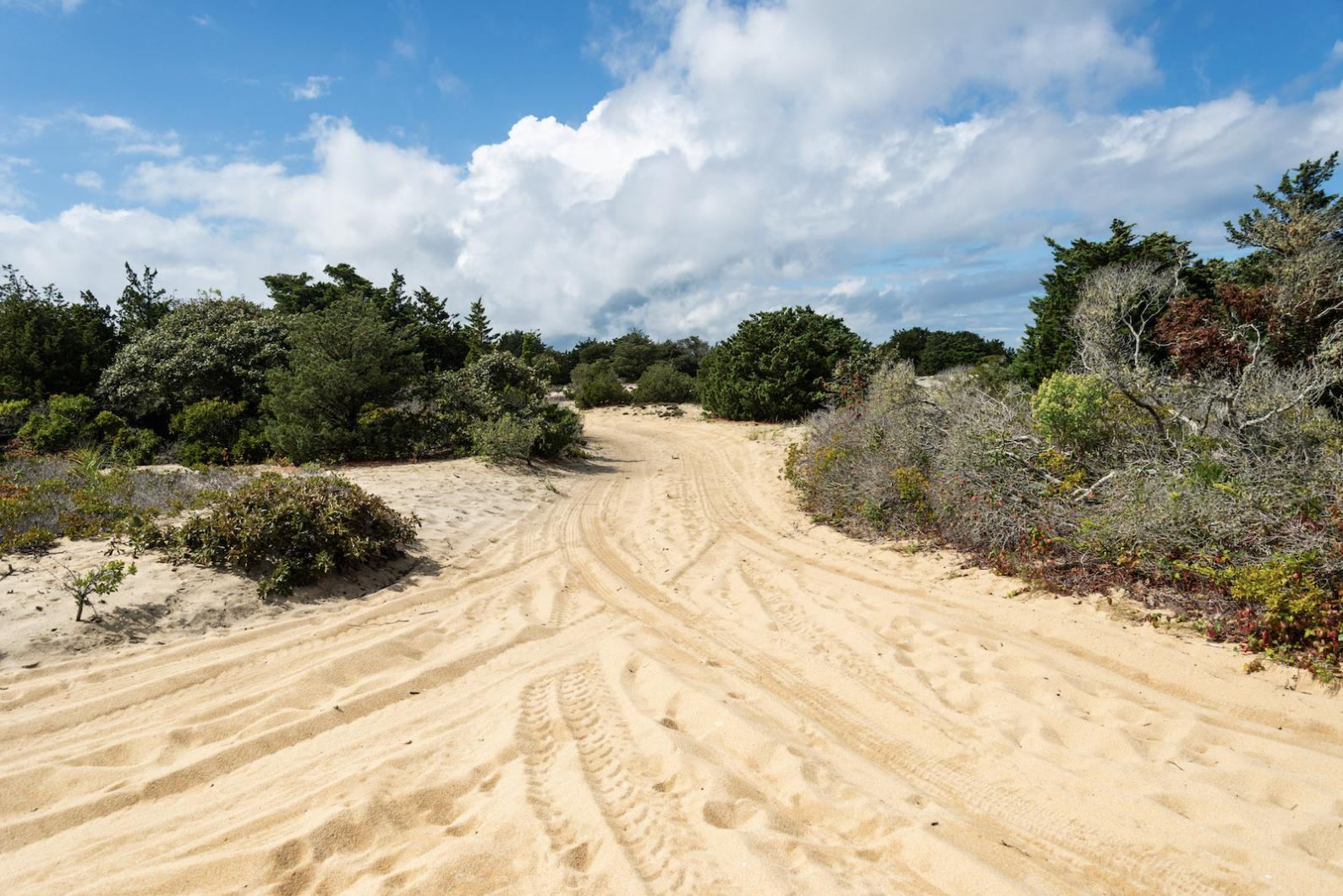
For decades, the Trustees have sold permits allowing people to drive out to the sandy beaches of Chappaquiddick, a popular destination for swimming, fishing and shellfishing. But the practice has come under fire in recent years.
Conservation officials are still on the fence on whether to approve The Trustees of Reservations’ oversand vehicle program on Chappaquiddick.
For decades, the Trustees have sold permits allowing people to drive out to the sandy beaches of Chappaquiddick, a popular destination for swimming, fishing and shellfishing. But the practice has come under fire in recent years, with neighbors alleging a pattern of mismanagement, noncompliance and understaffing at the dynamic coastal properties.
In a meeting held Nov. 8, the Edgartown conservation commission voted to extend the Trustees’ temporary order of conditions, a stopgap agreement between the two parties that allowed the Trustees to continue to operate the trails.
Originally set to expire Nov. 30, the conservation commission voted at that meeting to allow the Trustees to continue operating under its existing rules through the end of the year.
In a rare reconsideration, however, the commission chose to revisit its vote at Wednesday’s meeting after abutters raised concerns about the voting process. After some discussion, the commission decided to extend the order of conditions just one more week until the next hearing on Dec. 6.
Different parties have different ideas of what would happen should the temporary order of conditions expire. Shellfishermen have advocated to keep the properties open during scalloping season. Neighbors say that the public will be minimally impacted by a winter pause, when few are going to the beaches regularly. Most discussions revolved around whether the expiration will impact the Trustees’ winter restoration plans for the area.
The debate surrounding the Trustees’ management of its Chappaquiddick properties has endured for over a year and a half, since the statewide land trust first approached the commission to renew its OSV operations permits in 2022. Unable to decide on a long-term agreement, the commission ultimately granted the Trustees a temporary order of conditions in April 2023 meant to keep the beaches open through the end of the fishing derby season.
More than six months later, commission members and Trustees officials are nowhere closer to a path forward.
Approval is made more complicated by the fact that officials cannot determine what historic regulations looked like. Recently, building inspector Reade Milne wrote to the planning board stating she could not locate the Trustees’ original 1990 special permit allowing OSV access and requested the board’s advice.
At the Nov. 29 meeting, conservation officials questioned whether a refusal to extend would hinder the Trustees’ winter restoration projects. Although the beach nourishment and dune restoration projects have been approved under a separate permit, conservation agent Jane Varkonda admitted a non-extension could complicate matters.
“It makes it very gray as to whether Trustees personnel and equipment could access that area,” Ms. Varkonda said.
Trustees Islands director Darci Schofield said that although a majority of the restoration work will be carried out through a contractor, a small portion towards the end will be done by Trustees personnel. One major project, the trail restoration and beach nourishment at Cape Pogue, had been set to begin that week.
“It’s critical to get that taken care of,” commissioner Geoffrey Kontje said. “It’s overdue.”
Beach access advocates also pointed out that a failure to extend would make some of the Island’s most popular shellfishing destinations inaccessible to the public during scalloping season.
Abutters, many of whom were Cape Pogue residents, protested the extension, citing the Trustees’ recent and longstanding history of noncompliance. Since the temporary order of conditions took effect this spring, the town has found the Trustees to be noncompliant on two counts. Ms. Varkonda said she has also been in communication with Ms. Schofield regarding a set of port o’potties that had not been adequately secured.
“Jane and I were not in alignment in our understanding of the conditions, but I think we are doing better about that stuff,” Ms. Schofield said of the incidents.
According to town bylaws, extension votes do not require public hearings and are typically handled internally, Ms. Varkonda said. Still, she acknowledged that the current situation was “slightly irregular.”
“In this case…transparency is of the utmost importance,” Ms. Varkonda said.
Correction: A previous version of this article stated the building inspector's letter was addressed to the conservation commission. The commission was copied on a letter to the planning board.
Comments
These beaches represent a
Zulu ChappyThese beaches represent a significant amount of the publicly accessible shoreline on Martha’s Vineyard. It’s important that the Conservation Commission allow full access to the public, and end the constant bickering with abutters and the Trustees. Don’t let perfect be the enemy of good. And if all else fails, the town can use eminent domain to make all of Cape Pogue public.
A justice of the
Rich EdgartownA justice of the Massachusetts Land Court made this crystal clear- the right of way is fully appropriate. Why are we still talking about this? I urge the public to join the Edgartown Conservation Commission zoom meeting on December 6 at 4pm. The following is a quote from The Vineyard Gazette, May 9, 2022.
“In his ruling, Judge Speicher noted that the right of way at issue was originally established in 1891 and passed to the Trustees in 1959 when the organization acquired 132 acres and created the Cape Pogue Wildlife Refuge. A separate easement created in 1987”.
“Under state law, easements that don’t limit how they can be used are interpreted broadly — even if, for example, modes of transportation have changed, the judge wrote”.
“Accordingly, use of the right of way by motor vehicles is completely consistent with the general right of way granted in 1891,” the judge wrote.
Formed in May 2021,the MV
Peter Sliwkowski, President of MV Beachgoers Access Group Edgartown/ChappyFormed in May 2021,the MV Beachgoers Access Group (www.mvbag.org) is a group of Vineyard residents, business owners, and frequent visitors focused on preserving the balance between responsible beach access and active wildlife conservation on Martha’s Vineyard.
The leadership team put together our thoughts on the value of access to properties on Chappy and the NOI approval process that is ongoing.
- Leland, Wasque and Cape Pogue Refuge, under the stewardship of TTOR, boasts OSV-accessible properties that constitute 35% of the public beaches on Martha's Vineyard. Source: Beach Access Analysis Commissioned by MVBAG July 2021
- These properties not only hold considerable economic value for the Island but also contribute significantly to the overall visitor experience and the quality of life for its residents.
The public access to these properties serves much more than just a fishing and shellfishing destination. It provides the Island community a year-round outdoor nature classroom for Island school students, hosts children's summer camps, facilitates natural history programs for adults, provides opportunities for swimming, picnicking, kayaking, leisurely walks along the shore, and ultimately serves as a cherished gathering place for families and friends.
- OSVs are the only practical method of access to these properties especially for the elderly and disabled. A recent Letter to Editor in the Vineyard Gazette by Rich Thompson eloquently articulates the essential nature of OSV Access.
- It is MVBAG's understanding that the goals of these various meetings is to shape the development of the Notice of Intent (NOI) and Beach Management Plan, ensuring that the ultimate Order of Conditions is both balanced and reasonable.
- Although TTOR has demonstrated certain limitations in effectively managing the properties, MVBAG is relying upon the Town, led by the Conservation Commission Committee and supported by other relevant town committees, to exercise oversight and ensure that proper management standards are upheld.
All of the above use the
Bob D. ChappyAll of the above use the common sleight of hand of the OSV crowd of conflating "public access" with truck access. All of these beaches have public access, it's just the you might have to walk to get there. The elderly and disabled are also frequently brought up. If that's the case, then make truck access only available to those with handicapped license plates. Certainly 99% of those you see coming out of their trucks are fully able to make the hike. There's no doubt there's a negative impact on the fragile coastal environment by the large number of trucks often seen lined up on the beach, but also all the trucks significantly (and I do mean significantly!) degrade the beach experience for everyone else. I'm there to be on a remote beach, not a parking lot. I'm tired of rhetoric presenting truck access as the only option when it's not. Get out and walk, you'll enjoy the experience more and feel better too.
"Might have to Walk"? Bob,
Rich Edgartown"Might have to Walk"? Bob, do you suggest beachgoers walk 3.4 miles from the Chappy Ferry? There are 20 public parking spots on Chappy for 9 miles of beach. This compares to 400 public parking spots for less than a mile of beach at South Beach. Until an abutter agrees to build a parking lot in their front lawn, there is effectively no parking. This is the simple reason OSV exists and must continue. For someone who is tired of rhetoric and sleight of hand, you seem to practice both quite well.
Add new comment