


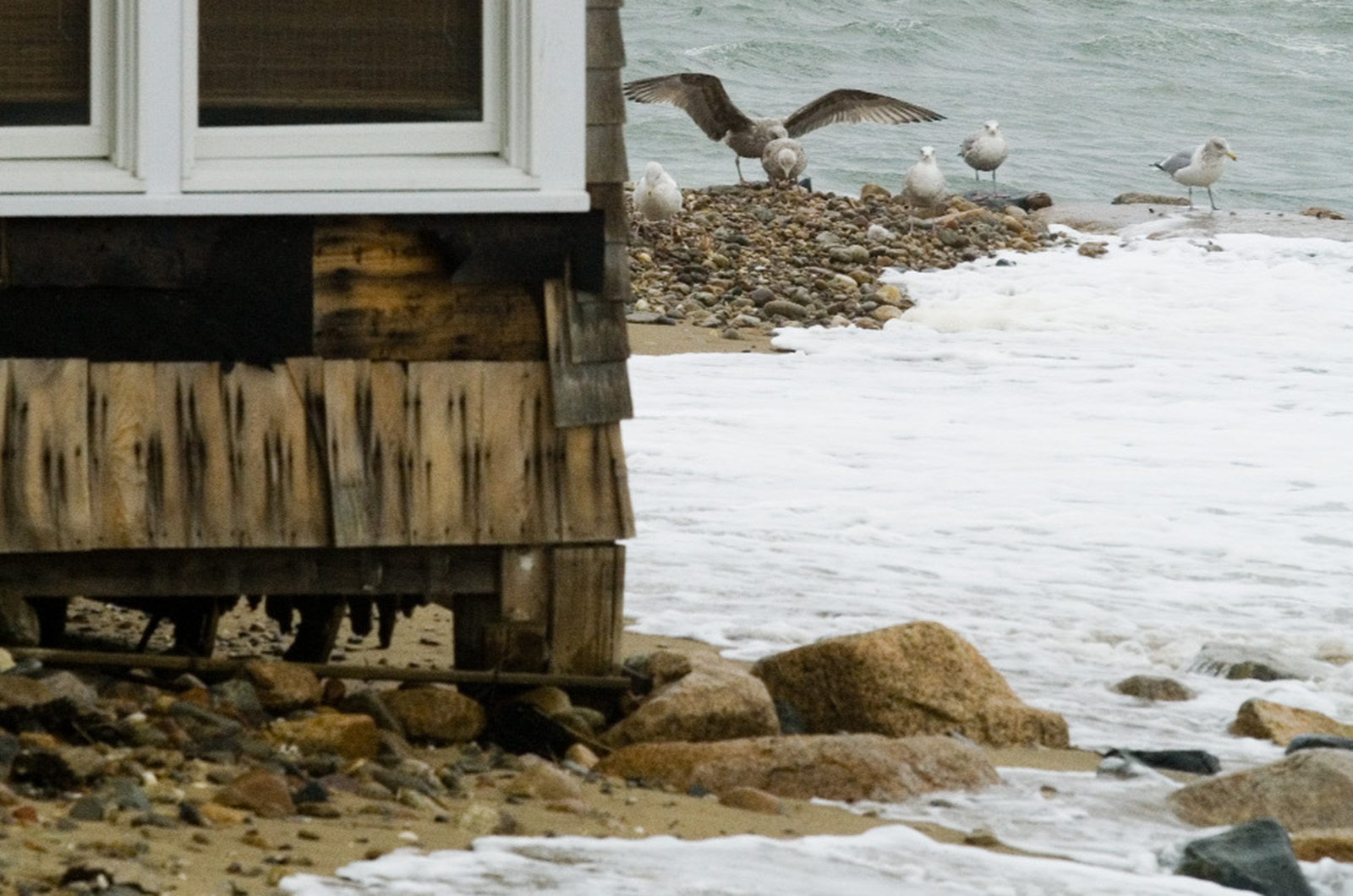
As the national insurance market retreats from areas ravaged by wildfires and storms, Island insurance agents say Martha’s Vineyard is increasingly being considered a risk by the companies writing homeowner policies.
As the national insurance market retreats from areas ravaged by wildfires and storms, Island insurance agents say Martha’s Vineyard is increasingly being considered a risk by the companies writing homeowner policies.
Some insurers are declining to renew either portions of home insurance or entire policies. In many cases, home insurance prices have gone up by 20 per cent or more. One Vineyard insurance agent said she has seen premiums jump 50 per cent as companies take a harder look at insuring on the Cape and Islands.
The tightening market is a result of fewer companies wanting to take on the risk of insuring an Island community with sky high real estate values at a time when major storms and fires are battering other parts of the country, agents at three Island agencies said.
“Nationally the insurance market is in a really tough spot,” said Richard Soo Hoo, the chief operating officer at Sterling Insurance in Tisbury. “The Island is really a microcosm of all that.”
“I’ve never seen anything like it,” said Paula O’Connor, business manager and executive vice president at Mone Insurance in Vineyard Haven.
Joe Gervais, founder and president of Tashmoo Insurance, said fewer than 5 per cent of Tashmoo’s clients — about 70 homeowners — have had their plans not renewed by carriers.
While Mone hasn’t seen many carriers canceling policies yet, Ms. O’Connor said the market is trending that way.
“The prices are going up by thousands,” she said. A 30 per cent hike isn’t unheard of, and she’s seen premiums on commercial properties start to double.
Insurance renewals started to come in the late winter, and by spring large increases were seen almost across the board, leading to what Ms. O’Connor described as a year of “horror” so far in 2023.
About 30 years ago, several of the large companies stopped insuring Island homes, according to Mr. Gervais. Lloyd’s of London stepped in to fill the void.
“Our marketplace has been dominated by Lloyd’s of London for the last 10 years,” Mr. Gervais said. “The household name insurance companies have not done business out here for over 30 years.”
Now Lloyd’s, which has several companies under its umbrella, is pulling back as more destructive storms are expected in different parts of the country.
Insurance companies buy what’s known as reinsurance — basically a form of insurance on themselves to protect from large claims. Though the Vineyard hasn’t had any major damage from a storm or other disaster in years, catastrophes elsewhere — such as tropical storm Idalia — ripple through the entire market. As reinsurance rates rise, it becomes more expensive to write insurance policies, and many insurers are simply backing out.
“Basically, it doesn’t matter where these hurricanes hit at all, and we are going to take a hit for that,” said Mr. Gervais. “We are going to suffer.”
Narragansett Bay Insurance stopped writing new policies as well as peeling away from existing policies here, according to Mr. Soo Hoo, and other companies are starting to offer non-standard coverage.
The remaining companies that would write new policies are limiting the number of customers they will take on because of the high cost of construction on the Island. Companies are also hesitant to take on too many new properties in one area in case a large storm were to damage all of them in one swoop.
“The cost to rebuild is so high it eats up that capacity fast,” Ms. O’Connor said.
Finding insurance up-Island is especially difficult because of the lack of full-time fire departments or town water, increasing the risk in the eyes of many insurers.
One homeowner in Edgartown shared a letter from their insurance agency with the Gazette. In August, AIG declined to renew a portion of the homeowner’s policy related to storm damage.
“The reason for nonrenewal is to reduce the Company’s exposure to catastrophic losses for risks with an unacceptable exposure to windstorm, hurricane, or flood due to proximity to water, elevation, construction type, or lack of exterior protection,” the notice read.
Many insurance companies have started to amend policies to include high mandatory wind deductibles. A 2021 report from the state Division of Insurance noted that wind deductibles had started creeping up in coastal areas, including the Vineyard, Cape Cod, Nantucket and the South Coast.
All but six of the top 25 insurance companies in the Massachusetts market had mandatory wind deductibles, and the largest deductibles were for coastal communities, according to the report. Some customers were seeing deductibles as high as 5 per cent.
Later reports for 2022 were not on the division’s website and the state agency did not respond to a request for comment this week.
With wind deductibles so high, most wind damage from storms likely won’t get covered at all anymore, Mr. Gervais said. As an example, a $1 million property with a modest wind damage deductible of 2 per cent would need to reach a damage threshold of $20,000 before the insurer stepped in to help.
“In most cases if there is a big storm, the insurance policy will not cover that damage because it’s less than $20,000,” he said.
Ms. O’Connor expects wind coverage to be rolled back in the coming years, as it has done for some commercial properties.
“I think that’s where the homeowner market is trending,” she said.
In some instances, people with higher risk properties can fall back on the Massachusetts Property Insurance Underwriting Association. The state-legislated association, commonly referred to as the FAIR Plan, writes policies for eligible applicants who cannot find other insurance.
However, the association only provides coverage for properties up to $1 million. Island agents said that leaves the Vineyard vulnerable because of the Island’s dizzying valuations and the cost of construction. The median home price in 2022 was $1.4 million.
“If they would increase their cap it would help out a lot,” said Ms. O’Connor. “Right now, it doesn’t do people a lot of good.”
Mr. Soo Hoo said that insurance often runs in cycles, with tough markets coming every six to 10 years. The current market, however, is one of the toughest.
One longtime insurance agent in his office has been helping homeowners for 30 years.
“She said it’s the worst she’s ever seen,” he said. “I would have to agree. If you look around nationally, it’s never been so bad.”
Comments
this is actually rather old
Ginny Jones WTthis is actually rather old news --it has been difficult to get and even more difficult to afford home owner's insurance for many years. Thanks to the RE agents for helping to promote the run away prices so that every house here, whether chicken coop or castle peaks out at gob smacking prices so that everything costs more -- eye watering more.
I’m with Tashmoo, who we love
One of the 70I’m with Tashmoo, who we love, and the company canceled my policy. The only company they could find doubled the premium and by the sounds of it we were lucky to get that.
An Actuary would tell us the
Tom Engley West Tisbury.An Actuary would tell us the odds of a large tropical system hitting MV is better than not So insurance companies at betting it is and raising prices. We cannot blame agents for these companies. Those are our friends and neighbors. The companies have reaped billions for decades and expect us to share their short falls. Short falls in profit not revenue. Shameful in the fact that we all strive for equality but remain left behind.
And a very important,
George Curme ROANOKEAnd a very important, significant reinsurance market worldwide reported by the weather Channel just now that total losses for the latest hurricane across the SE IS will total 1billion$ before it's all settled. That is a hugh amount. Not admitting reality is tantamount to fraud.
Environmental warming
Islander MVEnvironmental warming combined with the greed that took over the housing market and then the construction market — let’s face it, materials and labor have not risen commensurately with the costs of construction, they are charging more because they can. This is what happens when investors take over the island, of the housing market weren’t so high, construction probably wouldn’t be, but where would that leave the wealthy? They have nothing to do anymore.
With premiums so high it
Marty Milner TALLAHASSEEWith premiums so high it might make sense for all of the wealthy homeowners to pool that amount with everyone else and ask for a blanket policy insuring just homes on the island. It might be high enough in premium value to start an independent company. Reinsurance can be a two way street. By eliminating all the risk adverse people in the middle stream and being more direct, premiums might become reasonable. Stability of the community is key. South Florida is almost in open rebellion over rates.
Is there any way that MV
Not an Insurance Professional MVIs there any way that MV could be self insured? Has anyone crunched the numbers on what we all pay to outside insurance companies, and if that could be enough to create a fund capable of sustaining projected claims even in the worst of storms?
This is an interesting idea.
Islander MVThis is an interesting idea. It sounds idealistic and who knows if it's possible, but that doesn't mean it isn't worth looking into! I'm not sure how one would look into it, but you could ask your local insurance agent if it is an actual possibility, like, if this type of thing is done, or maybe you already know it could be done.
If an insurance company has
shamika mv and dcIf an insurance company has to pay out $500k to rebuild a house that is lost, it doesn't matter whether its in MD or MV. Its 500k and thats what the premium is based on. You might get a smaller house here built for that price than on the mainland, but your premium represents the value of the dwelling.. NOT the land. Most of the policies have wind deductibles so the insurance co does not get in the position of replacing roof shingles that blew off. For less than total loss it will cost more to make a repair here, but to screw us with policy premiums 3-4-5 times off island prices is ridiculous. Maybe a 30 percent increase would be fair.. but insurance companies are supposed to spread the risk among policy holders, not discriminate against those who 'might' have a future claim based upon flawed weather predictions.
Add new comment