

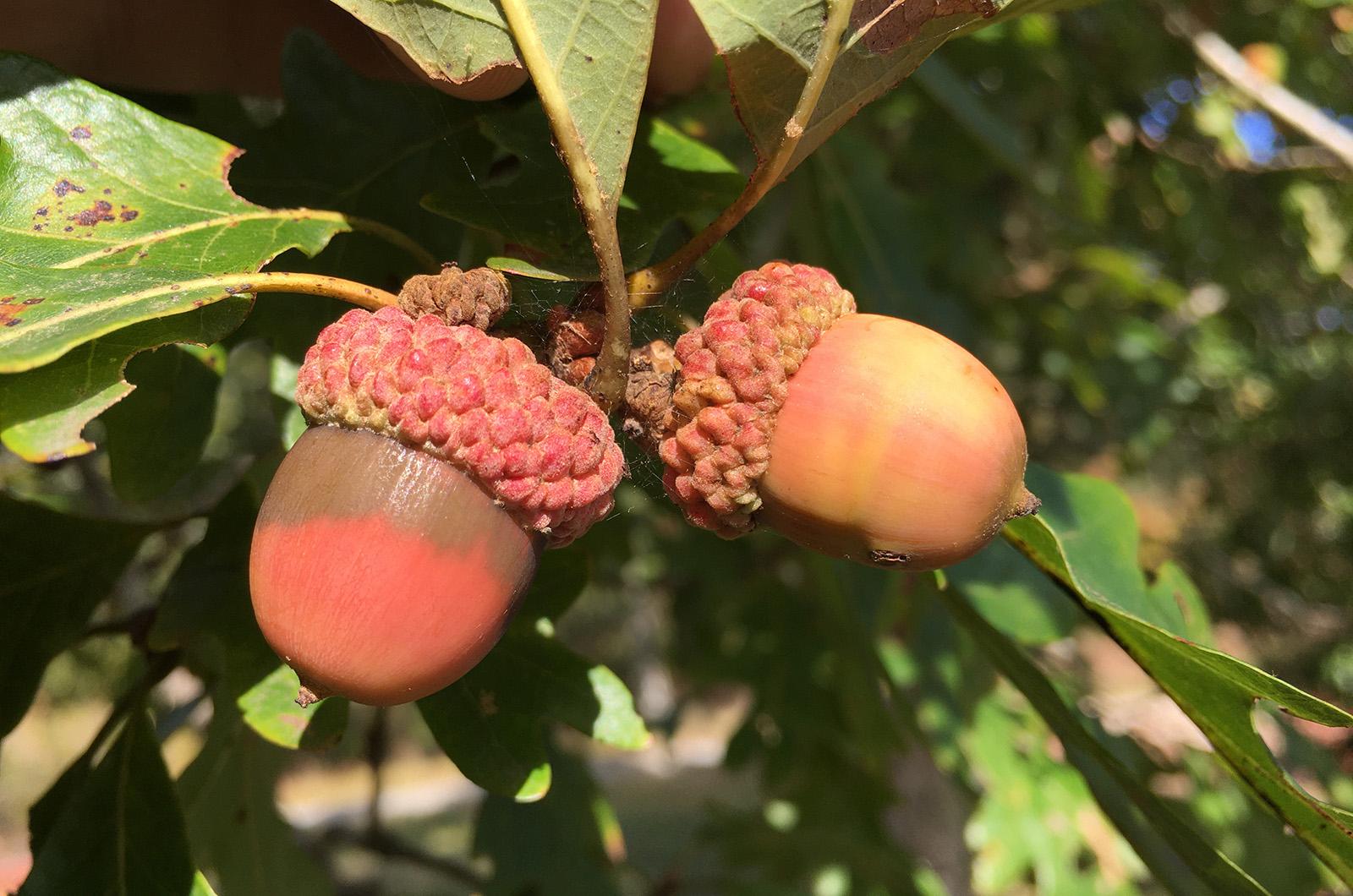
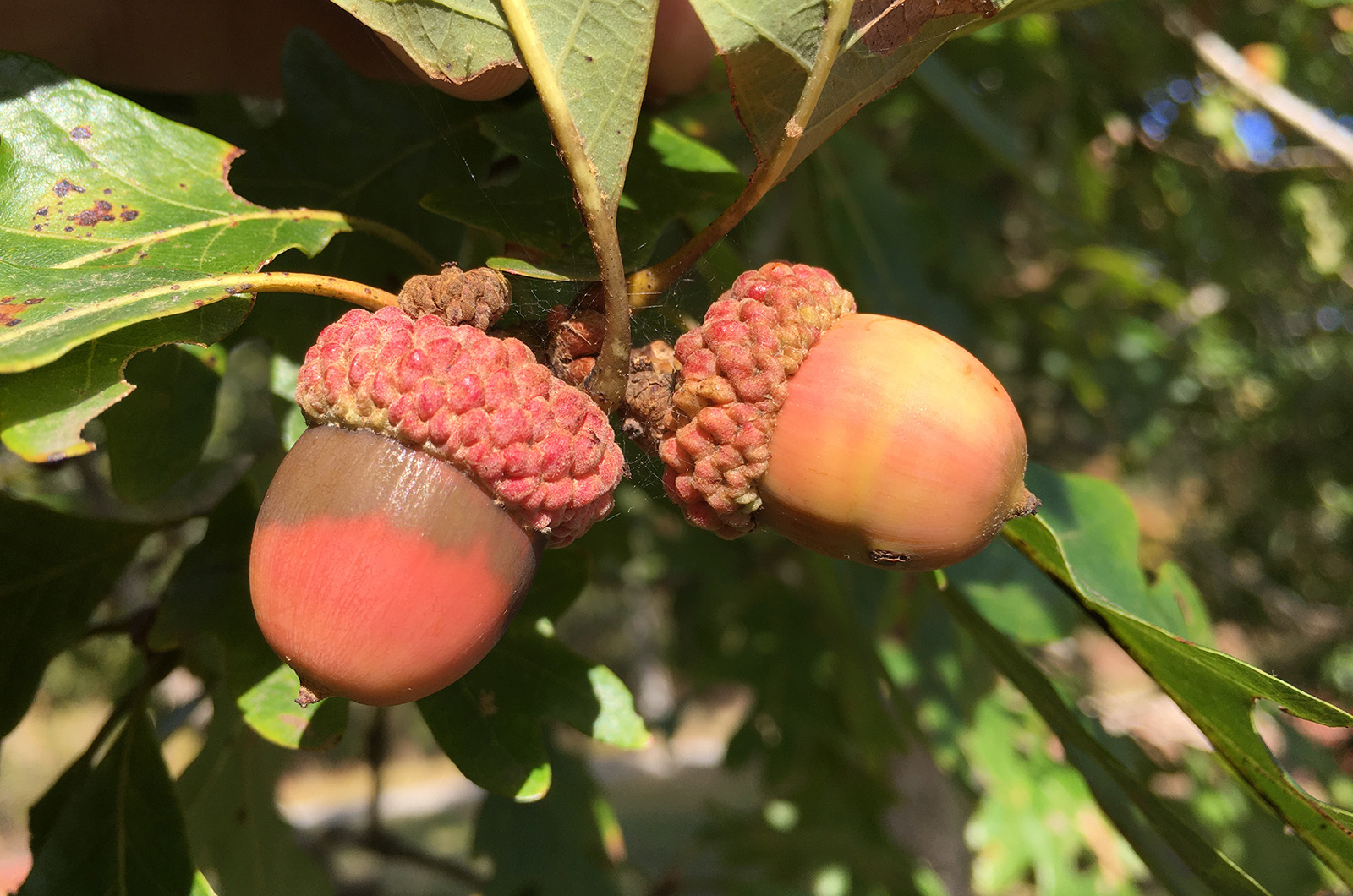
My first career job out of college was running a large campus arboretum nursery at Michigan State University.
My first career job out of college was running a large campus arboretum nursery at my alma mater, Michigan State University (MSU). My current job is the director of the Polly Hill Arboretum.
I love growing plants from seed, especially woody plants, just like Polly Hill did. While working at MSU I would visit the botany department herbarium. Within the collections of pressed flat dried plant specimens, I would read the identification label, but also discover the necessary details about where the specimen was collected so I could later find them and collect seed to grow at the nursery. Here I found maps to the plant kingdom. One kingdom I quickly fell for was the oaks.
At some point during these investigations, the curator of the MSU herbarium asked me if I liked oaks. I replied eagerly, “Why yes, I do!”
He told me unequivocally that he hated oaks! He explained that there was not a more botanically-vexing group of trees. I later discovered his frustration. Oaks are not content to have a single name placed upon them; they often hybridize making their identification confounding. However, this practice has allowed oaks to evolve, migrate and become keystone forest species all over the planet.
The curator, also a professor of botany, could see oaks captivated me and he invited me to travel to Oaxaca, Mexico, to collect and document oaks as part of my graduate studies. Imagine growing up in frigid Michigan and being transported to subtropical Oaxaca. This experience would change how I looked at oaks, particularly my understanding that trees are vulnerable to extinction. The oak trees and forests of Mexico were rapidly being decimated. Some of the sites we came across were destroyed and others in steep decline. Despite seeing trees cut or bulldozed, I also encountered remote villages of indigenous people in Oaxaca utilizing oaks for acorn meals (porridge and bread), charcoal or building materials. They approached their native oaks as gifts that deserved both reverence and protection.
After my early oak days, I ended up coming to Martha’s Vineyard in 2001 to begin work at the Polly Hill Arboretum. We have six species of native oaks here, and swarms of hard to identify hybrids that I find endearing. Some Islanders complain about the monotony of oaks here on the Vineyard, their messy acorns, their dull brown leaves that cling to the branches in winter, their sheer ubiquity, but you won’t find me complaining.
From a broader context of the world, there are 430 species of oaks and in too many instances, they are threatened with extinction. My devotion to oaks has led me to travel to many parts of the world to witness them in their native habitat. What I discovered on my trips, and here on Martha’s Vineyard, is that oaks are truly the tree of life. There are no close competitors in the temperate tree world in terms of the abundance of biodiversity oaks support.
I was recently asked to write a book review for a popular gardening magazine. The book, The Nature of Oaks, The Rich Ecology of our Most Essential Trees, was written by entomologist Douglas Tallamy. The book’s prologue sets the stage with a simple truth: “Oaks support more forms of life and more fascinating interactions than any other tree group in North America.”
The author details the life support oaks provide to a multitude of codependent lifeforms — birds, mammals, insects, spiders — and takes you on a journey through a year of life with oaks including the fantastic native fauna found just below the bark crevices or underneath the fallen leaves carpeting the forest floor. Oak leaves, slow to decompose, hold more life beneath them than the trees above.
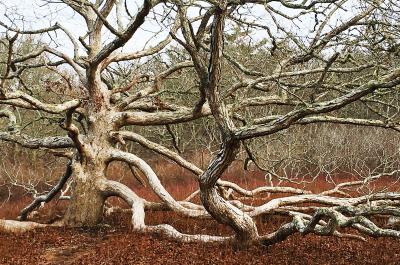
White oaks at Menemsha Hills.
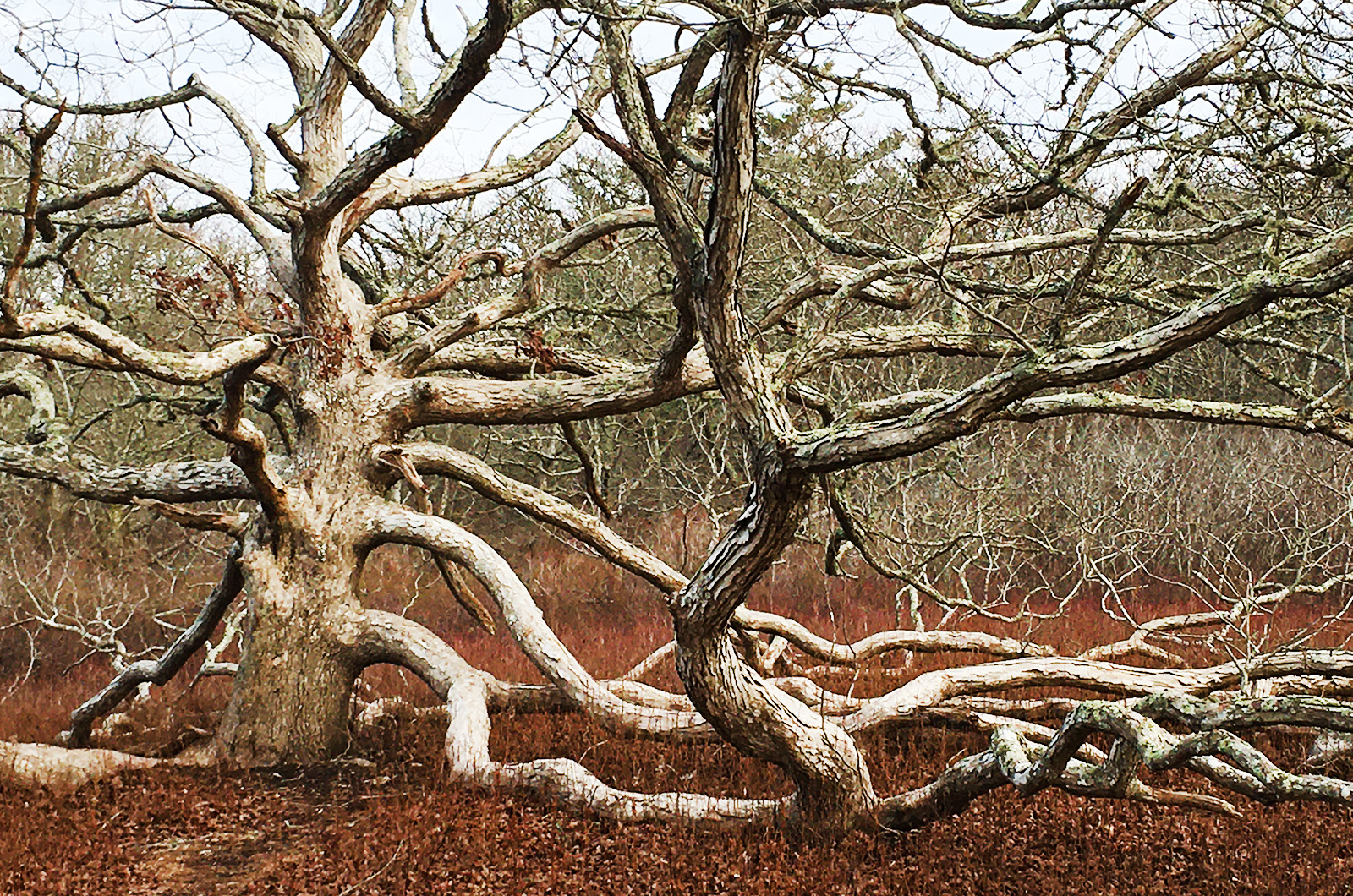
White oaks at Menemsha Hills.
How does this translate to Martha’s Vineyard? Too often, our native landscapes are scraped away for development, soils disrupted and the web of life (biodiversity) torn apart. Often in their place are large, chemically-dependent lawns, a barren monoculture.
When soils are disrupted or turned over, thousands of years of geological history and countless lifeforms are erased. Our ancient woodlands that remain today have been harvested in the past, yet the geological soils that support their growth have remained intact. Oaks have persisted, re-sprouting from cut trees or returning once again as acorn seedlings.
I hope that the information I have shared about oaks will give you a newfound appreciation for the ecological glue that holds our Vineyard ecosystems together. If there is a best-case scenario for choosing a tree to face the unknowns of climate change, it’s our existing oak woodlands with their demonstrated adaptive genetics and inherent resilience to meet the challenges of tomorrow as they have for millions of years.
You need not go far to have a close encounter with oaks on Martha’s Vineyard. Let’s acknowledge oaks as gifts, use this resource wisely, and save them for future generations.
Tim Boland is the executive director of the Polly Hill Arboretum and chair of the Oak Conservation and Research Committee of the International Oak Society.
Comments
Well done, thank you!
Bk EdgartownWell done, thank you!
I have several large Oaks on my New York property and I have read about their environmental benefits and admired their beauty. Long live the Oak!
Fascinating. I love oak trees
Linda Oak BluffsFascinating. I love oak trees. I have 6 huge ones in my yard, towering over my tiny house. I have been told I have at least 3 different varieties!
Tim, just yesterday I was
Robert Skydell Oaxaca, MexicoTim, just yesterday I was marveling at the site and sight of Monte Alban, including several of the large trees that stood out among the ruins as specimens.
Polly Hill introduced me to what seemed like a crazy concept of planting trees from seeds back in 1986. Just before leaving NYC for Martha's Vineyard, I flew back to Pittsburgh to collect seeds from the black walnut tree that grew in the small backyard of my college years. I also collected some acorns from my favorite tree in Central Park, a towering shingle oak (quercus imbricaria). The acorns turned out to not be viable, but the black walnuts certainly were. I still think about the beautiful tree I left behind on the Vineyard and how improbable the idea of growing a tree from seed once seemed to the much younger version of me.
Best regards to you, Tim!
Hi Bob; I remember our
Tim Boland West TisburyHi Bob; I remember our bonding over growing trees from seeds and your inspirational encounter with Polly when you first arrived on MV. Enjoy Oaxaca, which I return to periodically as part of my broader oak conservation work. The food market in Oaxaca is a botanical treasure trove and the indigenous people are so kind and wise. I believe a black walnut you planted at the Fiddlehead market still grows! I also poke around Tea Lane from time to time.
My best to you!
How interesting to read about
Vasha Brunelle Vineyard HavenHow interesting to read about the adaptability of oaks and why we would be wise to preserve and plant them. Doug Tallamy's book, the Nature of Oaks, is both captivating and informative, being some of the best nature writing I have read.
Wise words about an island
Ginny Jones WTWise words about an island treasure and vital resource from a pre-eminent island "treasurer!"
For ten years I cared for a
Tom Engley West TisburyFor ten years I cared for a property on Martha’s Vineyard all the way down Oyster Watcha road on the the pond. Way out there on the shore the oaks bend and lean against the ever present wind trees a hundred years old May only be a few feet tall and climb as u retreat toward the woods. One fall I was cleaning an area around the out buildings and I picked up a large trash barrel that was upside down and to my amazement when I lifted it thousands of acorns poured out. A unintended silo for rats I had disturbed their stash. The following day I went to gather the stash for a pig farmer friend of mine and to my astonishment every single acorn was gone. Over night they had moved the cache and I often saw ducks on the OW road filling their crops with acorns Nelson Bryant once told me he shot a duck at town cove that had 68 acorns in it when he dressed it out. The mighty oak is a treasure for all.
Tim, thank you so much for
Marc Rosenbaum West TisburyTim, thank you so much for this informative and heartfelt tribute! We love our oaks too!
It’s so wonderful to see that
Catherine WierzIt’s so wonderful to see that your passion for trees, and oaks in particular, continues, Tim! I learned so much from you and Jan at The Morton Arboretum. The appreciation you instilled still follows me. Fantastic article!
Add new comment