


As the Vineyard’s sister island, Nantucket and its multi-million dollar real estate market have been positioned as an ominous indicator of what’s to come.
When 200 Vineyarders took to the steps of Beacon Hill last month to make their case for an Islandwide housing bank, state Sen. Julian Cyr and Rep. Dylan Fernandes urged Islanders to explore additional local solutions, offering the same advice.
“Look to Nantucket,” Mr. Fernandes said.
As the Vineyard’s sister island, Nantucket and its multi-million dollar real estate market have been positioned as an ominous indicator of what’s to come. Recently, local housing advocates have started to look to its island neighbor and other seasonal vacation communities for clues on how to move forward.
More government investment, incentives to increase housing density, deed restrictions requiring year-round occupancy and caps on short-term rentals are among the tools being tried in Massachusetts and elsewhere to address the issue.
“They’re about five years ahead of us,” Edgartown planning board chair Lucy Morrison said of Nantucket. “Their situation is much more dire, but because of that there’s been more action.”
Last year, the average home price on Nantucket crested just over $4 million, just as the Vineyard’s average reached $2.2 million. Nantucket housing director Tucker Holland said that the extreme nature of Nantucket’s housing crisis has prompted officials to look for creative solutions, including modifying its zoning bylaws to support the development of year-round housing.
In 2015, Nantucket voters approved a bylaw to encourage workforce homeownership and rentals, offering a density bonus to properties that were at least 25 per cent income restricted.
Mr. Cyr said that many of the Vineyard’s current zoning bylaws actively discourage density, particularly the three-acre parcel minimum that restricts construction in the up-Island towns.
“If you look at the Vineyard’s zoning bylaws, they lend themselves to building second homes and luxury homes,” he said.
In the Island’s denser downtown neighborhoods, parcels are not restricted to single-family dwellings, but there are few town incentives to combat the general market trend of larger, single-family seasonal homes. Mr. Cyr also pointed out that while affordable housing is one area of improvement, other reforms must take place to put homeownership in reach for the middle class.
“We’re going to have to build our way out of this in part,” Mr. Cyr said.
Nantucket has also made investments in affordable housing a greater priority, devoting large chunks of its budget to the issue. Since 2019, the town has dedicated about $70 million to housing. In 2022, Nantucket residents voted to allocate $40 million to affordable housing efforts. This year, Nantucket voters will also weigh in on a proposed $6.5 million permanent tax override to fund housing initiatives.
Meanwhile, Vineyard towns have collectively allocated approximately $10 million for housing since 2019. This year, town warrants propose a little more than $2 million towards affordable housing and housing initiatives.
Some Island towns are leaving money on the table, as well.
In 2018, the state allowed municipalities to impose up to a 6 per cent tax on short-term rental stays, which are paid for by vacationers. While they could go higher, Aquinnah, Chilmark and Edgartown only collect 4 per cent.
Additionally, while most of Nantucket’s windfall from the short-term rental and lodging tax goes back into affordable housing, almost every Vineyard town’s revenue pours back into the general fund, Oak Bluffs affordable housing chairman Mark Leonard said.
“They as a community have decided that they are going to invest in housing,” Mr. Leonard said.

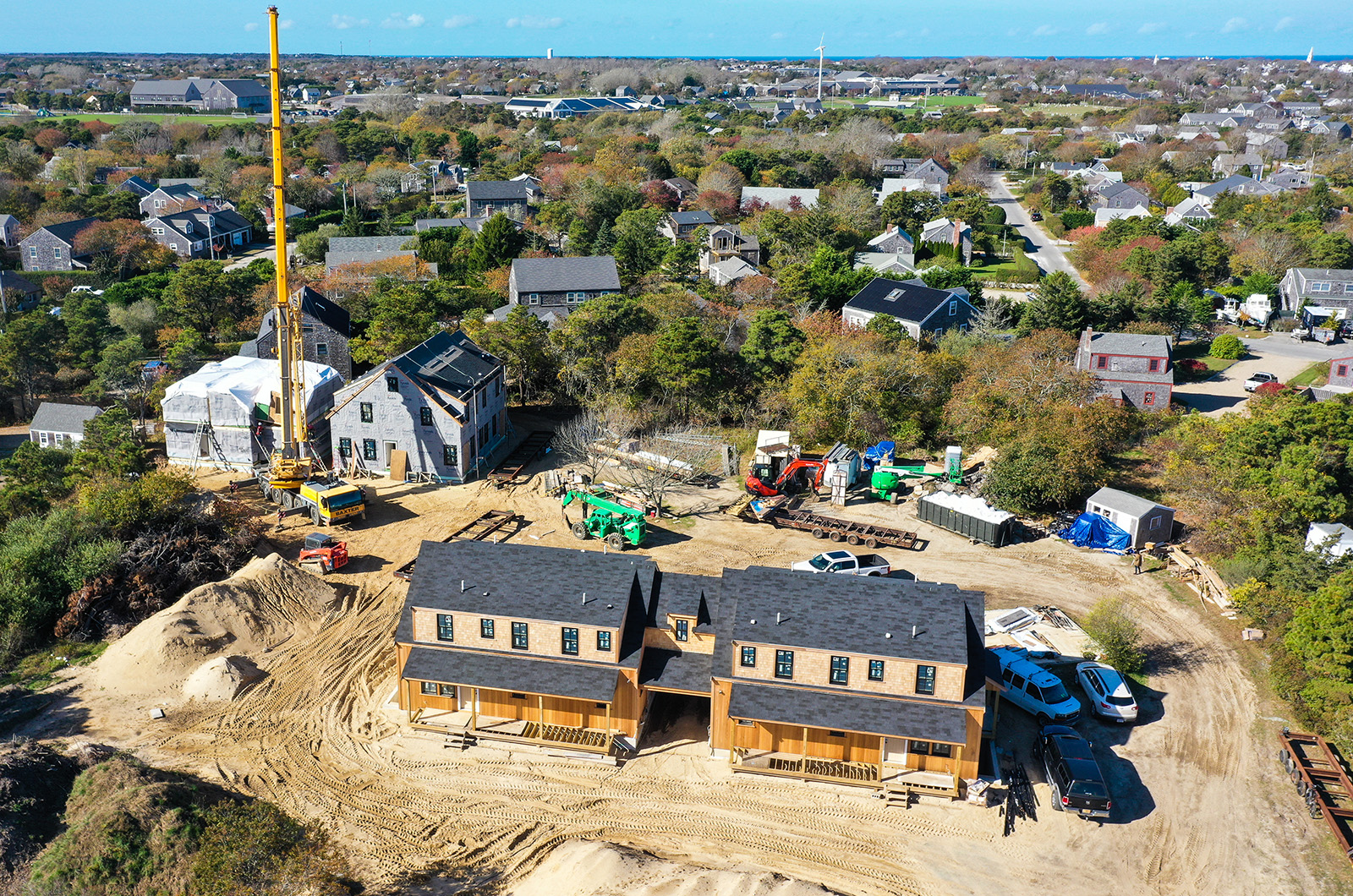
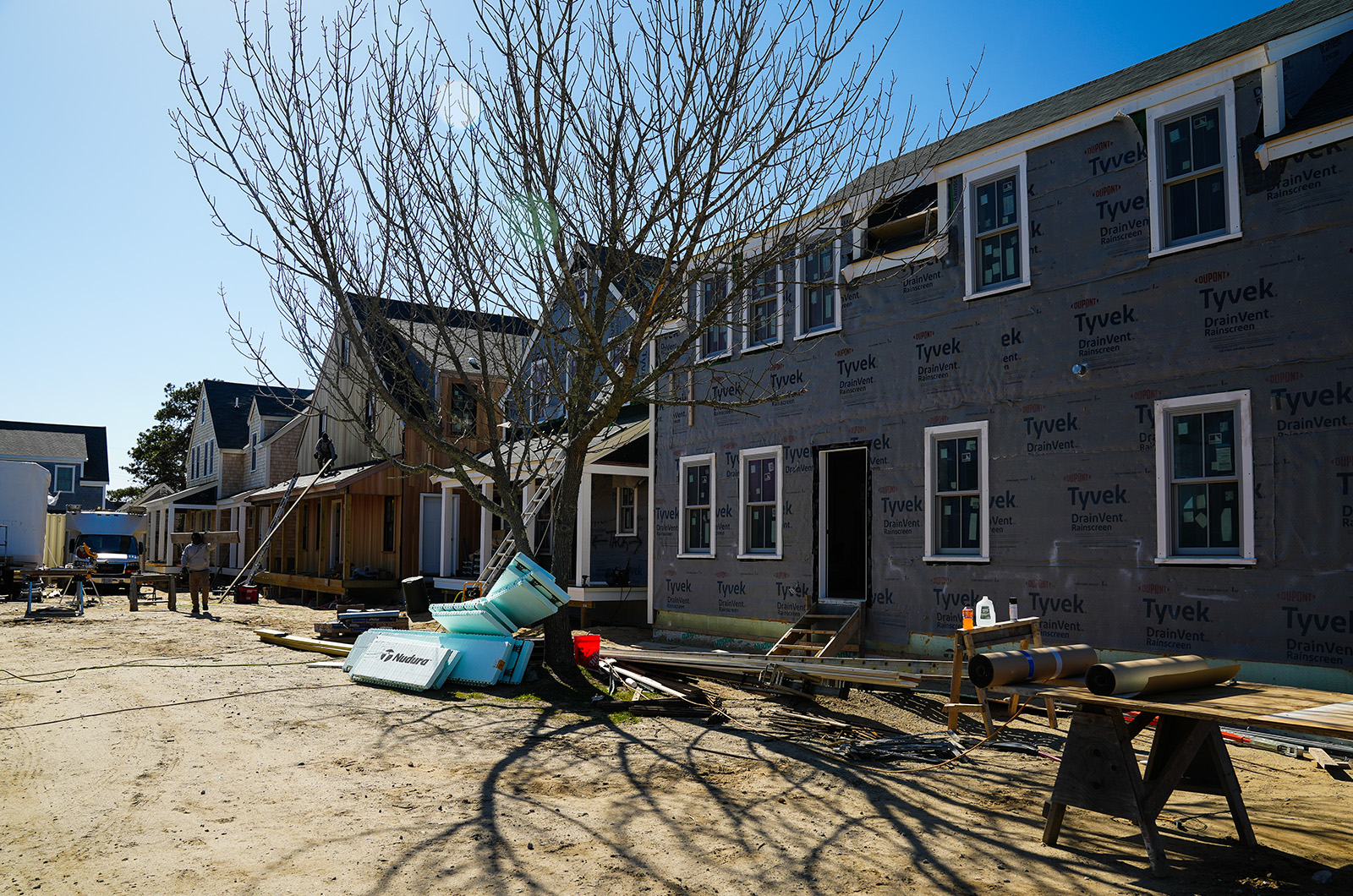
Construction crews work on a Nantucket housing project on Fairgrounds Road.

Construction crews work on a Nantucket housing project on Fairgrounds Road.
In Edgartown, short-term rental tax revenue goes into a capital stabilization fund, which requires a two-thirds majority vote for any withdrawals. Unlike the general fund, a stabilization fund rolls over year to year, collects interest, and can be used on any capital expenses over $25,000.
Although Edgartown town administrator James Hagerty did not disclose the total amount in the capital stabilization fund, he said the town expects to spend roughly $100 million on capital expenses in the next five to 10 years.
“Instead of making any commitments, Edgartown has been putting it aside,” Ms. Morrison said.
Mr. Hagerty added that in the past, the town’s affordable housing committee has floated dedicating a set percentage of that revenue each year to affordable housing initiatives.
“We’ve responded that they have about $750,000 in their fund now and if they have a proposal for a project they can go through the regular channels,” he said.
Both islands face another unique real estate problem: a finite amount of space for new developments, plus a disproportionate number of seasonal properties cutting into existing inventory. On the Vineyard, 49 per cent of homes sit empty year-round.
Despite these limitations, Nantucket has also had more ambitious housing proposals than the Vineyard, with one ongoing project potentially adding 225 rental apartments. The largest projects before Vineyard town boards right now top out at about 60 units.
Other vacation communities have explored deed restrictions as a way to maintain their year-round population. Vail, Colo., for instance, implemented a buy-down program in which the town purchases existing properties, places deed restrictions on them for year-round occupancy and puts them back on the market to rent or buy at a subsidized price.
“The restriction in Vail’s case requires them to work in Vail,” Mr. Holland said.
Mr. Leonard said deed restrictions such as the ones in Colorado are key to keeping prices down for year-round residents.
“[Without them,] your rent can go up any time, or can go away,” he said.
In Massachusetts, municipal deed restriction is a bit more complicated, Ms. Morrison said, since municipalities don’t currently have the legal authority to deed restrict in perpetuity. A recent bill filed in the state legislature seeks to change that, opening the doors for towns to set up their own buy-down programs.
The affordable housing development nonprofit Island Housing Trust has also been looking into purchasing and deed-restricting homes using Vail’s model, but has not yet found a reliable funding source. In Vail, the buy-down program is funded by a bond measure set by the town.
“If passed, the housing bank and transfer fee could fund this type of program,” housing trust CEO Philippe Jordi said. “With the market where it is...right now we just don’t have those kinds of resources.”
Across New England, coastal resort communities have taken different strategies to try and ease their housing crunches.
In Bar Harbor, Me., a tourist hotspot on Mount Desert Island, the town has put a cap on the number of non-owner-occupied short-term rentals, limiting them to 9 per cent of the total housing units in town.
Provincetown, meanwhile, spent more than $8 million in 2018 to buy a foreclosed 28-unit timeshare facility to create the state’s first municipally-owned market rate housing complex.
The complex is now filled and seeks to hit the “missing middle,” people who make too much money to qualify for affordable housing but still fall well short of being able to live in Provincetown, where the median home sale price in 2022 was $2 million.

Vineyard officials are looking at other towns, such as Nantucket and Provincetown, to see how they are handling their housing crises.
Vineyard officials are looking at other towns, such as Nantucket and Provincetown, to see how they are handling their housing crises.
At town meeting this year, Provincetown voters also passed a home rule petition to create their own year-round deed restriction program. The program, which needs to be approved by the state legislature, would allow the town to buy deed restrictions from homeowners that would prevent properties from becoming seasonal homes.
That same town meeting approved $2.25 million in funding for a 65-unit affordable housing development. Still, the search for developable land has proven challenging for the town at the tip of the Cape. Leslie Sanberg, a Provincetown select board member, said the town has looked into developing housing on parking lots, in old public safety buildings and even on an underutilized land near Route 6.
“Even the smallest piece counts,” she said.
Some see these other communities as unfair comparisons, since six Island towns means six times more bureaucratic obstacles to pushing through any kind of agenda. Martha’s Vineyard Commission housing planner Laura Silber emphasized the need for an Islandwide discussion around housing issues even if the solutions look different for each town.
“None of our towns function if our other towns aren’t functioning,” she said.
To foster those discussions, the MVC plans to create a Housing Action Task Force, hosting open public meetings on the latest housing developments Islandwide. The six Island planning boards have already begun to work with the MVC to commission a study on short term rentals’ economic impacts on the community.
Mr. Jordi said that a similar study in Vail prompted local officials to take more immediate action, and that he hopes Island lawmakers follow suit.
“Once we know the impacts, that’s when we can really come together and look for solutions,” he said. “That’s what’s really going to stem the bleeding.”
Comments
A call to arms to tax and
Mark EdgartownA call to arms to tax and restrict others property, feels rather authoritarian.
Why no mention of the many
MartyWhy no mention of the many towns and cities in Florida which set a minimum rental period, effectively banning short term rentals. The restriction can be eased into the market as real estate changes owners in order to avoid causing people or LLCs to default on their mortgages. It would provide a soft landing to balance a robust tourist economy with attracting year round working families. It could be done in conjunction with municipal buildings being repurposed, and do we really need 6 separate towns? Let’s unify the island and centralize most services to free up municipal buildings. There are many solutions but no unified island to enact them. We can and should be better than this.
Centralized planning,
Mark EdgartownCentralized planning, restrictions on personal property, sound familiar comrade? You are talking about crashing real estate values and economically forcing people to sell their properties. BTW without STR, there is no tourist economy.
Perhaps I wasn't clear. I
MartyPerhaps I wasn't clear. I suggested easing in to restrictions of short term rentals, not elimination. Our situation is in need of rebalancing. Yes, I agree we need short term rentals. We also need people to service the short term rentals and the occupants. Sadly the island has not organically solved the problem of not enough housing for workers across the economic spectrum. Is "comrade" a dig at liberals? What do you, Mark from Edgartown, propose as a solution? I am the owner of a rental property. I choose to rent it year round. If I bought in an area with restrictions I would have factored that into it. I have seen the ugly side of greed and economic exploitation living here. It is no wonder the young adults are fleeing the island.
There was a tourist economy
Larry ChilmarkThere was a tourist economy here for years before Airbnb, VRBO and the rest came crashing in.
This affordable housing is
Sara OBThis affordable housing is getting out of control. When is enough? Deed restrictions now? This is just too much.
The only affordable housing
Susan FalmouthThe only affordable housing is for people that have the money. People need to go where they can afford it. You can blame the current government for making sure their “voters” are welcomed, housed in the best places, fed, medically taken care of rather than the hard working AMERICANS trying to provide a life for themselves and their families.
Who is going to sell you a
Laurence Vaughn EdgartownWho is going to sell you a pair of shoes, dig through the hardware store for that odd part you need, make your bagels and coffee, or even build your house?
If everyone who cannot find affordable housing, or ANY housing leaves, the island economy would crash because workers have no place to live.
I guess you got your house
Dylan OBI guess you got your house years ago on the cheap.
Nice try. I paid 18 PERCENT
reality check edgNice try. I paid 18 PERCENT fixed mortgage rates in 1983, or 13.75 VARIABLE. So quit whining. Money was free for the past few years. Prices rose with INFLATION... who is responsible for inflation? Those who say anyone and everyone deserves a cheap house wherever they want?
The island does not really
Bob EdgartownThe island does not really want affordable housing as all you have to do is follow any project and see the NIMBY people come out. Next the MVC puts costly contingencies on the project, then the town adds more for good measure. And then most of all these units are built to a very high standard at a very high cost where you could build to a good standard and get more units. 3 acre zoning is a joke but it has done what they wanted it to do keep building and density down.
It’s pretty obvious at this
Shelby Nickerson EdgIt’s pretty obvious at this point. We need to drastically limit short term rentals so that we aren’t incentivizing real estate investors to gobble up single family homes and convert them into rental units.
The facts do NOT support that
William GarrisonThe facts do NOT support that short-term rentals are the issue. In the last decade, more and more full-time residents live on MVY, up over 25% while the housing stock in the same period has increased just 2%. The biggest impediment to year-round housing is seasonal owners down from 63% to 49 %......
100% agreed! I hope the
Marty100% agreed! I hope the voters on the island figure that out before we become known for substandard services, lack of essential workers, restricted and lacking beach access, and limited services. Add remote landlords only invested for the bucks, and the future is pretty clear. Some would say it has already arrived.
Limit Short Term Rentals to
Frederick Rundlet TisburyLimit Short Term Rentals to Residents of Martha's Vinyard Island only or to property owners who must be present on the property when other structures are rented. Short Term Rentals may only be allowed in nonresidential zoned areas as STRs are "Businesses"
Move where you can afford
Mike EdgartownMove where you can afford
Finally a comment I can agree
Robert Colonial Vineyard HavenFinally a comment I can agree with. Not everyone can live here. There are lots of other great and more affordable places to live.
So, I guess the island won't
Brian OBSo, I guess the island won't have teachers, cops, firemen, garbage men, DPW workers, librarians, ect...
People don’t understand
Ron EdgartownPeople don’t understand simple economics. If you limit or reduce rentals. There will be no need for affordable housing. Plain and simple.
Folks that come to our beautiful island spend money go to the shops and restaurants etc…
Without them, you can have all the affordable housing without the need for a workforce.
Don’t shoot yourself in the foot, the alternative is not good.
Tourism supports every aspect of our Economy. From construction, retail, hospitality
You name it.
This affordable housing is an issue but no need to hit the panic button. There are simple solutions.
Run more fast ferries and you
commuter new bedfordRun more fast ferries and you will have a sufficient labour pool of hard workers who willingly commute to MV for the high wages. Its a lot cheaper to subsidize boat trips than buy land, build it out, and administrate the project to assure compliance with restrictions The US government used to subsidize airline service to small underserved communities.. why not do the same for a fast ferry. It used to be called the 'essential air service' to small communities. Its a better use of funds than awarding a 'lottery ticket' to a few lucky beneficiaries.
Great idea! A letter from an
Steve C VHGreat idea! A letter from an Island employer gets you a $20 round trip ticket on the early and late boats. It’s a win win!
I could not agree more. Many,
Trey WilliamsonI could not agree more. Many, many people already commute. If the travel time was reduced with a fast ferry it would reduce any labor shortages.
I believe the phrase about
Jim West TizI believe the phrase about Nantucket as a “multi-million dollar real estate market” might understate the market size. Years ago I was gobsmacked when Nantucket surpassed the billion dollar annual real estate sales. MV followed a few years later. I suspect by now both are well into the billions with Nantucket annual sales roughly 2X MV.
Just a little point to say that the affordable housing issue is even more of a dichotomy.
Thanks for article. Huge issue.
There is no silver bullet.
Alex M Jackson, WYThere is no silver bullet. MV should look to some of the mountain resort communities to see how we are addressing the issue. Of course, each state has differing laws on what a local county or municipality can do. In Jackson Hole, the town and county can offer incentives for deed restricted properties. Local residents can also vote on special taxes dedicated to financing capital projects such as affordable housing.
How would the deed
MarieHow would the deed restrictions work? Hopefully the town would buy my house at full market value first.
Restrictions on private property are a huge overreach.
MV is experiencing the
Carmen Del Raval EdgartownMV is experiencing the excruciating flip side of its exemplary conservation.
Careful, conscientious planning and zoning has kept the island looking and feeling much as it did in the 1970s or earlier. A lot of it feels frozen in time in the best possible way.
Unfortunately, today's housing crisis – while involving other factors, obviously – is a direct result.
I lived and worked in the Hamptons in the early '00s and, seeing the area's natural loveliness ruined by strip malls, car dealerships and McMansions, gained a new appreciation for the Vineyard's conservation approach.
But watching my elderly Vineyarder parents try in vain to access consistent medical care over the past two decades has convinced me that what we need at this point isn't an accessory apartment or an affordable complex here and there; it's a Soviet-style high rise bloc complex in the island's central forest, with thousands of apartments to house the myriad medical personnel, teachers, summer workers, and other employees – not to mention the younger generation – whose increasing shortage imperils quality of life for all Vineyarders.
Obviously, this won't happen – though ironically, high-density housing that is totally out-of-character in one place would actually leave the rest of the island preserved in-character. The truth is that nothing short of massive development will sufficiently address the appalling housing situation – about the worst I've seen anywhere.
Well Said!
Barry ChappyWell Said!
The MV Land Bank and other
James ConnecticutThe MV Land Bank and other property preservation programs are a boon to property owners. Who wouldn't support a program that ensures escalating scarcity in a an already limited island market?
You seem to be suffering from
Steve M ChilmarkYou seem to be suffering from selective memory? MV looks nothing like it did in the 70s. One example I would offer is Katama. I recall when most of the land south of the fork was wide open. There was little out past the Mattakeset tennis courts besides Mattakeset itself and The Dunes. I could come up with many more examples of parts of MV that were open land even in the late 70s that now have a house on every buildable lot.
Yes! There is no reason this
nancy VINEYARD HAVENYes! There is no reason this can't be accomplished. We should also follow Nantucket's example. I also agree our towns could be combined into one. Think of the money that could be saved and put toward affordable housing. Enough discussion. Time to act!
No thank you. Edgartown
Mark EdgartownNo thank you. Edgartown enjoys effective leadership that are good stewards of taxpayer money, no boondoggles or obscenely managed projects. Tying multiple rocks together doesn’t make them float.
I have rented apartments year
Doreen Kinsman vineyard havenI have rented apartments year road for over forty years, here in V.H. with tenants who remain in place until they choose to leave.
Short term rentals are mana from heaven to. enterprising folks buying up homes for sale as rapidly as they come onto the market.Often several to one purchaser. Reason is simple...in a couple of months one makes as much or more money than offering year-round much needed accommodation to families who actually live and work here. Answer is simple. As a landlord one rarely or ever has to go to court, evict for non-payment, or endure abuse of the property. Short-term rentals remain easy uncomplicated money-making but poses an ever ongoing threat to our stable community life.
Without STR’s we will kill
Gerry EdgartownWithout STR’s we will kill the economy. No retail, restaurant, construction jobs etc…
But we will have affordable housing for what exactly? Our economy is driven by tourists and rentals.
Look at any job on the island without tourism we don’t have a thriving healthy economy.
Build a few units in each town maybe on public land, Chilmark included and call it a day.
Not really. STR’s are a
R Scott Patterson EdgartownNot really. STR’s are a recent development on MV. They have grown exponentially in the last decade. Are you trying to make the case that the economy of MV only works now because of STR’s?
The issue is zoning. If we
Joe Bower EdgartownThe issue is zoning. If we want to preserve the rural character of the Vineyard, we must rezone particular areas that make sense, e.g. close to public transportation. That means the towns have to face up to the need. That means planning boards need to plan and selectmen need to lead.
Sick of hearing we can't
Pearl WTSick of hearing we can't survive without the constant greed of more, more, more tourism and STR. Let's give it a whirl.
Pearl, what do you think our
Nick ObPearl, what do you think our Economy is based on? It’s tourism. STR are a birdie part of the economy. Without our summer folks we won’t need affordable housing, it’s that simple.
We all depend on it. From retail to construction jobs you name it.
https://vineyardgazette.com
Steve C VHhttps://vineyardgazette.com/news/2023/04/13/vineyard-looks-other-resort…
Other resort towns aren’t the only place to look for possible solutions. Consider New York City‘s Mitchell-Lama housing program, a tremendous success in developing residential homeownership for working people.
https://hcr.ny.gov/ml
All we need to do is incentivize developers to construct for this program and that can be done by tax abatement’s and credits. Even as rentals, construction of these units can be incentivized by real estate tax abatements.
The help and service industry
A tax paying Citizen Down my street and Up yoursThe help and service industry personnel should be ferried back and forth to the islands, if they can not afford to live on the island. No one who has made an investment in the Vineyard, should have to cater to or use tax money to help individuals who can not afford to be there.
I have some news for you, the
Chris EdgartownI have some news for you, the people who can't afford to live here and are forced off are probably not going to be too thrilled about that.
It's pretty unlikely they will be going out of their way to "commute" to this island so they can mow your lawn. When they leave, they don't come back.
Some of you are so out of touch with the lives of average people, it's unbelievable. Good luck to you.
What happens when the ferry
Larry ChilmarkWhat happens when the ferry is canceled?
Why is there never a
lets not be nimbys mvWhy is there never a suggestion of a REAL affordable solution. Maximum density on the closed landfills by allowing nicely designed 'manufactured home' communities. In the old days 'trailer parks' had a negative reputation. Visit some nice ones in FLA and you will see how you can easily acccomodate 40 families on an acre in cheap nice modern homes. A connection to the sewer plant will quiet those blaming the 3 bedroom per 1/2 acre septic requirements. Of course you will NEVER hear this from the proponents of affordable housing complexs because they won't get their $$$ building it
Vineyarders, like those in
James ConnecticutVineyarders, like those in Nantucket, Aspen, Telluride, Sun Valley, Maui, Naples, etc. have accrued the benefits of appreciation in the past several decades' luxury second-home real estate boom. Land preservation has also taken some premium real estate off of the market, while builders and all the associated trades have reaped hundreds of millions of dollars in accounts receivable island-wide. But this development begets development. Every shack and bungalow now get targeted for 4-bedroom "Coastal Living" transformation. Although the boom has removed most starter and "affordable" houses, subsidized affordable housing will not stop this trend no matter how many unnecessary suburban-style homes are built in pristine pine barrens and over the island's aquifer. At the numbers needed, the only way to match supply with need is via market forces. Island businesses must either provide housing (as many do already) or raise wages to match local rents. If there is an employee shortage, then the business faces bankruptcy. It should not be the government's (federal, state, or local) job to interfere with either market conditions despite politicians' love of rent control, Section 8 vouchers, MRVP, and AHVP in Massachusetts. Think about it, have any of these programs ever solved the problem of affordable housing? More affordable housing simply adds to the total stress on the island infrastructure and services (more kids = more teachers = yet more housing need). Better to stop now before the island just turns into suburban sprawl. Affordable housing is just a way for businesses to get tax payors to subsidize their underlying costs, and nothing more. Let island capitalism work with government interference.
Here in Vail we have a lot of
Michael Marshall vailHere in Vail we have a lot of different deed restrictions, some are more restrictive than others but, they do not seem to have hurt real estate prices whatsoever......
They are also not a silver bullet for all that ails our resort communities but they do help......
Build UP!!
Brenda Leonard Oak BluffsBuild UP!!
2nd 3rd and 4th story floors on commercial property for employee rentals ONLY.
Allow small 1-2 bedroom efficiency units on private property with owners residing on the property 6 months of the year.
What am I missing here… most
Michael ChilmarkWhat am I missing here… most short-term rentals are likely seasonal only, in second-home owner properties. I don’t see how this has significant impact on affordable housing options for year-round islanders. And the suggestion that homes are being snapped up by real estate investors makes no sense.. is there data to support that claim? At $ 1 million + purchase prices, generating 30-40k/yr from short-term seasonal renters is hardly a cash-flow bonanza.
Wonderful that we have projects that create 30-60 affordable units to be SOLD at below- market rates, but what is really needed are higher-density apartment complexes at affordable RENTS to islanders that qualify based on income levels to be determined.
I grew up in a nice Town
Kate OBI grew up in a nice Town outside of Boston. I would love to move back but I can’t afford to. Plain and simple. I would like to drive a new BMW Instead I have a 15 year old Subaru…
STR are a big part of our Economy. We lose that we won’t need affordable housing there will be plenty of housing and no hood paying jobs.
Add new comment