

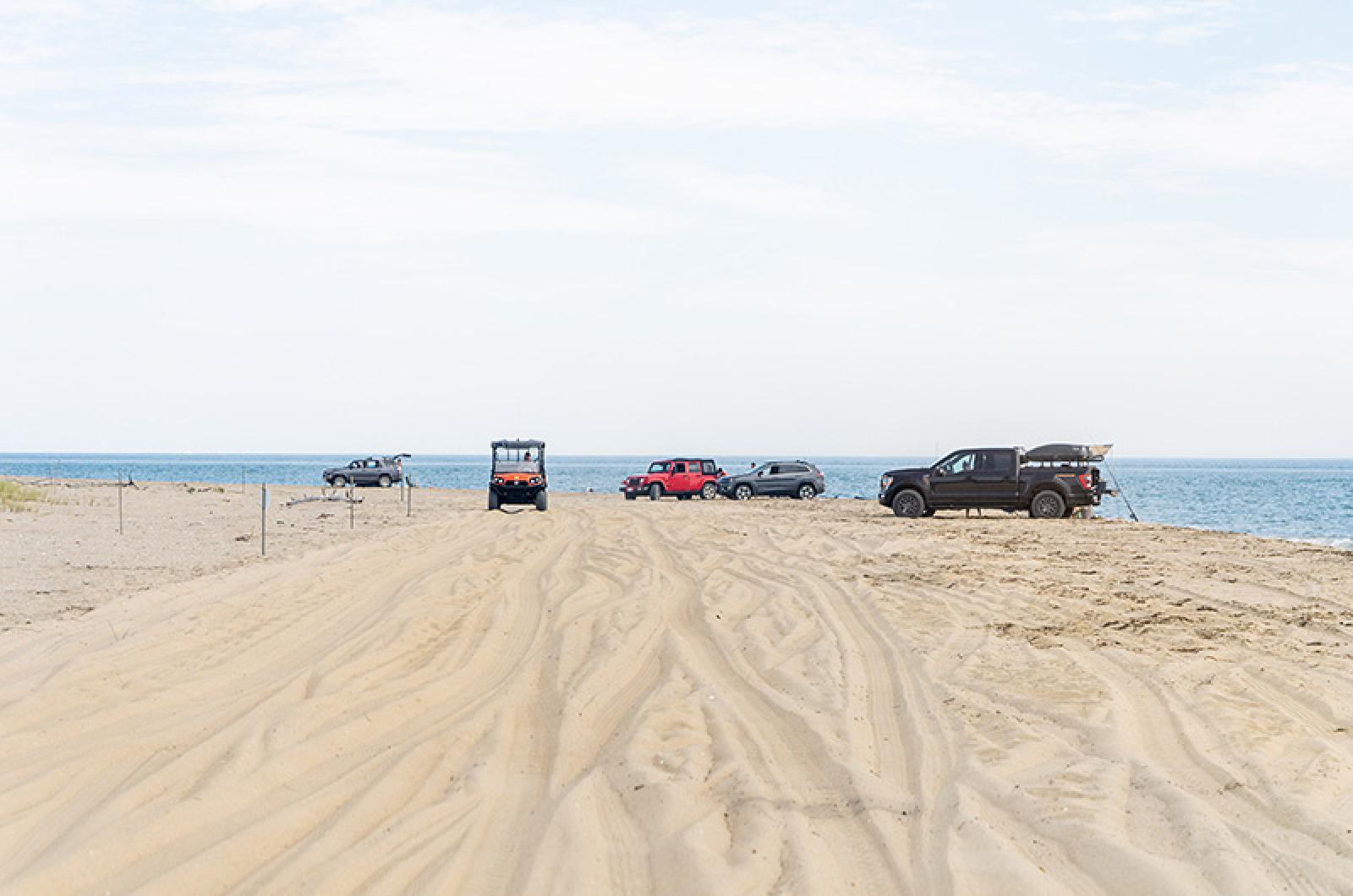
The Edgartown conservation commission conditionally approved The Trustees of Reservations application to sell OSV permits on Trustees property from Wasque to the Jetties.
After five months of contentious debate, Chappaquiddick beaches will be open to oversand vehicle (OSV) access once more.
In a heavily attended public hearing on Wednesday, the Edgartown conservation commission conditionally approved The Trustees of Reservations application to sell OSV permits on Trustees property from Wasque to the Jetties, allowing people to drive out to beaches again this summer and through the derby.
The commission has yet to finalize its order of conditions, but the agreement will only extend until the end of November, when the Trustees will have to submit a new application with a revised beach management plan. Last summer, the organization, which has managed conservation properties on the Island since the 1950s, withdrew its draft beach management plan after widespread public outcry.
Since then, the Trustees have faced increased scrutiny regarding its management practices on Chappaquiddick, which features both a dynamic shoreline and sensitive coastal wetlands. The hearings have often grown heated and personal as abutting Chappaquiddick residents voiced concerns on what they considered to be a more recent pattern of environmental neglect and mismanagement.
Over the course of the hearings, the Trustees have amended their application – called a notice of intent (NOI) – to reflect their withdrawal from Norton Point Beach, which is now managed by the town of Edgartown, as well as their withdrawal from the northernmost section of Cape Poge Wildlife Refuge, citing persistent resident backlash to OSV use in the area. The final NOI covers this reduced scope, encompassing only six miles of Chappaquiddick shoreline but many more miles of interior trail.
Questions of adequate staffing, visitor education, and vehicle capacity limits peppered the eighth and final hearing Wednesday evening. In a 49-page response to the commission which she summarized in the hearing, Islands portfolio director Darci Schofield attempted to assuage these concerns.
Per the commission’s orders, OSV permit holders will now be required to bring a spare tire, a tow device, a jack, a support board, a shovel, a tire gauge, and an official Trustees OSV driving guide while driving on Trustees’ properties. The equipment is intended to prevent visitors from getting stuck in the sand, an ongoing concern for abutting Chappaquiddick residents. Visitors will also be required to watch an instructional video on OSV use before buying their permits online.
Additionally, the Trustees will more diligently close certain sections of trails deemed unsafe for driving due to erosion or tidal activity, Ms. Schofield assured the commission. Closures will be advertised on the Edgartown side of the Chappy Ferry and at Trustees checkpoints at Mytoi Gardens and the Dike Bridge gatehouse.
While commission member Geoffrey Kontje floated the idea of assigning vehicle limits to the properties to prevent overcrowding, neither the rest of the commission nor Ms. Schofield ultimately believed there was enough current data to support a defined limit. Former Trustees Islands director Chris Kennedy vouched for the current NOI, pointing out that Edgartown will not be imposing a defined vehicle capacity limit in their management of Norton Point.
On their busiest day last summer, Ms. Schofield reported that 289 cars passed the Trustees’ vehicle counter near Dike Bridge.
“I’ll be really excited to come back to you in the fall and report some data,” Ms. Schofield said, adding that she would be open to an informed limit or guideline once more traffic data has been properly gathered and analyzed.
A hundred attendees showed up to the hearing hosted via video call, although many more approached the waiting room and were turned away due to the video platform’s group size limit. While previous hearings focused on Chappaquiddick residents’ grievances against the Trustees, this time around, many attendees spoke to the importance of OSV access for the Island’s fishing community, particularly during the Martha’s Vineyard Striped Bass and Bluefish Derby.
“Many grand leaders have been caught on those beaches,” derby committee chair Phil Horton said. “Reduced OSV access would reduce derby registrations and in consequence, derby registration revenue.”
Peter Sliwkowski, a representative of the Martha’s Vineyard Beachgoers Access Group, also spoke in favor of the current NOI, emphasizing the lack of publicly accessible beaches on the Island.
“Forty per cent of public access beaches on the Vineyard are not accessible now because Norton [Point] is closed and Chappy is closed,” he said.
As more and more seasonal renters and residents voiced their support for OSV access, Ross Kessler of the Massachusetts Department of Marine Fisheries, argued that a flawed plan is still preferable to no beach access at all.
“It’s going to be a work in progress going forward,” he said. “This isn’t the end.”
Many Chappaquiddick residents, however, stood their ground.
“Darci is very good at answering questions without necessarily speaking the truth in every way,” Leslie Self said. “I just hope that [the commission] will not buckle under the pressure of the press and the groups who want this settled right this instant.”
In the end, commission members opted to push through the NOI in order to preserve beach access through the summer and derby season this fall, with plans to revisit again this winter. Ms. Schofield reiterated that the Trustees plan to submit an updated draft beach management plan this October and hope to finalize an agreement with the town by the end of December. Until permits for 2023 become available, the organization announced that visitors will be able to get on beaches with their 2022 sticker.
Although passions ran high over the course of the hearings, each side expressed a shared goal of preserving and enjoying the unique beauty of Chappaquiddick. Avid fisherman Nelson Sigelman summarized the essence of the dispute while recounting his days spent fishing on the secluded shoreline.
“Time has a habit of standing still on Chappy,” he said.
Comments
Democracy in action! Chappy
Rich EdgartownDemocracy in action! Chappy access preserved for the many and not dictated by the few. Reasonable compromise achieved and binary outcomes avoided. Next year onto the Gut!
Disappointed to hear that the
John McCauley ChappyDisappointed to hear that the Trustees nor the Town of Edgartown can’t at least agree to reasonably impose a finite amount of permits and a daily maximum. So how many permits can the Trustees sell? 2,000, 10,000 ? How many permitted people can go out in one day? 300? Or a 1,000? More? Ms. Scofield’s constant “assuaging” (word salads?) can’t mask her pattern of constantly kicking the can down the road around the proven false hopes of a magical beach plans and more traffic data. It is laughable if it wasn’t so disingenuous. The Trustees have been measuring traffic data for the last 10 years and have shared none of it. The Trustees set vehicle limits on many of their other properties on-Island and off and refuse to do so here. Why can’t they establish or suggest some sensible limits? Let’s hope our Town government in offering the Trustees the right to sell permits will impose a modest level of regulation here — some initial limits — given that the Trustees constant “assuaging” continues to demonstrate their resistance to any restriction and their continued failure to lead or share any apparent expertise on sensible management of these beautiful lands.
Limits aren't needed because,
OSVLimits aren't needed because, unlike some other Trustees properties with limits, even on peak days the Chappy beaches aren't anywhere near crowded--there are miles and miles of beach (and the Chappy Ferry already limits capacity). Moreover, 47% of the publicly accessible shoreline on MV is only accessible by OSV. Artificially limiting OSV access would significantly reduce beach access.
In 2021, MV Beachgoers Access
Peter Sliwkowski, MV Beachgoers Access Group EdgartownIn 2021, MV Beachgoers Access Group (www.mvbag.org) commissioned a Beach Access Analysis from Ground Water Studio which provided some great data on the beach access on the Vineyard and how it compares to Nantucket.
Here are highlights:
Beachgoers Access Analysis from Ground Water Studio Group
• Of the 62.6 miles of the outer shoreline on Martha’s Vineyard, only 24% (14.9miles) is available to the public via parking and walking or OSV.
• The Trustees of the Reservations (TTOR) is the largest manager of publicly accessible shoreline on Martha’s Vineyard, managing 51% (7.6 miles) of the publicly accessible beach.
• 47% of the publicly accessible shoreline are only accessible by OSVs and all managed by the TTOR.
• Nantucket has 27% smaller outer shoreline but has 18% more beachgoer access. In peak summer, on a per capita, Nantucket beachgoers has 2.4x more outer shoreline access than Vineyard.
Here are links to the actual studies:
Nantucket versus Vineyard - https://drive.google.com/file/d/1LPy9gLdSsdQ6U2tSGSf8c9aTRj7gRp_X/view?…
Vineyard Beach Analysis - https://drive.google.com/file/d/1-jkLkoLoyDQ3FDMdNqvaden5wTiniC9Z/view?…
Eminent domain could secure
BeachgoerEminent domain could secure access from north of the Jetties to the Gut, and without an order of conditions for north of the Jetties, residents shouldn't be able to travel beyond the Jetties either.
As a Chappy homeowner and
Scott M Fedonchik New YorkAs a Chappy homeowner and lifelong fisherman, I'm very glad this passed and appreciate the goodwill from the Commission and Trustees. I'm out on the beach over a hundred times a year and the situation at the Jetties is going to be very problematic. It's one the trickiest areas to navigate on the entire reserve and many folks are going to get stuck out there. They should really consider opening to the Lighthouse to avoid the complicated turns, steep beach, and very soft sand around the Jetties. That's a major red flag...
Whatever happened to TTOR
Steward of the Land ChappyWhatever happened to TTOR being a steward of the land? In a 1992 press release The Trustees of Reservations "explained that monitoring vehicular access is integral to the continued preservation of Cape Poge" and "stressed their commitment to preserving the fragile ecosystem on Cape Poge". In that 1992 press release the organization went on to state, "the use of over-sand vehicles on the Island has skyrocketed. Sales of OSV permits at our Wasque Reservation have doubled in that decade. It is crucial that TTOR, as steward of this extraordinary and vulnerable ecosystem, determine the carrying capacity of Cape Poge Wildlife Refuge and limit vehicular access...". How come a conservation organization cares less about the environment now than it did in 1992? OSV use has only increased. The available beaches have only gotten more fragile. Yet they do nothing to limit access or to monitor and control the number of vehicles, which they themselves recognized as vital to protect the fragile ecosystem over 31 years ago. Truly shocking that a conservation organization needs to be reminded they they should care about the environment.
Add new comment