



As coastal ponds and estuaries continue to deteriorate throughout the Cape and Islands, the DEP has proposed a pair of wastewater regulation amendments that could have sweeping impacts across the region.
As coastal ponds and estuaries continue to deteriorate throughout the Cape and Islands, the state Department of Environmental Protection has proposed a pair of wastewater regulation amendments that could have sweeping impacts across the region, forcing Island towns to upgrade hundreds — if not thousands — of septic systems, or come up with a long-term plan to mitigate their nitrogen pollution.
The proposed Title 5 amendments, which constitute the most substantial changes to the state septic code since it went into effect in 1995, are twofold; the first amendment involves designating coastal communities that have been polluted by nitrogen runoff as “nitrogen sensitive areas.” The second would require the installation of enhanced septic systems on all new and existing properties within those sensitive areas in five years — a massive undertaking that would cost tens of millions of dollars.
Communities may be exempted from the second part of the regulation, however, if they apply for a watershed permit, giving them more flexibility in developing a 20-year plan to address nitrogen pollution.
Although the regulations would only immediately apply to particularly impaired communities on the Cape, areas of Martha’s Vineyard and Nantucket would likely follow quickly thereafter, state DEP commissioner Martin Suuberg explained in a letter that went to affected towns earlier this year.
While the final regulations are still being hammered out in a public hearing process that began Wednesday, Nov. 30, Island officials are already bracing for the regulations’ impacts.

The state will designate the light green areas as nitrogen sensitive after the new regulations are promulgated.
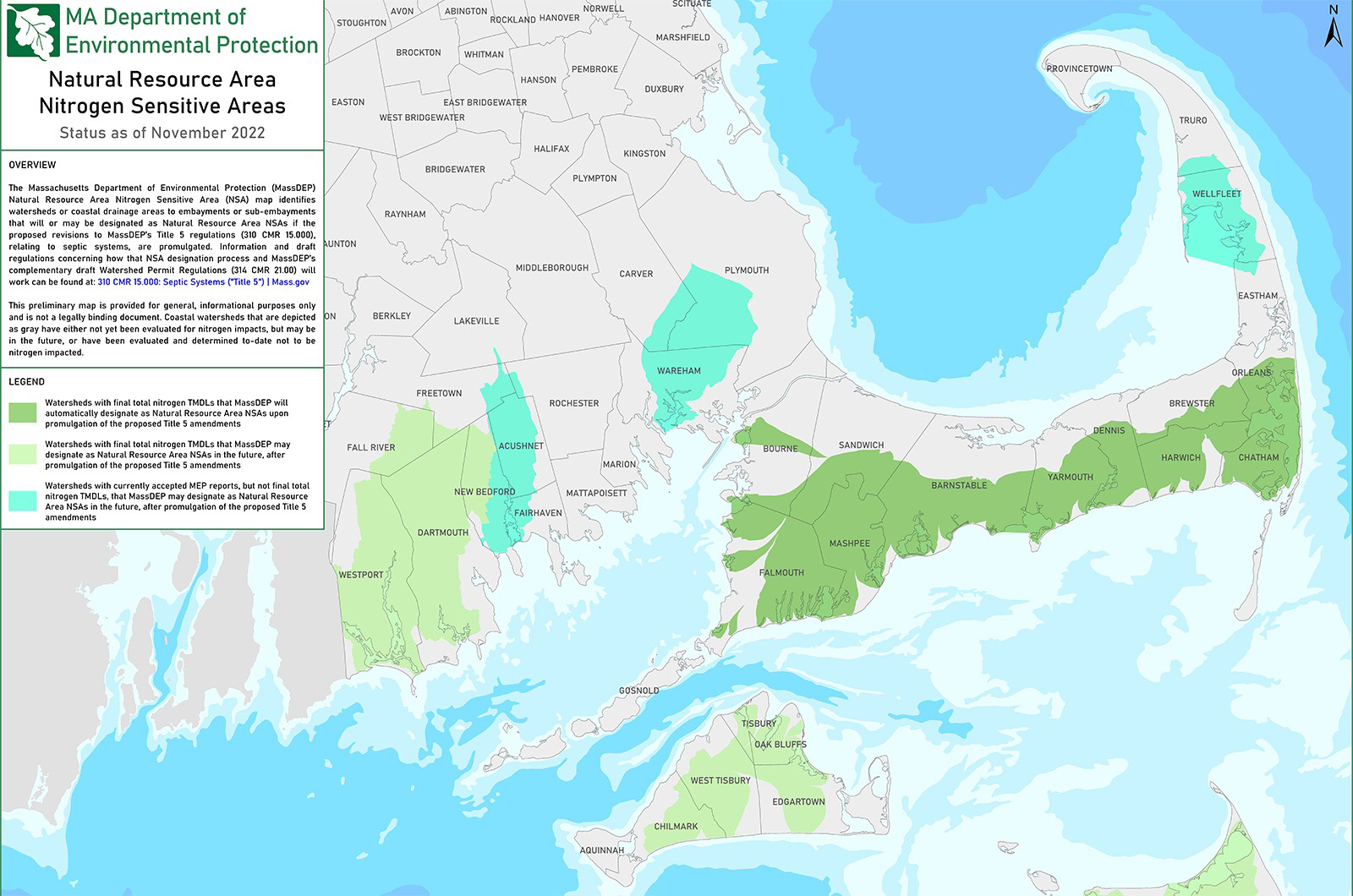
The state will designate the light green areas as nitrogen sensitive after the new regulations are promulgated.
“It’s bigger than anything that’s happened with on-site wastewater in Massachusetts ever, period,” said Matt Poole, Edgartown health agent and elected member of the Chilmark board of health. “It’s a big increase in [the board’s] daily septic and wastewater activity, and we already do a lot.”
The proposed Title 5 amendments come in response to decades of nitrogen pollution leading to ecosystem disruption on the Cape and Islands, and follow closely on the heels of a Great Ponds Foundation study this summer that identified septic waste as the primary nitrogen polluter in the Island’s great ponds.
Because of the rural nature of much of the Island, most homes rely on septic systems rather than town sewers to handle water from toilets, showers, dishwashers, sinks and laundry machines. But the runoff from those septic systems can seep into the Island’s sandy soil, making its way into ecologically-sensitive coastal ponds and damaging the ecosystem.
“Densely populated areas have resulted in more nitrogen loads than these water bodies can accept,” said Marybeth Chubb, head of the MassDEP wastewater management program, at a public information session on Nov. 15. That nitrogen, she explained, can lead to a process of eutrophication in the ponds, causing excess algae growth, oxygen depletion and the death of fish, shellfish and eelgrass.
“Unaddressed, this problem will become worse,” Ms. Chubb said.
If the regulations are adopted, Ms. Chubb explained, they would immediately go into effect in Cape Cod communities designated as nitrogen-sensitive areas, aiming to reduce nitrogen pollution in their watersheds by upwards of 75 per cent. Chilmark, West Tisbury, Oak Bluffs, Tisbury and Edgartown all have areas that could be designated as nitrogen sensitive after the regulations are promulgated, meaning all five towns could be subject to similar restrictions following their enactment on the Cape. Each Island designation would be subject to its own public hearing process before restrictions were put in place.
Towns on the south shore, including Westport, Dartmouth and New Bedford, could also be designated as nitrogen sensitive. At Wednesday’s public hearing, public officials from the region blasted the state for failing to address nitrogen pollution, and instead passing the buck onto towns or homeowners.
“It’s basically death by a thousand cuts with lemon, or death by a thousand cuts with lime,” said Dartmouth select board member Shawn McDonald.
The move to update the regulations follows a 2021 lawsuit from the Conservation Law Foundation, claiming that the state DEP, as well as the towns of Mashpee and Barnstable, knowingly neglected their obligation to halt pollution-causing septic systems in those areas. The new regulations function as a compromise, pushing towns to either upgrade septic systems fast, or devise a plan to deal with them broadly down the road.
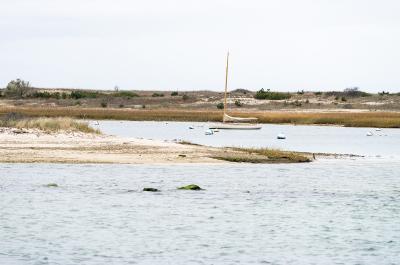
Parts of Menemsha Pond would be designated as nitrogen sensitive.

Parts of Menemsha Pond would be designated as nitrogen sensitive.
“It’s the carrot and the stick approach,” said Doug Cooper, who owns a business that does Title 5 septic inspections on the Island. In an interview with the Gazette following a septic inspection, Mr. Cooper said that updating septic systems to include enhanced nitrogen mitigation technology can be a complex and invasive process.
“Some systems are fairly easy to upgrade, and some are a bloody nightmare. Imagine a car where you’re adding in a turbo charger . . . you’re gonna be pulling up wires and hoses everywhere,” he said, referring to the need to dig up large portions of a homeowner’s yard to put in the upgrade. Other systems, he added, weren’t fit for upgrade, and would need to be replaced wholesale.
The upgrades are also expensive, costing anywhere from $30,000 to $50,000 each. Mr. Poole estimated that upgrading all of Ocean Heights, which is in the Sengekontacket watershed, could cost up to $25 million, a burden he said would ultimately fall on the town via a financing plan mandated by MassDEP; at the public hearing, speakers also expressed concern over the financial burden on homeowners, particularly because financing could be too expensive for towns alone. “Financially, I don’t think Edgartown, or any of the other towns on the Vineyard, can do the five-year option,” he said.
As a result of the cost and involvement it would take to upgrade all those systems, Island towns are initiating plans for a watershed permit.
“Five years is just too fast to get it done,” said Tisbury health agent Maura Valley.
Ms. Valley believes that Tisbury is well situated to meet the new state requirements, since it already has more stringent nitrogen regulations than other Island towns. However, Tisbury’s sensitive Lagoon Pond watershed points to another challenge towns may face: collaboration.
Lagoon Pond, like Sengekontacket and the Tisbury Great Pond, straddles two towns, and will require joint management to meet new regulations.
“It’s not clear to me, on the state level, how shared watersheds will work,” said Ms. Valley. “But from an Island perspective, we will have to work with the other towns.”
All three down-Island towns have an advantage in developing their watershed permit, as each has already begun working on a comprehensive wastewater management plan (CWMP). Critically, CWMPs will inform the health boards as to the current and planned future sewer capacity in the town; every sewer-connected lot represents one less property that has to be put on septic. Mr. Cooper suggested that smaller wastewater processing facilities for dense areas, such as the one at the Aquinnah tribal housing, might be another possible option.
For the up-Island towns, health agents are considering a whole different set of options.
“I can’t get my head around what Chilmark’s solution might be like as easily,” said Mr. Poole, who is recommending that Chilmark hire an environmental consultant to help with the process. “We want to have someone that’s not gonna be outgunned when they’re at the table,” he said.
West Tisbury health agent Omar Johnson also said he planned to recommend a consultant.
“It’s a huge, huge project,” he said.
The regulations will also have broad implications for town planning, said Mr. Cooper.
“Historically, the Island had mostly controlled growth through the health and septic code,” he said, meaning that towns will also need to think critically about how to modify their growth and development policies as septic regulations change.
Still, there is hope among health officials that the Title 5 update will have a major benefits for at-risk, stressed Island water resources.
“Time will tell as to what the regulations will look like,” Oak Bluffs health agent Garrett Albiston said. “But it’s going to be positive for the towns and the quality of water on-Island.”
The state will hold its final public hearing on the changes over Zoom on Dec. 5 at 6 p.m. Written comments will be accepted through Dec. 16.
Comments
Well how does this bode for
Bob Kelly Oak BluffsWell how does this bode for all the OB Circuit Ave businesses who want a sewer hook up? Or for the Campground that wants to connect ten toilets? I don't think people are going to be very patient with being told no because the ponds need to be cleaned-up but it sounds like there won't be be any choice to make this a priority.
Perhaps the Land Bank, as
Richard Leonard Oak BluffsPerhaps the Land Bank, as there is land under the ponds which they could take a legal interest in (% ownership or conservation restriction?) can help us pay for this…and in so doing, help fund our water resources and infrastructure which are so critical to housing, shell fishing industry, economic sustainability, and our overall environmental and personal health.
Instead how about a proper
Washashore West TisburyInstead how about a proper waste water treatment system for the island and sewers. Possibly paid for by the Land Bank tax, and possibly paid for by other property taxes, but also with a large amount of Federal funding. It would be cheaper long term for the local home owners and way way better for the environment. It could be built in a centralized location, like near the airport.
Wow!
Harriet WTWow!
Is there going to be
NRSIs there going to be containment as well for the proliferation of in-ground swimming pools on-island? I am thinking especially, of those in the large homes that surround ponds such as Sengekontacket.
just another big government
here we go again mvyjust another big government over reach
If septic systems are causing
Dave EdgartownIf septic systems are causing the majority of the nitrogen load entering the ponds, are they also compromising our wells and our neighbors’ wells? Perhaps banning the use of fertilizers on lawns would be a more cost effective first step.
Yes, our wells are definitely
Anna Edey TisburyYes, our wells are definitely impacted by all upstream septic systems. Title 5 septic systems cause roughly 80% of the Nitrogen pollution that is killing our ponds, whereas Lawn Fertilizers cause less than 7%, roughly. And here's a shocker: the newer a Title 5 septic system is, the more Nitrogen pollution it causes - it takes years for a Title 5 system to develop the self-made biomat liner that can begin to reduce the Nitrogen pollution somewhat.
It would seem the more secure
Chris KatamaIt would seem the more secure, scalable and cost effective solution would be for the towns to expand the sewer systems instead of tackling this by retrofitting thousands of septic systems. This way the water would be captured and treated and fully eliminate potential seepage into our aquifers. My guess is that this is perceived as too expensive for the towns so they want to push the cost onto homeowners.
great idea, but opponents
just a thought edggreat idea, but opponents would claim the logical idea of expanding sewer hookups would impede their power to limit construction by #of bedrooms per lot
That would be best, treatment
John VHThat would be best, treatment plants are better at cleaning water than even "enhanced" septic systems. These systems also require ongoing maintenance, which would be difficult and expensive to enforce over thousands of properties. As I understand it, most current "enhanced" systems revert more or less to conventional systems if power or key components fail, or if they are not regularly maintained.
Homeowners would still have to pay for expanded municipal plants, no doubt, through higher taxes or use fees, which is not unfair, and would be less of a financial shock to most than having replace each individual system.
You are right but beware of
Doug Cooper KatamaYou are right but beware of the impact of sewer expansion on community character. It needs to be accompanied by updated planning and zoning regulations. Many of which are out of date and not up to the task.
I don’t see how a sewer
Washashore West TisburyI don’t see how a sewer system would change any of the characteristics of the community. And as far as regulations go, that’s a fairly easy fix (if it’s even needed).
I agree, Chris.
Carol formerly ChilmarkI agree, Chris.
Home owners pay the taxes
Albert NauHome owners pay the taxes that pay for the sewers.
Outlaw ALL lawn fertilizer!!!
Ken Rusczyk Oaks BluffOutlaw ALL lawn fertilizer!!!!
Lawn fertilizer is a much
Washashore West TisburyLawn fertilizer is a much much smaller contributing factor. Septic adds way way more nutrients to the water than fertilizer from single family homes. But I am okay with also doing that. It’s just not enough. The bigger problem is the septics. A sewer system with waste water treatment (and a good amount of federal funding) would have a significantly greater positive impact.
With all the extra money
Jim EdgartownWith all the extra money Towns have with the short term tax revenue, why don’t towns set up a fund to expand sewer systems and a fund for people that need to upgrade.
This is a total overreach. Yet we continue to want more affordable housing built?
I no expert in this field by
Ted VHI no expert in this field by any means, but it would seem to me that if they're really serious about tackling this problem, the sale of all commercial fertilizers should be banned on the Cape and Islands. This has got to be a major source of nitrogen loading in the waterways.
Hold on to your wallet folks.
Have you discussed your
Albert NauHave you discussed your proposal with farmers and landscapers?
With out fertilizer there is little to farm or scape.
It's called organic farming
Carol formerly ChilmarkIt's called organic farming (uses compost) and it works very well. I lived on an organic farm in Katama in the 70s. Bob Daniels was (successfully) organic before organic was cool.
And those fertilizers do
Washashore West TisburyAnd those fertilizers do contribute some, but not nearly as much as septic systems. We should put our money where it has the most impact.
And look at where they have
Carol EdgartownAnd look at where they have approved the placement for the new, massive,for profit "senior living" development! Right in the middle of the light green areas on concern on the state map! But I know, it is a couple of old camps in Ocean Heights that are the problem.
Yes it is many of the hold
Cj EdgartownYes it is many of the hold houses/camps that have terrible septic systems that are the big polluters. How can those owners begin to spend $30,000-50,000. Besides we all know there are some bad landlords that own these, and do not update anything.
When we sold our home earlier
Rich Oak BluffsWhen we sold our home earlier this year we were required, by the town, to upgrade to a Title 5 septic system. It was needed and we made the upgrade (for $50,000) without complaint. At no point was the Town of Oak Bluffs ever considered to be on the hook for those costs (it was either us or the buyers). Why should the towns pay for these upgrades now? If the Commonwealth requires them, then the landowners should be required to pay for them. They will ultimately reap the benefit of the septic systems when they eventually sell the property. I understand that year-round residents will find these expenses prohibitive and something should be done to assist them, but let's face it. The summer residents and corporations that now own most of the waterfront properties cannot only afford these expenses but should be held accountable for the pollution they have been creating for decades.
There are many commercial
Bob EdgartownThere are many commercial businesses that would like to tie into existing municipal sewer systems right now on the island. Most of them would like to expand their business so they can make more money. This is simply greed as all these businesses are profitable right now. Greed is what is killing this island. Enough is enough. Save the existing capacity of our municipal plants to help our ponds.
We need to do a much smaller
Carl OBWe need to do a much smaller scale Deer Island. Where we have a new sewage treatment plant and a pipe that runs out to sea several miles and treats the sewage. I worked on deer island and I know the costs are expensive, but nitrogen enhanced systems are costly as well.
Carl,
Dean OBCarl,
This is a great idea… we need more ideas. Less building mega mansions…
I hope we get expansion of
Ken Edg.I hope we get expansion of the sewer plant and hook ups for all soon. Im not digging up my back yard.
Deer island treatment plant
Danny East ChopDeer island treatment plant sits on solid land in the middle of a protected harbor. Where exactly several miles off MV do you envision a new treatment plant operating?
The plant sits on a peninsula
Jack EdgartownThe plant sits on a peninsula off Winthrop, Ma. It treats the sewage and then sends the sewage out in a massive pipe out to sea, treating the sewage as it exits…. We could do this on a much smaller scale.
I worked on the project for 4 years it’s very impressive, sometimes you need to think outside the box. Making everyone dig up there yards is not going to work.
A waster water treatment
Washashore West TisburyA waster water treatment plant has many options for treating the waste without dumping in the ocean. That is a very outdated way to do it.
That is an outdated way to
Washashore West TisburyThat is an outdated way to handle wastewater treatment. There are much better and effective ways for wastewater treatment facilities to work.
Add new comment