

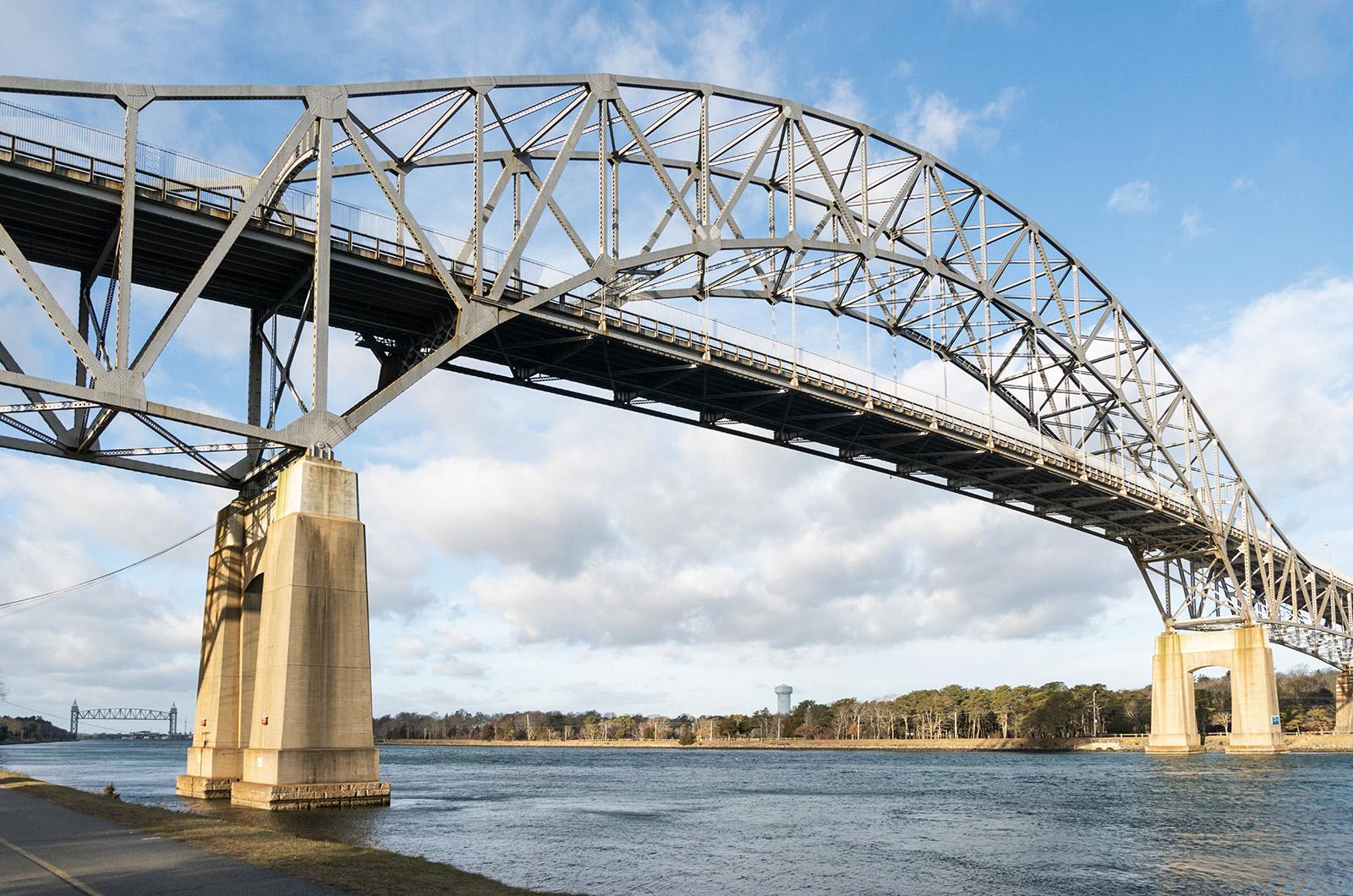
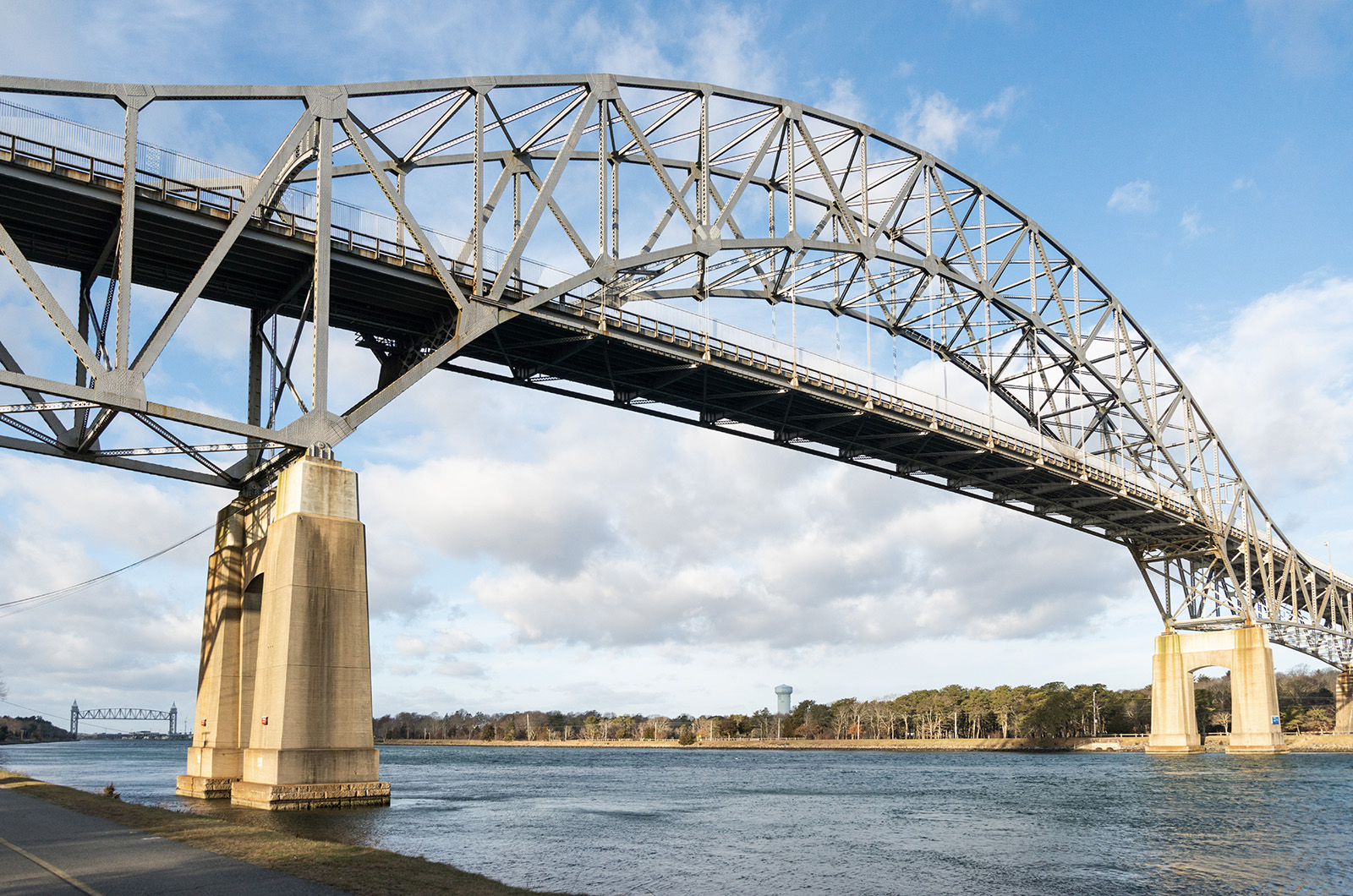
<p>After a 2019 study found that the iconic Bourne and Sagamore bridges were “functionally obsolete,” the public got their first look at the three proposed replacements during a public hearing on Tuesday.
After a 2019 study found that the iconic Bourne and Sagamore bridges were “functionally obsolete,” the state Department of Transportation offered its first look at three potential replacements, each of which would have inbound and outbound traffic on separate, closely constructed bridges.
The first of two hearings on the bridge replacements took place at 6 p.m. Tuesday via Zoom and saw over 500 attendees. Hosted by MassDOT program manager Bryan Cordeiro, the meeting focused on the overall purpose and need behind replacing the two structures, which have spanned the Cape Cod Canal and served as a gateway to the Cape and Islands since the 1930s.
The current bridges are both four lanes, with two lanes each of inbound and outbound traffic on the same structure, as well as narrow walking paths.
The favored arch option.
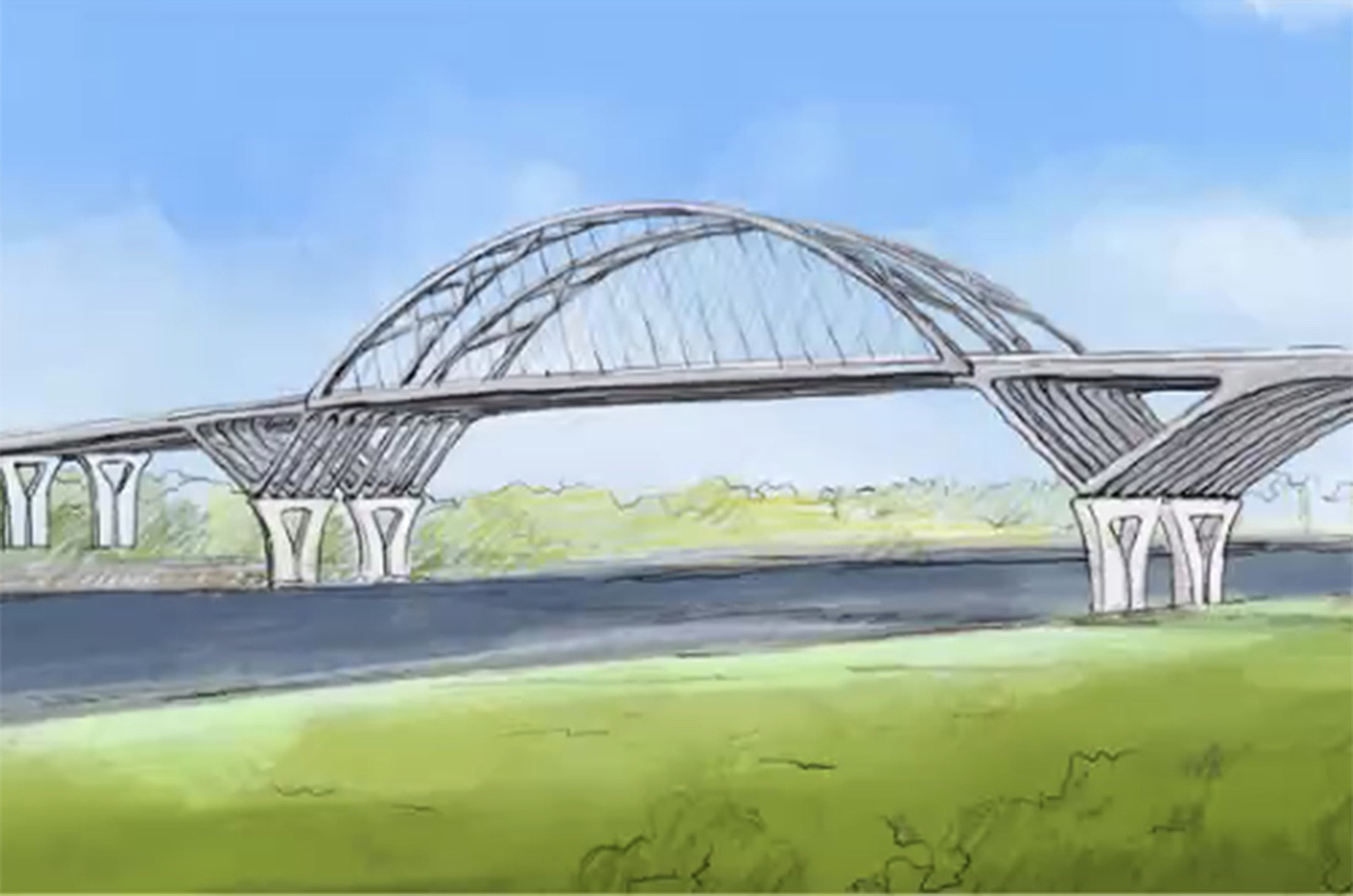
The favored arch option.
Although the Army Corps has historically been responsible for the two bridges, it was decided in 2020 that once the project finishes, MassDOT will take over responsibility for the new structures.
The project is still in its nascent stages. Although there are no clear construction timelines, bidding is expected to start around September 2025, with construction beginning roughly 18 months later and estimated to take six to seven years. Construction will be federally funded.
Since both bridges are in urgent need of replacement, the project’s lead structural engineer John Smith said that the fastest way to replace each four-lane bridge was with two, two-lane bridges, so the state can begin diverting traffic away from Bourne and Sagamore as soon as the first bridge is completed.
“This is the quickest way to move traffic,” Mr. Smith said, adding that the new bridges will be built as closely as possible to the existing structures.
A diagram of the construction phases showed that the bridges would only be demolished once the first of their replacement bridges had been built. Traffic would be diverted to the completed first bridge while construction commenced on the second bridge.
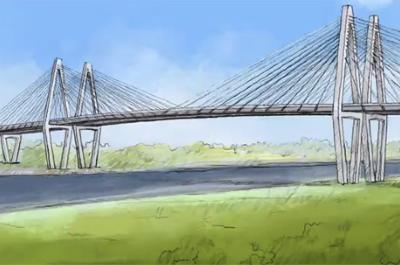
The cable-stayed option.
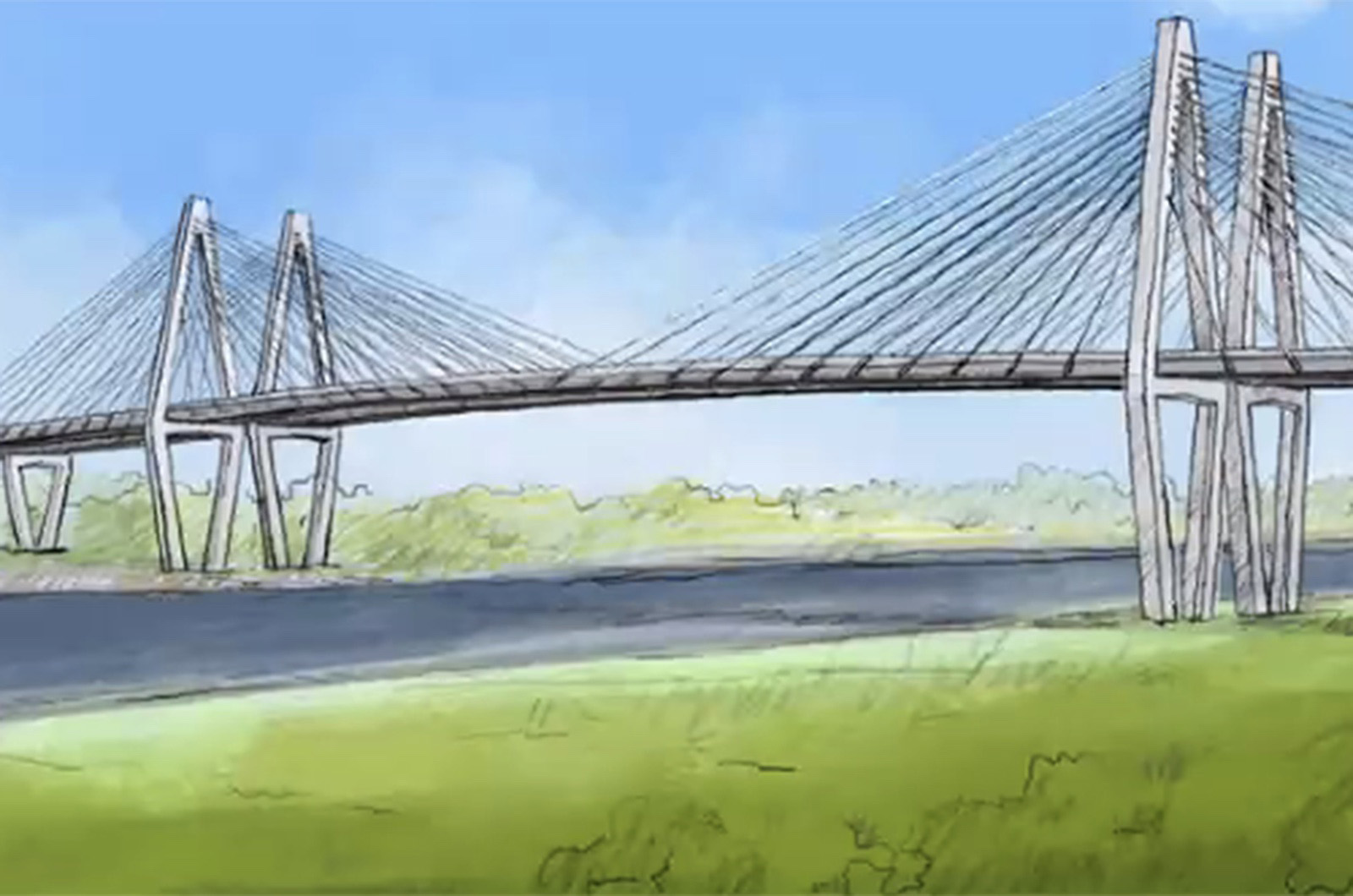
The cable-stayed option.
Mr. Smith went on to present three possible bridge type options with an eye towards preserving the “iconic gateway experience” of the existing truss bridges. Because the canal and its surrounding area is designated as a historic district, aesthetics and historical context will play a role in the final design, Mr. Smith said, adding that the current design would be too expensive and unwieldy to recreate identically.
“The existing bridges are iconic, well-recognized,” he said. “[They are] associated as a landmark to the Cape Cod Canal and the Cape.”
The first two options, the concrete box girder and the cable stayed bridges options, would be the least historically consistent, Mr. Smith acknowledged. The concrete box girder is an open top bridge with no arch or gateway overhead and wide rails on either side, according to renderings shown at the meeting. Its legs require a deeper concrete foundation, but the structure lends itself well to wind resistance during construction, engineers said. The cable stayed bridge, on the other hand, is best recognized by the Leonard P. Zakim Bunker Hill Memorial Bridge which spans the Charles River in Boston. The cable stayed option features two triangular towers with supporting cables, and is more vulnerable to wind during construction, meaning that adverse weather could delay the overall timeline.
The third option, known as the “arch,” was the clear favorite of the night, and the option engineers are most leaning towards for their recommendation, Mr. Smith said, although MassDOT is still soliciting public comment before engineers make a formal decision. The arch option most closely resembles the existing bridges with its steel network tied arches, Mr. Smith said, and offers the most accelerated construction timeline since its arch can be pre-fabricated off-site and installed relatively quickly with minimal susceptibility to wind.
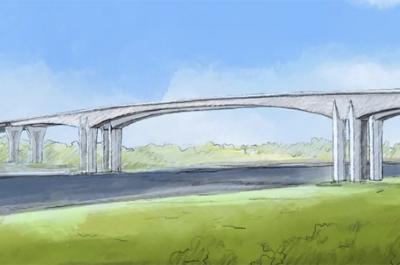
The concrete box-girder option.
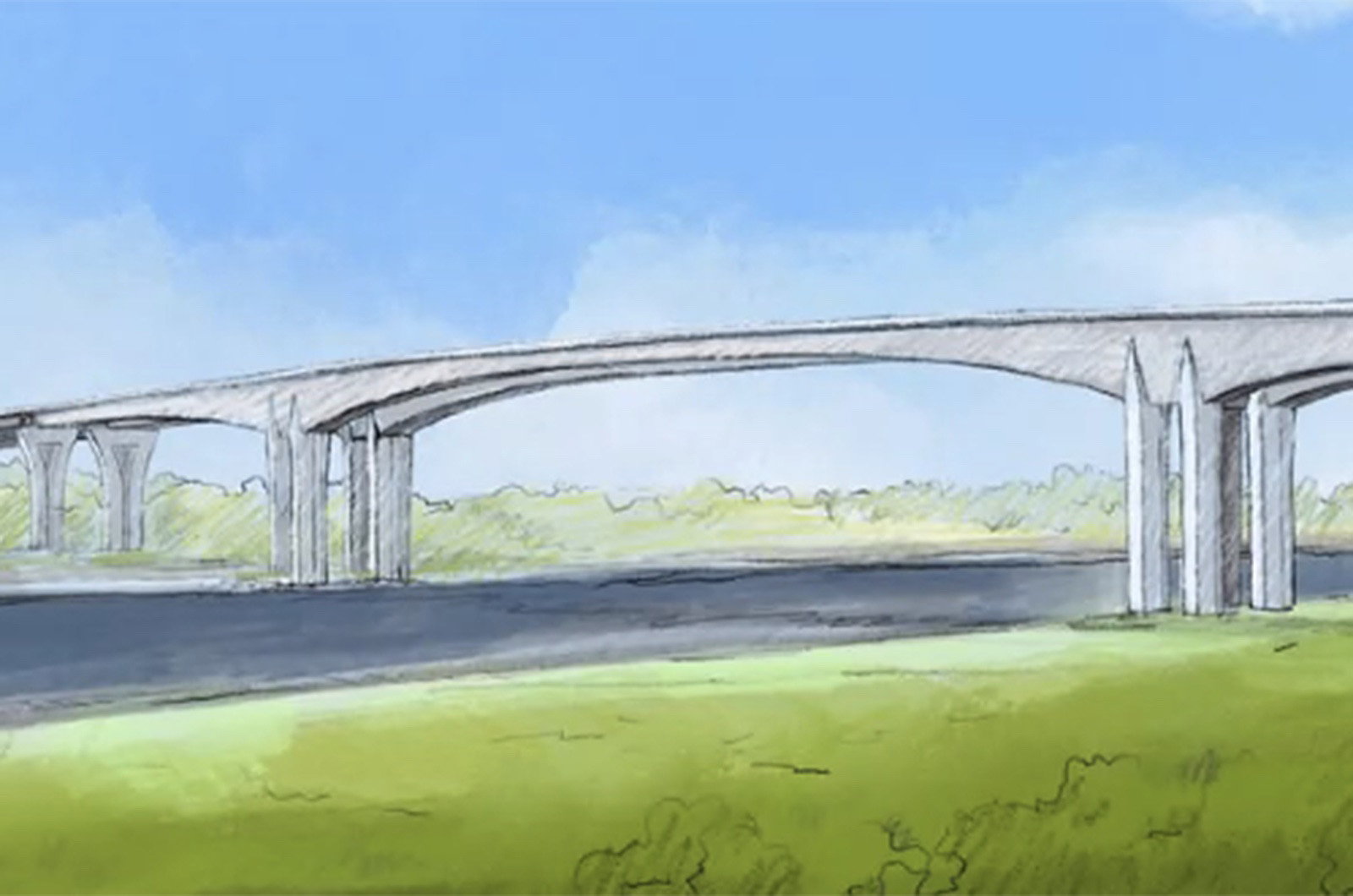
The concrete box-girder option.
“This model does provide iconic portal similar to the existing bridges,” Mr. Smith said. “The innovative structural system in a lot of ways harkens back to the innovative structural system of the original.”
“I would agree that the Arch type bridge is best suited for entry to Cape Cod,” attendee Brian Cleary said. “I’ve owned a home in Sagamore Beach since 1965 and excited to see this next step in upleveling living on the Cape.”
All three bridge options would have a shared-use-path for walkers and bikers.
The public is invited to share their opinion of the three bridge types through the MassDOT website, where individuals can complete a short survey. The project is still in early stages, Mr. Cordeiro emphasized, and for that reason officials cannot yet speak to the specifics of bridge accessibility, construction, or how the project will affect neighboring communities.
“We don’t have a design ready to share – we’re a long ways away from that – but when we do have a design we do want to talk with the public, talk with advocacy groups about what their needs are and have adequate multimodal accommodations,” Mr. Cordeiro said.

Construction phase process.
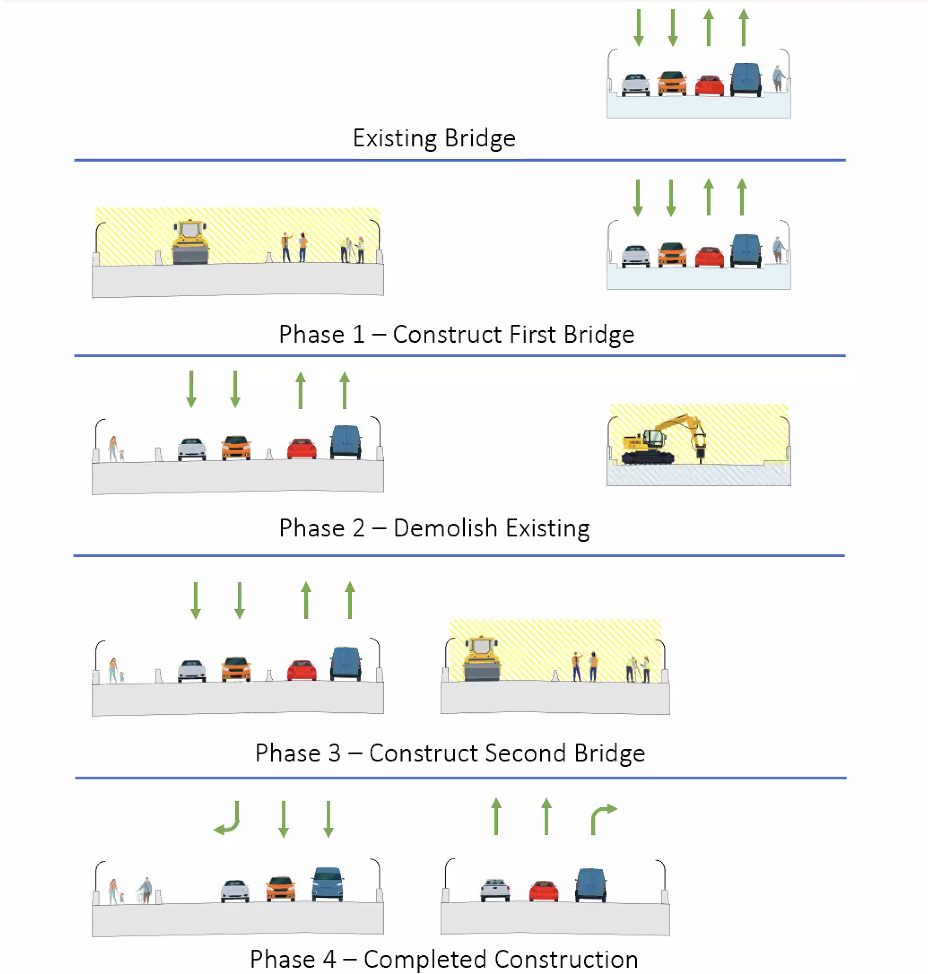
Construction phase process.
“This project is really focused on replacing the bridges with the uses in kind,” Army Corps engineer Dave Anderson echoed.
Representative Steven Xiarhos, who represents the fifth district of Barnstable that contains both bridges, expressed support for the upcoming project.
“I know we have a ton of work ahead of us but I was pleased with your presentation and I want you to know that we’re here to get it done,” Mr. Xiarhos said. “We call this the project of a lifetime and I look forward to getting it going.”
MassDOT will continue to hold public hearings at different points of the construction project, Mr. Cordeiro assured, once more details crystallize. Individuals can email comments or questions to [email protected].
For more information about the Cape Cod Canal bridge project, visit www.mass.gov/cape-bridges.
Comments
This doesn’t make any sense
Islander MVThis doesn’t make any sense to me. Am I missing something, or does the state want to replace each bridge with TWO SEPARATE bridges? So we will have four bridges when complete? I am no construction genius but I would think it would be far, far cheaper to build only one larger replacement bridge per bridge. I hope I am mistaken. If not, God help our state leaders. I would hope the money spent on multiple bridges could instead be spent on maybe education, health care, housing, public transit, and improving public beach access.
You are mistaken.
Albert NauYou are mistaken.
It is common practice to build separate bridges for each direction of travel.
Beyond four lanes there is no economy of scale.
The saftey reason for two bridges is the elimination of head on crashes.
Okay, I guess I’m used to the
Islander MVOkay, I guess I’m used to the bigger bridges in metropolitan areas with complete separation for direction of traveling, avoiding head on collisions, often by running the public transit rail carls in the center. Thanks for not being a jerk about it while explaining!
I grasp to understand the use
George Stein OBI grasp to understand the use of aliases in comments . Then seeing the assumption of funding for redundancy of multiple bridges I understand necessity to shield oneself from embarrassment.
It is common practice to have
Albert NauIt is common practice to have separate bridges for each direction of travel.
A major failure or maintenance can be accommodated by the other bridge.
Were you also a fan of not
School's Out TisburyWere you also a fan of not listening to the state on a new elementary school and passing on $34 million in state contributions to build it? I'll leave it to the experts, not islanders.
This concept is far different
John Cape CodThis concept is far different from earlier communications about this project which involved 2 new bridges with a total of 6 lanes each which were to be constructed next to each existing bridge currently in place.2 of the 6 lanes were for merging traffic from the on ramps to reduce traffic congestion with merging traffic, which always has been a problem especially during the busy season with heavy traffic. This newer update is ridiculous with 4 individual bridges and only 2 lanes each which does nothing to address the merging issues with the on ramps and results in the exact traffic capacity we have today. No real improvements except newer expanded bridge structures with better pedestrian / bike access, but with the same traffic capacity we have had since 1935. Both original 4 lane bridges were built in 2 years from 1933 to 1935 and here we are in 2022 saying that it will take 6 to 7 years to complete? The design / cost / construction timeline is out of touch with current traffic capacity needs. If they could be built in 1933 in 2 years with a lot of manual labor and basic construction machinery, why is going to take 6 to 7 years now? The original replacement concept was acceptable as it addressed the traffic issues along with pedestrian / bicycle access. The Cape needs bridges to meet current and future traffic capacity, not rebuilding with costly replacements with outdated 2 lane capacity.
The new bridges will
Albert NauThe new bridges will accommodate more traffic.
The lanes will be wider and the possibility of head on crashes will be eliminated.
The speeds will higher.
Build a bridge with double
BrewsterBuild a bridge with double the vehicle capacity next to each existing bridge. Make each bridge of the pair one-way. Make the newer bridge, with large capacity, the bridge leaving the Cape, since that's where the backup always is. Use one of the new lanes for pedestrians and bikes.
P.S. Seven years is absurd.
If it takes ten years from
Brewster BrewsterIf it takes ten years from project conception to completion, why did they wait until the bridges were functionally obsolete to begin seriously planning this project? Was this "functionally obsolete" designation a complete surprise? Ten years ago, did they have NO idea that these bridges would need replacing? "We ignored the obvious and now it's urgent that we act" will be the epitaph of the human race.
So now we have to use functionally obsolete bridges for over a DECADE (!), enduring all manner of planning and infighting and delays. Who suffers? The residents and the visitors of the Cape.
obsolescence doesn't
bobobsolescence doesn't necessarily mean it is going to fall into the canal from disrepair. it is obsolete because it is extremely under capacity for the number of cars that use it, as well as the narrow lanes with no divider between directions isn't up to current safety standards
How about a tunnel I’m
Tom Engley West TisburyHow about a tunnel I’m serious. Would be a better solution.
I was thinking the same thing
Bob EdgartownI was thinking the same thing. People have joked for decades about the secret tunnel but it seems like it would be very doable.
100% agree
Islander MV100% agree
This is how they build
Albie Scott Santpoort Zuid, the NetherlandsThis is how they build bridges in the Netherlands. The distance over the Rhine River at Nijmegen is the same as the Cape Cod Canal. The builders of the bridge were given a 10 hour window for moving the new bridge into place, as it required closing down river transport on the busiest river in Europe.
https://www.youtube.com/watch?v=51kH-tkOBIM
The Rhine river bridge is is
Peter EdgartownThe Rhine river bridge is is interesting, but we do not have the level staging area adjacent to the water (and a much stronger tidal flow). Has the idea of tunnels been even looked at? The Cape is a glacial terminal moraine, meaning it's sand and dirt, not bedrock. Would seem that a tunnel might be cheaper... and what are the long term maintenance costs of a tunnel vs. a bridge?
Tunnels should definitely be
Islander Too TisburyTunnels should definitely be considered.
Then, just leave the existing iconic bridges in place and convert them to recreation areas.
Like the elevated garden in NYC. It could be fabulous. A whole new way to enjoy the Cape and the Canal.
I’d love to see a tunnel
John Irving North FalmouthI’d love to see a tunnel instead of a bridge but I’m sure it would be much more expensive.
Separating the on Cape and
Ana de Sousa Oak BluffsSeparating the on Cape and off cape with only 2 lanes each way on the bridge will only create a mess along the too narrow canal connectors! Maybe use a zipper with four lanes on each bridge to accommodate peak traffic and have concrete separators. I’m intrigued with the thought of two tunnels and maybe accommodate rail in a larger tunnel
maybe have the MBTA run year
drea warehammaybe have the MBTA run year round every day instead of seasonal weekends only.with stops all the way to P town. we love taking the train , no stress and easy.
Why not fill in part of the
Otto West TisburyWhy not fill in part of the canal and just build roads? The canal is artificial anyway, and the commercial marine traffic it was built to accommodate no longer exists.
I’m surprised the replacement
Sharpy Cape codI’m surprised the replacement bridge will not be a replica of the original. Cape Cod should keep the same old fashioned look in my opinion!
I had originally thought of
Scott DennisI had originally thought of building the new bridge with 2 lanes on either side of the existing bridge, then once traffic is rerouted take the old span down and build a bridge for 2 tracks of light rail. Since we are moving to electric vehicles I’m wondering how many people coming to the cape from a distance would drive. Some people with 2nd homes here could just leave a vehicle at the house and take the train. Seems easier than recharging your vehicle 1 or 2 times to make the trip. The train would also be good for commuting to the city and the airport.
Add new comment