


In 1944, four-year-old George Hartman watched the Germans march out of Brussels, and the British march in.
In 1944, four-year-old George Hartman watched the Germans march out of Brussels, and the British march in. But even more memorable to young Mr. Hartman was the visit later that year from his uncle George, and the Christmas gift his uncle brought: a miniature toy steam engine, hooked up to a little generator and lightbulb. Now, with 80 years, two engineering degrees and several tons of rusted iron under his belt, Mr. Hartman runs the Island’s Antique Power Museum, and is one of the last keyholders to the esoteric mysteries of rust and gasoline.
As a child, Mr. Hartman emigrated to America with his family, and he brought his mechanical mind with him. He encountered many other kids with bicycles, so he salvaged his own rusty model from the dumpster. “I could either fix it myself or not have it,” he recalled. In 1958, he made his first excursion to the Vineyard, and though he didn’t move to the Island full time until decades later, he immediately connected with the place. “Once you’re here you’ll always come back,” he said.

One of many treasures housed in the antique engine barn.
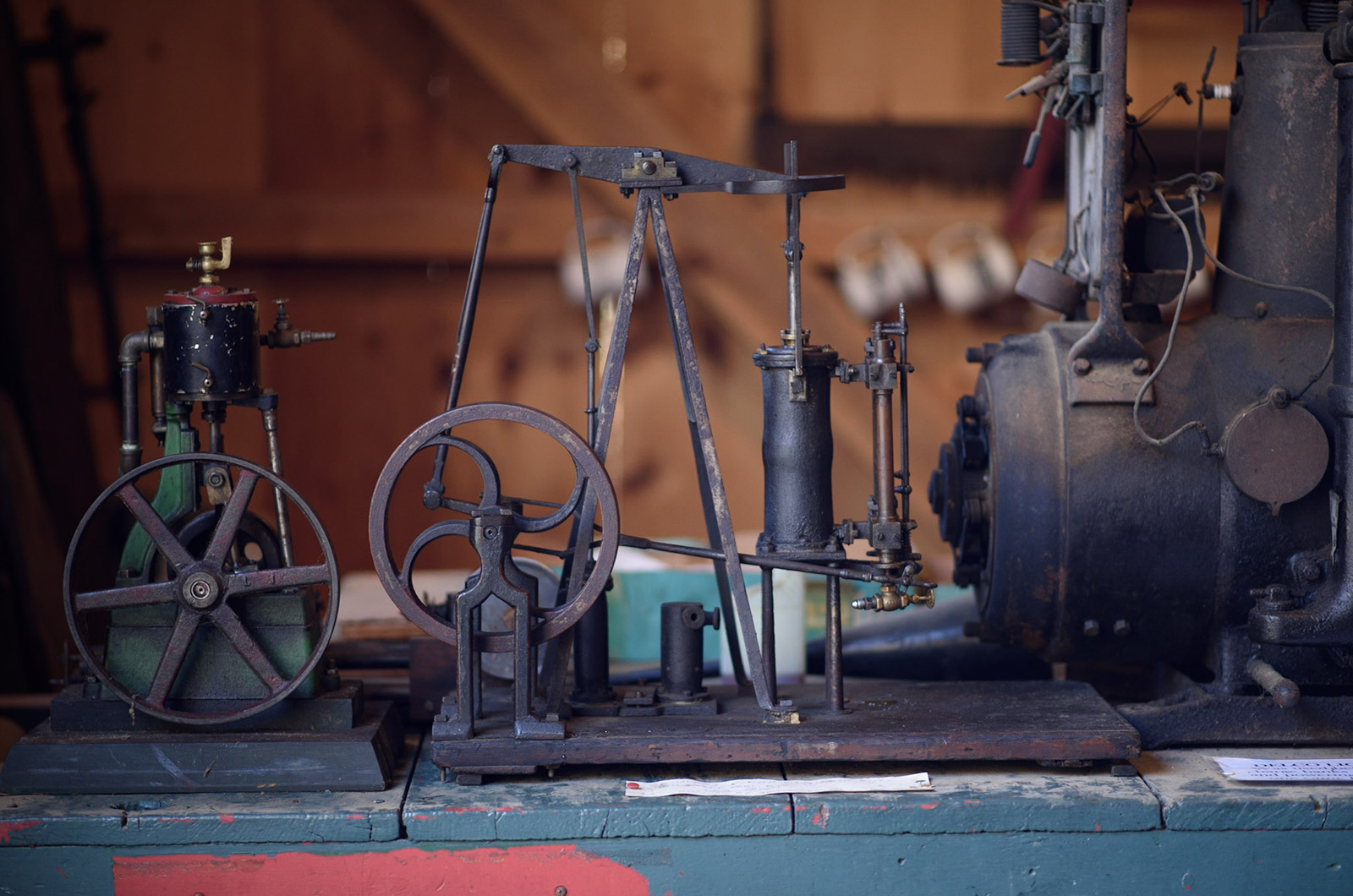
One of many treasures housed in the antique engine barn.
In the mid-1970s, Mr. Hartman began to bring bits of his mechanical ephemera to the Island with him, starting with a rusted North Carolina barnyard engine he bought for $10. He displayed his finds in front of Machine & Marine (the current site of West Marine), then owned by his friend Dan West. Soon after the old engine went on display, other engines for Mr. Hartman to repair started coming out of the woodwork across the Island.
Bill Honey, longtime president of the Martha’s Vineyard National Bank and avid antique engine collector, was critical to bringing together auto-antiquarians from on and off-Island for a real engine show, Mr. Hartman said. He recalled their biggest show in 1989, when they filled the Grange Hall with over 200 exhibits.
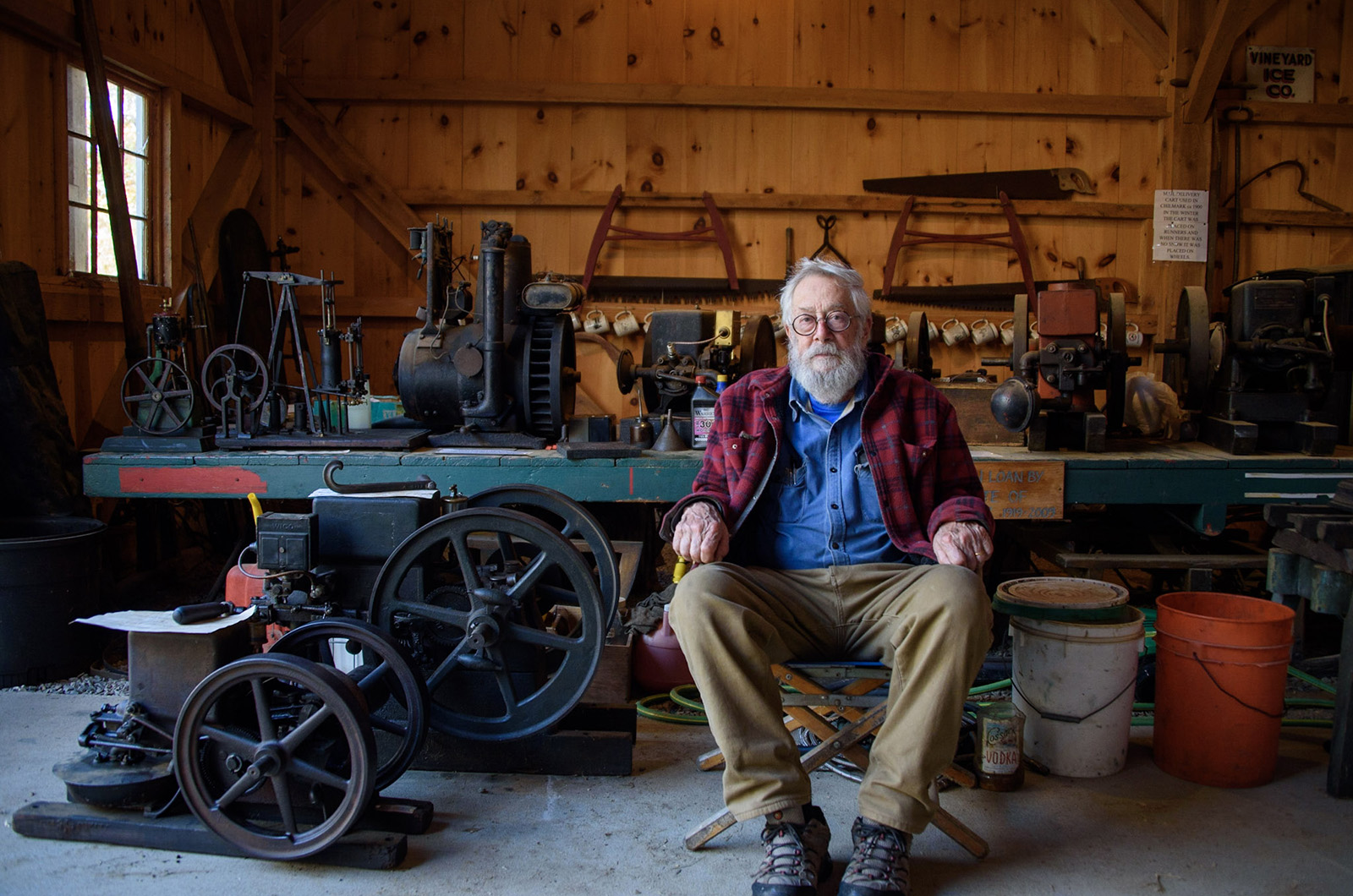
Today, the Antique Power Museum has a permanent collection at the Agricultural Fairgrounds, open at the annual fair, the harvest fest and by appointment. If you give Mr. Hartman a call, he will drive by to unlock the barn and give you a tour. He wears a short, disheveled white beard and thin tortoise shell glasses, often sporting a flannel with suspenders. He keeps a notebook, with a tally of every vistor’s home state or country.
On a recent walk-through with a Gazette reporter, he explained that the engines in the collection are mostly gasoline powered, four-cycle models. “They might be two horsepower, but these are all Clydesdales,” he said, before kneeling next an engine named Titan Jr. to explain its four cycles. First intake (the combustion chamber fills with gas), then compression (the piston moves back, compressing the gas), then ignition (the gas explodes, pushing out the piston) and finally exhaust (which resets the process).

Mr. Hartman and his wife, Andrea.

Mr. Hartman and his wife, Andrea.
Most of the early 20th century engines don’t fire on every turn, instead coasting for several revolutions after one ignition. These are the hit-and-miss engines, with their distinct “ch-ch-ch, boom, ch-ch-ch, boom,” sound that Mr. Hartman imitated. In addition to being hit and miss, some of the older engines are make-or-break (that is, they use a mechanical circuit-breaking contraption to make a spark, rather than a spark plug).
And if gasoline isn’t your cup of tea, Mr. Hartman is happy to show off an array of mid-1800s steam engines, all powered by a propane boiler of his own construction. A highlight of the collections is the steam-powered popcorn engine, painted in bright colors since it would be visible to the crowd, with a boiler-tube contributing heat to an attendant peanut roaster.
The antique engine barn is full of treasures like this: a gasoline-powered washing machine, the old Chilmark postman’s carriage, a collection of antique toy engines, a 1930s electric windmill. They are all lovingly cared for by Mr. Hartman, among the last of the antique engine alumni after his old pal Dan West died last year.
At this time of year, Mr. Hartman is prepping the engines for winter, oiling each one well, shooting compressed air to eliminate the excess fuel, and making sure no critters have made a home in the engine hoppers (he recalled one year when he kickstarted and engine, only for a squirrel’s collection of acorns to come cannoning out of the exhaust pipe).
Mr. Hartman will be 81 soon, but he remains committed to the work. He makes sure that every engine still gets run, at least once a year.
Comments
I am 68 now; when I was young
Dave Kolb EdgartownI am 68 now; when I was young I often spent summers with my Grandfather in Ohio. He too collected and rehabbed old gasoline engines, and resold them ("with only a 12% profit", he always said with a wink). With a lot of effort, we would take them to local fairs and run a portable grist mill belted to them and sell small bags of stone ground cornmeal. The sound of those old hit and miss girls are truly magical to my ears and take me right back to my boyhood days. I hope to call George soon. Thank you for the excellent article; if only it could have had a sound clip attached it would have been perfect!
Thank you George for keeping
Brant Weatherford Oak Bluff Community, Crossroads, TexasThank you George for keeping these wonderful engines, and their history, alive. As a seasonal MVCMA resident, it is always a treat to visit them at the Ag Fair each summer.
A tour of the museum with him
Steve Cripps AtlantaA tour of the museum with him is time very well spent . George is a treasure!
As George's son in law, a
Peter Northrup Bridgewater, MAAs George's son in law, a highlight of my year is helping the Museum at The Ag Fair as volunteer staff. I love to explain the various engines in the historical context from when they were made. The small walking-beam engine(2nd photo) made in 1815 (when the War of 1812 ended) was a engine design used on ocean going ships when converting from sail to steam power. The summer before Covid, Tom Thomas brought a belt driven 1918 washing machine to demonstrate at the Museum. Brand new in 1918 it cost the same as a soldier's pay for 1 month. I like to wonder how many men going off to fight World War One may've bought their wives such a labor saving device. Go to the MV Antique Power Museum, see history in action.
Mr. Hartman was one of my
Steve Haley CarrolltonMr. Hartman was one of my Engineering Professors at a community college in Hampton, VA. He had such great sea stories about mechanical things and always new something about how the systems were engineered. Things he said always sparked my interest to do more research on the subject. The one I still remember most prominently to this day was: Mr. Hartman, what is Reynolds Number in fluid dynamics? (This was in the 70's so we didn't have computer generated graphics). He said, "You notice in the movies, how they film a smaller scale model ship in a tank and it looks fake because the bow wake doesn't stick to the hull and flow away like the full scale version." Yep. That's because the Reynolds number is not scaled with the model. Bingo, just realized how all those wind tunnels over at the local NASA facility measure functional data on air foils. NTF tunnel had not been constructed at the time. It's design is based on using Liquid Nitrogen as the test section gas in order to match the Reynolds number of real flight. So two things are the takeaway from this. Modern computational fluid dynamics have cut the need for a lot of the mechanical modeling and guys like Mr. Hartman are the ones who help get use there. Thanks for all the knowledge you imparted on you students.
Add new comment