


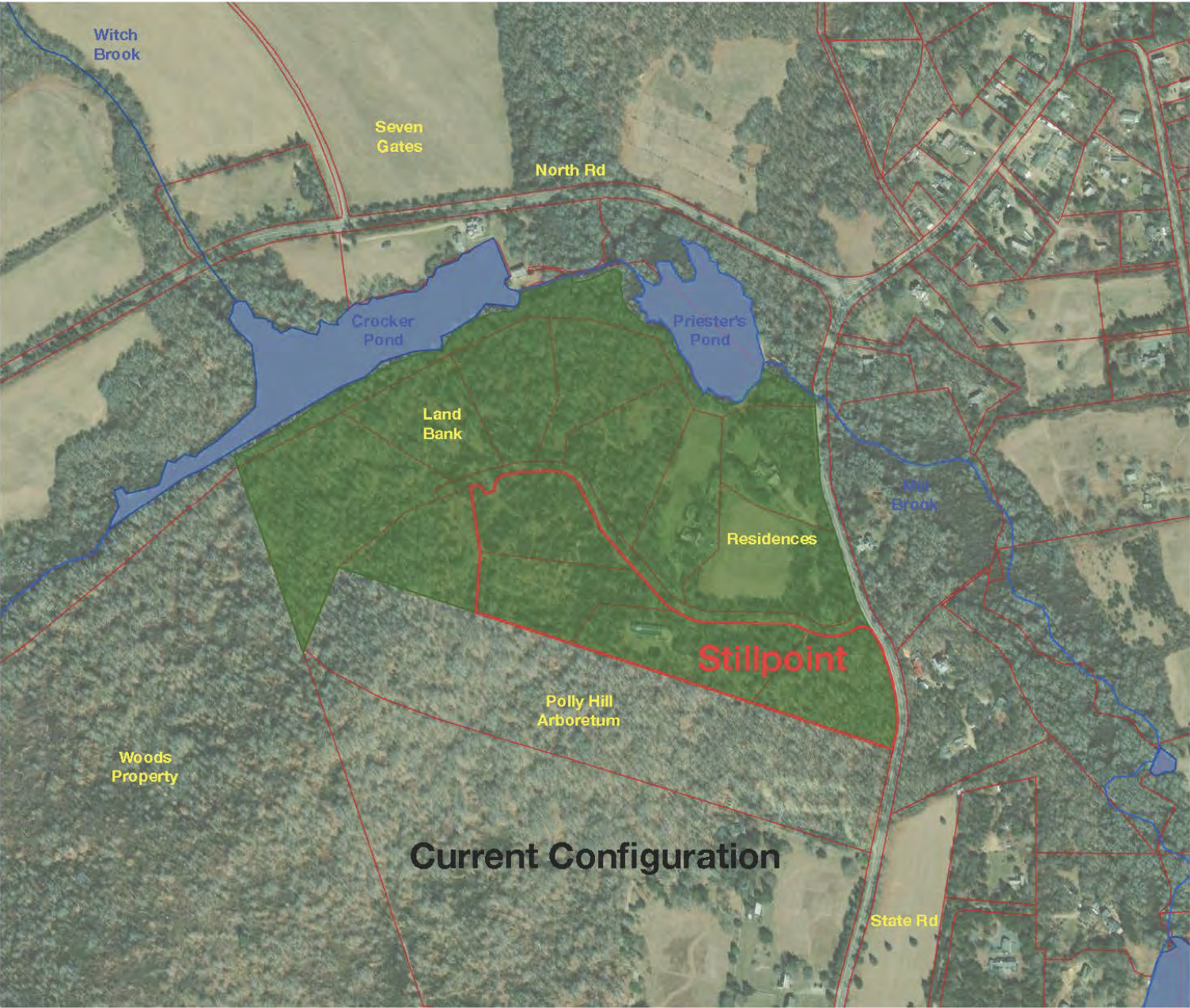
A proposed arts and humanities center in West Tisbury would play host to classes, discussion space and weddings, drawing support and questions during an MVC hearing Thursday.
More details have emerged on a proposed arts and humanities center in West Tisbury that would play host to classes, discussion space, weddings and more, drawing support and questions during a hearing before the Martha’s Vineyard Commission Thursday,
In written and videoconferenced testimony since the hearing for Stillpoint opened in early October, dozens of Islanders have expressed support for Thomas Bena’s concept of a gathering space for educational conversations and outdoor contemplation. Mr. Bena is a principal in Stillpoint Martha’s Vineyard Inc., which owns the property.
Situated on approximately 13 acres just north of Polly Hill Arboretum, Stillpoint would be open daily from 7 a.m. to 10 p.m. for classes and nature walks, according to Mr. Bena. About 50 to 60 classes a month would take place, with group sizes from 10 to 40 people. Evening events in summer would involve 40 to 60 patrons and three to six staffers or volunteers, two to three nights a week.
The proposal also includes hosting events, like weddings, of 80 or more people twice a week in the offseason, and once a week in the summer. Applicants have proposed about 40 parking spots for the venue. Future plans include the construction of a 20 by 30-foot workshop.
But even as details have slowly emerged regarding the property, members of the commission asked for further clarification Thursday night about Stillpoint’s precise intentions for the mostly-undeveloped land and its 3,200-square-foot barn.
Hearing officer Doug Sederholm questioned Mr. Bena, noting that while the Stillpoint proposal bans outdoor amplified music at weddings, it permits any other outdoor amplified music between 9 a.m. and 9 p.m.
“Among your core values are quiet and nature, as stated in your presentation,” Mr. Sederholm said.
“Given your two closest abutters are Polly Hill Arboretum and the Land Bank, [both] dedicated to the quiet enjoyment of nature, how is allowing any amplified music on your property … consistent with your mission statement?” he asked Mr. Bena, who said he’s simply trying to allow for the possibility of a guitarist plugging in on occasion.
Stillpoint’s mission statement is: “To create a gathering space for educational offerings, including but not limited to discussions, workshops, silent retreats, and the arts.”
While Mr. Bena is asking to host an unlimited number of weddings with fewer than 80 people, and up to four with as many as 100, he told the commission he’s committed to working in concert with neighbors.
“The major concern when I’ve talked with abutters has been large, loud weddings,” Mr. Bena said.
“It’s not in our mission to have large, loud parties and weddings … but [wedding business] is a funding stream we want to keep on the table,” he said.
“I’m just not the kind of person who’s going to produce something that’s going to ruffle the neighbors’ feathers, but I do want keep some options open,” Mr. Bena added.
Stillpoint supporters who spoke Nov. 3 included the property’s new, nearest neighbors, Anna Fitch and Banker White, as well as Jennifer Randolph of the Northeast Native Network of Kinship and Healing
“It is everything I would want to provide services at … educational services, prevention services for young girls on what is a healthy relationship,” said Ms. Randolph, an Aquinnah Wampanoag tribal member who founded the community’s first domestic assault program.
Stillpoint’s acres and the adjoining land bank property offer contact with the undeveloped Island that her people need, she said.
“That preservation of land and that space is so important to us,” Ms. Randoph said.
Land preservation concerns led other speakers to urge caution and apply more limits to Mr. Bena’s vision, which by Nov. 3 had expanded to include potential housing for future employees although Stillpoint initially had been proposed for non-residential uses only.
“While we recognize the need for flexibility, we also recognize the need for restraint,” said West Tisbury resident David Foster, expressing concern that there still may be more to the plan that hasn’t been disclosed.
“The conservation future of this property should be preeminent,” said Mr. Foster, who joined the online meeting with West Tisbury resident Tess Bramhall after the two also submitted a letter to the written record.
Ms. Bramhall is the founder and Mr. Foster a board member of the Land Protection Fund, administered by the Community Foundation of Martha’s Vineyard.
“There is a lot of uncertainty abut how this project will be financed and one has to wonder about what new phases might appear … to make this a viable venture,” Mr. Foster said.
Commissioners continued the hearing to Nov. 17 in order to have updated nitrogen projections for the property.
Comments
Pristine fragile water and
Tom Engley West TisburyPristine fragile water and land with Mill brook right there also bad sight lines on State rd. Traffic would be a mess and quite frankly dangerous. I believe there is a shared driveway across the street as well. I love the part where it states 80 or more people. Wait what.
Thanks, Tom, for bringing up
Jake Davis ChilmarkThanks, Tom, for bringing up this point. Our Stillpoint team has from the beginning of the MVC process voluntarily offered to limit all events to a maximum of 100 people including staff. Though that limit is noted at one point in the article, you are correct that the article does not make clear when it says "80 or more" that actually that is 80-100 maximum including any staff. I believe the traffic issues were dealt with satisfactorily in the last MVC hearing, and that the nitrogen issues for the watershed will also be in the coming hearing. Please do reach out to us if you would like to discuss further. https://www.stillpointmv.org/
The only way this is a money
Mr. B ChilmarkThe only way this is a money-maker (and that is what it is, no matter where the money goes) is through the rentals for weddings. It will be used to the allowed maximum, which appears to be as many as can be scheduled if they are under 80 participants. The traffic in the area will increase significantly, and the map suggests that the entrance/exit would have to be on a dangerous corner.
You are correct, Mr. B., that
Jake Davis ChilmarkYou are correct, Mr. B., that the reason our Stillpoint team would hold private events such as weddings would be to create income streams to allow a broad swath of the community to benefit from being in this space, not just those who can afford to own property in this area of the island. For instance, programs for indigenous women, conversations on racial and socio-economic divides, and contemplative retreats may need other sources of income to be viable. If the community steps up with enough donations to cover these needs, then we will be delighted and relived not to have to hold private events such as weddings. But since that can't be guaranteed, we also can't guarantee not to hold income-generating events.
A venue for an unlimited
Christine SengeA venue for an unlimited number of weddings in W. Tis, a 3 day rock concert on a small ball field on a one block residential street in V.H., and people from out of state buying up homes in residential areas & converting them to expensive weekly rentals. The island is being exploited as a cash cow, and there is no entity working island-wide to prevent its conversion from a place of solace & renewal to a crowded, noisy, honky-tonk resort.
I disagree on the last point,
Jake Davis ChilmarkI disagree on the last point, Christine. I think I can speak on behalf of the whole Stillpoint team when I say that we are really grateful for the role the Martha's Vineyard Commission has played over the past fifty years as the island-wide entity trying to protect the Vineyard, its human and ecological communities. We recognize that the folks serving on the MVC and town boards do that work out of care, and have to balance different and competing interests.
To bring the point back to the topic at hand, when weighing the regional impact of a project like Stillpoint, boards such as the MVC need to consider not only the legitimate concerns of neighbors who would like to keep their particular corner of the island protected and quiet. They also consider the interests of other sectors of the island community including those who - without Stillpoint providing a community space - might not have the opportunity to use this special place in the Mill Brook watershed to do healing work for indigenous women, hold conversations that bridge socio-economic and other cultural divides, and other community activities that deeply needed, but not lucrative.
Add new comment