


As Vineyard Wind breaks ground on the nation’s first industrial-scale offshore wind farm, global supply chain issues and rising commodities prices have stalled a second project.</p>
The race for offshore wind south of Martha’s Vineyard experienced both strong tailwinds and heavy turbulence this week, with Vineyard Wind breaking ground on the nation’s first industrial-scale offshore wind farm just as global supply chain issues and rising commodities prices have stalled a second project.
Meanwhile, a third project planned for south of the Island, Park City Wind, is before the Edgartown Conservation Commission for review, as Island officials weigh another undersea cable proposal.
All three projects — Vineyard Wind, Commonwealth Wind and Park City Wind — are at least partially owned by Avangrid, a giant renewable energy company based in Orange, Conn. Vineyard Wind is a 50-50 joint partnership between Avangrid and a Danish company called Copenhagen Infrastructure Projects, while Avangrid owns 100 per cent of Commonwealth Wind and Park City Wind after the projects restructured in early 2022.
Each of the multi-billion-dollar projects have secured approximately one-third of a federal offshore lease area about 15 miles south of Martha’s Vineyard. And all three have proposed running undersea transport cables from their lease areas through the Muskeget Channel east of Martha’s Vineyard to connect with a switching station in Barnstable.
Vineyard Wind, which plans to produce 800 megawatts of energy using about 60 turbines, announced in a press release Tuesday, Nov. 1, that it had started construction on its undersea cables. Nearshore cable work off the south coast of Cape Cod is expected to begin in the coming days, the release stated.
The installation process is expected to continue through the fall of 2022 and into the spring of 2023, according to Vineyard Wind, and includes the burial of two cables beneath the seafloor about a mile east of Chappaquiddick. Work will be done by the Prysmian Group, an Italian manufacturing company, the company said.
A tug named Nicole Foss has started what is called a pre-lay grapnel run through the cable corridor to make sure the burial site is free of debris, according to a project update. The cable laying work will be conducted by another boat, the Cable Enterprise.
But just as Vineyard Wind breaks ground, Commonwealth Wind — an approximately 1,200 megawatt project planned for an area 22 miles south of the Vineyard — is facing a delay. In an Oct. 20 filing with the state, Commonwealth Wind asked the department of public utilities to suspend its review of the company’s power purchasing agreement for a month as it reassesses its financial viability.
Proposed cables would run east of Martha's Vineyard.
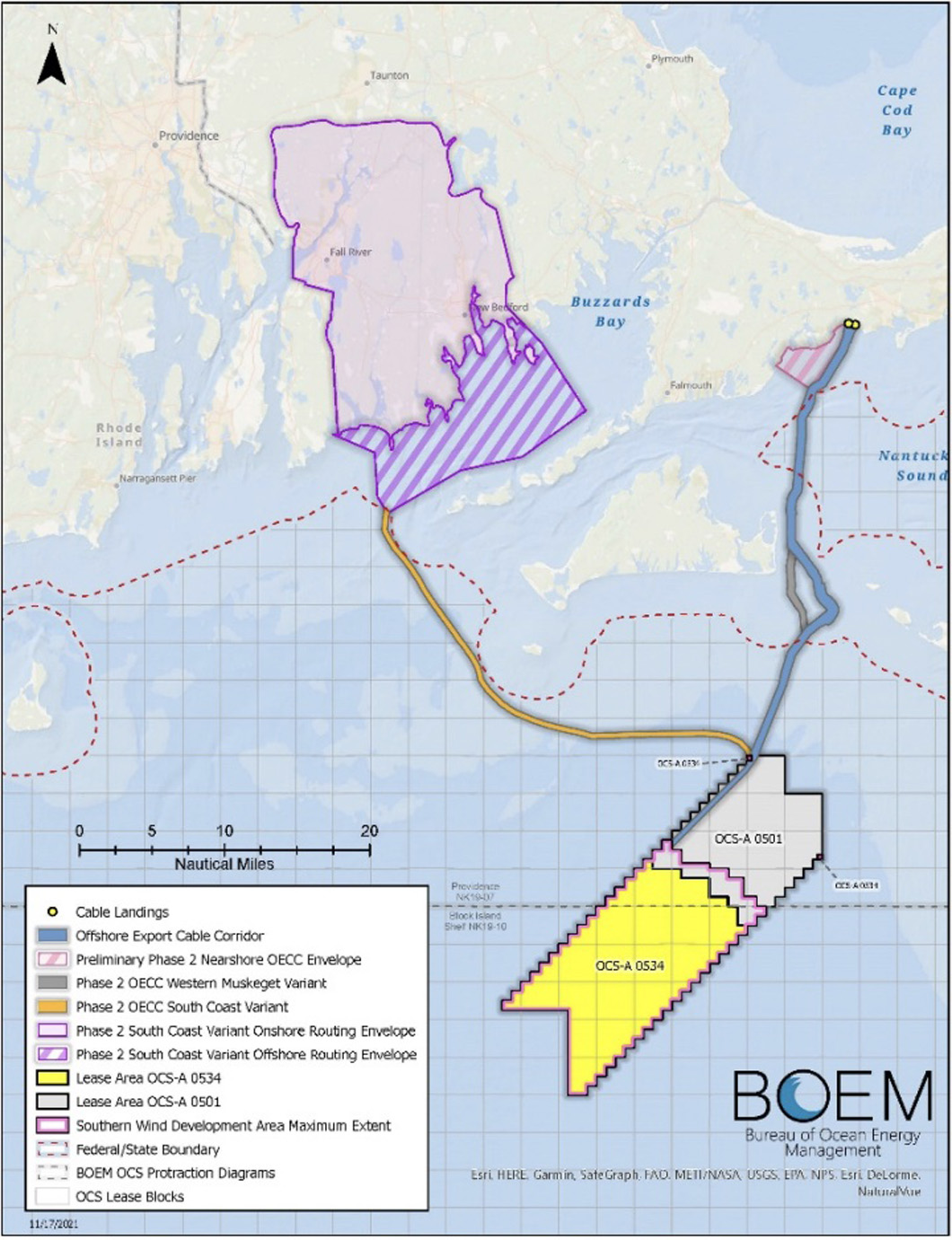
Proposed cables would run east of Martha's Vineyard.
“Global commodity price increases, in part due to ongoing war in Ukraine, sharp and sudden increases in interest rates, prolonged supply chain constraints, and persistent inflation have significantly increased the expected cost of constructing the project,” Commonwealth Wind wrote to the state. “As a result, the project is no longer viable and would not be able to move forward absent amendments to the [power purchasing agreements].”
Commonwealth Wind said that it could use the delay to explore more favorable tax incentives and financing options.
Vineyard Wind remains commercially viable, a spokesman said this week in an email to the Gazette, and is moving forward with construction. Vineyard Wind officials hope to have the project online by the end of 2023.
Meanwhile, Park City Wind is proceeding with its application to install two additional offshore cables beneath the ocean floor within Edgartown’s town limits. Unlike Vineyard Wind and Commonwealth Wind, which has committed its energy to Massachusetts, Park City Wind has an energy contract with the state of Connecticut.
At a meeting before the Edgartown Conservation Commission Wednesday, Oct. 26, Pat Johnson of Avangrid and Holly Carlson-Johnston of Epsilon Associates outlined the project’s community benefits and impact on Island waters.
The two offshore export cables would lie within a one-mile-wide corridor that extends north from the project’s lease area next to the Vineyard Wind project all the way to the West Barnstable substation. It is the same corridor where the Vineyard Wind cables will be laid, Ms. Johnston explained, and its location was determined “to avoid and minimize impacts and maximize successful cable burial.”
“The state has been heavily involved in the rating of the corridor,” Ms. Johnston told commissioners. “The cables themselves will only use a very narrow portion of the corridor identified.”
Ms. Johnston said environmental impacts would be minimal, as installation speeds are only about 100-200 meters per hour, and the installation vessels don’t reach speeds high enough to threaten wildlife such as the North Atlantic Right whale. The cables themselves would be buried between four and eight feet underground roughly 50 to 100 meters apart from each other.
“Most of the corridor will remain unaffected by the project,” Ms. Johnston said.
Given the overlap between Vineyard Wind and Park City Wind, and the expectation of more cable construction in the future, commissioner Edward Vincent asked if the proposed area was the most logical place for a corridor. Ms. Johnston said it depends on the project and its destination.
“What we’re trying to avoid here is what you sometimes hear called the spaghetti of cables,” Mr. Johnson said. “To have cables placed in an order that makes sense, not all over the place.”
Commissioner Maximillian Gibbs expressed concern about what would happen if the cables became exposed by a sand wave field or other factors.
“The installation [takes place] in a stable seabed, not in fields of sand waves,” Ms. Johnston responded. “The cables may be buried at a greater depth if a sand wave moves over them, but they’re in the stable seabed. They’re not expected to move.”
Ms. Johnston also noted that Avangrid will be conducting regular temperature surveys which could help determine if a cable becomes uncovered, as well as geophysical surveys and a habitat recovery plan that is still in the works. In the event a cable does become uncovered, cable protection measures such as concrete bags, rocks, or rock bags could help rebury them, she said.
Edgartown’s energy committee chairman Alan Strahler expressed support for the project, noting that the energy committee has already written a letter of support for the New England connector.
“[The project’s] impact on the seafloor is minimal,” Mr. Strahler said, adding that the project’s community benefits outweigh any potential risks. “Investment in key core infrastructure is one benefit, as is improving the electric grid’s resiliency on-Island.”
The commission continued the discussion on Park City Wind’s project until Nov. 30.
Comments
The reporter needs to get the
Quitsa ChilmarkThe reporter needs to get the facts straight so the public understands that it is NOT American companies that are destroying our offshore marine environment using our tax dollars ad rate subsidies. Avangrid is only nominally a "Connecticut" company. It is wholly owned by Iberdrola, a multinational with its headquarters in Spain. All three projects that will turn the waters south of the island into an industrial wasteland are completely foreign owned and controlled. As for the fiction of the "green jobs", the British ensign flying from the Cable Enterprise might give you a hint. The offshore wind industry is a lot like the bad old days of colonialism. The US is just another Third World country allowing its resources to be destroyed for foreign profits.
why can't people see this...?
steve smyth new jerseywhy can't people see this...?...coal for steel columns...gas and diesel for every step along the way...and lots of petro chemical resin for blades...add that to the now famous jobs...jobs...jobs jobs talk...YIKES...it's years down the road before those jobs are US jobs...by then OSW will have failed in a Cat 3 hurricane and the whole mess will be left to rust and remind us of who really controls our lives with energy dependency...excellent comment...more people have to pay attention...
How come no mention of the
reality check edgHow come no mention of the cost to consumer for this electricity? After expressing a shock at my current electric bill rising 60+ percent since December (and expecting another unknown increase with the new rate Jan 1), it would be helpful for the gazette to investigate and report the facts on the HUGE increases. We are being forced into buying 'clean electric' yet no mention of the actual price. Checking alternate electric suppliers, it appears that all electricity sold in MA is required to have 51 percent renewable NOW. This explains the exponential rise in costs here. New England, where most electricity is generated from clean natural gas is expected to experience a shortage, caused by increased electric demand, while the regulators a few years ago blocked a logical gas pipeline expansion (of a few inches of an existing pipeline) All well and good for going green, but you'll have a LOT LESS green in your wallet.
The electrical rate increase
Jeremy Osborn TisburyThe electrical rate increase we have seen, which is about to get worse, is because we are relying on natural gas. With winter coming, and Europe no longer buying their gas from Russia, we are now competing with European countries and will have to pay more since the demand is higher. If this project and others like it were already completed, we wouldn't be paying these electricity prices.
The electric rates are in 6
reality check edgThe electric rates are in 6 month increments from the default setting of Cape light compact. Same if eversource is the 'supplier'. They SUMMER increase was 40 percent instead of the usual decrease. You are dead wrong about the cost of wind being less. Before cape wind failed, they PROJECTED a wholesale cost of .28 per KW. That was many years ago. We are now paying RETAIL of 16.99 ish... it will go up. And your argument about competing with Europe for US national gas is not accurate. We have more than sufficient supplies here.. .and there is NO WAY to sell it in Europe since every proposed LNG terminal has been denied by activists. I have another home off island, and the electricity there USED to cost more than MV... but not now. Mandating that electric utilities purchase the wind and solar at ANY price has financial consequences for the retail consumer
What's driving up electric
Carol formerly ChilmarkWhat's driving up electric rates is the much higher cost of natural gas, thanks to Putin's war on Ukraine. Renewables are the cheapest generation sources in New England's electric portfolio mix; solar is the cheapest of all.
Its been reported that the
just a thought mvyIts been reported that the northeast USA has less than a 25 day supply of deisel fuel available. This is the same as #2 heating oil. Since OPEC+ cut production by 2 million barrels per day in a political move, the federal government has tried to play the price game (they cant) by releasing oil from the strategic petroleum reserves, leaving the country in a VERY dangerous predicament. That reserve is to be used for emergencies *such as when hurricanes shut refineries*, not to lower the gas price by a few cents prior to an election (its increased .50 this month so it didnt work) Lets hope that the reported threats of Iran targeting Saudi Arabia prove to be wrong. The last time it caused a 50% reduction in saudi oil output and a major price spike. Being energy independent DOES affect our national security.. and depending on foreigners who hate us is not good foreign policy. High oil prices enrich our enemies, and allow Putin to afford weapons for his war in Ukraine. If the price of oil declines, so does their agression.
Tesla has deployed a large
frank brunelle TisburyTesla has deployed a large new Powerpack system in Nantucket, which relies on two underwater cables, to secure the island’s power.
Nantucket is a small island of about 11,000 permanent residents about 30 miles off the Massachusetts coast, but it’s also a very popular tourist destination.
During the summer, the population can rise to 50,000 people, and the demand for power rises with it.
The island’s electricity is currently supplied via two submarine cables that connect to the mainland transmission system on Cape Cod.
It results in a critical failure point, but the island’s power is still secured with two six-megawatt diesel generators acting as backup power.
In 2017, National Grid, the power company in charge of the system, warned that the two generators are reaching the end of their useful life and need to be replaced.
Instead of going with new generators, the company commissioned Tesla to build a 6 MW/48 MWh battery energy storage system.
Two years later, the project is now completed, with 234 Tesla Powerpacks deployed on the island (via WBUR):
How long have you guys had
ZachHow long have you guys had that submarine cable system? I was a little concerned that the Electromagnetic waves from under water cables would affect migratory aquatic species but I guess that it won't if you guys have already been using undersea cables?
About Ludlow Electric
frank brunelle TisburyAbout Ludlow Electric
Ludlow Electric supplies electricity in Ludlow, Vermont. They presently provide electricity to residential, commercial and industrial customer accounts, with a total of 4 industrial customer accounts, 720 commercial accounts and 3,100 residential customers signed on for their services. The average residential electricity rate for consumers of Ludlow Electric is around 11.87 cents per kilowatt hour . This is less than both the Vermont and the US average prices of 19.42 and 14.11 cents per kilowatt hour, respectively.
A clean energy solution
frank brunelle TisburyA clean energy solution
A single Rolls-Royce SMR power station will occupy the footprint of two football pitches and power approximately one million homes. It can support both on-grid electricity and a range of off-grid clean energy solutions, enabling the decarbonisation of industrial processes and the production of clean fuels, such as sustainable aviation fuels (SAF) and green hydrogen, to support the energy transition in the wider heat and transportation sectors.
As a major shareholder in Rolls-Royce SMR, we will continue to support its path to successful deployment. Find out more at www.rolls-royce-smr.com.
I submitted three possible
frank brunelle TisburyI submitted three possible alternative solutions to the issue of energy costs and stability for Martha's Vineyard, but there are in fact many more possibilities. It is up to our leaders to come up with a better solution than paying so much for power, by using at best very expensive alternatives. Nantucket succeeded in obtaining a very powerful Tesla off-grid battery backup system. The village of Ludlow Vermont has a more than century of expertise in providing energy for its village independently, and far less expensively, and more efficiently. Numerous companies are exploring and developing Small and Micro Nuclear Reactors and one would easily fit on a few acres on Martha's Vineyard and it would be less expensive by far and would protect us from any cable failures or mainland infrastructure failures. It is up to our leaders.
I was a consultant to the
Jane Chittick Amelia Island, FLI was a consultant to the overall Program Manager of the nascent Strategic Petroleum Reserve from start to finish (inception, choosing storage type, preparing the salt domes, buying the oil, getting the transport from abroad to the domes, and the first drops of oil in the reserve). Originally to be 1 Billion barrels of crude, it was reduced to 750 million barrels. Everyone has forgotten the Arab Oil Embargo 1973-74: our nation was in a war then, whether it was called that or not. "Strategic" is the operative word: the reserve is for times our nation is at WAR and sometimes (but rarely) for EXTREME natural disasters ("extreme "- not typical disasters like hurricanes that certainly wreak havoc, but are not crushing the ENTIRE nation). It is unfathomable that our STRATEGIC reserve is now vulnerable, the country is buying dirty oil from enemies, and the administration is trying to buy votes by pretending to regulate gas prices at the pump and home. STRATEGIC here means the military and waging battle when at war. Citizens' pocketbooks are not in this equation at all. This whole administration has no clue and nor do reporters who do not understand the meaning of the reserve's name: for military use only in times of war or some disaster that overwhelms the entire nation.
Sales from the SPR have been
Robert Skydell Essaouira, MoroccoSales from the SPR have been going on periodically since 2015 to help offset Federal deficits. Also, since crude prices fluctuate, often widely over time, it is prudent to buy when the price is low to replenish supplies.
Our dependence on a massive petroleum reserve to ensure a strategic capability in the event of a war can also be mitigated by investing in cleaner, safer and more domestically produced renewables rather than continue our dependence on hostile, oil-producing countries.
I don’t understand how we can
Ellen EdgartownI don’t understand how we can be so upside down in our country. The cost of EVERYTHING is out of control. I am on a fixed income and never in my 78 years did I have seen anything like this… what happened?
I feel for young people with families and the elderly… it’s not fair.
Ellen, although things are
tom aquinnahEllen, although things are not good currently, inflation is the 1980s was far worse than now. We had a pandemic, Russia has started a war and the Fed injected far too much liquidity into the market. You are correct, it isn't far. Nor are wars, pandemics and politics.
After years of hypothetical
Finally some tougher questions-Really Check Martha’s VineyardAfter years of hypothetical advantages of wind power being proposed, reality has struck. Eyesore wind turbines generating expensive power is not the answer. Hopefully this all stops with Vineyard Wind. Why don’t we let them complete their failure of a project before we start allowing additional projects to litter the water off a Martha’s Vineyard?
This opinion is more biased
ClarkThis opinion is more biased than I am; however, I do think it makes sense to take the wind farms step by step. Build one, see how it goes, learn from it, build another one if it makes sense. Seems logical, no? It's strange they are dumping them all in at once. It's fishy.
Wind farms are not new,
Robert Skydell Essaouira, MoroccoWind farms are not new, untested technology. Far from it. The cumulative data and experience for both offshore and land-based wind installations throughout the world is huge.
The 'step by step' approach you suggest passed a few decades ago which is why wind farms have proliferated in both developed and underdeveloped countries despite the nonsensical claims espoused publicly by a certain former President.
Elections have consequences.
Lorraine EdgartownElections have consequences.
Wouldn't it be better to
Elsbeth ToddWouldn't it be better to continue to put monies into hefty, substantial subsidies towards solar, since the infrastructure is already there on most homes? Yes, I know we don't get enough sun in the northeast to completely offset all cost, but certainly something is better than nothing. If it were affordable to put solar on homes, people would do it. Currently, even with some subsidies available, it is still unaffordable for most. More is needed.
Certainly, you are aware that
Corn Fused Vineyard HavenCertainly, you are aware that offshore wind farms are privately funded.
The 2022 Contract price for electric sales to Eversource is 0.078 per kWh.
If only the projects had not been delayed by the prior administration, that
would be the cost of electricity from Vineyard Wind.
Compare with your current bill
Add new comment