



<p>State Sen. Julian Cyr and Rep. Dylan Fernandes came before Island leaders on Monday to pitch a statewide real estate transfer tax, as political headwinds shift with the upcoming election.
State Sen. Julian Cyr and Rep. Dylan Fernandes came before the Island’s Housing Bank Review Committee on Monday to pitch significant modifications to housing bank legislation that was approved at Island town meetings last spring but has languished on Beacon Hill.
The formation of the housing bank review committee followed 2022 town meeting votes from all six Island towns to form a housing bank funded by a two per cent transfer fee on most real estate sales over $1 million. The 27-page document approved at town meetings included a regional structure and bureaucracy for the housing bank, modeled after the Martha’s Vineyard Land Bank.
The review committee is made up of representatives from each Island town, with a mandate to make minor changes before the draft is submitted to the state as a home rule petition at the next state legislative session.

About 30 people came to the meeting in Edgartown Monday.
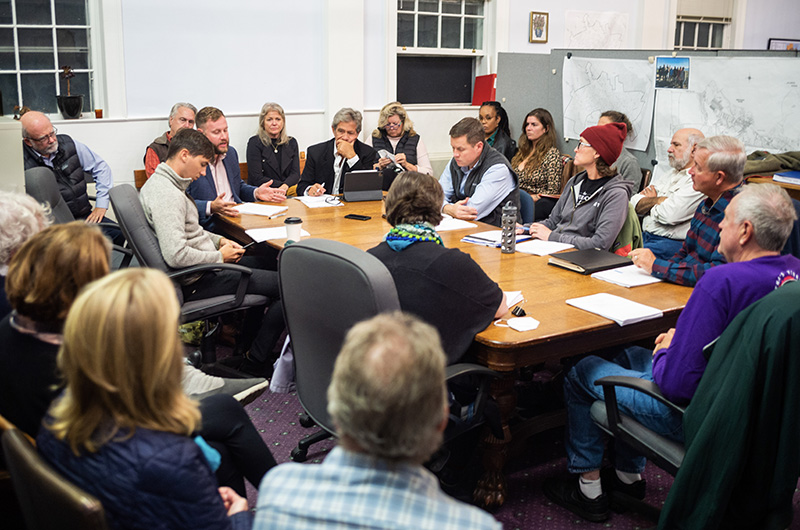
About 30 people came to the meeting in Edgartown Monday.
Efforts to pass the home-rule petition at the state-level looked grim this summer, when Mr. Cyr withdrew an amendment to a broader economic bill that would have allowed individual communities to enact a transfer tax, citing lack of support from the state senate and Governor Charlie Baker. But with state attorney general Maura Healey leading in gubernatorial polls and political headwinds appearing to shift, Mr. Cyr and Mr. Fernandes came to the Island on Monday to outline how the Martha’s Vineyard proposal might fit in to a statewide strategy.
“Certainly, there is a will on-Island that we need to do something about housing,” said Mr. Fernandes. “But that’s only going to happen on a statewide level.”
Since Mr. Fernandes and Mr. Cyr first filed a 2017 Nantucket housing bank home rule petition, Mr. Fernandes said, many communities had begun their own efforts to enact similar legislation.
“The momentum around it statewide is so much greater than when we started,” he said, explaining a plan to pass statewide enabling legislation allowing community transfer fees modeled on the short-term rental tax bill (H.4841), passed in 2018.
“The stars, I think, are aligning in a lot of ways,” he said. “This is good timing for you guys.”

Chilmark housing committee representative Jim Malkin.

Chilmark housing committee representative Jim Malkin.
The new statewide strategy, he said, would require the committee to remove the Island-specific transfer fee regulations from its draft. Instead, the representatives said they would work to pass a statewide real estate transfer tax that could then go to affordable housing committees in individual towns, similar to the short-term rental tax enacted four years ago. The legislation would also allow the funds to go to broader regional entities, like the Martha’s Vineyard Housing Bank.
Mr. Fernandes then turned things over to Mr. Cyr, who presented changes to the draft that were recommended after a review from a statehouse lawyer. Some of the suggestions, he said, were procedural, while others were more substantive.
“The draft legislation is highly proscriptive… it stifles the ability of the housing bank not only to be agile, but to do work that needs to be done, and change with time,” he said.
The housing bank draft legislation includes strict requirements for carbon and nitrogen neutrality in housing bank development, and a limit on the housing bank taking on debt that exceeds 10 per cent of its annual revenue. If these provisions were included in the state petition, Mr. Cyr said, the Island would have to submit any future changes to them as new home rule petitions and would also slow down the draft’s passage in the senate.
Mr. Cyr said “the bucket,” or the key structural elements of the housing bank, would hopefully remain in the legislation.

State senator Julian Cyr.

State senator Julian Cyr.
“We need to make a small bucket of those things germane and essential to the act,” committee chair Jim Malkin clarified in an interview with the Gazette following the meeting. Those central elements, he said, include the use of transfer fee money, a commitment to use 75 per cent of existing dwellings and the ability for the housing bank to engage in borrowing. He also emphasized the need to work through these changes quickly, with Mr. Cyr and Mr. Fernandes requesting another draft by November.
Mr. Cyr and Mr. Fernandes did not specify the percentage amount of the statewide transfer tax at Monday’s meeting.
Committee members expressed confusion and some concerns about removing town-approved language from the draft legislation. But Mr. Cyr and Mr. Fernandes hastened to add that these regulations might remain as local, rather than state-level, provisions.
“You’re giving yourself more authority than the state,” Mr. Fernandes said. Committee chair Jim Malkin recommended that the group develop a “memorandum of understanding,” which would put the proscriptive materials into a town agreement.
Mr. Cyr also inserted some caution in Mr. Fernandes’s earlier optimism on the transfer fee bill: “We may be fortunate…but this may take many years. The forces against a transfer fee are strong.”
Laura Silber, who headed the coalition to create a housing bank on Martha’s Vineyard, said in a call Tuesday that the meeting was productive, and thanked Mr. Cyr and Mr. Fernandes for their work in trying to get the legislation passed.
The committee will meet again on Wednesday, November 2nd and 6 p.m. in Edgartown town hall, to discuss these possible changes, and ways to localize housing bank provisions. Modifications will then get brought before the town select boards.
Comments
Fairly predictable the stars
George Stein OBFairly predictable the stars align for legislators to get in gear immediately preceding elections. The disgrace of creating the illusion of an actual commitment to serve the public is beyond an embarrassment.
Why does it always seem it’s
Bob EdgartownWhy does it always seem it’s new taxes are the answer to everything. We seem to be building affordable housing now maybe not as fast as some like but that may be the best for the island in the long run to go slow. Once a tax is created they never go away and only increase in time, use caution.
A tax is a negative feedback
Mark EdgartownA tax is a negative feedback loop that will only create increased demand for more development. Outside of unfairly taxing homeowners, this is a massive negative for our island infrastructure and environment.
I am still so proud that all
Caitlin Burbidge Vineyard HavenI am still so proud that all towns came together to make this happen! It was no small feat. When the time comes, we will need to offer emails and calls supporting this at the state level. So stay tuned. Let's go MV!!
By the time the MASS
gina Menemsha/NYCBy the time the MASS legislature rewrites your original 27 page proposal I doubt you will recognize it.. & as for passing an additional TAX as the foundation for this venture will be very very difficult to get approved .. Nobel cause bad approach..
Why is the burden always on
Hal EdgartownWhy is the burden always on the homeowner? Why not tax everyone?
I am against this 100%!! Bad for the island. Glad it’s losing steam…
The tax is only on NEW SALES,
Islander EdgartownThe tax is only on NEW SALES, not on *existing homeowners* — god please, let the voters have that thumped over their heads. For everyone worried about “theirs” and not about the community and taxes, it doesn’t tax existing homeowners, goodness gracious. Maybe the press needs to a better job of putting that out in front?
I love the people who talk
Gail OBI love the people who talk about “community” you have to take care of your self and family first…
This is simple economics,
Mark EdgartownThis is simple economics, levying a tax on the transaction increases the frictional cost and will reduce proceeds to the seller because it reduces the buyers purchasing power. The solution to everything is not to slap a tax on it.
Yes. But it’s ANOTHER tax
Michael ChilmarkYes. But it’s ANOTHER tax upon what’s already been paid - you paid a 2% land bank fee on purchase, you’ll pay capital gains on the sale of your home (barring one-time exclusions), now a new fee on the proceeds, and if you relocate on-island, another 2% land bank tax on the new purchase….
"The forces against a
Jackie Chilmark"The forces against a transfer fee are strong.” ~Julian Cyr
May the forces be with us.
This was never going to be
Chip Coblyn OBThis was never going to be easy. To those who have already invested years of their time, thank you. Let’s keep moving forward. The Vineyard and Massachusetts at large can’t afford to keep losing younger residents over lack of housing opportunities.
Add new comment