

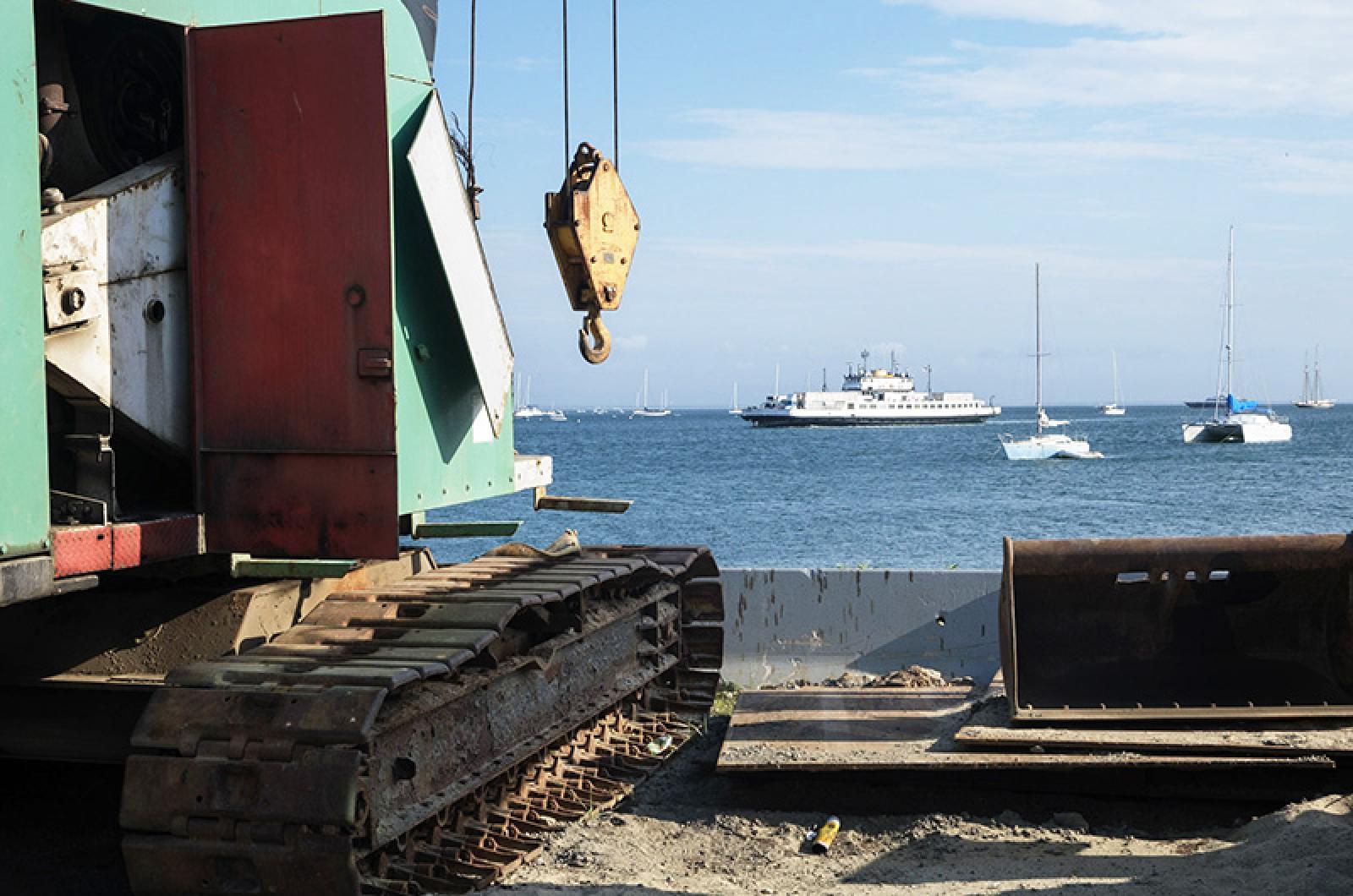
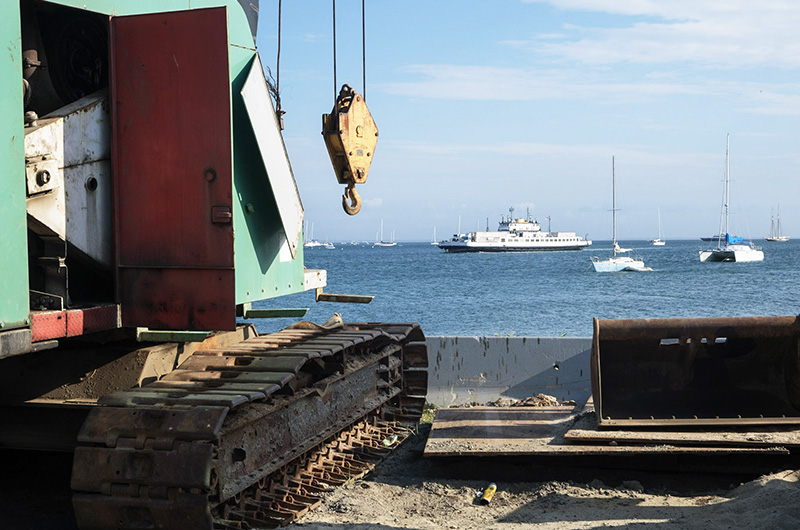
Vineyard Wind plans to make the Island its operations and maintenance hub for the offshore wind development project. It hosted a recent jobs fair at the regional high school.
Peyton Jeffers graduated from the Martha’s Vineyard Regional High School in June, but on Tuesday night he found himself back in the school cafeteria — this time scouting for a job.
The occasion was a job fair hosted by Vineyard Wind, the international conglomerate that is now poised to build the nation’s first commercial-scale wind farm 15 miles south of Martha’s Vineyard. Currently studying hydraulics through a joint program with Bristol Community College and the MV Center for Education and Training (MV CET), Mr. Jeffers hopes to be one of the first technicians to join the operations and maintenance team for Vineyard Wind 1.
“I have to jump on the opportunity,” he said. “They want the youth to be interested, and are actually providing a path for people to change things . . . It’s a sort of glimpse of hope for the future, just the fact that the world could be less dependent on fossil fuel than it currently is.”
Mr. Jeffers was one of about three dozen Islanders who came to the job fair, the second one hosted this year.
Vineyard Wind 1 plans to make the Island its operations and maintenance hub for the offshore wind development project. A trio of infrastructure projects — including the redevelopment of a waterfront pier at the Tisbury Marine Terminal, a new maintenance building on Beach Road in Vineyard Haven and a new 9,000-square-foot helicopter hangar at the Martha’s Vineyard Airport — have all now cleared or nearly cleared permissions at the local level. An Army Corps of Engineers permit is still needed for the marine terminal work, a spokesman for Vineyard Wind told the Gazette by email.
But if all goes according to plan, construction on the projects will begin by the end of the year, the spokesman said.
Communications spokesman Andrew Doba had initially expressed interest in organizing a meeting with the Gazette, but did not offer a time despite repeated requests over several weeks. Instead, he provided general answers on behalf of Vineyard Wind to questions posed by the Gazette in an email.
Vineyard Wind 1 is the first planned development from Vineyard Wind, a joint venture between Copenhagen Infrastructure Partners (CIP), a Danish investment firm, and Avangrid, an energy conglomerate that serves much of New England. With 62 turbines and an estimated budget of $2 billion, the project aims to bring 800 megawatts of power to southeastern Massachusetts — enough to power 400,000 homes or take 250,000 cars off the road, according to company estimates. New Bedford’s commercial seaport is the staging area for the construction phase of the project, also planned to begin later this year.
•
In documents filed with the Martha’s Vineyard Commission, Vineyard Wind has pledged to bring as many as 56 new jobs to the Island.
Richard Andre and Erik Peckar of Vineyard Power at recent jobs fair.
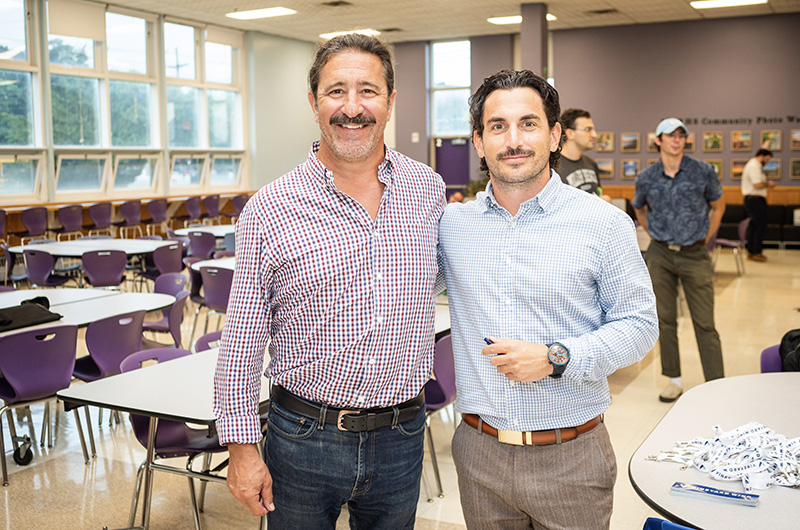
Richard Andre and Erik Peckar of Vineyard Power at recent jobs fair.
In an interview with the Gazette this week, Richard Andre, president of Vineyard Power, the Island energy cooperative that is Vineyard Wind’s community partner, emphasized that the positions created by Vineyard Wind would be year-round, “livable, working-wage” jobs.
“To rely disproportionately on . . . ways to make your money seasonally is really stressful on a community, it’s stressful on housing, it’s stressful on just working,” he said.
“These jobs are going to be around for 20 plus years,” he added. “It’s a real huge economic input to this Island.”
At the job fair Tuesday — which Mr. Andre and Vineyard Power helped organize — representatives from subcontractors General Electric and Semco Maritime along with Avangrid supplied information on positions ranging from administrators to turbine technicians to able seamen who will help operate the crew transfer vessels that will ferry technicians between the offshore turbines and the maintenance staging ground on the Vineyard Haven waterfront. The majority of the jobs will pay annual salaries of more than $80,000, according to documents filed with the MVC.
Less clear is how many workers hired for those jobs will live on the Island, and how many will commute.
On the Island, community partnerships for workforce training have included a collaboration among Vineyard Wind, MV CET and Bristol Community College. The program began in the fall of 2019 to train and certify wind turbine technicians. To date, the program has graduated eight students, MV CET executive director Holly Bellebuono told the Gazette in a recent interview.
“We’ve had everyone from landscapers and gardeners to a chef who was in the culinary world and decided he wanted to change,” Ms. Bellebuono said. “These are primarily people who are completely shifting their career course.”
Ms. Bellebuono said she hopes to attract more people to the program. She admitted that communications have been difficult at times between her organization, which is the adult education training program on the Island, and the corporate entities contracted by Vineyard Wind.
•
At the job fair Tuesday, onboarding schedules were detailed that would see the first local technicians hired in the first quarter of 2023, with hiring of more technicians and administrative positions to continue through 2024, when the wind farm is expected to be fully operational.
Mr. Andre said in addition to promoting local hiring, Vineyard Power has used its position as a community partner to negotiate a series of benefits that will ensure the milk and honey of the wind farm stays close to the Island.
First among these is $7.5 million in benefits to be delivered by Vineyard Wind over the next 15 years — amounting to about $500,000 annually.
According to Mr. Andre, 40 per cent of that funding will go directly toward reducing the electric bills for low-income ratepayers registered with Cape Light Compact, an energy aggregator for the Cape and Martha’s Vineyard.
Low-income ratepayers are defined as those who earn less than 60 per cent of the median income for the region, Mr. Andre explained. About 600 Island residents are currently registered as low-income ratepayers, although that number could increase as awareness of the community benefits program grows, he said.
“We . . . are going to be doing a lot of outreach to make sure that people are aware of the program,” Mr. Andre said. “We’re going to put money in their pockets . . . and we’re going to reduce their electricity bill.”
The price cuts will likely begin by the end of this year, he said.
The remaining 60 per cent of the community benefits funding will go toward creating resiliency in more than 30 critical facilities previously identified by Island towns and nonprofits.
“A critical facility could be the Tisbury water department or the Edgartown wastewater treatment facility,” Mr. Andre said. He also listed the Tisbury School and town emergency shelters, like the West Tisbury Library.
The facilities will receive funds to buy new battery and solar technologies designed to support self-sufficiency in the event of a natural disaster or other emergency.
•
When Vineyard Power and Vineyard Wind signed the community benefits agreement in 2015, they also pledged to explore ways for Vineyard Power to buy long-term energy contracts from Vineyard Wind, to lower the price of renewable energy for local ratepayers.
At the time, such a purchase would have violated state energy laws. But that changed in August of this year, when the Massachusetts legislature passed a bill that will allow Cape Light Compact to buy long-term contracts directly from renewable developers. Mr. Andre said Vineyard Power had a strong hand in drafting the bill.
“What that . . . enables is us to buy offshore wind from the offshore wind companies directly,” with Cape Light Compact as a kind of procurer, he said.
But with demand for renewable energy high (and the sale of long-term contracts helping to pay for construction on offshore wind projects), he said Vineyard Wind has already sold its planned 800 megawatts to regional energy groups.
Still, he remained confident that the Vineyard ratepayers will soon have access to affordable renewable energy through one of the other wind farms, like Mayflower Wind, planned for the outer continental shelf. He added that Vineyard Power could also purchase long-term energy contracts if Vineyard Wind overproduces.
“I feel really optimistic that you know, in the next couple of years, we will be able to directly purchase offshore wind [energy] from one of the developers,” Mr. Andre said.
Comments
Wind mills in the ocean south
Bob Wilkinson Salt Lake CityWind mills in the ocean south of the island. Why am I a bit hesitant of this venture? In the west the number of windmills is an eyesore as well as a killing field for birds. The cost to build and put these into the ocean is tremendous. Will they take the windmills out when the next power idea comes along like hydro. How will this affect the fishing industry and the tourist industry? As you can gather I am not a fan of this power fad. There are other ways to address the issue of power without destroying the beautiful ocean south of the island. Why don't they place the windmills just off the coast of Edgartown. How would that fly? This project will begin the ruination of the ambiance of the ocean. There is plenty of power available without doing this project. As an old islander there are just too many questions and I have addressed only a few. You sure you want windmills around this tranquil isle? Look long term and do the research. This idea of a wind farm off the island is not a good one. You cannot take them out once they are in place. Who is getting the energy from the turbines, the Vineyard? Probably not. Who approved this disastrous idea? Place them near your house and see if you like it. It is always approved for someone elses territory, not their own.
Bob, relax. You won't see
Kenny Oak BluffsBob, relax. You won't see them from Salt Lake City. The island needs real, year round jobs and renewable energy is not the fad you claim it is.
Please elaborate on the
reality check mvyPlease elaborate on the 'cheap' electricity. My recent 'supplier' portion of the bill jumped to around 18c per kwh from less than 12c. I recall 10 years ago the failed cape wind project promised a 'wholesale' cost of mid 20's.. so with inflation how can this project promise 'cheap' electricity. I'd like to see a number. As one who got snookered by the electric ulility into installing 'cheap clean efficient' electric heat in the 1980s, I'm waiting.. If you don't recall, the promise was the more electricity used by a home, the rate would decrease via the 'space heating rate'. After they got all the new homes in Mass to install electric heat, with one swipe of the pen that rate was eliminated.. so based on personal experience with promises from electric utilities I am a not easily convinced..skeptical for a reason.
This is info from 2019, about
Thatcher Ulrich Brooklyn / Oak BluffsThis is info from 2019, about the power purchase agreements between Vineyard Wind and Eversource & other local utilities. "The average nominal cost of the 20-year contracts is $89/MWh, but the utilities estimated that ratepayers will receive about $1.3 billion in net benefits from Vineyard Wind over the lifetime of the contracts." That translates to 8.9c per kwh. I don't know if there are provisions in there for inflation and so on, or how firm that number is. But it suggests that it will lower the supply portion of our bills.
As I understand it, the huge jump in supply charges over the past year have to do with shortages of natural gas in MA, made even worse by the shutoff of Russian gas to western Europe, so now EU countries are buying up more Liquified Natural Gas. Vineyard Wind (and projects coming after) promise to reduce our purchases of natural gas and shield us from unpredictable prices in the future.
The vast industrialization of
Quitsa ChilmarkThe vast industrialization of our irreplaceable and priceless near coastal marine environment that will eventually damage the island's primary business of being a summer resort. Add those job and economic losses to the disruption of commercial fishing, and the unknown consequences on marine mammals, fish and shellfish of covering hundreds of square miles with these enormous industrial facilities and you get a long-term tragedy. All this to make some European investors and a handful of their local "partners" richer. In the meantime, we do nothing at all to curtail the construction of new coal-fired plants in China and India that will add more new greenhouse gas emissions in a month than the so-called Vineyard Power project will displace over its entire service life. Oh and by the way, it's not "low cost power" if subsidies are used to help poor families offset the cost increases. That's just a transfer from one set of people to another made necessary by the inherently high cost of offshore wind.
I would be a tidy sum that many of the jobs will go to off-island people and to commuters from the mainland. Don't buy the propaganda.
if we don't move to cleaner
tom Aquinnahif we don't move to cleaner energy, there will be no island. You understand that, right?
This summary of benefits from
Mike Jacobs ChilmarkThis summary of benefits from the first offshore wind project is great. Multiply this for each additional windfarm in progress, and you can see how this clean energy transition is bringing jobs, infrastructure and financial support for people on the island.
While I'm basically for this
gina Menemsha/NYCWhile I'm basically for this massive project I feel most of Mr. Andre's response on the Company's vision very vague. especially on the financial benefits potential for MV The $500,000 goal seems very low in the big picture IMO..
Please contact Vineyard Power
Vineyard Power Vineyard HavenPlease contact Vineyard Power or visit Vineyard Wind's website for more information regarding project benefits. https://www.vineyardwind.com/vw1-benefits
And when you read this
Quitsa ChilmarkAnd when you read this "information" remember that the people feeding you these fantasies have a long history of distortions and misrepresentation. For example -- "We worked out an agreement with environmentalists to protect the endangered North Atlantic Right whale." That's why they asked the Interior Department to give them an "incidental take" permit that allows them to harass or kill nearly two dozen right whales just during the construction phase? They don't give out information, it's just propaganda to take advantage of the justified concern many of us feel about climate change.
The industrialization of our
John Fuller EdgartownThe industrialization of our beloved ocean is a mistake, these massive turbines will be safety hazards, eyesores, deadly to migratory birds, costly and difficult to remove.
It's a lot easier to remove a
Laurence EdgartownIt's a lot easier to remove a wind turbine from waters beyond the horizon than it is to deconstruct a nuclear power station.
You can also overhaul turbines or completely replace them at the same location.
To claim that Industrial Wind
Mary Chalke NantucketTo claim that Industrial Wind and fossil fuels are not one and the same, is the ultimate greenwash.
Add new comment