

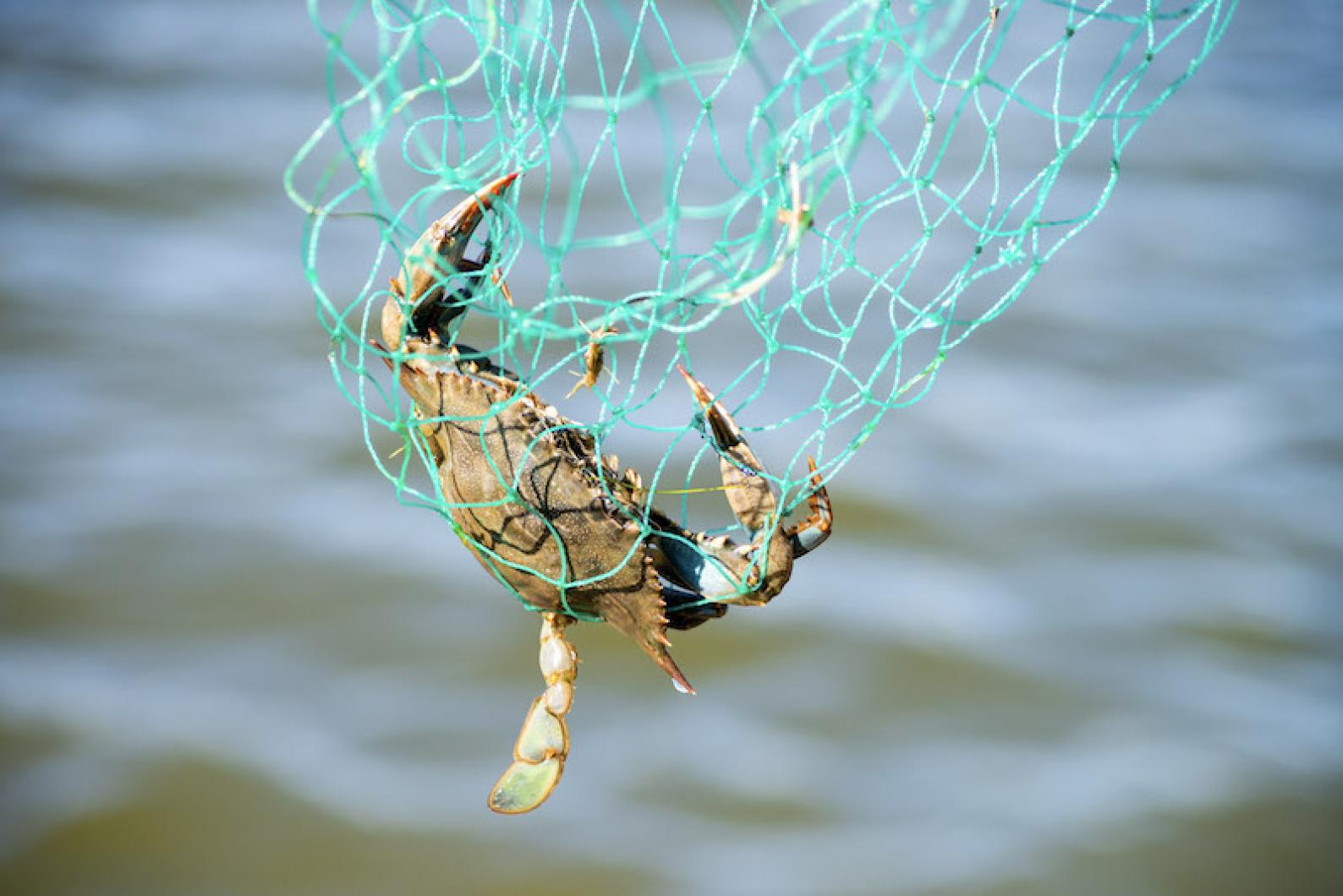
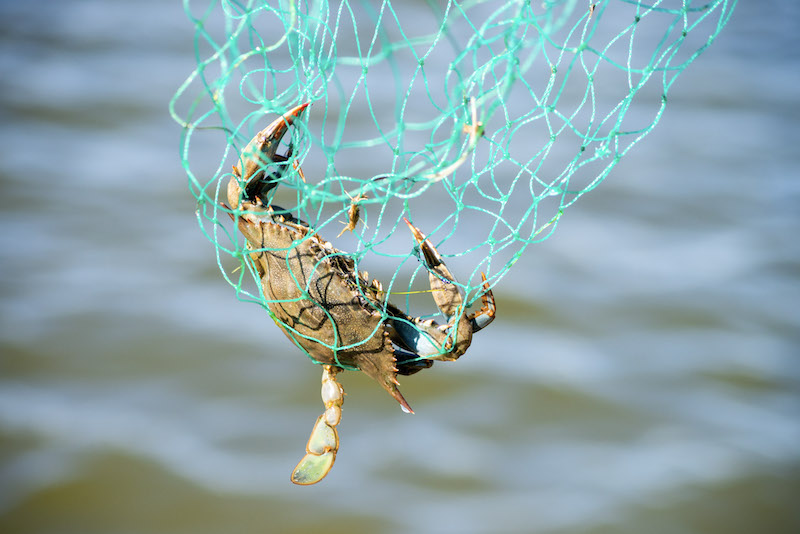
A good crab year doesn’t have a negative impact on the great pond’s ecosystem - and this is definitely a good crab year.
Earlier this summer, as Great Pond Foundation director Emily Reddington helped her survey team dredge a section of Edgartown Great Pond with a large seine net designed to capture a wide cross-section of pond life, from clams to fish to crabs, she had a bit of a surprise. This year, the fish in the net turned up headless: As the net had dragged toward the surface, dozens of blue crabs had descended on the trapped fish—and begun devouring them.
Populations of the native blue crab are booming in the Island’s great ponds, a treat for those who enjoy the sweet, rich flavor of the eastern seaboard delicacy. And despite any macabre stories, Ms. Reddington said that a good crab year shouldn’t have a negative impact on the great pond’s ecosystem.
“They’re a normal part of the ecosystem, even in these numbers,” Ms. Reddington said. “All summer we’ve been hearing there are high numbers of blue crabs. People are reporting armies marching across the shoreline.”
“This year is by far the best we’ve seen in 8 to 10 years,” she added.
Blue crabs are a native species with cyclical population dynamics that aren’t as dependent on immediate climate conditions as other organisms in the great ponds’ brackish ecosystem, like cyanobacteria, which can respond in days to changes in a pond’s salinity and temperature.
In fact, the biggest determinant for Island crab populations is the timing of when cuts are opened in the great ponds, Ms. Reddington said. Blue crabs mate in estuaries like the great ponds—where fresh and salt water meet—but, in order for the larva to develop properly, the females must lay their eggs in marine waters. If the ponds are cut at the right time of year, the larva will come rushing back into the estuary, laying the seeds for an excellent crabbing season. Blue crabs take between 12 and 18 months to mature.
The biggest threat to blue crabs is overfishing, not the climate, but that overfishing is largely confined to the Chesapeake Bay, where the crab is a staple food source (and Maryland’s state crustacean). Ecologists have speculated that blue crab populations, which prefer warm waters, are actually poised to benefit from rising temperatures in the long-term. This will be true on the Vineyard as elsewhere along the east coast.
“As the climate warms, many of the fisheries are getting pushed northward,” Ms. Reddington said.
Luckily crabs in the pond are safe to eat this year, with cyanobacteria populations staying low in the great ponds. Cyanobacteria or “blue-green algae” blooms can produce potentially harmful toxins that gather in shellfish tissue.
“I’ve heard of zero cases of cyanotoxin poisoning after crab consumption in Massachusetts,” said Edgartown shellfish constable Rob Morrison.
That said, Mr. Morrison confirmed that there is always an elevated risk, as with all seafood from Island ponds.
“If you have a concern about it, I urge people to limit the number of shellfish and crab meals they eat in a month,“ he said.
Those wishing to collect their dinner on the Great Pond shores should be careful only to take male crabs, called “jimmies,” per local shellfish ordinances. The sex of blue crabs can be determined based on their underside: The male blue crab’s abdomen is shaped like the Washington Monument, while the female crab’s is shaped like the Capitol Building. (Here as elsewhere in the story of blue crabs, one feels the influence of the Chesapeake Bay.)
Harvesting female crabs, called “sooks,” can damage the species’ reproductive prospects, according to Ms. Reddington.
“We are seeing a lot of females with eggs, so they’re definitely in their reproductive season,” Ms. Reddington said.
Other regulations include prohibitions against use of closed traps in recreational harvesting. In other words, Mr. Morrison said, be sure to use an open net.
“Anybody that obeys the regulations can harvest crab as far as I’m concerned,” said Mr. Morrison.
Mr. Morrison recommended diving into the blue crabs Chesapeake-style: with Old Bay or J.O. #2 seasoning.
“It’s a lot of work to get the meat out of it, but it’s really good,” Mr. Morrison said.
A full list of crab harvesting regulations can be found at www.mass.gov/orgs/division-of-marine-fisheries.
Comments
Here are some simple rules.
Nelson Sigelman Vineyard HavenHere are some simple rules. Females can be easily identified because the tips of their claws are red. The size limit is five inches, spike to spike across the body. Anything smaller is not worth picking for meat. And the limit is 25 crabs per person. Take it from me after several hours spent picking crabs, that's more than enough.
and don't forget the
Island Mike MVand don't forget the underside of a female has a delta, or pyramid shape from her backside with the tip nearer to the "front" side.
Nelson, I'll go one better..
Tom Richardson MattapoisettNelson, I'll go one better...if you are used to lobster dont even bother trying to pick blue crab meat. Too much work.
which resteraunt on Island
rob the roofer new jerseywhich resteraunt on Island serves local blue crab ?
As far as I know, no Island
Scott Ryan New Jersey/EdgartownAs far as I know, no Island restaurants serve local blue crabs.
Living in Maryland for most
Rita EdgartownLiving in Maryland for most of my life, blue crabs were a staple of summertime gatherings. Not so much anymore. Low harvests, escalating supply costs, and intense labor shortages have resulted in an extremely high price for crabs in the DELMARVA region. Makes me think that the crabs know their value and are migrating further north to MV where price is not a concern. LOL
Add new comment