


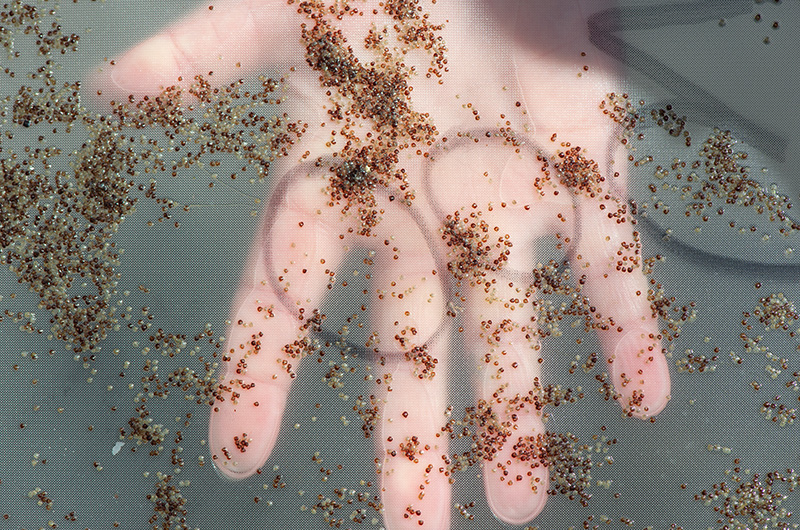
Alley McConnell of the Martha's Vineyard Shellfish Group affectionately calls the shellfish hatchery, with its small, stacked, simply constructed, white-painted rooms and south-facing windows "a water garden tree-house."
Alley McConnell of the Martha’s Vineyard Shellfish Group affectionately calls the shellfish hatchery, with its small, stacked, simply constructed, white-painted rooms and south-facing windows “a water garden tree-house.”
Ms. McConnell is the newest member of the staff, having joined the operation four years ago.
Alley McConnell joined the team four years ago.
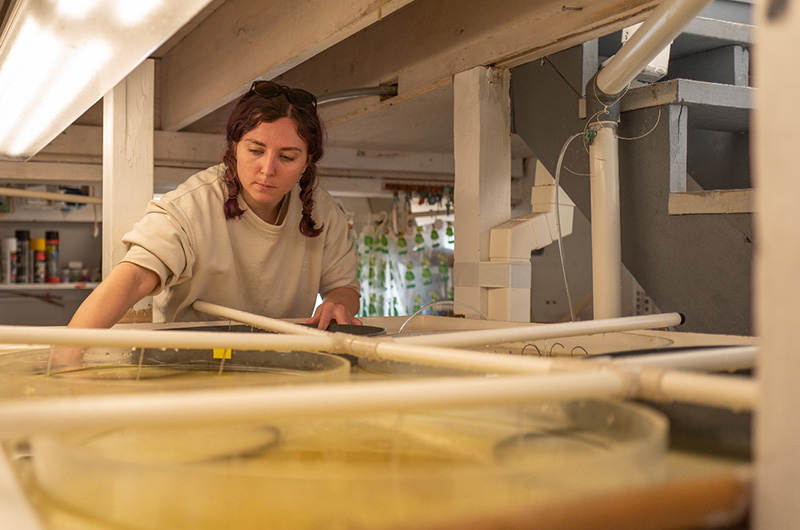
Alley McConnell joined the team four years ago.
The hatchery is a laboratory and breeding nursery for oysters, quahaugs and bay scallops to help support wild populations, restore local ecosystems and provide seed for commercial experiments. It sits over a small cove near the middle of the Vineyard Haven side of Lagoon Pond. On the top floor a line of plastic columns, one foot in diameter and as tall as a person, bubble away. There is no place to sit down or lean on anything to take in the view.
“The different colors are at different stages,” says Emma Green-Beach, shellfish biologist and director of the shellfish group. She is talking about the algae growing in the vertical tanks in shades from verdant green to muck brown.
“Some are commercial strains,” she explains. “Some are strains we’ve kept going for 30 years.”
The algae will be food for the shellfish seed growing in tiers in water-filled trays, like tightly stacked bunk beds.
The hatchery was created in 1976 by shellfish biologist Rick Karney. Officially he is retired.
“Rick still stops by,” Emma says. “He’ll tell us, ‘You’re doing that wrong’ or ‘Oh, wow, great, that really works.’”
Exponentially larger facilities are able to control every aspect of the nursery environment, Ms. Green-Beach says, using expensive equipment to balance temperature, light and nutrients in the seed trays. In contrast, the Martha’s Vineyard hatchery keeps it simple.
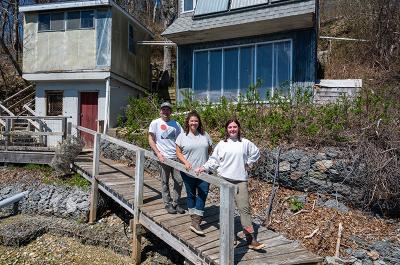
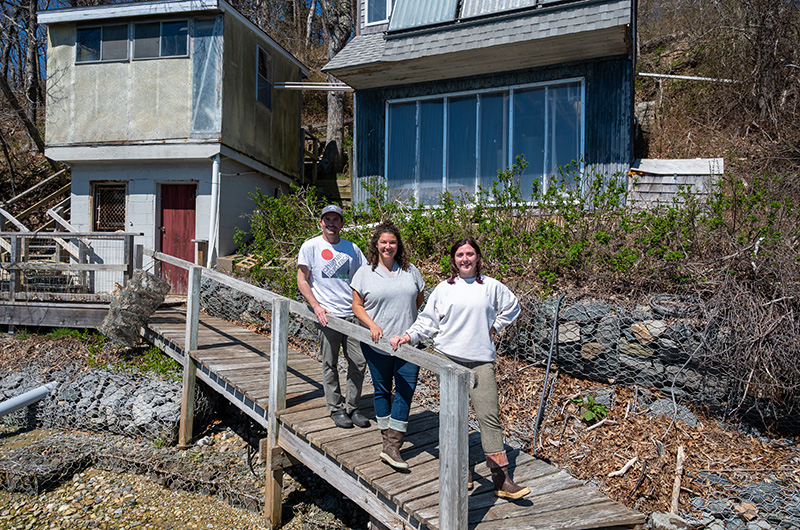
“Our water comes from the Lagoon. Most of our heat comes from the sun,” she says. “Doing things simply lets us be adaptable.” This season the crew — Ms. Green-Beach, Ms. McConnell and Chris Edwards — is trying to grow scallop seed earlier than ever. In the middle of April the trays are home to scallops that are already over a month old. Under a microscope their shells are still translucent, revealing gill bars stretched out like little radiators. The scallops spin around under the lens using a foot equal to the size of their bodies. “The pandemic highlighted that oyster farmers needed to diversify,”Ms. Green-Beach says. “Without restaurant business, people in all five Island towns that own grants to grow shellfish in floating cages had a hard time selling them.”
The scientists at the shellfish hatchery hope that by spawning scallops earlier, they can make growing scallops in cages a viable supplement to growing oysters. If the scallops don’t have to overwinter in cages, the labor of growing them is cut in half.
The high price of scallops reflects how hard it is to raise them.
“We call them the princesses of the shellfish world,” Ms. Green-Beach says. “They’re picky about what they eat; they are more specific about their salinity tolerance; you can’t air dry them and put them in a truck.”
Scallops have also suffered the greatest decline among shellfish on the island.
“It’s death from a thousand cuts,” Ms. Green-Beach says.
Cars, paved roads, lawns and septic tanks all introduce toxins onto the land that, at the end of the season, wash down into eel grass beds. Water temperatures have changed drastically as well.
The vast majority of shellfish seed the hatchery grows is distributed among the Island towns for habitat restoration, and to support recreational and wild fisheries.
“Resource enhancement,” Ms. Green-Beach calls it, as she and her team care for and nourish hundreds of thousands of baby scallops, born of local parents and growing fast in bubbling trays all around her.
Comments
The MV Shellfish group is an
David Damroth ChilmarkThe MV Shellfish group is an under the radar mainstay of the island's economy. It is also vital to the health of our island's waters. Rick had a dream and we all helped him bring it to life by our financial support over the years.
Emma and her crew are now running the show and deserve even more support as they enhance and refine their mission.
Funding is always an issue. If you can, send them a donation. Every little bit helps!
I am grateful for their passion and dedication.
The Martha’s Vineyard
Cynthia Bloomquist West TisburyThe Martha’s Vineyard Shellfish Group Inc is one of the many not for profit organizations recognized and supported through Amazon Smile. In addition to providing the Shellfish Group support directly, if you use Amazon, you can have them share their profits with this worthy service. It’s worth the few minutes to set it up and use Amazon Smile for your purchases from Amazon. Thanks, Rick, for the vision and Rick, Emma, and crew for the hard work.
Thanks to Rick, Emma, Ally,
Maria Abate Oak BluffsThanks to Rick, Emma, Ally, and Chris for the boat-load of hard work, passion and community good will. The MVSG's work effectively combines a science-based approach and knowledge of local salt pond nature, so islanders and visitors alike can continue to enjoy and benefit from all the ecosystem services that these ponds offer. If you can, please support this vital island organization, and feel even more satisfied after you enjoy your next plate of delicious shellfish or cup of "chowdah' on MV! (http://www.mvshellfishgroup.org/donate-now; MVSG, P.O. Box 1552, Oak Bluffs, MA 02557).
Add new comment