


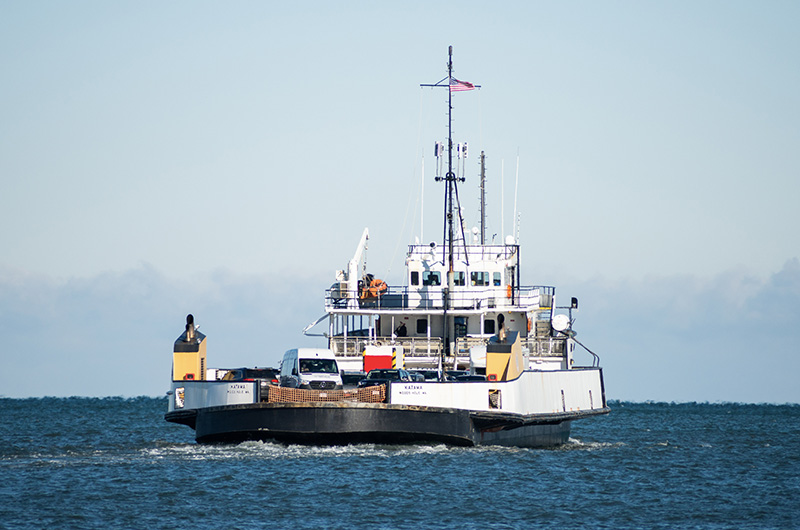
Three of the Steamship Authority’s four freight ferries — the Gay Head, Katama and Sankaty — will need to be replaced within the next three to five years, a marine survey has found.
Three of the Steamship Authority’s four freight ferries — the Gay Head, Katama and Sankaty — will need to be replaced within the next three to five years, a marine survey has found.
The survey of the SSA fleet was done by Marine Safety Consultants of Fairhaven, whose report was aired at the monthly meeting of the boat line governors Tuesday.
The Gay Head, now 41 years old, is functionally obsolete and needs “rigorous preservation and expense” to keep operating, according to the report, while the Katama (aged 40) and Sankaty (41) are “at or near [the] extent of useful life.”
Surprisingly, the oldest freight boat of all has the most time left — five to seven years, according to the report.
“The Governor, though it’s 68 years young right now, actually has a longer useful life expectancy than the other three freight boats,” SSA general manager Robert Davis told the governors, noting that the vessel was repowered in 2011 and has had new generators in recent years.
Mr. Davis said the boat line is looking to replace its aged-out freight ferries with converted offshore supply vessels, many of which have been idled since the latest downturn in undersea oil exploration.
“These assets are sitting there, [and] the indications are that there are some opportunities,” he said.
A similar strategy brought the Gay Head and Katama into the SSA fleet in the 1980s, Mr. Davis said. Like the Sankaty, purchased in 1994, the two sister ships are former oil platform supply vessels refitted as freight ferries.
“There was a downturn in the market [and] we were able to acquire them for cents on the dollar,” Mr. Davis said.
The obsolescence survey found that the SSA car and passenger fleet is also aging out, with the exception of the six-year-old Woods Hole and the 15-year-old Island Home.
The 48-year-old Nantucket has five to seven years of useful life remaining, according to the report.
The survey also pegged the Eagle, built for the SSA in 1987 to ply the Nantucket route, for replacement in 12-14 years, as long as it is refitted and repowered by 2025.
The Martha’s Vineyard, built in 1993 and refurbished in 2018 with a subsequent dry dock last year, will need replacement in 18 to 20 years.
This is the third fleet survey the SSA has commissioned over the past decade, Mr. Davis said.
In 2012, he said the emphasis was on vessel construction. A 2018 survey focused on preservation methods, and the latest study, conducted in 2021, was to determine whether the SSA’s preservation efforts have been effective.
The answer to the last question appears to be both yes and no, according to the survey results. While rigorous maintenance and overhauls have kept older ferries operating, Mr. Davis said, the returns begin to diminish when a vessel reaches an average lifespan of 25 to 30 years.
“As a point of reference, the average age of [the SSA fleet] is 34 years old,” he said. “There comes a time when the cost of repairs and replacement parts becomes higher than the cost of a new [vessel] . . . Equipment becomes obsolete, [and] parts no longer available for repair.”
But financing a new ferry poses challenges. To produce another boat like the diesel-powered Woods Hole would cost close to $45 million in today’s money and take 15 to 18 months to build, Mr. Davis said.
“It’s a balancing act in therms of finances, in terms of what can be done, but also taking into account the need for service,” he said.
The cost of an electric or hybrid ferry is presently unknown, but Mr. Davis said a report on alternative propulsion systems by Elliott Bay Design Group, the Seattle-area naval architecture and engineering firm that designed the Woods Hole, is due to be ready by next month.
•
On Tuesday, Mr. Davis told the SSA board that masks are still required aboard all ferries, which remain under a Coast Guard order.
On Wednesday, the requirement was dropped after the Coast Guard lifted its rule.
In his report to the board, Mr. Davis said shoreside work on the Woods Hole terminal is completed, with the third slip fully functional from a marine standpoint, although supply chain delays have slowed the installation of its ticket reader.
The next phase of the terminal project will begin in September with site work for the permanent ticket office and its utility building.
Winning construction bids are expected to be chosen in the fall with the building process to begin at the start of 2023, Mr. Davis said.
On the Vineyard side of the sound, the Oak Bluffs terminal is 80 per cent of the way through a pile-wrapping project designed to give the pier’s 400 pilings another 20 to 25 years of service, director of marine operations Mark Amundsen said.
The $1.4 million dollar project, which includes the installation of six new pier pilings, is slated for completion April 29, well in advance of the terminal’s season opening in May.
In other business, Mr. Davis said a request for proposals from firms interested in providing freight service between the Vineyard and New Bedford, issued March 21, has already attracted 20 responses from as far away as Turkey.
The deadline for bid submissions is August 2, Mr. Davis said, with evaluations to be completed by the end of September and finalists identified by the end of October.
Governors popstponed action on a request to license a barge freight service between New Bedford and Nantucket, to allow time for staff to draft a contract that addresses the concerns of state Rep. William Strauss, whose 10th district includes New Bedford.
In a letter to the SSA, Mr. Davis said, Mr. Strauss supported the service proposed by New Bedford-based 41 North Offshore, but wants a stipulation that it cannot be used to ship waste to New Bedford.
The barging company’s anchor client for the service would be the United Parcel Service, Mr. Davis said.
A special meeting will be called once the contract is drafted.
Governors also postponed action on a request from the boat line’s longtime food and drink concessionnaire, Centerplate, to waive its contractual minimum payment for a third year.
“I think their request is a reasonable one,” SSA attorney Terence Kenneally said, noting that the company has struggled with staffing and supply shortages since the SSA permitted concessions to resume last year.
“We didn’t let them back on the vessels until May,” Mr. Kenneally said.
The SSA’s take from concessions for the year was $346,000, Mr. Kenneally said, compared to $843,000 in 2019, the last pre-pandemic year.
“Hopefully things are going to be improving here and the traveling public is going to be coming back out and enjoying the concessions on the boat,” he said.
But Falmouth governor Peter Jeffrey balked slightly at waiving the minimum. “I don’t know why their hiring problems or supply chain problems should become the authority’s burden to bear,” he said. “Why aren’t we countering?”
Traffic aboard the ferries is rebounding solidly from pandemic depths, Mr. Davis said, pointing to February numbers showing a 19.1 per cent increase over the same month in 2021 in the number of passengers on the Vineyard route.
Vehicle traffic was up 7.4 per cent per cent over last February and freight increased by .8 per cent on the Vineyard route, Mr. Davis said.
Comments
We want electric ferries.
Sarah GWe want electric ferries. Please stop delaying this commitment. It will save money in the long term. It’s not complicated and it will be a political issue soon at the state if it’s not already.
Solar powered freight boats.
George Stein OBSolar powered freight boats. Electric adds to carbon footprint. I love the salt spray on these treasures.
Not against electric, but to
Charles M BarnstableNot against electric, but to say it is simple is very optimistic. The cost and design for electrification is not simple and it is extremely expensive as the technology is still not fully developed . Most importantly is that the infrastructure at either WH or MV is not capable of charging at the rates required - new power lines would have to be run to WH to accomplish this task and most like MV will not work due to the high electric requirements.
How about we focus on
John Aldeborgh KatamaHow about we focus on reliability and cost for a change. The SSA seems to have an unquenchable thirst for capital projects, which only guarantees higher prices for everything going forward.
The GOVERNOR is more than a
island girl WTThe GOVERNOR is more than a freight boat. She is about the most sensible vessel in the fleet and always a popular ride except for those who grumble about a bit of salt spray. She is able and capable as well as double ended and smooth running, Do whatever you need to do to keep her running. She makes good sense and she is economical as well as sensible to run. there is about half as much vessel to keep in CG COI status!
The current terminal building works just fine -- we don't need a fancy facility -- think conservative and cost effectie!
Try riding it as a passenger,
R Scott Patterson EdgartownTry riding it as a passenger, it's terrible!!!!!!
A bridge would solve these
Blythe OBA bridge would solve these problems!
A bridge would cost billions
JaredN Boston/ChappyA bridge would cost billions of dollars.
Doubtful. I’d love to see
Slater MVDoubtful. I’d love to see your cost analysis though…
I used the relatively
Thomas Hodgson wtI used the relatively recently built Tappan Zee bridge as a benchmark. The TZ is the only comparable recently-built US bridge I could find info for. It was completed five years ago at a cost of four billion dollars. It's about half the length that a Vineyard Bridge would need to be. So, twice 4 is 8, and add inflation and the extra cost of doing anything "Massachusetts style", and you get the ballpark figure of 8-14 billion. The only possible source of that kind of money is the federal government. Not only do they have other fish to fry, Congress still remembers how our fair State did on the "Big Dig", which was projected to cost 2.5 billion. The actual final cost of the big dig was close to 25 billion.
Considering the army corps of
Mitch EdgartownConsidering the army corps of engineers just estimated the cost of replacing the canal bridges at 1.45-1.6 Billion (with a B), I don’t think your “bridge math” works.
A bridge? Where would we get
Thomas Hodgson wtA bridge? Where would we get the eight to four billion dollars needed to build a bridge?
A stimulus package? Another
Jim EdgartownA stimulus package? Another tax? Maybe?
Yea another tax on real
Rob EdgartownYea another tax on real estate that’s the answer… it never ends…
A bridge would destroy the
Mitch ChilmarkA bridge would destroy the Vineyard.
How about a high speed
Jim EdgartownHow about a high speed passenger only ferry? It worked well a few years back when boats were down…
Yes!
Trey WilliamsonYes!
Jim, I agree. A high speed
Lorraine EdgartownJim, I agree. A high speed ferry, passenger only, purchase etickets online, just make loops, back and forth, easy peasy. It is past time for that and if the SSA cannot or will not do it, another company can and should. The very idea that passengers should have to take a huge, automobile and truck ferry and wait, milling about, is Conestoga wagon days. Let us get with modern day transportation and service the passenger who pays.
Buy canoes
Charlie Callahan So Boston/EdgartownBuy canoes
Time for the Chunnel which
Stephen G Devine Oak BluffsTime for the Chunnel which would eliminate the SSA altogether.
If you think a bridge would
Paul V. ChilmarkIf you think the SSA is expensive I encourage you to examine the per mile cost of boring a tunnel in the US. From $100m per mile to “ New York City’s Second Avenue Subway which opened to the public on January 1, 2017 after racking up an astronomical cost of $2.5B per mile. That’s 2.5 billion US dollars per mile, not millions, just to be clear.”
Source: https://resource-erectors.com/career-blog/us-tunnel-industry-costs/
https://tunneltalk.com/TunnelTECH-Apr2015-Arup-large-diameter-soft-grou…
Sure even though Mr Davis has
Jonte Green nySure even though Mr Davis has been wrong on most every project he has touched, let's listen to him and buy 4 more new boats so we can raise the cost of steamship travel another 50-75%. If the Governors would stop patting him on the back and analyze his actual impact -- more boat breakdowns, more cancellations, out of control cost increases, lower revenues, etc. these are signs of executive failure. The Islander, Naushon, Nobska, Auriga lasted years and years --- all did the job -- look at all the costs of breakdowns, fixes, downtime on all Mr Davis' new boats ---disgraceful. Yet the Governors keep applauding......
This is disheartening news.
Guinevere Cramer Oak BluffsThis is disheartening news. The freight boats are the best! They seem to be much more reliable than the newest Woods Hole ferry.
I agree! But unfortunately
Jake Breton woods NHI agree! But unfortunately they are old… it’s like fixing An old car… money pit
We have a terrific
Chuck Hodgkinson West TisburyWe have a terrific opportunity now. Before we make any commitments to new boats--electric or otherwise -- please have an objective pro forma business plan done to a new business model and cost structure for a separate, free-standing nighttime freight company. It can lease boats from the parent company. It would divert a portion of the freight service to New Bedford with a separate business model for the parent company car and passenger service to MV out of Woods Hole and New Bedford. Include fast ferries for some MV passenger service. This would theoretically change the fleet configuration for MV service. With some freight out of New Bedford over night, car space will be opened up to Woods Hole on the current boats for year-round islanders and visitors.
Old boats need replacement,
Thomas Hodgson wtOld boats need replacement, and it comes as a "surprise"? Meanwhile, the SSA has been wasting a hundred million or so on their new administrative Palace in Falmouth, and on the boondoggle in Woods Hole. The money they have wasted in the last few years is enough to have bought a new boat, or maybe two. To put it bluntly, has the SSA management just shown us yet again why they should get the boot?
Exactly Tom! Not to mention
Slater MVExactly Tom! Not to mention all the luxurious amenities we now find on board. You and I remember the islander and Nantucket before her refit. Hard plastic seats, no big screen tvs (everyone is just looking at their phones now anyway). It’s a ferry people. Point A to point B. Everyone is so entitled now they just have to be on a luxury cruse?
Yes! This! Thank you! Also I
Jo Jans MV and MIYes! This! Thank you! Also I would love to add that purchasing some more used offshore supply boats is a great idea. Especially now. If the surveys and refit are done correctly this seems as though it is the highest cost to benefit ratio of all the options. Let’s not forget however that the freight boats as they are currently configured had a significant amount of structural modifications to both width and length. Another thought, the Katama, Gay Head, and Sankaty all have very large holds below the freight deck. Is there possibly a way to utilize these unused holds to transport cargo as well? Perhaps on night freight runs as mentioned above? I don’t know the answers, and am sure glad I’m not in the position of having to make these decisions!
Add new comment