

The pivotal question of whether to create a Martha’s Vineyard housing bank is on the table as annual town meetings and elections draw near.
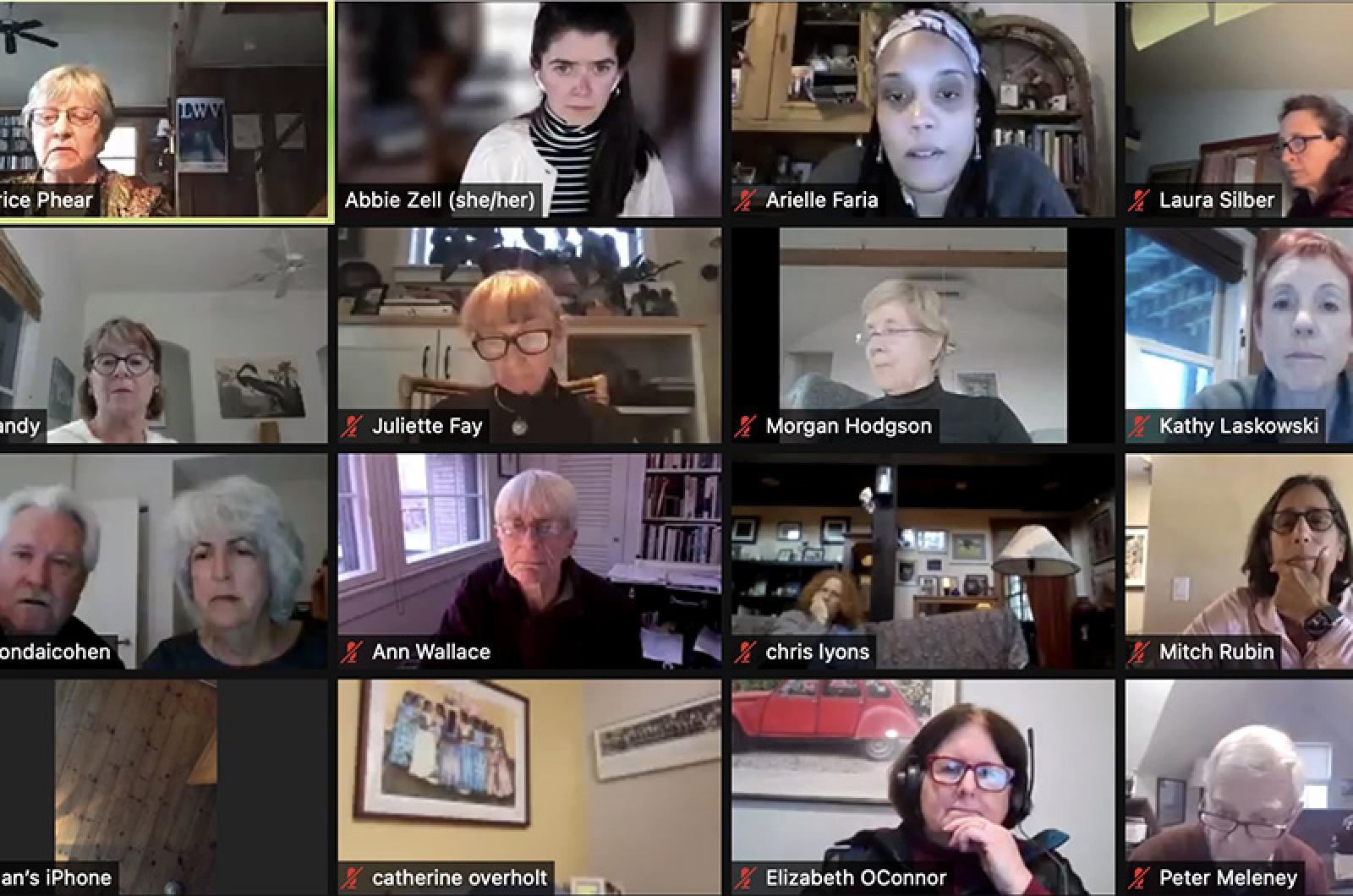
With the pivotal question of whether to create a Martha’s Vineyard housing bank on the table as annual town meetings and elections draw near, Islanders weighed in with concerns, comments and questions at an online forum hosted by the League of Women Voters Wednesday night.
Nearly 100 people logged into the Zoom meeting, which was moderated by the League. Members of the Coalition to Create a Martha’s Vineyard Housing Bank, the advocacy group campaigning for the housing bank, took center stage to answer questions that were read aloud from the Zoom chat.
The housing bank will appear as a question both on town meeting floors and in ballot boxes this spring, in a first step that would subsequently lead to passage by the state legislature. If all those hurdles are cleared, the question would return to voters for a final vote in the ballot box. Organizers hope to see the bank in place by 2023.
Modeled after the Martha’s Vineyard Land Bank, the housing bank would collect a buyer-paid two per cent transfer fee on most real estate transactions that fall above $1 million. The money would be distributed in the form of grants for affordable housing projects on the Island. A seven-member elected Islandwide commission would manage the bank, with appointed town advisory boards in place as well.
In order to qualify for affordable housing under the housing bank, applicants would have to earn within 240 per cent of the area median income. For a family of four, that limit is about $250,000 a year.
On Wednesday night coalition members fielded a wide array of questions on everything from the bank’s structure to who would be eligible for affordable housing.
One person asked what would happen if someone who qualifies for affordable housing through the housing bank subsequently reaches an income over the qualifying limit. Would they have to relocate out of a deed-restricted affordable home?
“They absolutely do not have to leave,” coalition steering committee co-chairman Arielle Faria said. But if the house is sold, the next buyers would have to qualify based on income, she said.
Rental properties created using housing bank funds would be deed restricted for year-round use by qualifying Islanders.
“Can you tell us who will monitor compliance?” asked Meg Higgins.
Coalition coordinator Laura Silber said the housing bank commission would be in charge of compliance, using hired staff.
Another point of discussion revolved around whether creating more available housing through the housing bank would have the unintended consequence of attracting more people to the Island, especially given the current trend toward remote work.
In short, coalition members said people who already live on Island and work remotely will be eligible for housing created by the housing bank. But anyone who wants to move to Martha’s Vineyard will be required to have an Island employment contract in hand in order to be eligible, they said.
Coalition members acknowledged that remote work is increasing and likely to grow. But they also pointed to rapid turnover rates at Island fire departments and schools, who spend money to train employees only to see them lose their housing a year or two after moving to the Island.
Coalition members also pointed to the robust popoulation of workers who commute to the Island for work, and likely don’t put the money they earn back into the Martha’s Vineyard economy. Asked about the number of people who commute to the Island each day, coalition member Doug Ruskin said he found through Steamship Authority data last year that an average of 325 commuter tickets were used each day — not counting those who commute using individual ferry tickets.
“So the answer is hundreds,” he said.
Many who attended sought more clarification on the lengthy, densely-worded draft legislation. Others questioned the potential effect on property taxes. Coalition members said they believed the impact would be negligible.
Annual town meetings kick off on April 12 in four Island towns: Edgartown, Oak Bluffs, Tisbury and West Tisbury. League spokeswoman Beatrice Phear urged everyone to participate.
Corrected from an earlier version that stated the qualifying income ceiling would be 250 per cent of AMI. The correct number is 240 per cent.
Comments
$250,000 is a huge income.
mike Somewhere$250,000 is a huge income.
This is a bad idea.
The State needs to pay for affordable housing, that's what we pay some of our state taxes for already.
Taxing local buyers to subsidize a family that makes $250,000 is absurd.
Our localbuyers are generally
Elaine Miller TISBURYOur localbuyers are generally look for a property under the $1M threshold and they would be transfer fee exempt, that is if they could find a home for under $1M. It is predominantely second home buyers who would be paying the tax and they are usually the owners who rent their homes for the summer season, thus creating the housing shortage to begin with.
$250,000 is a lot of money but when you consider the inflated Island cost of housing, fuel, groceries dental and mental health services and other mecessities, $250,000 doesn't go a long way for a family of 4 or 5. These are the reasons the hospital, who employs 450 people, have 96 positions to be filled.
I totally disagree that the
gina Menemsha/NYCI totally disagree that the summer owners are the entire cause of the affordable housing crisis .. There has been a huge Island building boom since the early 80's. A large part of the MV problem is the very large general population increase over the past 10 yrs.. So the summer homes are sometimes rented to afford the property in general due to all the costs you mentioned including annual increases in property taxes for many services they never use.. Let's not assume they are at fault ..
So, what percentage of the
Bob OBSo, what percentage of the year round population fall into 240% of AMI? It's obviously more than half. Is it 75%? Is it 90%?
So, basically, we have some large percentage of the year round population, who get to vote on this, eligible for a housing subsidy, and we want the folks who own second homes (who don't get to vote on this) to pay for it all. This sounds like an utterly immoral cash grab to me.
your comment blaming second
second home owner edgyour comment blaming second home owners is WAY off base. As the 'former' owner of a rental property, you can THANK the year round tenants who, after 10 years made me decide to gladly take a loss. The 'no pets' clause ignored, the place looked like an animal shelter. The failed septic since the washing machine became the 'community laundromat' for their friends. The rotten floors because windows left open in the rain. The '3 tenant' who decided to rent to 'a few other friends for the summer' that became a dozen, all of whom had never ending guests. Or the trash all over the yard. I could go ON AND ON. The blame rests with the year-round renters who have earned a reputation as bad tenants. Why one earth would some fool ever rent to year rounders. This is based upon my experience with Island year round tenants, some summer tenants, many winter tenants. NO THANKS. The blame is NOT with those who gladly pay taxes without burdening the schools and other services, thus subsidizing the year rounders.
You need to get real numbers
MarieYou need to get real numbers not a guesstimate. Not all summer homeowners rent. And many year-rounders have rental housing. I do not rent my home, it is used by family. In my neighborhood most homes are Summer homes but not rentals.
Housing prices have gone up all over the country not just the Vineyard. There seems to be a shortage of year-round jobs that pay a good wage. Maybe local government should look at attracting businesses to the vineyard. Solve the problem with jobs
At some point you have to stop taking other people’s money to solve your problems.
It’s a good idea but a bad
E West TisburyIt’s a good idea but a bad income threshold. As someone with a household income of half that, who made owning property on the island a reality in the past few years WITHOUT the help of trust funds, family money, grants, affordable housing, etc (money we earned on our own at our jobs), I feel that having an income limit that high is subsidizing those homebuyers new cars, family vacations, and dinners out in addition to their homes. Some sacrifice must be expected here.
E, as someone in the same
Janet TisburyE, as someone in the same boat I totally agree. Our family makes under half that income limit and through various schemes made home ownership possible over many years. We worked hard, we saved, and made it happen. I feel the idea is good but this limit is simply too high.
Hi Mike, unfortunately
Laura Silber, CCMVHB West TisburyHi Mike, unfortunately existing state funding is not sufficient to meet the local need -- the Island already directs Community Preservation Act funding toward housing efforts, but that is also limited.
The 240% Area Median Income cap is projecting out the range of the year-round essential workforce who will need loans/assistance to access housing here in the next decade. In 2016, Nantucket median home price was approx $1.2 million -- where MVY's is currently ($1.26 million for 2021, via LINK). According to LINK data the 2021 Nantucket median home price was $2.588 million, and 2022 year-to-date median is over $3 million. It is an infrastructure issue, as workforce (medical, municipal, public safety)becomes priced out at all levels.
Any funding, including loans, that the MV Housing Bank would provide would only go to a home that is deed restricted to perpetual year round occupancy, whether rental or ownership. Link to the Housing Bank Warrant Article with all details is here: https://www.ccmvhb.org/the-warrant-article
If a housing bank is created
Brian Vineyard HavenIf a housing bank is created …. I believe it should be to create rental properties…by renting homes or apartments we can house many more individuals… I am sure we have over 400 commuters but how many commute year round ? How many want to live on the Vineyard year round ? How many are single ? I totally support rental properties… I do not support the purchase of homes … how many commuters make six figures a year much less $250,000 a year… ?
Did I read this correctly? In
Linda Northampton, Mass.Did I read this correctly? In order to qualify for affordable housing a family of four needs to earn $250,000 or less?? Wow. Who makes that kind of money unless one is upper middle class?
If a housing bank property is
Stephanie EdgartownIf a housing bank property is sold how does it remain "affordable"? Are housing bank properties deed-restricted on sale price? Are there restrictions on how soon a home can be sold?
Yes, it remains affordable by
Ed EdgartownYes, it remains affordable by a deed restriction, the same practice that currently exists on affordable housing lots. This keeps the price affordable if it is sold. And also there are restrictions on how soon a home can be sold — there is no “flipping” allowed.
The deed restriction is a
Walker West TisThe deed restriction is a smart mechanic.
More taxes and bureaucracy
Mark EdgartownMore taxes and bureaucracy are not the solution here. 1) taxing the equity built by homeowners over the years is just wrong and simply a wealth transfer from those working hard to maintain and invest in their homes. 2)There seems to be a need for much more robust oversight for an organization that could be collecting millions of dollars with the potential to funnel into pet projects and those where conflicts of interest exist, how will that be managed? 3) The article states that this organization will use hired staff to enforce broad based compliance, again this feels like a gross misuse of taxes on homeowners and creation of a large bureacracy. 4) There does not seem to be a sunset provision as in the Nantucket legislation and without a cap this will only encourage endless development and incentivize more people to move to MV which will continue to expand the existing issue. Hard no on this legislation.
Hi Mark! From my
Jared TisburyHi Mark! From my understanding, the Housing Bank would not tax homeowners, it's a 2% fee assessed to people BUYING property (and the first million is exempt). I am pretty sure there is a sunset provision - would recommend going to ccmvhb.org/faq and learning more about what is actually being proposed, as it seems like you have some misconceptions about the project. It has changed a bit over the last few months due to great community input from folks like yourself.
A tax of any kind on either
Mark EdgartownA tax of any kind on either on the buyer or seller reduces the proceeds to the homeowner, that's economics 101. Either you take money directly form the seller or the buyer reduces their bid because they have less buying power due to an additional 2% tax being levied on top of the Land Bank fee. The FAQ does nothing to address my concerns and in fact has created more. This entity is going to be able to take on leverage??? This proposed entity feels very unorganized and without proper governance. Another bureaucracy that has the potential to abuse tax proceeds.
I would like to know how they
TisKid MVI would like to know how they will measure success or failure. Is there a target end date? What is the concrete data point being sought? What are the projections for how long it will take to get there? Will this result in using up more open land faster? Why or why not? What are the potential consequences of not doing this?
To clarify, an individual
Trey WilliamsonTo clarify, an individual that is not an island resident, does not work on the island (yet), or commute would be eligible for the MV Housing Bank but input from daily commuters are to be dismissed because they "likely don't put money they earn back into the MV economy"? Yikes. So I am left to believe that if a someone receives housing and then leaves/quits their island job after 3 months they won't be asked to move out. Furthermore, the MVHB should reconsider commuter dollars being reinvested in the community (meals/beverages, gas, work supplies, etc.). These AFFORDABILITY efforts should be hedged by pursuing a commuter fast ferry which would benefit benefit ALL island stakeholders. This recent meeting clearly shows that certain island stakeholders are already excluded. Affordability on MV is bigger than just housing. (3/18/22 - 12:50PM).
Hmm. many vague answers from
gina Menemsha/NYCHmm. many vague answers from this session IMO. 1 of the major red flags is the hiring of "staff" to manage the program owner options/rules. & not enough emphasis on the repurpose of properties already built .. Read another Bureaucracy layer ..
This proposal is a very very rough draft. & not ready to be taken seriously ..
Please go to CCMVHB.ORG for
Kim West TisburyPlease go to CCMVHB.ORG for information on all of the above.The recording of the League of Women Voters forum is available on the site and will answer many of these questions and/or misconceptions. Other questions, please reach out to a steering comittee member (listed on the website).
I think it could be modeled
Rena Vine Oak BluffsI think it could be modeled after another program that I know of where if you have worked and lived locally for 5 years and are below a certain income level, the city is your co-owner and goes in as a half-buyer with you. This has helped teachers and city workers to live where they work.
Creating a new bureaucracy
Lorraine EdgartowonCreating a new bureaucracy will not solve any housing crisis. The word crisis is thrown around indiscriminately these days. There is NO housing crisis on this island. There are people who want to live here who cannot for various reasons; we do not owe anyone housing on this island. If we did not keep creating bureaucracy after bureaucracy with layers of costs, we would be much further ahead. As expenses rise, due to government actions beyond our control, the rise in expenses is reflected across the board. Now, before everyone gets their knickers in a twist, when I write that there is NO housing crisis, that does not mean we do not have a problem housing certain levels of workers. This idea of always attacking the property owner, a sitting duck, for more and more taxes is certainly later going to kill the goose that lays the golden eggs. Now, I realize I have singled out two innocent birds, but there is no reason to levy any more taxes on the property owners. Not all of the property owners are Midas, with coffers overflowing with gold, many are hanging on to generations of family properties, many are renting houses with the plan of retiring here in their golden years, so we have to be very careful in meting out the constant grab for taxes on property.
This is such a bad idea.
Ted Vineyard HavenThis is such a bad idea. Build affordable apartments for workers out by the airport and buses can bring them to work.If you want permanent housing on the island, you should work towards that goal. No one owes you the opportunity to live here. I can't afford to live in Manhattan and don't expect anyone to supply housing for me to live or work there.
This is such a well thought
Walker West TisburyThis is such a well thought out endeavor. I really hope it passes so we can make movements forward as a community.
As a healthcare worker on
Amy EdgartownAs a healthcare worker on island 20 yrs+, my partner in the trades. Of course, we work extra side jobs in the summer. We along with many of our other "family of 4" island friends, have made it this far on way less than $250,000 a year. This 250K income threshold will not succeed in retaining true island work force. We will instead have to complete in a pool with those in the next income bracket, perhaps those working remotely with salary's based on a metropolitan cost of living wage. Additionally, in that case, not contributing to the island " working force" at all. We need another Ted Morgan. He had a vision and made it happen. 60 or so families now have an island home. This is what we need. Another Morgan Woods.
There is absolutely no doubt
Eric Mulhern EdgartownThere is absolutely no doubt that the housing crisis is real. As a full time worker and business owner on the side, i have been struggling to make ends meet and I'm now moving off island -- because i can't find stable or affordable housing. This housing bank is the only legitimate solution to the problem. The people behind it have been working hard to create something for the community and are creating an extremely thoughtful solution.
I support the housing bank
Hannah Burbidge EdgartownI support the housing bank and there is definitely more context behind a lot of the questions in these comments that are addressed on the CCMVHB website. I found it super helpful when understanding this article fully.
People keep rallying behind the fact that we need a "perfect" option - what a lot of people don’t see is that this coalition has worked with every town individually (select boards, fin com etc) as well as the public and they’ve shifted the legislation to meet as many of our collective requirements as possible. The housing crisis is real and I am happy these people are stepping up to help keep the community a community!
The funds will serve mostly lower income folks (despite the cap listed here) and 75% of funding will go towards repurposing existing buildings. This island is bleeding working class people… they are leaving! Preserve this community. Vote for the Housing Bank.
On the idea of building mass
Christina West TisburyOn the idea of building mass housing at airports and bussing workers back and forth, entry level hourly workers are not what is missing on MV; it is families who want roots on this island who will create communities. Mid-level management/college degree level jobs are the ones that need filling, there is not a shortage of sub 23 year old entry level workers. In order to obtain and retain the kind of people who will teach your children, grow your food, put out your fires and clean your teeth, we need real housing opportunities, not just apartments and dorm style housing.
There is nothing wrong with
Ted Vineyard HavenThere is nothing wrong with living in an apartment. People all over the country live in apartments and don't expect others to buy them a house. This is an island with limited land and it can't support continued expansion of single family housing. More schools, workers and trades people will be needed to support continuous growth and the cycle will just keep feeding on itself. What makes this place special will quickly come to a halt.
An imperfect solution to a
michael chilmarkAn imperfect solution to a real problem. Seems to me a tax on home-sellers will further push up home asking-prices as they head to market. Homes selling over $1 million are certainly well-represented in the overall sales on MV. And I suspect many/most sellers are also simultaneously buyers, here or elsewhere, counting on the proceeds to allow the purchase. Not to mention the 2% buyers tax if here on island. And the capital gains taxes possibly due. And the limits on personal deductions imposed by the last administration. Enough with the money-grabs and the vilification of second-home owners. Most worked hard for what they have. Nobody is "owed" the privilege of home purchase. I'd agree that affordable rental housing should be the focus.
E, Mark, Gina, Ted, Lorraine,
mike SomewhereE, Mark, Gina, Ted, Lorraine, Amy Michael, Spot on.
Staff will require up to 10%
No Sunset clause - 10yrs
2% is too high - 1% max
The Vineyard only has finite land - even if the Towns relax the lot size minimums.
How many potential lots could there be?
Where would this higher density housing be - spread out?
How many working families are there now?
If families can make it now with a lot of hard work, what was the income that they made it on.
Maybe the cap should be more in line with that.
At todays rates 1M = $3,592 @ 3.5% for 30yrs with a 20% down payment - $130,000- $150,000 would be a closer number for making a mortgage payment like that and getting by.
People have been making it on way less for years.
Add new comment