

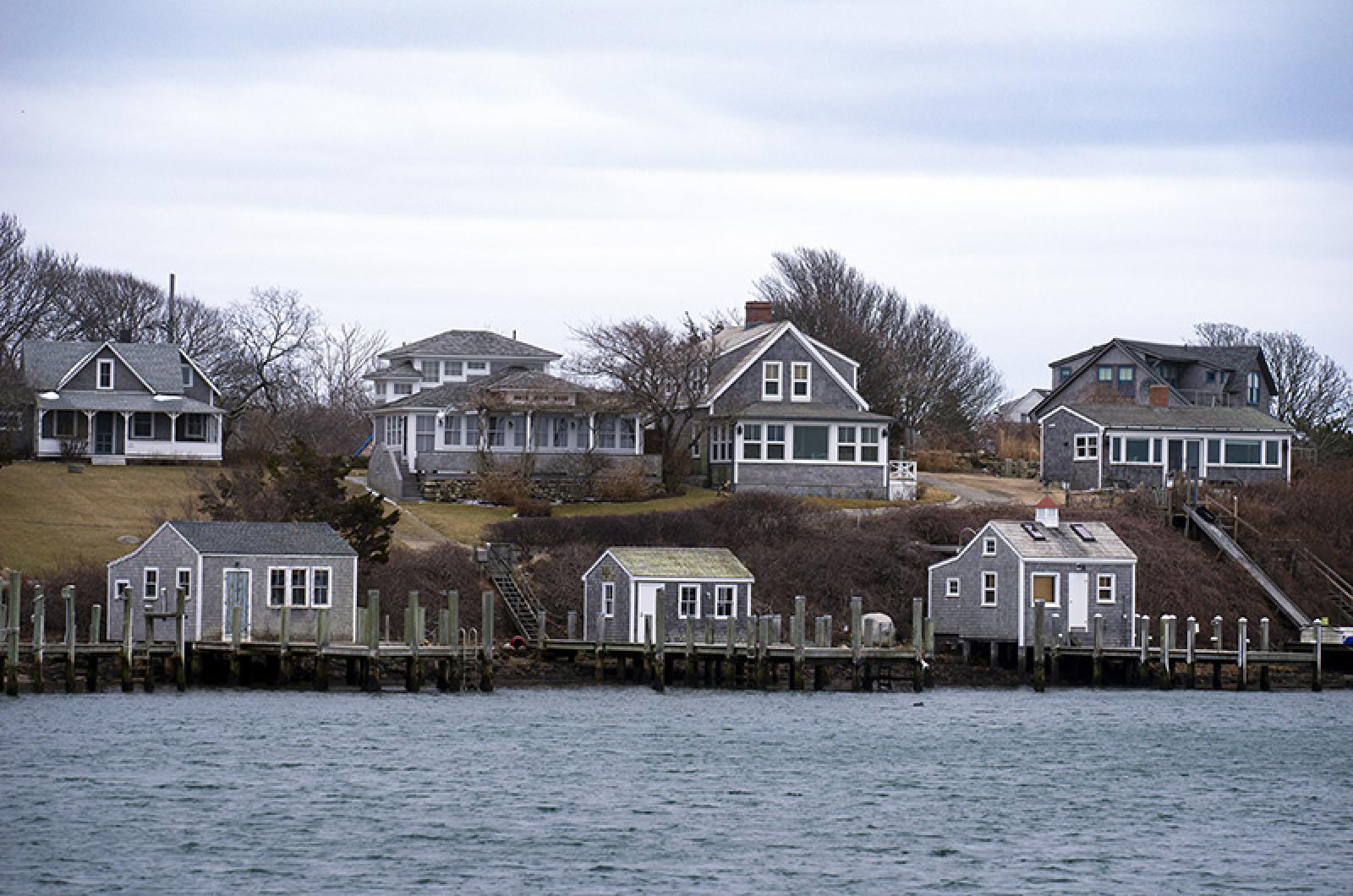
More than 2,650 properties on Martha's Vineyard have registered as short-term rentals since the state expanded its tax levy on lodging almost three years ago.
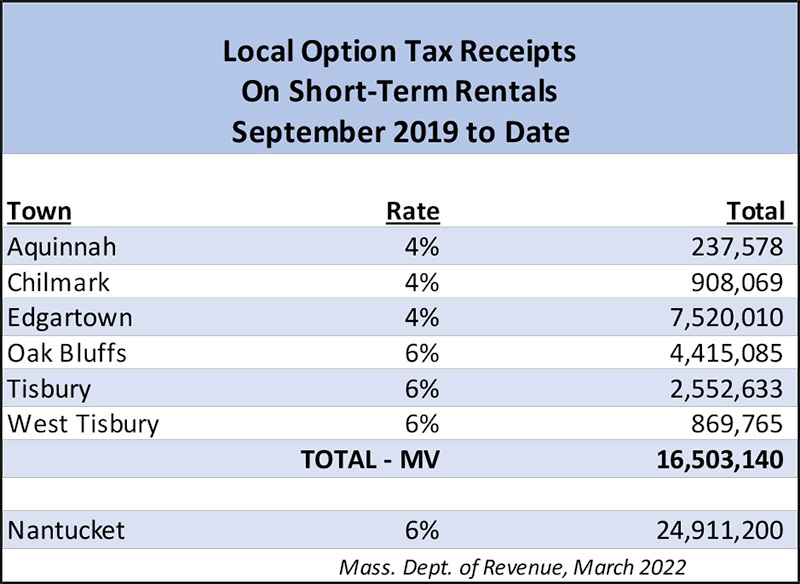
More than 2,650 properties on Martha’s Vineyard have registered as short-term rentals since the state expanded its tax levy on lodging almost three years ago, generating about $16.5 million in revenue for Island towns so far.
All but about 100 of those are private homes and apartments that are rented by the day or week, according to a public registry maintained by the state Department of Revenue. The others include hotels, lodging houses and bed and breakfast establishments that rent more than four rooms. (B&Bs that rent three or fewer rooms are exempt).
Rental agents report that vacation rental bookings for the coming summer are soaring, with prices well up and inventory scarce. With surging demand as the pandemic recedes, tax receipts from short-term lodging are likely to grow exponentially in the coming years.
Yet as Island voters prepare to consider another proposed tax on housing when town meetings convene this spring, some Island towns are not maximizing the amount they could earn from this existing tax.
Towns in Dukes County have the option of imposing excise taxes of up to 6 per cent on short-term rentals, over and above the 5.7 per cent the state imposes. Additionally, there are two other local option room taxes available to towns, but for different reasons they have not been adopted on the Vineyard. Oak Bluffs, Tisbury and West Tisbury now charge 6 per cent; in Aquinnah, Chilmark and Edgartown, the local option tax is just 4 per cent.
After many years of debate, the short-term rental tax was signed by Gov. Charlie Baker in December 2018 and took effect with rentals starting on July 1, 2019. Short-term rentals are defined as rentals that last fewer than 31 days; year-round and longer-term rentals are excluded from the tax. People who rent their properties for fewer than 14 days per year aren’t required to pay the tax, but they still must register with the state.
The law, spurred by the growing popularity of Airbnb and other rental aggregators, expanded the longstanding rooms tax, which formerly was levied only on hotels and motels. In its first year, from July 1, 2019 through June 30, 2020, it generated $34 million in new revenue for the state and $32.8 million for Massachusetts cities and towns. Those amounts rose to $40.6 million and $37.5 million for the year ending June 30, 2021, according to state Department of Revenue figures.
Landlords are required to collect both the state and local taxes from their tenants and remit them to the state, which then gives the local portion back to the towns. The taxes are intended to be paid by renters.


When the short-term rental tax was first adopted, many rental brokers were concerned it would chill interest in the Vineyard by driving up prices. But Molly Valle, rental manager for Wallace and Co. in Edgartown, who handles about 100 properties that rent from $5,000 to $60,000 per week, said that has not come to pass.
“It really didn’t kill the market,” she said. “People are spending such a huge amount of money to come here . . . it really only affected the mid-range, and not that much.”
Ms. Valle said most places are fully booked, with limited availability left, and inquiries still pouring in. She said most Vineyard homeowners list their homes through multiple agencies, a practice Wallace and Co. encourages.
At WeNeedaVacation.com, a website devoted to short-term rentals on the Cape and Islands, Martha’s Vineyard advance bookings are up 37 per cent over this time last year, chief operating officer Jim Reese told the Gazette by phone.
He said they have seen a 127 per cent increase in vacationers over pre-pandemic years, while rental rates are up 10 per cent over 2020. That’s the highest increase the company has seen to date, compared with an average annual price increase of 2 to 3 per cent.
“Bookings continue to set exceptional numbers and set records we haven’t seen in our 25-year history,” Mr. Reese said.
Before the new law took effect, total receipts from the room tax on the Vineyard never exceeded $2 million a year. In its first year, ending June 30, 2020, the tax generated $3.4 million in local revenue, $1.5 million of which went to Edgartown and $1 million went to Oak Bluffs. For the year ending June 30, 2021, Island towns generated $5.4 million. And for the first two quarters of the current fiscal year, Island towns have already generated $7.5 million. (Receipts trail actual rental months, so the first two fiscal quarters — which follow the busy summer season — tend to be the most lucrative.) By comparison, Nantucket has generated almost $25 million from its 6 per cent tax since the law was expanded in 2019.
There are actually three local option lodging taxes available to towns, each requiring a majority vote at town meeting to enact. Any town in Massachusetts can impose a local option tax of up to 6 per cent; towns can also impose an additional 3 per cent “community impact fee” on multiple properties run by the same operator in a single town. And the law provides that towns in Barnstable, Nantucket and Dukes counties who opt into the Cape Cod and Islands Water Protection Fund can charge an additional 2.75 percent, with proceeds dedicated to water quality projects, though Vineyard towns are not yet qualified to participate.
For the basic local option tax, state law gives municipalities full discretion about how to use the revenue. Unless voters direct otherwise, the money goes to the town’s general fund.
When West Tisbury first voted to adopt a 6 per cent tax in 2019, an amendment was proposed at town meeting to earmark the funds for affordable housing, but voters turned it down.
“The thinking of the town is we can always use that money [in the general fund] for affordable housing,” said West Tisbury town administrator Jennifer Rand. “The voters decide.”
Edgartown town administrator James Hagerty said his town decided to take a conservative approach to the short-term rental tax until more historical data is available for analysis.
“We are going to wait to see some historic trends on this money prior to making a commitment [to increase it],” he told the Gazette.
“There’s a thought of leaving money on the table — yes and no,” Mr. Hagerty continued. “Maybe you are taxing some of these rental properties that have other unintended benefits. It’s a policy decision. We want to do our own review before we decide whether to increase it.”

He said typically five years of historic data are used to forecast for capital planning and other town projects.
For this year, he said the town plans to put $2 million of the money into a town stabilization fund that can be used for projects such as wastewater and climate change-related infrastructure needs, at the direction of voters.
“This money is very unreliable,” he said of the rental tax, noting that Edgartown actually took in less in September 2021 than it did in the previous September.
The community impact fee, designed to target professional property managers rather than individual homeowners, has been adopted by 21 Massachusetts municipalities ranging from the cities of Boston and Cambridge to the tiny hamlet of Egremont in the Berkshire hills. Under state law, not less than 35 per cent of the money collected from that tax must be used for affordable housing or local infrastructure projects. It is not clear how many rental properties on Martha’s Vineyard fit this criteria, but no Island town has adopted this tax.
Adam Turner, executive director of the Martha’s Vineyard Commission, said Vineyard towns should be able to participate in the Cape and Islands Water Protection Fund in the near future if they so decide. The fund was originally created to help pay for sewering on Cape Cod, a requirement that came out of a federal lawsuit against the EPA.
In order to participate, a town needs to have a section 208 [federal water quality management] plan or equivalent. Mr. Turner said Edgartown, Tisbury and Oak Bluffs are all in the process of writing comprehensive wastewater management plans. And he said the MVC has begun working on a 208 plan for West Tisbury, Chilmark and Aquinnah, using a $200,000 grant, that will address nitrogen pollution in the saltwater ponds up-Island.
An analysis done by the MVC in early 2019 found that that the Island had more than 11,000 vacant units of housing, of which 10,621 were estimated to be seasonal. The analysis went on to estimate that half of those — 5,310 — were short-term rentals. Using the local option tax rates that were in effect at the time (West Tisbury did not have any tax until July 2019), the MVC calculated that the law could generate about $6.8 million annually for the Vineyard.
As of March 2022, only about half the number of units estimated by the MVC have registered as required under the short-term rental law. Edgartown has by far the most on the Island. As of March 8, there were 934 registered rentals in Edgartown, in addition to 21 hotels, 18 lodging houses and five bed and breakfast establishments. Lodging houses are homes where four or more people rent individual rooms.
Oak Bluffs follows with 590 registered short-term rentals, 19 hotels, 11 lodging houses and four B&B establishments. Tisbury has 439 short-term rentals, 10 hotels, 10 lodging houses and four B&Bs. West Tisbury has 221 short-term rentals, two hotels, two lodging houses and five B&Bs. Chilmark has 275 short term rentals, three hotels and three lodging houses. Aquinnah has 93 short-term rentals and two hotels.
It is not known how many units of housing on the Island are actually rented on a short-term basis, in part because the number is constantly shifting.
Ms. Valle at Wallace and Co. said some people who used to rent have moved into their homes full time. “Because there is such huge turnover in property, a lot of our rental homes are no longer available,” she said. “We have a lot of repeat renters who are kind out of pushed out.”
But others who have recently purchased homes are entering the summer rental market. And while some homeowners will stick to the two-week minimum to avoid paying the short-term rental tax and reporting the extra income, there is also a trend among some homeowners to rent to people who want longer stays, she said.
“It changes every year, and is kind of a moving target,” Ms. Valle said.
And because the state relies on the honor system for landlords to register, there are likely to be scofflaws.
Since the rooms tax was expanded in Massachusetts, companies have sprung up who will track the number of short-term rentals to ensure the town is collecting the maximum amount of revenue. But Ms. Rand said West Tisbury has opted not to go that route.
“We are not doing that,” she said. “I’m sure there are some people who are not registering but the lost revenue is not enough to make it worth hiring another employee.”
Meanwhile, the demand for vacation housing on Martha’s Vineyard shows no sign of abating.
Mr. Reese of WeNeedaVacation reported a 100 per cent increase in new clients on its website this year.
Ms. Valle also noted that returning customers have been augmented by newly minted vacationers, most of them from New York, Connecticut, Massachusetts, New Jersey and California.
“The Vineyard has become very attractive . . . and it’s becoming more of a Nantucket-like group of people,” she said.
Corrected from an earlier version which reported that rental rates are up 127 per cent at WeNeedaVacation.com. The correct number is 10 per cent; vacationers booking with the site are up 127 per cent over pre-pandemic years.
Comments
Gross overreach and money
Mark EdgartownGross overreach and money grab by the government.
Hardly, Mark. Every dollar a
Schools Out TisburyHardly, Mark. Every dollar a tourist pays is a dollar an Islander doesn't pay. Given how much tourism has reshaped this island in the last 25 years I'm all for tourists pitching in to reduce our burden.
Not really. The revenue is
Chris OBNot really. The revenue is highly skewed due to a pandemic in which people couldn’t fly, so they came to the Vineyard for outdoor space and less restrictive travel. As gas prices rise and other destinations open up, less will come. Why impose more tax now? Wait until the pandemic and the inflation rise is over, let it all settle and see where we are. Then decide, will more tax mean less visitors or can we safely add the cost. By the way I would argue that tourists keep this island going. The more tax they pay the less the spend when the come, very few renters are rich, most get together with a couple of friends or family and split costs. Greed never ever wins.
“ Every dollar a tourist pays
Marie“ Every dollar a tourist pays is a dollar an Islander doesn't pay”. I guess it’s good as long as we get Other people’s money? One day Other People will get tired of paying.
It doesn’t seem like you have
Mark EdgartownIt doesn’t seem like you have a fundamental understanding of our tax system or economics. You are taking money out of islanders pockets and making it more expensive for tourists to support our economy.
In 2019 when the West Tisbury
Bruce Stone EdgartownIn 2019 when the West Tisbury adopted the local option for the room excise tax, the town meeting articles that were not approved were not to dedicate them to affordable housing but to dedicate them to stabilization funds for other municipal uses see https://www.westtisbury-ma.gov/sites/g/files/vyhlif4036/f/uploads/atm_h… .
Mr. Stone
Tom MVMr. Stone
What is your definition of “other municipal uses?
At that time, the purposes
Bruce Stone EDGARTOWNAt that time, the purposes were capital costs for future road reconstruction and municipal vehicles.
Thanks for this reference ...
Jim NYC/ChappyThanks for this reference ....I was thinking it would be a fresh change if the towns looked at this new found "revenue" as not something to spend rather to use it to lower residents' current taxes.
The homeowners in our towns
MVYThe homeowners in our towns fund ALL town operations through their real estate tax. The stabilization funds are necessary to maintain our roads and public buildings, they will need to be funded one way or another. Those landlords that rent in the short term are contributing even more to the towns budgets by lowering the rates for those that can live here without the need to rent. Everyone wants more affordable housing yet we all voted to impose more taxes and fees on housing and landlords. I don't think punishment techniques through more taxation are working for us.
" and it’s becoming more of a
Susan Bucks County" and it’s becoming more of a Nantucket-like group of people"
Say it isn't so.
It is getting harder and
Tim McCumber Hackettstown NJIt is getting harder and harder to find and afford rental houses for my family. I have been a annual visitor with my extended family for more than 50 years. Rates keep going up and up and coupled with the ferry cost and available MV ls looking less and less a possibility each year. Enjoy your "more Nantucket like group of people" as more and more long time visitors get priced out.
I agree. We have visited
Betsy Shea Trumbull CTI agree. We have visited each summer for the better part of 30 years. The Vineyard is our favorite place to be. We had to forgo some of our summer visits recently because of the rising cost of rentals. Sadly, that may happen more often as rental costs climb higher each year.
My thoughts too, Tim. We
Susan Bucks CountyMy thoughts too, Tim. We devoted summer visitors must make way for the super wealthy.
Many of us have been coming to the Vineyard for decades, not just summer rentals, but also visits in other seasons.
We love and respect MV, follow the news throughout the year in the Gazette, but find it increasingly difficult to secure our summer places.
More important, my heart goes out to Vineyard residents and their adult children, with regard to their housing.
Right there with you. Been
RB MassachsettsRight there with you. Been coming to the island for 53 years, and I've never seen it this bad. We've been looking for a reasonably priced 1 week rental for months, and we are flexible. Nada. Too much money chasing too few rentals. Looks like the White Mountains for us this year,
I agree. We talk a lot about
tom BostonI agree. We talk a lot about the island being only for the rich. But when you keep adding taxes and fees every chance you get, you are pretty much making certain it's an island for the rich. A 10% tax on a very high rental rate to begin with crushes the middle class. We can't have it both ways.
"...and it's becoming more of
Cleveland E Rockville"...and it's becoming more of a Nantucket-like group of people." Is this a good thing or a bad thing?
MV has always had its own
Susan Bucks CountyMV has always had its own identity and character, and becoming "more of a Nantucket-like group of people" is not a good thing.
It's not just political, it's essential, and may be too late to avoid.
I'd like more Nantucket like
balance it out edgI'd like more Nantucket like folks... predominately successful Republicans. If this island was any further left leaning it would tip into the Atlantic.
Really? What a sad comment. I
mm edgReally? What a sad comment. I think most come to enjoy the beauty and serenity of the island. I have no idea the political leanings of the people on the beach who sit nearby, nor of those strolling on the waterfront or even dining at the next table. Please stop encouraging anger and divisiveness.
Read those lawn signs ! My
George Stein OBRead those lawn signs ! My actual tears are for residents families who gets squeezed off the Island due to housing issues.
Short Term Rentals diminish
Frederick Rundlet TisburyShort Term Rentals diminish housing available for Islanders and have a negative effect on quality of life for all. STRs are "businesses" in residential zoned areas. Our communities are no longer ....where we know and enjoy our neighbors. The Vineyard is a different place unfortunately.... May the force be with us
How about long term rentals?
MVYHow about long term rentals? Would you consider them a business too? Most landlords HAVE to rent in order to be able to keep their homes here. Needles to explain the rising costs, higher local taxes, utilities, insurance, mortgage payments etc. Many do the "vineyard shuffle" and many make great sacrifices by moving out of their homes. It is these very landlords that are funding the towns budgets. Renters and visitors aren't.
First things first
Tom Engley West TisburyFirst things first Everything on our beloved Island cost about 30% more then the mainland. Our gas our food our housing and our labor. I caretake 2 houses that are short term rentals one by a young family who have deep island ties and without these rentals wouldn’t be able to own a home here they live off island and use the home more then they rent. As for Nantucket people this is nonsense have u ever been to Nantucket. I lived there for a year. It’s more like Edgartown and what’s wrong with Edgartown people.
We are at a tipping point for many aspects of our world ,greed is back and get used to it we are aging out and that’s a fact. More and more people are buying off island then turning around and commuting to work here. When carpenters and plumbers and electricians are making $150.00 per hour and leave with their hard earned wages they are not spending it here and when people who aren’t legal resident stress our school systems they have to teach any student that enters our school systems teachers are making 100,000$+. Stop this madness
The towns need to get money from somewhere.
Good morning, children, as an
Lorraine EdgartownGood morning, children, as an old curmudgeon of been there, done that, seen it all, you ain't seen nothing yet. The glitterati found us a couple of decades back and that genie ain't going back in the bottle. IMNO.
"A couple of decades back?"!!
Jesse Clearwater, FL"A couple of decades back?"!! That's an understatement!
Seems that money generated
Jackie Kane Oak BLuffsSeems that money generated should be utilized towards affordable housing for year round Islanders and for summer workers. The entire economy of the island is going to collapse if we do not fix the housing crisis and offer affordable housing to residents and summer workers.
This is a new tax revenue
Islander61 OBThis is a new tax revenue that towns are now receiving, correct? This isn't something that town governments have had for an extended period of time, correct? So, they shouldn't have these funds earmarked for anything really yet, correct? Well, it seems this new tax has given island towns over $16M in just this past year. MVY stated above stated that this is to help maintain public buildings. Hmmmm, we are now staring at a funding formula crossroads for the new high school. The island, not Oak Bluffs, not Edgartown, not Chilmark, THE ISLAND, has just qualified for assistance from the MSBA. The island as a whole will be looking to come up with approximately $75M to pay for the new building. So, since this money has theoretically not been spent yet, couldn't the new funding of the school be based on a percentage of money brought in by the STRT? If you were to take just 25% of this tax every year for the next 20 years the school would be paid off, with no additional taxes paid by JQ taxpayer. That would still leave towns plenty of revenue from this tax to put towards other town projects or return to the taxpayer. It is time for towns to work together to pay for the much needed school and get creative in finding less painful ways to pay for it, instead of raising our taxes. "Come on, people now smile on your brother, Everybody get together, try to love one another right now." Let's work together for a change and stop pitting ourselves against each other and invest in our students, our future. When you travel and people ask you where you are from, do you say Oak Bluffs, or do you say Martha's Vineyard? When the hockey team just played Nantucket, was the chant "LET'S GO CHILMARK!"? No, it was "LET'S GO VINEYARD!". We are one, let's act like it. Get this done please.
Thank you, Islander61. You
Jose Oak BluffsThank you, Islander61. You are completely right. This is such an obvious and good use for the funds which would benefit the entire Island. Parts of the building are well past their useful lives meaning when there is some sort of system failure, every town will have to come up with the money to remediate on an emergency basis which will be very expensive. It makes more sense to be proactive especially since inflation makes the cost of waiting very expensive.
The tax on short term rentals
Eric Poehler Vineyard HavenThe tax on short term rentals will not keep people away from Martha's Vineyard period, wherever you travel in the world you pay local tax on rentals except for the rare example. I remember discussion that centered on year-round housing needs that maybe by taxing short term rentals that landlords i.e., owners would possibly be more likely to offer their properties as year-round rentals. I don't think it worked, what do you think?
Jackie is right
Tom Engley West TisburyJackie is right
My wife and I vacationed for
Theo Fair Lawn NJMy wife and I vacationed for over 35 years on the Vineyard. We got married in Edgartown! For my 60th birthday we Were able to rent a place that allowed us to host friends (3 other couples)who had never been on MV before. It has always been a special place for us. Sadly we are part of that group that can no longer afford to vacation here.
The reaction of the human
Lorraine EdgartownThe reaction of the human being to tax money flooding the coffers is akin to feeding time at the zoo. Or, for you fishers of fish, chumming. Throw it in and watch the chaos. In my golden years, it has become a rather interesting source of amusement. INMO.
Sounds like funding for the
Ken Edg.Sounds like funding for the new high school. I bet the state would go for it.
People thought the new tax
RT WTPeople thought the new tax would keep people away, and it didn’t. Any added tax may keep some who have been coming here from returning, however, they will be replaced by 5 more looking to come here in summer. There are many more families wanting to come here in the summer than there are rental units.
It surprised me to read that
Brian EdgartownIt surprised me to read that Nantucket has so much higher revenue than MV.
I find it very hard to
DownislanderI find it very hard to believe that short term renters are having any problem renting their places. The island is packed to capacity in the summer. Those folks are obviously staying somewhere.
Several decades ago I looped
Marty Milner TALLAHASSEESeveral decades ago I looped the island, which I knew very well from my own business, and noted to myself that there was at least one livelihood business on average every quarter mile or so. Some were low impact, many were part time, most were not year round. There was a giant underground economy. In general the island by its very nature is an almost self supporting capitalist hive/entity that sends a lot of money to the federal and state governments. It still is a very financially poor county on a year round basis. Tweaking the taxes to favor one business over another is always a hard task.
It would seem to me that the labor on the island is particularly squeezed almost to the point of being endangered. In a recent visit I noted how thin the labor veneer was and the resultant stress that was impacting it. The study of stress on MV is not a new thing. My only thought is that the very fabric of the island culture may rend very soon as basic services become unavailable- for any price. It looked to me like the billionaires had pushed the millionaires to one side and the ripple was traveling through the ENTIRE population. If there is tax money available, bolster the edge.
I would suggest gradually
Steve FalmouthI would suggest gradually increasing the tax over time. When you get to the point where the tax starts to have an impact on rentals, you can dial it back just a little so you can max out revenues.
Congratulations on the tax
Local business owner Vineyard HavenCongratulations on the tax money. This is a huge part of why there is no year round housing. There is no housing for hospital workers, no housing for any kind of employees or business owners. The vacationers complaining about not being able to spend a weekend here should be humiliated. People are spending all of their money on rent and basic houses cost a million dollars. Even those are bought with cash, on the 1st day, making it impossible for almost any regular family to come close to buying anything. People complaining about prices for electricians, plumbers and carpenters? Good luck finding employees that will work here, you have to overpay anyone who will show up and can do the job. If an average house is 1.3 million why would the people who have to live here cost less to work on those homes? Plus with all that said, at least we aren’t living in a war zone. Really none of us should be complaining.
Not all rental units are
Amy EdgartownNot all rental units are owned by greedy, money hungry landlords. As a seasonal business owner, we house our seasonal employees. Therefore, we are unable to offer a year round rental. Would love to offer islanders a great rental for the other 9 months of the year but there are very few situations that make that attractive option to an islander, and honestly, its very risky as a land lord due to tentant rights. It's a complicated issue, but not all landlords are greedy.
Add new comment