

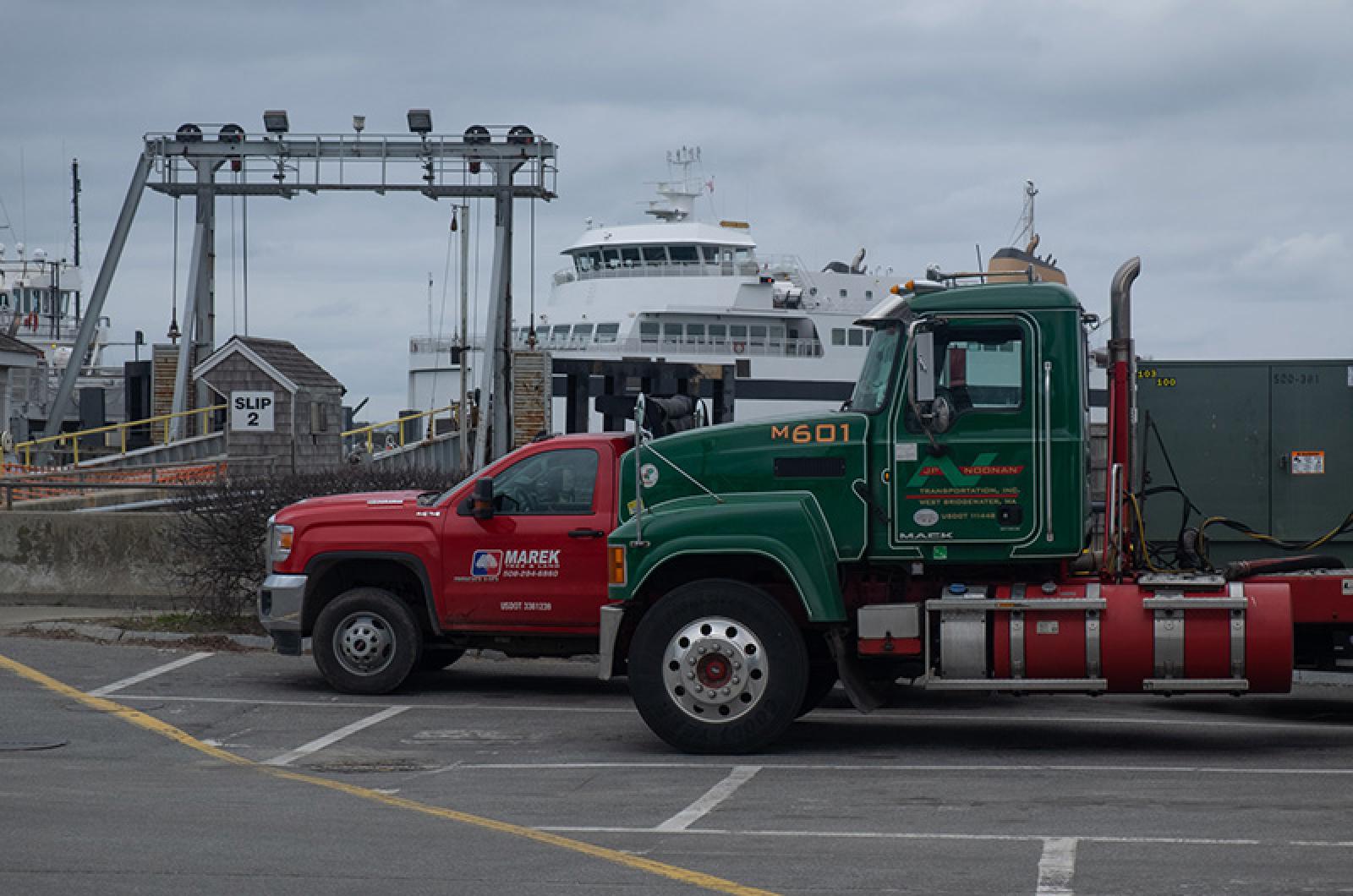
Developing an alternate port to ship freight by ferry to Martha’s Vineyard is feasible, but major obstacles make locations other than Woods Hole problematic, a new report concludes.
Developing an alternate port to ship freight by ferry to Martha’s Vineyard is feasible, but major obstacles including cost, travel distance and lack of infrastructure make locations other than Woods Hole problematic, a new report commissioned by the Massachusetts Department of Transportation concludes.
The 68-page report prepared by Urban Harbors Institute and released this week by the Steamship Authority concluded that State Pier in New Bedford would be the most practical choice among several alternatives examined for a new freight port. But significant investment in infrastructure would be needed to make that possible, and leaders in the Whaling City appear more focused on tourism-related waterfront redevelopment projects, the authors found.
“The mainland off-cape port in Massachusetts that is best positioned to handle non-bulk freight is New Bedford; however, shipping non-bulk freight to the Islands is not a priority use of the waterfront for the city,” the report said. “Other ports may be too far from the Islands to make short-sea shipping financially viable.”
Moreover, the report found, shifting even half the freight currently carried from Woods Hole to New Bedford would result in an overall increase in nitrogen dioxide and carbon dioxide emissions without significantly improving traffic congestion in Falmouth.
Instead, the authors suggest three possible steps to reduce traffic and emissions: consolidating freight in trucks before they reach the Cape, reducing the amount of waste coming from the Islands and doing more short-sea shipping from locations outside of Massachusetts.
The report, dated Sept. 2021 and funded by the state using federal highway funds, is the latest in a series of studies conducted over the last two decades to evaluate the potential of shifting freight traffic away from Woods Hole, where longstanding complaints from residents about noise and truck traffic have grown more insistent in recent years.
The report looked at New Bedford/Fairhaven, Fall River, Somerset and Wareham before concluding that New Bedford offered the best potential as an alternate port, though not without drawbacks.
Studies conducted in 2000, 2012 and 2016 by the Steamship Authority all came to the same basic conclusion: despite its apparent attractions, a New Bedford to Martha’s Vineyard route is cost prohibitive. A key reason is the travel time. Although New Bedford is relatively close to the Island, treacherous currents in the Woods Hole channel require boats to navigate through Quick’s Hole, adding another 30 minutes to a two-hour trip.
In the latest evaluation, Urban Harbors analyzed the existing freight transported by the Steamship Authority. Between 2018 and 2020, the annual number of freight trucks traveling between Woods Hole and Martha’s Vineyard declined slightly from 53,449 in 2018 to 53,366 in 2019 to 47,999 in 2020.
Focusing on 2019 numbers to avoid the impact of the pandemic, the report estimated that 40 per cent of those trucks traveled through New Bedford on their way to or from the Vineyard.
Assuming all of those trucks passed over either the Bourne or Sagamore bridges, traveled on Route 28 and down the Woods Hole road, the report concluded that trucks travelling on ferries accounted for 0.14 per cent of all bridge traffic, 0.7 per cent of all Route 128 traffic and 1.84 per cent of all Woods Hole road traffic.
“Though freight trucks are a very small per cent of overall traffic on Falmouth roadways, community members in Falmouth have voiced concern over the impact that freight activity to and from Martha’s Vineyard has on the local roadways and community character,” the report found.
“If efforts were made to reduce volume and/or congestion through the removal of freight trucks from local roadways, it would be important to ensure that cars and smaller trucks seeking to travel by ferry would not take the place of the rerouted freight trucks and reduce any benefits associated with the decrease in truck numbers,” the report continued.
The report also looked at greenhouse gas emissions from trucks and vessels between Woods Hole and Martha’s Vineyard and compared them to a model of what would be produced if less than half of the freight trucks diverted to New Bedford. While the amount of nitrogen dioxide and carbon dioxide emissions from trucks alone would decrease, the overall emissions from trucks and vessels would be 20 per cent higher than under the current scenario, the report said. The report found that about 38 per cent of the freight carried on trucks between Woods Hole and Martha’s Vineyard is comprised of mail, express packages, food and fuel, 17 per cent is building materials and 13 per cent is waste and recyclables generated on the Island and shipped off.
“The demand for freight on the Island is largely fixed, barring some significant change in activities on Island (e.g., major development projects). Further, the Steamship Authority currently has capacity to transport additional freight. Given these factors, it does not seem that there is unmet demand for freight shipping,” the report said. “If freight were to be shipped from a non-Cape site, however, it is possible that the newly freed capacity could result in changes in schedules, an increase in the number of passenger cars transported, or some other modification to current practices,” it said.
Comments
I can hear the howling in
Schools Out TisburyI can hear the howling in Woods Hole from here.
Same old song and dance. How
George Stein Oak BluffsSame old song and dance. How many of these appear each generation only creating revenue streams and efficiency for the contracted firm ? When you buy a home the surrounding environment has been there reflecting your purchase price.
And how many more studies
John Cape CodAnd how many more studies will be done to reach the same conclusion ? To reduce noise / traffic impact on Woods Hole Rd. need to monitor the speed limit for a lower designation & ban truck jake braking for starters and look at possible road improvements to enhance safety on this busy roadway. This has been proposed already but has not yet been implemented by any agency. The amount of traffic to Woods Hole is not going to go away as much as some people would like it to. Continued review by all is needed for any possible improvements to traffic / noise solutions to help even it is minor.
Experiment: Let a private
RJ PocassetExperiment: Let a private company start a freight-only service utilizing SSA docks on MV.
Private company is going to
JOHN Cape CodPrivate company is going to have the same fuel expense use for starters so no change on that item cost. Infrastructure cost for port improvements in New Bedford has to be paid by someone. This topic has been studied numerous times over the years and it comes down to it will be more expensive to ship from New Bedford and all costs will be passed on to the users of the service which will then be passed on to the consumer via higher prices. It's bad enough now with current Worldwide high inflation cost's delivered via Woods Hole for the Islands.
Why would a private company
Dizzy TisburyWhy would a private company sign up to lose money?
SSA commissioned Cambridge
Nat Trumbull Woods HoleSSA commissioned Cambridge Systematics to conduct an independent study of the impact of freight ferry operations from New Bedford on the cost of goods sold on Nantucket and Martha’s Vineyard. Here are the findings:
"The increment of cost to the retail price of goods sold on the islands of diverting one-third of
all freight to New Bedford would be under 0.35 percent in all tested cases.
While the increment of cost to shippers of New Bedford-based service would range from 12
to 40 percent (worst case), the cost of ferry transportation represents only 0.8 percent of the
retail price of goods sold on the islands. Thus, while marginal change in the cost of this last
leg of the trip is significant to the shipper, it results in very small change in the ultimate retail price of products sold on the islands.
It is estimated that the cost of goods wholesaled in the New Bedford area averages 2.9
percent less than comparable goods sold in Massachusetts as a whole. If 10 percent of the
shippers changed suppliers as a result of a shift in operations to New Bedford, it would result
in a reduction of the wholesale costs of goods sufficient to eliminate the increase in
transportation costs."
I seem to recall that ferries
CH Oak BluffsI seem to recall that ferries used to run Woods Hole passage routinely. Perhaps I'm wrong. Are all the ferries going to NB for service going through Quick's? What would the numbers look like if they mandated all freight traffic via New Bedford; reduced number of WH-MV trips and limited to passengers and cars. Seems like if you make two key assumptions - Quick's and 40% you inevitably get to a pre-determined conclusion.
You're right . . . though it
A. Bowdoin Van Riper Vineyard HavenYou're right . . . though it's been a while. The SSA hasn't run ferries through Woods Hole routinely since 1960, when the enabling legislation was rewritten to eliminate the mandate for year-round service to New Bedford (and the associated operating deficits). When they did run through Woods Hole routinely, it was mostly with steamers (Nobska and her sisters from the 1920s) that drew about 9 feet, compared to 14.5 feet for the Katama and *her* sisters. Five-and-a-half extra feet of draft might well make a difference in Woods Hole.
I've never seen a reference to whether SSA ferries bound for Fairhaven go through Quicks' or not, but it's a good question. If they *do* use Woods, it may make a difference that they're making the passage unladen and aren't constrained by a schedule (so they can time their passage to take advantage of fair currents). There may also be a difference (in someone's calculations) between taking a modern ferry through Woods Hole a couple of times a year and doing it 8-10 times a day, 365 days a year.
Already been tried. Freight
Darren Welch Vineyard HavenAlready been tried. Freight Boat Sea Bulk Minnesota 4 trips a day from VH to NewBedford... didn't last long..
I think it would be helpful
BCS Oak BluffsI think it would be helpful if the residents of Woods Hole took a trip on the boat. As you pull away from the dock and look back it's evident that Woods Hole is a small city with the MBL and WHOI buildings. I'd suggest Woods Hole residents look within and try to somehow limit the traffic to these large office/educational buildings.
I think having more ports
Chris TisburyI think having more ports available would be a benefit to us. It is quite often that a slip gets put out of service. Imagine if something happened and woods hole was out of service.
With respect to the money, the Steamship is spending a fortune on gigantic and opulent terminal buildings yet we use their services to get from point A to point B.
A priority of getting us from A to B and an optional C would be a vast improvement.
Add new comment