

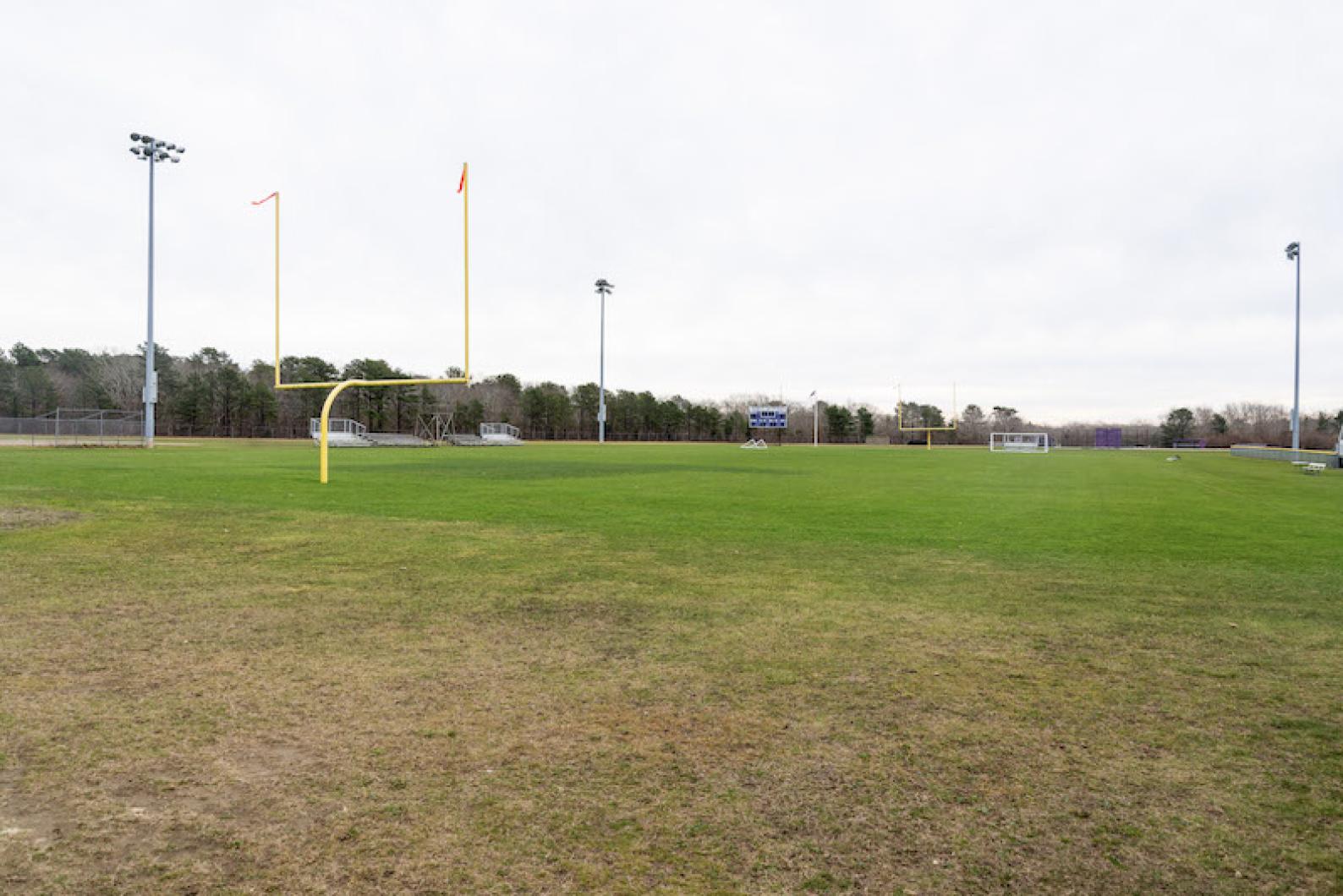
The Oak Bluffs board of health opened the floodgates Tuesday to opinions on a draft regulation that would ban artificial turf in town — opening up fresh wounds in the divisive athletic fields project at the regional high school.
The Oak Bluffs board of health opened the floodgates Tuesday to comments and opinions on a draft regulation that would ban artificial turf in town — at the same time opening up fresh wounds in the divisive athletic fields project at the regional high school.
The draft rule comes amid growing concern about groundwater contamination caused by PFAS — a large group of slow-decomposing chemicals. If adopted, the rule would prohibit the “installation, storage and dumping of all artificial turf containing PFAS” on any property in Oak Bluffs.
It also would likely put the brakes on the hot-button $7 million project to overhaul the regional high school athletic fields using turf.
Town health agent Meegan Lancaster said the board of health has been in talks with the school about the effects of PFAS since the turf project came onto the board’s radar in August, around the time the Martha’s Vineyard Commission voted 10-6 to approve the plan. “There’s a lot of concern surrounding PFAS right now . . . they wanted to look at this further,” Ms. Lancaster said of the board of health members.
Tuesday’s online meeting was dominated by experts and environmental advocates from around the country who warned about the dangers of PFAS. Spokesmen for the high school project also attended to vigorously defend the environmental integrity of their plan.
“All these PFAS that we’re finding in the turf . . . should be of grave concern to Martha’s Vineyard,” said Kyla Bennett, director of science policy at Public Employees for Environmental Responsibility, a nonprofit advocacy group.
She said the synthetic turf planned for the main field at the high school would introduce an unacceptable level of PFAS into the environment.
“I think it behooves you to go forward with this ban,” Ms. Bennett said.
Christian Huntress, whose firm designed the high school project, defended the planned turf field, saying among other things that a rigorous vetting process went into deciding what turf would be used.
When the project was approved by the MVC in August, developers agreed to a number of mitigation plans for microplastic pollution. A trench drain with a microfilter around the field to help capture plastics in runoff and a microplastic reduction action plan are among the measures planned.
“We took products and specifications very seriously,” Mr. Huntress said. “The products that we’ve specified have been reviewed.”
Amy Houghton, chairman of the school committee, said that the board of health meeting Tuesday caught school officials somewhat by surprise with its heavily-stacked lineup of experts and scant prior notice.
Ms. Houghton said the board of health notified Mr. Huntress of the meeting in a brief email late Friday afternoon.
“Our heads-up was, please find attached an agenda of the meeting,” she said.
“This was a prepared meeting where the board of health had called witnesses. We knew nothing about that,”she continued. “What happened was a very calculated presentation. And that’s not at all how it was painted to us.”
Ms. Lancaster said the board had previously heard on more than one occasion from a controversial scientific consultant for the schools, Laura Green, who had defended the use of PFAS. The Environmental Protection Agency, for whom Ms. Green worked as a special employee, has disavowed many of her claims about the alleged safety of PFAS.
“Dr. Green continually said that we weren’t understanding the science,” Ms. Lancaster said.
Ms. Lancaster said she then began to search for experts who could explain the science to the board.
“That was sort of the genesis of the draft regulation,” she said.
In looking for scientists to attend Tuesday’s meeting, Ms. Lancaster said, she was unable to find anyone to defend PFAS.
“If I had found somebody who said, ‘my scientific research is about PFAS being perfectly fine,’ I would have reached out to them,” she said.
Among those who condemned the use of PFAS at the meeting were experts from across the country.
“This is a nationwide problem, this isn’t Martha’s Vineyard alone,” Notre Dame physics professor Graham Peaslee said. He added that PFAS can end up in drinking water, and children are often born with some parts per billion of the chemicals in their bodies.
“PFAS are persistent, they don’t break down,” Ms. Bennett said. “They’re called a forever chemical for a reason.”
Courtney Carignan, a Michigan State University professor studying exposure science, said PFAS pollution can lead to adverse health effects.
“PFAS has been found to affect multiple systems in the body,” she said. She said the fact the federal Environmental Protection Agency is studying the effects of PFAS is cause for enough concern to enact a ban.
Kristen Mello, a chemist from Westfield, cited data from water samples taken around a high school with a turf field by a creek in New Hampshire. There, higher levels of PFAS were found in water tested at the high school than at two other testing locations further away.
“You guys are a sandbar — your drinking water comes from the rain,” she said. “Every bit of PFAS you add is yours to keep.”
But Joe Sullivan, the high school’s project manager for the athletic fields overhaul, disputed the notion that data from New Hampshire was necessarily relevant.
“I want to make sure studies are being done apples to apples,” he said.
Ms. Lancaster noted that the New Hampshire study was done by Alpha Analytical, the same lab tapped by MVC consultant Tetra Tech for tests on the high school project.
As discussion waned, board of health member Tom Zinno wondered whether it was possible for a turf field to be built without PFAS.
“They used to do this, it just wasn’t as good turf,” Mr. Peaslee replied, adding that he is not an expert on turf field development.
Paul Lauenstein, a water management advisory committee member in Sharon, said his town adopted a three-year moratorium on turf fields in 2020. Since then, he said the town has found success with grass fields using diligent maintenance.
“This has really opened my eyes to how many plastics we have in our lives,” Mr. Zinno said of the discussion.
Board of health member James Butterick, a retired physician, said he’s begun to see the medical community accept the dangers of PFAS in a similar way to its acceptance of the effects of cigarettes.
“I kind of look at this in a parallel way,” he said.
He later added that installing the field now could lead to problems in coming years, if data such as that shown by Ms. Mello proves to be replicable.
“We could have a very serious problem two, three, four years out,” Mr. Butterick said.
Mr. Sullivan said if the board is concerned about overall PFAS contamination, the scope of the problem is wider than banning turf fields.
Mr. Zinno agreed.
“If we do a regulation like this, it may have to be broader because the problem is broader,” he said.
While the turf project has been approved by the MVC, it still needs a special permit from the Oak Bluffs planning board.
Ms. Houghton confirmed that school has not yet submitted its planning board application. “It’s prepared and ready to go,” she told the Gazette by phone Wednesday.
She said the delay had been to allow time to meet with the Oak Bluffs building inspector in light of a new regulation adopted by the board of health late in the summer regulating impervious surfaces. “We wanted to make sure we understood what the building inspector was looking for,” Ms. Houghton said. Phase one of the fields plan centers on building a new track.
At the meeting the board of health took no action on the draft regulation. Another discussion is slated for Jan. 11, and board members said they intend to have a public hearing before any decision is made.
“Are we in a rush? I don’t think so,” said board chairman William White.
Ms. Lancaster said school officials were welcome to bring experts to defend the environmental aspects of the turf field.
“If they can find them, they are more than welcome to come,” she said. “If there’s something we’re missing here, we want to hear about it.”
Comments
Honestly, thank goodness.
Thank goodness Oak Bluffs ResidentHonestly, thank goodness. This “for the kids” nonsense must stop. I don’t believe there is no alternative to installing harmful, ugly, trendy turf. Wild that we have to listen to a football coach tell us that a grass field is somehow more dangerous than the sport itself? CTE?
"Wild that we have to listen
James EDGARTOWN"Wild that we have to listen to a football coach tell us that a grass field is somehow more dangerous than the sport itself? CTE?"
The grass fields the coaches speak of are "OUR" grass fields. OUR HS has never had a properly constructed and maintained athletic field since the school was built in the late 50's. So yes "OUR" grass fields have been inherently more dangerous than the effects of CTE on our HS players. So much so that I believe a class action lawsuit is coming. During the 7 yrs of debate on installing a safe field we have learned that our school has turned a blind eye to the condition of the fields. Many athletes have and still suffer injuries.
A grass field poses more of a
Seems a bit misguided^^^ Oak Bluffs ResidentA grass field poses more of a risk to a person’s health than repeated blows to the head/traumatic brain injuries that lead to CTE?
^^^ This is where these folks are coming from, it’s a bit of a case of clouded judgement in my opinion. Sports are certainly given their due and plenty of funding in this country —locally as well — but to allow this “for the kids” argument to walk yourself into making such statements like the above means some perspective has been lost to…emotion, I suppose?
Aren’t there still multiple properties surrounding the airport having to drink solely bottled water at their homes due to potential PFAS contamination? To me this seems obvious — I know the allure of the fancy new turf is hard to resist, but I think it has to be here.
Also, most ACL, etc. sprains and tears in football don’t occur without contact/alone in open field. I remain highly skeptical that even a terribly maintained grass field causes more catastrophic injuries than the literal sport itself. I’m not proposing anybody stop playing football, but I find it hard to believe arguments that blame grass versus tackling, etc. as the cause for most injuries.
I agree. The whole plastic
Carol formerly ChilmarkI agree. The whole plastic turf thing is a terrible idea.
Time for me to cash out my
T Bone Oak BluffsTime for me to cash out my house and leave this island while I still have fond memories. Too many groups with rage, pitchforks, and tiki torches on too many topics. The common good and common sense has given way to so-called experts, hired guns and lawyers. Good luck, Martha. And I hope someday kids get to play on a quality field, again. Vermont and Lake Champlain look mighty calming to me.
While I completely agree with
R Scott Patterson EdgartownWhile I completely agree with you assessment of the island the same applies to the rest of the country. Where do you plan to go to escape all the nonsense?
It's amazing to me that the
JG Oak BluffsIt's amazing to me that the opponents of the turf project are only concerned about PFAS from turf. Apparently PFAS from the numerous other sources are nothing to worry about. IF they really care about this issued shouldn't many other products be banned too? Why hasn't this been brought up before? If the turf field project is cancelled will they still ban other products?
It hasn’t been brought up
B EdgartownIt hasn’t been brought up before because it’s only now, all of a sudden, that PFAS are in the news. Just like when BPA was in the news all the BPA free plastic started coming out. The problem with the BPA and PFAS discussion is that the there are thousands, millions, of other chemicals in every day objects that have not been studied and still are dangerous. People thought they were “safe” with BPA free, it will happen again with PFAS free. Plastic will never be safe.
The Island has thousands
J Graham Indiana UniversityThe Island has thousands septic tanks, which contain PFOS, PFHxS, and other PFAS -- at concentrations that total higher than the drinking water standards! If the Oak Bluffs BAord of Health cared about aquifer protection, why don't they demand the installation of sanitary sewers? Why do they allow any new development? Every new home, new business, etc. is a new source of septic waste, which goes right into the ground, ground water, and, eventually, aquifer. Turf fields are solid plastics, not liquid wastes.
PVDF-HFP is a solid,
G Elliott Washington, D.C.PVDF-HFP is a solid, unreactive, polymer.
It is an inert plastic.
Did the Oak Bluffs Board consult a knowledgable chemist?
Or their own town public water suppliers? Or an environmental engineer?
The issue is also breathing
Father of 4 SDThe issue is also breathing and ingesting the pfas containing dust that it emits when weathered and played on. It's not just that as it volatilizes and leaches into the environment.
Why do we want athletes breathing pfas containing plastic dust? Artificial turf, as an industry, knows for a fact that their product is not pfas free and still markets it as such. They are the next tobacco industry.
If you read the Tetra Tech
Dave Golinski Natick, MAIf you read the Tetra Tech report, you learn that the proposed turf will not contaminate the aquifer. If you read the literature more broadly, you will learn that fire fighting foams, septic systems, land applied biosolids, and even compost can, and do, contaminate aquifers. Why hasn't the Board of Health done its homework? Is this an elected Board? If so, perhaps the voters should find better representatives.
Has the Oak Bluffs Board of
Dina Ralt Cambridge MAHas the Oak Bluffs Board of Health consulted with hydrogeologists?
Water protection engineers?
Analytical Chemists?
Environmental Toxicologists?
The State DEP?
The State DPH?
Seems that the school was invited to a knife fight, armed only with a toothpick.
No one knows what this
Charlie Callahan So Boston/EdgartownNo one knows what this garbage turns into when it deteriorates and turns to powder and the kids start breathing it in.The people who make it probably know what it turns into.Just like asbestos 90 years ago,the manufacturers knew what it would do to people,but people are expendable and they made billions and now the working shmos who worked with it are dying.What about the kids that are gonna be rolling in it and breathing it?It's all about the BUCK and nothing else
I am curious how all those
Really?! TisburyI am curious how all those speakers came to be on the speaker list? Did the members of the board of health request them in an open meeting? Was this a back door dealing? It was a single agenda item to review proposed wording and turned into extensive testimony. Who invited them to speak? Seems a more than likely violation of open meeting rules. Pretty curious at the least.
How about all the plastics on
Tom OBHow about all the plastics on our homes Decks etc.. should I be concerned about that? I hope we can keep the grass/turf…
This entire thing is just an
Geoff Oak BluffsThis entire thing is just an opportunity for people to pound their chest and be “experts” in an anti-sports movement that would benefit the kids. I sure hope nobody finds a paint chip picked up from ice at the arena by the Zamboni machine and deposited outside. I’m sure that would be cause for global health assessment by the “experts.”As someone who spent 40 years in college and professional athletics, this issue is exhausting to follow. The people pushing this movement must the the same “experts” in driving and parallel parking! Cannot wait to see the backup on Circuit Avenue as it will resemble Boston and NYC and give the all another reason to complain. Complaining is the only thing mastered on this island from too many people who have too much time on their hands!
PFAS are not the only health
Islander TooPFAS are not the only health and environmental issue raised by artificial turf.
In fact, by the scope of this whole project.
The "for the kids" arguement is emotional blackmail.
I am glad that the town of Oak Bluffs is at least looking at the PFAS issue.
We have to start somewhere in halting the use of dangerous toxins.
Should be a no-brainer when a better alternative is sitting right there, in plain sight.
The NFL Players Association
Hank EdgartownThe NFL Players Association wants all synthetic turf playing fields replaced with grass... due to an appalling amount of injuries caused by the former... just sayin'
The idea that grass may be a
William Oak BluffsThe idea that grass may be a better alternative is just not true. Some might argue that it is better for the environment. Considering the thousands of artificial turf fields that have been installed around the country, I'm not convinced yet. Natural grass required a ridiculous amount of maintenance. To get the type of quality/consistent fields that 1 artificial turf field can mimic requires thousands of man hours, tons of fertilizers, etc. (annually). Is that better for the environment or the budget? Even then, you should only put a couple (2 maximum) of practices a day on a single grass field. When the football team practices during the first rain storm, forget about it. The field will likely be a muddy (unsafe) mess for the rest of the season. Then due to the short growing season in New England, both lacrosse teams will have to deal with that same muddy grass field because (regardless of the amount of maintenance) no grass will grow until April at the earliest. I didn't mean to pick on football here. It just so happens that those athletes are usually the heaviest and cause the most wear and tear. The bottom line is that if you don't invest an incredible amount of money on an annual basis on grass field maintenance the fields do NOT hold up. Oh wait, we already know this.
Say goodbye to the track!!
James EdgartownSay goodbye to the track!! Asphalt with melted crumb rubber!! Back to running on grass around the football field again. Never to host a track meet again. Laughable
Dr. Butterick asked, "Can't
Sanford Smith Falmouth, MADr. Butterick asked, "Can't synthetic turf be made without PFAS?" The answer is yes. The larger question, though, is "why is there currently (as of 2020, anyway) more than 2 ppt of PFAS in Oak Bluffs drinking water?" Is the Board of Health investigating this issue? Does the fire department in your town use PFAS-containing fire fighting foam? Have you analyzed the contents of your towns' septic tanks? Here on the Cape, our septic tanks are in fact contaminating other folks' drinking water wells, downstream, with PFAS. Please look into these matters. Your residents will thank you.
Add new comment