

A comprehensive review of correspondence between the state DCR and staff and board members of the Sheriff’s Meadow Foundation shows all were closely involved with an aggressive trail cutting project.
A comprehensive review of correspondence between the state Department of Conservation and Recreation and staff and board members of the Sheriff’s Meadow Foundation shows all were closely involved with an aggressive trail cutting project in the Manuel F. Correllus State Forest from its inception in 2018.
The project, which carved more than 25 miles of new single-track trails through the 5,000-acre state forest — including 32 acres of priority endangered species habitat — never received permits from the DCR or the state Natural Heritage and Endangered Species Program.
In June 2020 Natural Heritage issued an order of noncompliance to Sheriff’s Meadow board member Michael Berwind, halting work on the project, about two years after the trail cutting began.
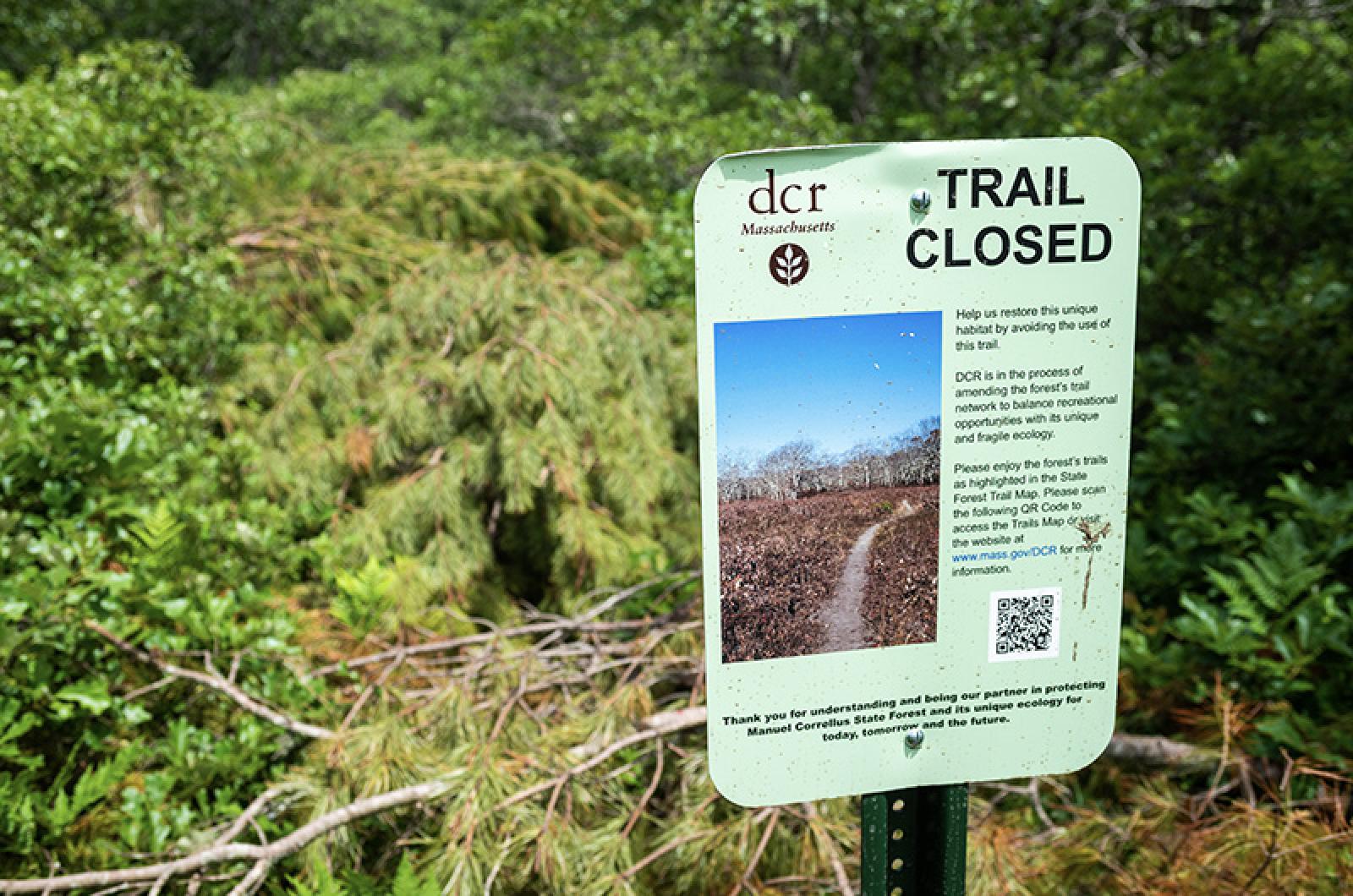
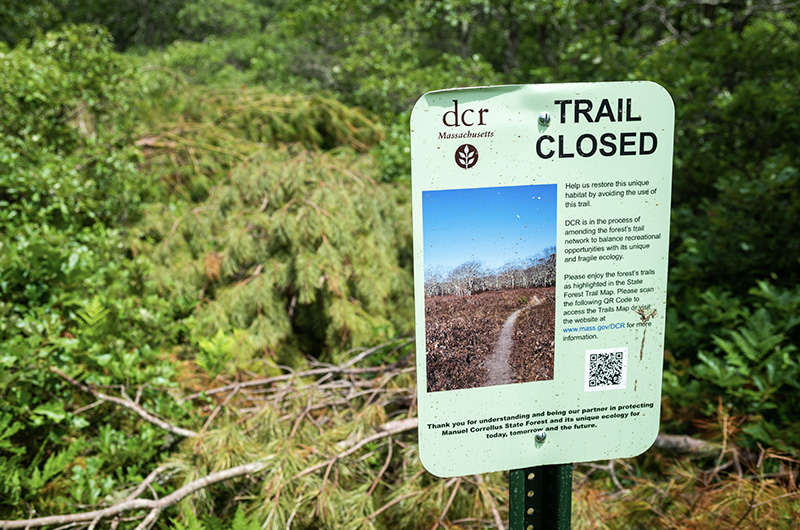
In a plan announced early this summer, Sheriff’s Meadow and DCR have since agreed to a five-year restoration and monitoring plan that will close the majority of the trails to the public.
Sheriff’s Meadow is a nonprofit, Island-based land trust that owns a number of properties on Martha’s Vineyard, including Cedar Tree Neck and Quansoo Farm. The state Department of Conservation and Recreation owns and manages the state forest.
In March of this year, the Vineyard Gazette filed a records request with the DCR to ascertain exactly how the project unfolded. Nearly 500 pages of documents provided by the state include hundreds of emails between and among state forest superintendent Chris Bruno, Sheriff’s Meadow executive director Adam Moore, Mr. Berwind and various DCR officials.
Citing an exemption under the state public records law, DCR declined to provide internal emails among its staff regarding the trail work and its aftermath. As a result, it is unclear exactly to what extent state environmental officials were aware of the project.
A comprehensive review of the emails shows that Mr. Berwind, an avid mountain biker and board member, played a leading role in the effort to create an extensive trail system in the state forest, but that he was not acting unilaterally.
Spearheading the work, often with great panache, Mr. Berwind relentlessly campaigned for a continuous single-track trail system. But both Mr. Bruno and Mr. Moore approved, and at times encouraged the work by Mr. Berwind, as well as other volunteers, even though there were no permits in hand.
Four months after Natural Heritage halted work on the trails, Mr. Berwind resigned from the Sheriff’s Meadow board. Emails provided by the state show that he remained involved in the remediation process well into 2021.
In Sheriff’s Meadow’s early summer newsletter that went out recently, Mr. Moore wrote a lengthy statement of explanation and apology about the trail cutting project. It marked the first formal statement from Sheriff’s Meadow since the problems became known publicly a year ago.
“Had we understood that our work was not properly permitted, we would not have undertaken it,” Mr. Moore wrote in part.
Mr. Bruno did not respond to a request for comment from the Gazette. Contacted by email, Mr. Berwind declined to comment.
•
Emails provided by the state show that as early as 2017, Mr. Bruno had reached out to Paul Jahnige, the director of trails for DCR, inquiring about a partnership with Sheriff’s Meadow for “trail reclamation work” in the state forest.
“I have a willing partner organization that is offering to assist in the process and implementation if and when approved,” Mr. Bruno wrote Mr. Jahnige in October 2017, referring to Sheriff’s Meadow. “Could you send me the criteria needed to begin the process.”
Mr. Jahnige replied by attaching the current trails map for the state forest as well as DCR’s trail proposal form. He also informed Mr. Bruno of the Natural Heritage review process.
But that process apparently never took place, even as trails were blazed through the state forest in 2018 and 2019, using heavy machinery. The trails quickly became popular among the Island mountain biking community.
The work was almost entirely led by Mr. Berwind, who served as head of the Sheriff’s Meadow trails committee. In lengthy notes to Mr. Bruno, with Mr. Moore and sometimes other Sheriff’s Meadow board members copied in, Mr. Berwind chronicled the trail cutting project in exhaustive detail.
“What have the forest elves been up to you ask?” Mr. Berwind wrote to Mr. Bruno, Mr. Moore and other Sheriff’s Meadow members in a progress report on Jan. 5, 2019, going on to detail the trail work from the previous year. “I believe Sheriff’s Meadow and DCR worked extremely well together this year,” Mr. Berwind wrote. “As a result, the single track trail connectivity through the forest should be significantly improved by the end of 2019.”
After another update from Mr. Berwind on April 1, 2019, Mr. Moore offered his approval.
“I thank you and your hard-working crew for your efforts helping the state forest,” Mr. Moore wrote to Mr. Berwind.
Mr. Bruno offered similar encouragement.
“We are coming to a great position in our trail program and commend all of the efforts in making this possible to everyone involved, something we can all be proud of in our forest,” he wrote a day later.
Emails show that Mr. Berwind took Mr. Moore and Mr. Bruno on electric bike rides through the state forest, showing them the work and potential new trail locations. He pushed for Sheriff’s Meadow to direct resources to the project, including the purchase of a Toro Dingo trail cutting machine, and asked that a newly-hired land steward report directly to him three times a week.
Sheriff’s Meadow bought the machine later in 2019, paid for by a donation from a board member.
By May 2019, Mr. Moore had made progress on inking a volunteer stewardship agreement between Sheriff’s Meadow and the state. In an email to Mr. Bruno, he updated the superintendent about a meeting he had with senior DCR officials Karl Pastore and Leo Roy. And for the first time in a long-running email correspondence about the trails that had begun more than a year earlier, Mr. Moore inquired about permits for state forest trails.
“I am going to follow up on . . . a cooperative agreement for us,” Mr. Moore wrote to Mr. Bruno. “In the meantime, can you please provide me with a map of where you want Sheriff’s Meadow to create trails, maintain trails, and to restore trails, and can you please provide me with any NHESP approval paperwork that you have, if needed?”
Mr. Bruno replied: “I will get these to you as soon as I can for your reference.”
Mr. Moore never followed up in writing about the permits, and Mr. Bruno never provided them, according to the emails.
Work continued on the trail clearing project through 2020.
•
In a phone interview this week, Mr. Moore said he did follow up verbally with Mr. Bruno multiple times. He acknowledged that it was a serious mistake that he never pushed further in writing, and that work continued in the forest despite the lack of permits. He said senior DCR officials who were familiar with the project had expressed no concern during the 2019 meeting about permitting, even after Sheriff’s Meadow received a grant to install benches on some of the trails.
“I did follow up verbally several times. Certainly, I should have followed up with an email . . . that was a mistake,” Mr. Moore said. “We were working with a trusted partner.”
Emails show that at least one DCR official, Mr. Jahnige, had some familiarity with the trail cutting prior to the citation in June 2020, contradicting the state’s timeline of events, which said senior DCR officials only became aware of the lack of permits in April 2020.
But on Jan. 7, 2020, Mr. Jahnige wrote to another DCR employee: “I understand there may be some trails on the ground that are not on our current map . . . These might be historic, or might have been built more recently with permission (although I don’t think we ever got trail proposal forms on any of them), or there might or might not be illegally built trails. In any case . . . given the priority habitat issues at the forest, we may need to discuss some NHESP process as well.”
•
No additional mention of permits was made via email until February 2020, when Sheriff’s Meadow ecologist Kristen Geagan became involved in the project.
“Adam has asked that I supervise the SMF crews DCR projects and make sure that they are consistent with DCR plans and NHESP permits,” Ms. Geagan wrote to Mr. Bruno on Feb. 20 that year.
The trail work continued through March. At one point Ms. Geagan emphasized that a re-route of one trail out of a frost bottom had not been approved.
“As I feared [Mr. Berwind] misinterpreted your email to give him carte blanche on trail maintenance,” she wrote to Mr. Bruno on March 6.
Mr. Bruno continued to praise the project.
“Great work continues being done in the forest,” he wrote to Mr. Moore on March 26.
On the same day, Ms. Geagan wrote a follow-up email to Mr. Bruno with an attached spreadsheet, requesting the DEP and Natural Heritage permit numbers for every trail worked on by Sheriff’s Meadow board members and staff.
There was no reply. Mr. Bruno left his position as forest superintendent a short time later (the state has not confirmed the actual date of his resignation).
•
On May 19, 2020, Mr. Jahnige sent Mr. Moore an email asking to talk about “significant recent illegal trail building.”
The two spoke on the phone, and Mr. Moore provided Mr. Berwind’s contact information, emails show.
On June 10, 2020, Natural Heritage issued the citation, requiring work to stop.
Emails show that Mr. Berwind remained actively involved, corresponding frequently with DCR staff about the trails.
On July 6, 2020, he wrote to Mr.Jahnige to say he had re-routed a 100-yard section of one trail out of a “sensitive frost bottom” in mid-March at the request of Mr. Bruno, who, according to Mr. Berwind, “was concerned about Natural Heritage.”
Later, on Sept. 11, 2020, Mr. Berwind wrote a lengthy email to Mr. Jahnige, advocating strongly to keep the trails open and criticizing SMF staff.
“If the DCR has other priorities and/or Sheriff’s Meadow is unwilling to commit the necessary resources to reroute trails around sensitive habitat areas, I am confident — under the direction of DCR — I can be part of or even lead a volunteer work team to get the job done,” Mr. Berwind wrote to Mr. Jahnige.
According to Mr. Moore, Mr. Berwind was asked to resign from the Sheriff’s Meadow board in October 2020.
•
From July 2020 on, DCR received dozens of emails from members of the Island conservation community and other state forest users, decrying the trail cutting.
Meanwhile, Mr. Berwind, who was no longer on the Sheriff’s Meadow board, continued to press officials to keep the trails in use. On March 1 of this year, just before a March 4 DCR public information session about the illegal trail cutting, Mr. Berwind sent an email to DCR staffer Eric Seaborn, saying he had been asked by Mr.Jahnige to go “radio silent” and “refuse media comments.” Mr. Jahnige said Mr. Seaborn had taken over for him to lead the remediation process, according to emails.
“I have approvals and go-aheads from DCR employees for all the volunteer and Sheriff’s Meadow Foundation work performed,” Mr. Berwind wrote to Mr. Seaborn.
He also wrote: “Paul [Jahnige] has done an excellent job attempting to calm the local waters. While doing so, he asked me to remain out of sight on the sidelines . . . My hope has been — and continues to be — given everything going on in the world today, DCR/[Natural Heritage] will come to the conclusion the existing single track trail system is a material benefit to an Island population.”
At the public information session three days later, DCR announced that nearly all the trails would be closed to the public, and that Sheriff’s Meadow would be responsible for a five-year restoration and monitoring program.
Comments
As a person who has walked
Chris Mara EdgartownAs a person who has walked the trails in the State Forest for years I began noticing these new trails right away. At first I was intrigued to be able to access areas of the forest unaccessible before. However it became obvious that these trails were NOT for walkers. They were made for mountain bikers. The layouts were purposely twisty in otherwise level terrain in order to create enjoyable bike rides but not walks. Very often 1/4 mile of trail was accessible by stepping 10-20 feet from one part of a trail to another. These aren’t trails, they are mountain bike tracks. It was infuriating that these trails were cut for such a singular purpose. It shows that there wasn’t accountability in their creation. I could understand a single fun mountain bike trail cut for a riders enjoyment just as the frisbee golf course was created but 25 miles worth?
I’ve seen the closed off trails and I’m glad. The forest should quickly fill them back in.
I still haven’t been able to
august west edgartownI still haven’t been able to discern how exactly the forest was being harmed by the trails, but that isn’t really the point of the trail closures, I suppose.
I'm sorry you can't "discern"
T Bone Oak BluffsI'm sorry you can't "discern" the harm. A Toro Dingo wasn't bought to clear hiking trails for the average person. That clearcutting machine was bought to fulfill Berwind's fantasy of world class mountain biking. Through our precious forest. How one man's obsession could cause 25 miles of harm is beyond the pale. It borders on unconscionable. Merriam-Webster defines discern as "to come to know or recognize mentally." Maybe you d0 need to think a bit more about what happened so it never happens again.
The frisbee golf had all
Jane varkonda EdgartownThe frisbee golf had all approvals and permits
“Take” of listed species in
Judith Kohn Salem MA“Take” of listed species in any area that is mapped by MNHESP is a crime, and can result in fines and even jail sentences. The fact that this was done in the State Forest with the knowledge of DCR is appalling. This work would have triggered MEPA (Massachusetts Environmental Policy Act) review and other state permits. I hope that there is some outcome beyond newspaper coverage for the DCR participants. DCR partners with nonprofits to advance these these types of projects all of the time. There is no way that they were unaware of what was happening.
How lucky we are that The
peter palches oak bluffsHow lucky we are that The Gazette supports and encourages investigative reporting of this quality.
There is more harm being done
Bob EdgartownThere is more harm being done to humans not being allowed to recreate in the state forest then there is being done to the state forest and the environment. A definite waste of any money being spent where ever the money came from.
I am uncertain exactly what
fred roven edgartownI am uncertain exactly what Bob's position is here. I have been walking the existing trails for 35 years with one dog or another and find there are more than enough areas for recreation and enjoyment and rarely the sight of another person. Where was the need for 25 miles of trails that were actually difficult and uncomfortable to walk and possibly designed to keep people away rather than encouraging expanded use? I agree someone should pay and hopefully Sheriff's Meadow members are absorbing most of the cost of reclamation.
The island is 9x20 miles.
T Bone Oak BluffsThe island is 9x20 miles. Dozens and dozens, if not hundreds of places "to recreate" on it. 25 miles of trail clearing was irresponsible from the beginning.
Jane, yes. The frisbee golf
Chris Mara EdgartownJane, yes. The frisbee golf course was done by following the rules with public input. I suppose a enjoyable mountain bike trail could have been done but 25 miles worth?
I agree just clarifying that
Jvarkonda EdgI agree just clarifying that it had permits
I agree the trail cutting was
Todd S Oak BluffsI agree the trail cutting was excessive but closing trails that had been in place for 10+ years is an overreach and keeping a few miles of new trails open to connect the network would have benefited all. Now can DCR start maintaining the remaining network?
Great article and work by the
Jane varkonda EdgartownGreat article and work by the gazette staff. I would like to ask DCR for their response and who is accountable for the mistakes made and how they will ensure this does not happen again. Why the cover up by DCR? Where is their leadership and stewardship and support for the 3rd superintendent since 2013? Why was Mr Berwind still involved with DCR after the complaints were lodged by the best and most dedicated environmentalists who live here and those who spent countless hours studying all the marvelous creature who call the forest home? I believe we deserve answers and we certainly did not get them in the meeting held to discuss what happened and remediation plans . We need more public input on how we, not a private land management
Trust or some one with funds to donate equipment and unlawfully create trails has obviously had.
Thank you Ms. Varkonda for
Johanna Hynes KatamaThank you Ms. Varkonda for your astute questions. Agree with all of your points.
Your points get right to the
Bill McCarthy EdgartownJane, Your points get right to the heart of the matter. A vehicle for public input will help offset the "asleep at the switch" (to put the best face on it) circumstances of an underfunded DCR. Do we know if the new supt. been able to occupy the house at forest HQ? As Steve P. points out, DCR hasn't so far been able to properly maintain the legacy trails this summer. I'll add my thanks to the Gazette for keeping on this story.
Every other community
august west edgartownEvery other community anywhere wants more trails, but not this one.
I certainly hope this is
Jim MAI certainly hope this is being investigated as a criminal matter.
I have lived in the middle of
Robert’ MacGregor West TisburyI have lived in the middle of the state forest for 25 years, what I want to know central to the discussion about trails and public use, is what is the overall environmental plan for the state forest? The main policy that I am aware of is suppression of fire, and managing the remaining plantations of pine and spruce. Jon Varkonda cleared and mowed firebreak meadows which abut my land, that along with the fire lanes support rare sand plain vegetation. The rapid succession of forest superintendents sadly has neglected their maintenance. I would like to see discussions about the state forest to include the overall environmental plan aside from recreation. Who makes these decisions and allocates the resources?
It’s funny that trails
Mike EdgartownIt’s funny that trails through the scrub oak and huckleberry are such an issue, some of its invasive anyway. Pick any road on the island and you will find a house being built that has more environmental impact than those trails. Or spend an hour at the airport, some of those jets burn more fuel in an hour than the average person uses in a year
Where's the funny part of
Jennifer KatamaWhere's the funny part of your comment?
This is a very disturbing and
Ginny WTThis is a very disturbing and detailed analysis and report on what was a very disturbing project on many different levels. Aside from all the conservation and/or recreation aspects and impacts, first and foremost this piece of property did not belong to SMF, nor did they have any sort of management arrangement with the state in place. The question of whether the trails are good or bad simply does not apply because the property belongs to we the people and it deserves the highest priority as an endangered species habitat (and yes, even for the pitch pines and scrub oak) as every plant and tree helps to protect our air and water natural resources. Further, various legal and professional protocols were ignored, and no clear path of permitting was followed as the project was undertaken. Boards of non profits are selected -- or should be -- for their dedication and adherence to the mission of the organization that they serve as well as to ethical and legal considerations. Of course they also have to be committed to various types of support and that is where the rocks, and the hard places can prove troublesome. Unfortunately Mr. Berwind apparently was or at some point in time, became a rogue member and he and his buddies have badly tarnished what is a very fine body of dedicated environmentalists who have accomplished so much positive for this island. That should be the end of the story
but it isn't. Unfortunately we have seen only a few -- too few -- acknowledgements of flawed judgement and ethical and moral, not to mention legal lapses. .
What are the conservation
august west edgartownWhat are the conservation impacts you’re referencing? One newly obvious one is the large trees you’re fond of are being cut down to block the trails.
Most trail workers would
SteveP EdgartownMost trail workers would ordinarily gather debris laying on the ground nearby to serve as a trail closure obstacle. Felling a mature tree and evicting everything living in it is a surprising choice.
It appears that the island
SteveP EdgartownIt appears that the island has alienated its best trail stewards in this debacle.
A quick tour of trails in the state forest makes it obvious that the state is not maintaining the legacy trails it explicitly committed to maintain during the March 4th forum. Double track is knee-high grown-in and single track is a face-whacking delight. Trails need maintenance. DCR is trying to get to some thoughtful equilibrium, but in doing so they are taking too many steps in the wrong direction by shunning the local folks actually doing the (volunteer) work. Slow clap.
Add new comment