


A growing number of ecological, economic and social pressures have prompted Island planners to consider a first-of-its-kind carrying capacity study for Martha’s Vineyard.
In 2017 — the last year of publicly available traffic data on the Vineyard — a total of 9,514 cars traveled down Beach Road on the first Monday in July, crossing the paved spit of sand and barrier beach between Oak Bluffs and Edgartown in anticipation of the bustling Independence Day activities.
In 2020, as a pandemic gripped the nation and officials canceled the famed Fourth of July parade amid public health concerns, the number dipped to 7,344.
In 2021, there was still no parade. And despite more than 90 per cent of the Vineyard reaching full vaccination status, the Covid-19 pandemic loomed large over the Island, with cases poised to rise and health officials confirming the presence of contagious virus variants. But the cars still came. In fact, more came than ever. A record 9,795 vehicles traveled between Edgartown and Oak Bluffs on the first Monday of last month, as a slight drizzle caked sandy Beach Road and Islanders were treated to the coldest Fourth of July weekend in two decades, with temperatures topping out in the mid-60s.
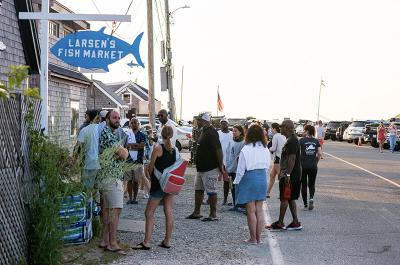
Lining up at Larsen's Fish Market in Menemsha.
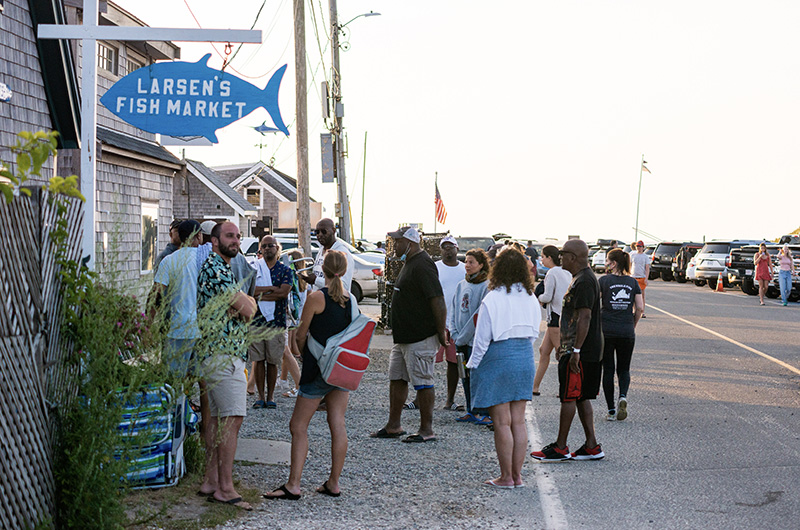
Lining up at Larsen's Fish Market in Menemsha.
The cars weren’t coming to a parade. They weren’t coming to the beach. They were just coming. And coming.
As the Island marches through its first post-pandemic summer (if such a term is even appropriate, considering creeping infection rates), a growing number of ecological, economic and social pressures have prompted Island planners — along with the U.S. Army Corps of Engineers — to consider a first-of-its-kind carrying capacity study for Martha’s Vineyard. Although funding remains a question mark, staff at the Martha’s Vineyard Commission confirmed this week that they are in discussion with the Army Corps research division in the hopes of undertaking the approximately $500,000 project. The study would holistically examine current infrastructure and potential buildout, showing how factors like wastewater, supply chain needs, energy use, erosion, housing and more will determine the eventual carrying capacity of the Vineyard.
Traffic is no longer the primary concern.
“Right now, the Vineyard has multiple issues. There are the logistical issues of traffic, drinking water and supply. And then, of course, you have the environmental issue,” said Dr. Brian Howes, a professor at UMass Dartmouth who headed the Massachusetts Estuaries Project and works with the MVC on coastal planning. “Currently, most of the estuaries on the Vineyard have some level of impairment. And all of that really stems from the shift of the landscape from pine and oak forest to residential development, because most of the Vineyard, now, is residential development,” he said.
The idea of the carrying capacity study, among other things, is to better understand the Island’s upper limits on growth.
Crowds gather for summer ritual of bridge jumping along State Beach.
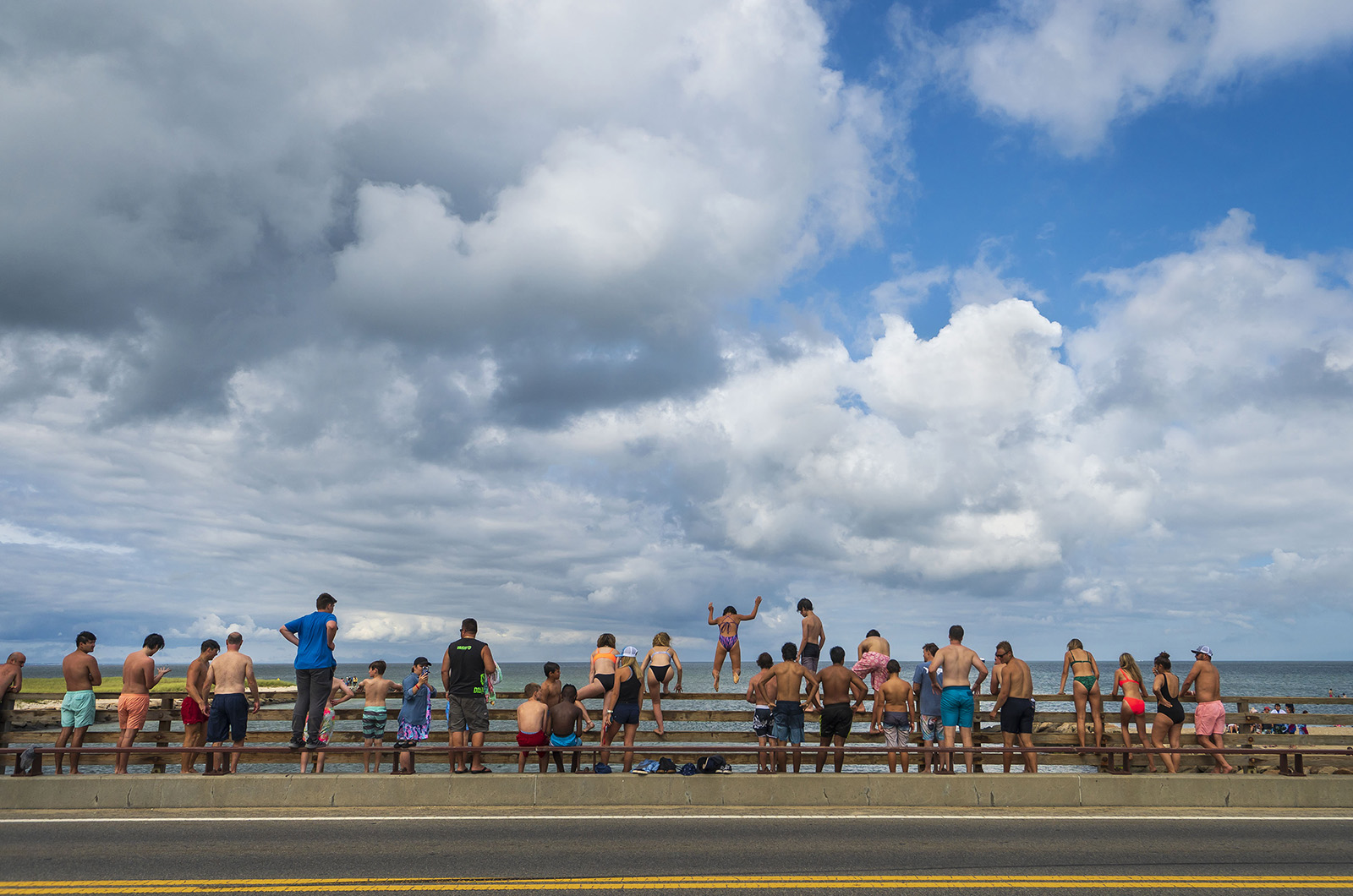
Crowds gather for summer ritual of bridge jumping along State Beach.
It also might help put a number on the actual summer and year-round populations, which remain a mystery to all. “There have been some attempts to say, on our busiest day, here’s what our Island population really looks like,” said commission special projects planner Dan Doyle, who among other things manages traffic counts. “But I don’t think it’s been this authoritative number that people can reference and cite.”
•
Accurate Island population data remains notoriously couched in myth. The 2021 Dukes County Hazard Mitigation Plan estimates the average summer population at almost exactly 80,000, using a complex methodology that factors in passenger ferry data, seasonal units and 2010 year-round census data. The year-round population is listed at about 16,000 and the seasonal population at 46,000 in that plan.
But those numbers are a decade old.
In that same decade, Steamship Authority automobile traffic has grown by more than 10 per cent — an increase of approximately 200,000 annual passengers — despite ferry schedules remaining largely the same. And the Island saw unusual swells in population during March of 2020 and the 2021 winter, as indicated by a nearly 3,000 vehicle discrepancy in two-way SSA traffic numbers – that is, many more cars came than left. In prior years the annual conversation about the Island tipping point was generally focused on summer road congestion. Now the commission is in contact with a senior scientific technical advisor with the Army Corps, Igor Linkov, to develop models for non-linear tipping points, that would look not just at traffic bottlenecks but at how sliding-scale variables like sea-level rise, energy use, water quality and wastewater capacity create thresholds for development.
There is also interest in using cell phone ping data to determine Island population numbers, with 2020 census data still mostly unavailable.

Crowds at State Beach on a summer day.
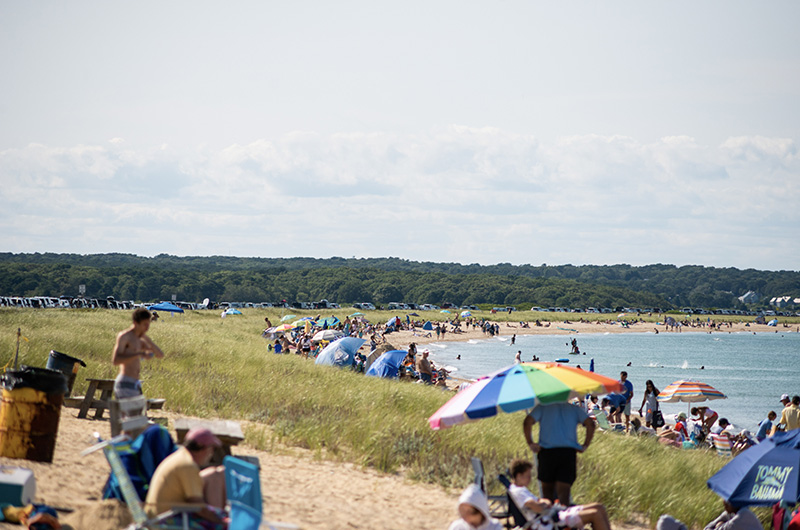
Crowds at State Beach on a summer day.
“These problems are massive . . . and it feels like there are a few pieces of information that we really need as an Island,” said Ben Robinson, who sits on the commission and has been working on the capacity plan grant. “Understanding the carrying capacity of our Island is one of those . . . because once you cross that threshold, the effects become non-linear.
Maybe not exponential, but definitely non-linear.”
Since that busy July 4 day on Beach Road in 2017, the real estate market has boomed, lifting the median home price well above $1 million as remaining housing inventory evaporates and rental prices skyrocket.
Restaurants and retailers are feeling new pressures this summer, limiting hours and services as a result of lack of seasonal labor and staff shortages linked to the scarcity of affordable housing.
Sea levels are rising, altering the Island landscape in unpredictable and sometimes rapid ways as salt marshes retreat and coastal dunes erode.
Cyanobacteria blooms have become annual events, closing ponds in some of the most pristine corners of the Island.
One of the Vineyard’s four aging undersea utility cables has failed, highlighting the fragility of the Island electric grid and forcing Eversource to rely on millions of gallons of diesel fuel to keep backup generators humming through the summer.
Every Island town has either begun, or recognized a need to begin a comprehensive wastewater management plan. Sewage treatment plants in Edgartown, Oak Bluffs and Tisbury are at or near capacity, limiting development potential on an Island whose year-round economy relies heavily on the trades.
“There’s a real debate about the sewering question. Who gets the sewer flow — does it go to development or nitrogen mitigation?” Mr. Robinson said. “Wastewater flow is like gold now. More valuable than gold.”
Dr. Howes praised the capacity study. “I think that it’s a very good thing that they are doing,” he said. “But it’s not just traffic and aesthetics. We need to keep the environmental health of the water in mind, especially in this region, especially on the Vineyard.”
•
Meanwhile, traffic data from the Steamship Authority indicates that the Vineyard is experiencing, yet again, one of its busiest seasons ever. Through July 21, regular-fare automobile traffic has outpaced 2019 numbers — a near-record year — by more than 17,000 vehicles. While excursion travel has dropped by 14 per cent, the dramatic increase in non-resident vehicles in 2021 has led to a 2.2 per cent total increase in automobile traffic on ferries from 2019.
Advance automobile reservations for the fall outpace 2019 by more than 10 per cent, mirroring increases in May and June. Truck traffic remains almost entirely on par with 2019 numbers.
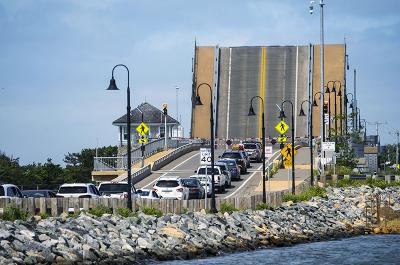
Traffic has reached an all-time high at some places this summer.
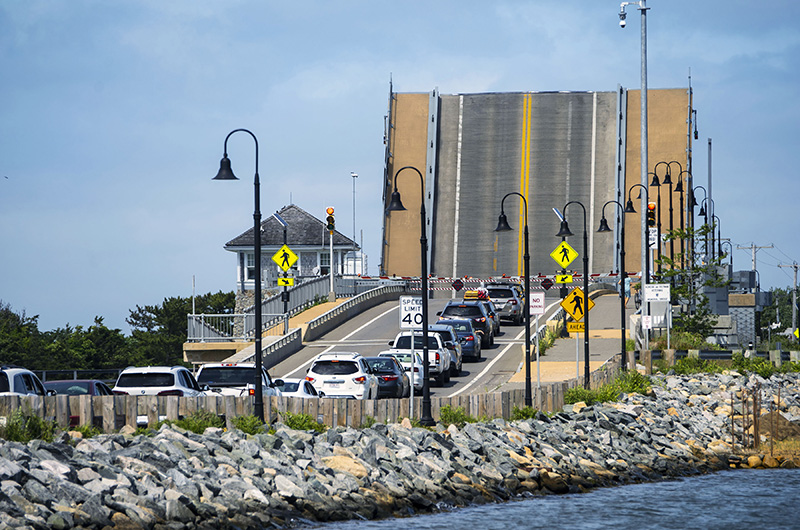
Traffic has reached an all-time high at some places this summer.
“One of the things we identified this year was that demand was showing itself sooner,” SSA general manager Bob Davis said in an interview. “People were making their summer plans earlier than they had been.”
The Steamship Authority on average runs at between 75 and 82 per cent of total vehicle capacity year-round, based on available linear feet, with trucks and freight accounting for about a quarter of that space. On certain summer days, capacity reaches 100 per cent, posing challenges for Islanders who need to travel and clogging traffic in all the port towns.
In 2019, the Island Home ferry reached its passenger capacity limit — mandated by the U.S. Coast Guard at 1,200 — about six times, according to Mr. Davis.
“We’re at the crosshairs,” he said. “It becomes a balancing act on all fronts.”
The same trends are reflected in almost any data set one can find. Island highway superintendents have reported unprecedented amounts of trash pickup in down-Island, main street receptacles. The Martha’s Vineyard Hospital saw a 600-patient increase in its emergency room visits in June from pre-pandemic numbers.
“It is very busy. Period,” Edgartown selectman Margaret Serpa observed at the board’s regular meeting Monday.
•
Nowhere have the impacts of residential development and population increase been felt more dramatically than in and around Island coastal ponds. Katama Bay, James Pond, Squibnocket Pond, Lagoon Pond, Edgartown Great Pond and Lake Tashmoo are among the ponds facing water quality issues.
In 1938, a massive hurricane blasted open the barrier beach at Tashmoo, turning the freshwater coastal pond into a saltwater estuary. Eighty years later, the lake is dealing with a different kind of storm.
With Cape Pogue mostly closed to anchoring this summer, more boats have flocked to Tashmoo, many of them day-boaters from the Cape. Shellfishing has been closed in much of the pond all summer.
“Sometimes it feels like the whole of Tashmoo is a boat yard,” Mr. Doyle said.
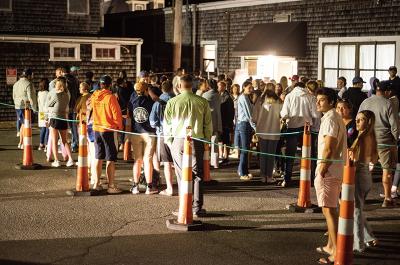
Late-night crowd at Back Door Donuts in Oak Bluffs.
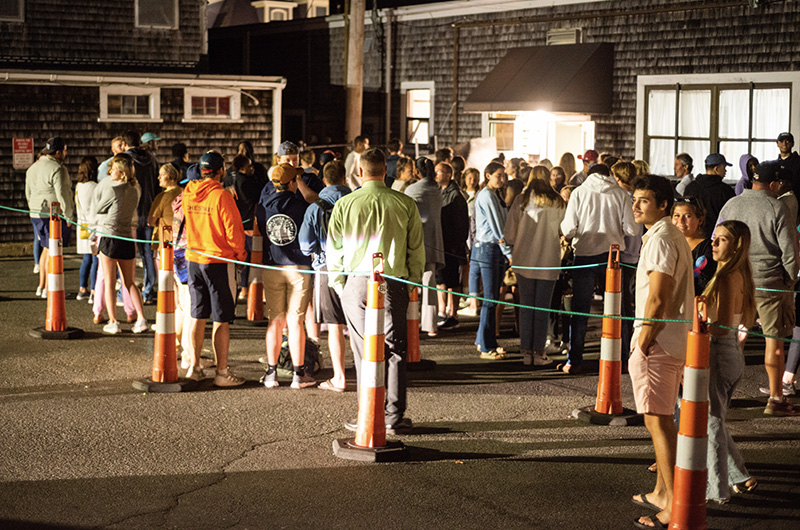
Late-night crowd at Back Door Donuts in Oak Bluffs.
Dr. Howes said the water quality in Tashmoo isn’t terrible, but the lake remains impaired.
“There are already a lot of limits, and I think it’s handleable,” he said of the Island coastal ponds. “But the problem is that as development increases, those nitrogen pressures will only increase.”
He pointed to Cape Cod, which has seen much more development than the Vineyard and is facing a vastly complicated cleanup problem, with many estuaries closed due to algal blooms or bacteria. A restoration project in Barnstable alone is projected to cost more than $1 billion.
Dr. Howes has a much rosier outlook for the Vineyard, emphasizing that the Island has not reached anything near the level of impairment seen on Cape Cod. He pointed to the efficacy of the recently installed Lagoon Pond permeable reactive barrier, along with advanced septic technology that limits nitrogen, as potential solutions to nitrogen impairment. But he stressed the importance of preserving and planning now.
“I’m very optimistic about the way the issue is being addressed aggressively on the Vineyard,” Dr. Howes said. “But the Vineyard still has high-quality environments that need to be protected. And it’s a lot easier to protect than it is to restore.”
Comments
There are too many people on
AM 02539There are too many people on Island during the summer. Period. Business owners and property owners will scream bloody murder at the mention of such a thing but it is true…..if you have a time horizon and perspective that is beyond the immediate present. The Island is bending….and there is risk that it breaks.
AM --- how does an island
Kenny Gee OBeeAM --- how does an island break? I don't want drama and ludicrous statements. I want facts. Finally the MVC is undertaking a worthwhile project -- to get the facts. Every August since Bill Clinton came here I've heard the same moaning and groaning. Come Labor Day all is good again.
"How does an island break?"
Douglas Finn West Tisbury"How does an island break?"
It has to truck its septage off-island for processing.
That won't end come September.
Every August since now
Mr Chappy ChappaquiddickEvery August since now deceased Teddy Kennedy Mary Jo came here I've heard the same moaning and groaning. Now come Labor Day all is not good again.
Way more people are staying year-round anybody can tell and feel that.
Agreed!!!
Mr Brown Vineyard HavenAgreed!!!
I remember 40 years ago when
BS Oak BluffsI remember 40 years ago when islanders were wringing their hands over the same issues. We've done okay since then and we'll be just fine going forward.
I'd assume the people who
Michelle P. 02568I'd assume the people who actually live here year round are not thinking "don't you dare impact my bottom line by chasing that sweet tourist honey away". Nobody likes having to sit in traffic for an hour to drive 3 blocks to the bank. I don't care who you are.
Not to mention, it's really hard to rake up the wash-a-$hore nectar when you can't find any employees to work the register/kitchen/phones.
Can we please take our heads out of the sand like a flock of island ostriches?! Locals have been begging town leadership to act for decades and the dystopian vineyard vision is just beginning to come to pass. The warm Vineyard Haven tap water this year is just another charming moldy stain rotting away at the essence that makes MV a destination worth that $15000/week cottage.
Fat pockets and no soul. Summer people. Some are not.
I still see lots of boats in
here we go again edgI still see lots of boats in Cape Pogue, now many simply anchored off the beach and it comes close to blocking passage. The 'home ports' on the majority of the vessels are "new seabury, falmouth,' and other places on the cape. Its LONG over due that we get the army corps of engineers to do some beach nourishment along south beach, as is done all over the rest of the east coast, simply pumping sand back on the beach where it was washed away from. When i grew up here south beach was hundreds of feet from the dunes, and the bunker was above the water. Sometimes 'letting nature' take its course is impossible and foolish.
Massachusetts is the only
BCS Oak BluffsMassachusetts is the only state in the nation that prohibits sand harvesting.
It is good to see that the
Tisbury West TisburyIt is good to see that the fear of “sea level rise” has driven down the property values of waterfront homes as more and more people shy away from investing large sums of money in properties that will soon be underwater. It would also be good to see more articles documenting actual “sea level rise” and its specific impacts. You know, numbers and not just vague statements. People’s actions in where they purchase homes and other waterfront buildings and the huge sums of money that continue to be spent on these properties speak louder than words.
Wonderful news! It's
Doug West ChilmarkWonderful news! It's critically important that the MVC be supported in this carrying capacity study. Our growth-for-growth's-sake mentality has us on the road to ruin, outstripping our resources of every kind and undermining the quality of life for everyday Vineyarders. E.g., Today's affordable housing efforts will never be achieved if mindless growth endlessly fuels demand and inflates the costs. An important outcome of this capacity study would rightsize the SSA service, aligning it with Island planning, not the SSA's revenue driven objectives. Let's get down to the basics of knowing our Island's best scale for thriving into the future.
What can we do to help? We
Hat West TisWhat can we do to help? We are all concerned ---
This sort of talk has been
Bob EdgartownThis sort of talk has been going on the island for over 40 years and every new person here thinks we should stop growing. This island is nowhere near build out and at its limit. With over 40% of the island already in permanent Conservation we are well in control. Instead of fighting growth at every turn we should prepare for growth. This is bad news for the Affordable Housing Group if you’re going to stop the island from growing you think prices are high now just wait-and-see.
Understanding the ‘carrying
DAJ Hidden CoveUnderstanding the ‘carrying capacity’ of the island is a wise and prudent undertaking. We need to place that information into context with the larger issue of global carrying capacity. In 1900 the world populations was 2 Billion. Today it’s 7.4 B with projections of adding another billion people ( mostly in Africa and other parts of the developing world) every11-12 years. Scientists studying carrying capacity suggest our “island in space” can reach 15 billion as an outer limit of sustainable resources globally ( ie clean water, food capacity, carbon dioxide levels, etc) and so children born today will be facing a dramatically different -and stressed- world. Our island of MV should study its own carrying capacity and then offer the methodology and metrics used to other communities throughout MA, the US and elsewhere. Once we understand the limitations to growth on our Island we can then begin the discussions about what we can / should do in response. We owe that to the children growing up here today -
"If You Build It, They Will
David F San Diego"If You Build It, They Will Come" - Field of Dreams (1989)
This conversation needs to
JasonThis conversation needs to include Massachusetts beach privatization laws, which creates extreme stress on the few public shorefront areas. Will be interesting to see if that topic gets taken up! :)
This is one of the major
RB EastvilleThis is one of the major problems on the island. That photo from Menemsha is a great example. Everyone is crowded onto the public beach while mere feet away, a private one sits empty. This is a scene that repeats on South Beach, Bend in the Road Beach, etc, etc, etc. That being said, it will never happen.
More beaches need to be
MarieMore beaches need to be available. How can a shoreline be private property?
Really, a study now. The
Anne EdgartownReally, a study now. The proverbial horse is already out of the barn!
This is great. While having
JayEff EdgartownThis is great. While having a consultant is having someone take your watch and tell you what time it is. In this case, there are enough naysayers that we need raw data and analysis. We all know that the island is overrun. I'm a fan of curtailing all new development. So let's get the data and make some realistic decisions -- and an action plan.
Its hard to believe you would
matt child of gay headIts hard to believe you would spend a half million bucks for information you already know!BREAKING NEWS....it gets really really busy here in the summer season and slows down after labor day....EVERY YEAR! For like fifty years! Invest that $ into a larger more modern waste water facility.Invest that $ into needed schools...feed hungry people that don't have enough food!A half million dollar study will not stop people from coming in the summer.......
Hear! Hear! I am so tired of
OBNY OBHear! Hear! I am so tired of hearing it’s sooooo crowded 2 months a year, I can’t take it, except I can gladly take all that summer money! We live on an island, and it’s a summer resort. Embrace it.
It's about flippin' time.
Amanda EdgartownIt's about flippin' time.
I agree, getting to the point
Mvnative VhI agree, getting to the point of ridiculous. I want to swim in the ocean,but won't because of crowded beaches. Let's limit the amt brought over.
I can’t wait until the study
Anna Newport RII can’t wait until the study determines there are too many people here in the summer and the commission is forced to decide who to turn away. Hint: The monied always win. The regular folk who might have only one week vacation and decide their dream is to be on MVY? They’ll be the ones denied entrance. Ironic this article is on the same weekend as a certain former president planning a huge birthday bash.
It would be even more helpful
Joe EdgartownIt would be even more helpful if the study also examined the challenge of affordable housing. The Vineyard that is much loved is based on community. Teachers, police officers, EMT, store managers, small business owners, and others who are working on the Vineyard need housing and if their children want to build lives here, they need housing too. For all the land we preserve, the Vineyard is not Brigadoon. Please add people to the study.
Long overdue study. Thank you
TisKid VHLong overdue study. Thank you very much MVC. This island a community was way better off before being discovered by presidents back in the 90s. After that it largely became unmanageable and we didn't get any better off. It just became much harder to live here.
It’s not the magnitude of the
Local MVyIt’s not the magnitude of the residential and visitor population that is the primary issue/challenge; it’s the decades long impact they’ve had on an increasingly fragile island. Clearly this needs to be addresses if only to validate what’s what and best practices from there. The MVC did a study in the year 2000 on the island’s residential and visiting population and the average daily population was 75,000 vs 80,000 recently as quoted in this article. It would be wise for those interested in this to read it. Managing the island better is a decades long endeavor but let’s not kid ourselves that, if the 2000 MVC study (https://www.mvcommission.org/sites/default/files/docs/Population_and_Ho…) and the numbers cited in this study are accurate, the number of people coming here is NOT meaningfully larger than 20 years ago (75,000 in 2000 vs 80,000 now). What’s different is that the island is more fragile for the 80,000 people that have been here or are coming here for several decades now.
What a waste of money, how
Mark EdgartownWhat a waste of money, how about using the funds for beach restoration.
The study can be financed
AM 02539The study can be financed with a surcharge on steamship travel for all non-property owners…$.50 each way for walk ons and $10 each way for non-commercial vehicles.
This is so upsetting, many
12 th generation islander Vineyard havenThis is so upsetting, many different things going on on the vineyard that are so upsetting. Steamship authority, just keep up the advertising and they will all come, with no,no consideration as to what all of this is doing to m.v. We can not handle this.. we do not need anymore people and cars. Do something about this, we live here, this is our home !!
Both sides of this discussion
Frank Brunelle Vineyard HavenBoth sides of this discussion are right. We need to limit carrying capacity, and we cannot because of a variety of reasons - too complex and numerous. This is not an article that actually imagines we can limit carrying capacity. This is an article about a discussion with the Army Corps of Engineers to undertake a study for half a million dollars by the MVC. Are you kidding me? The MVC is a non-profit corporation that seeks development projects and has the power to reject any Development of Regional Impact reviews, which are mandatory, to push projects forward. The idea that we can limit carrying capacity is ludicrous. This is all about a grant and money. Just stop.
First off, it's *not* the
Tom OBFirst off, it's *not* the "first of its kind." The MVC did a Build-out Study in the 1990s. Every 10 years it seems more people move in, and then complain about anyone else moving in after they've made it. Nothing has changed in that human nature in 50 years.
Second, there is no such thing as 'carrying capacity.' The Vineyard is four times the size of Manhattan - and Manhattan hasn't reached capacity. 'Carrying Capacity' is a clever term for "how many more people before I think its too much."
Thank you. Manhattan has a
OBNY OBThank you. Manhattan has a lot of room to grow. There was a study a few years ago that said just that. The result was 100,000 more cabs in the city plus an extreme amount of development. Now the city needs to implement congestion pricing just to cut down on the traffic that it allowed after the study. Be very careful what you wish for. It just might turn out that MV has a lot of room to grow and that will just give evidence for exponential building on island!
I like the Manhattan
Tom TisburyI like the Manhattan comparison: Since most of the staff that works in the buildings in downtown Manhattan arrive by mass transit, do you think MVTA will add a subway system, too? High-rise apartments on Circuit Ave? Congestion pricing in Edgartown?
It's time to create a holistic plan for the Island. Either let it become a geographically restricted wealthy paradise, or preserve for all incomes and backgrounds. I can't imagine how to do both, but maybe the MVC and ACOE can?
The story would be clearer if
Anonymous ChilmarkThe story would be clearer if it began by defining what "carrying capacity" is.
The Gazette should publish another article with a definition or correction or up-date to the story that explains what this term means.
The muffies and buffies
Charlie Callahan So Boston/EdgartownThe muffies and buffies whining about too any people are doing so because they have their piece of the pie,probably given to them by mutha or fatha and they don't want anymore people coming here. I've heard this whining like this since I came here 40 years ago
the obvious solution here is
august west edgartownthe obvious solution here is a bridge.
Add new comment