

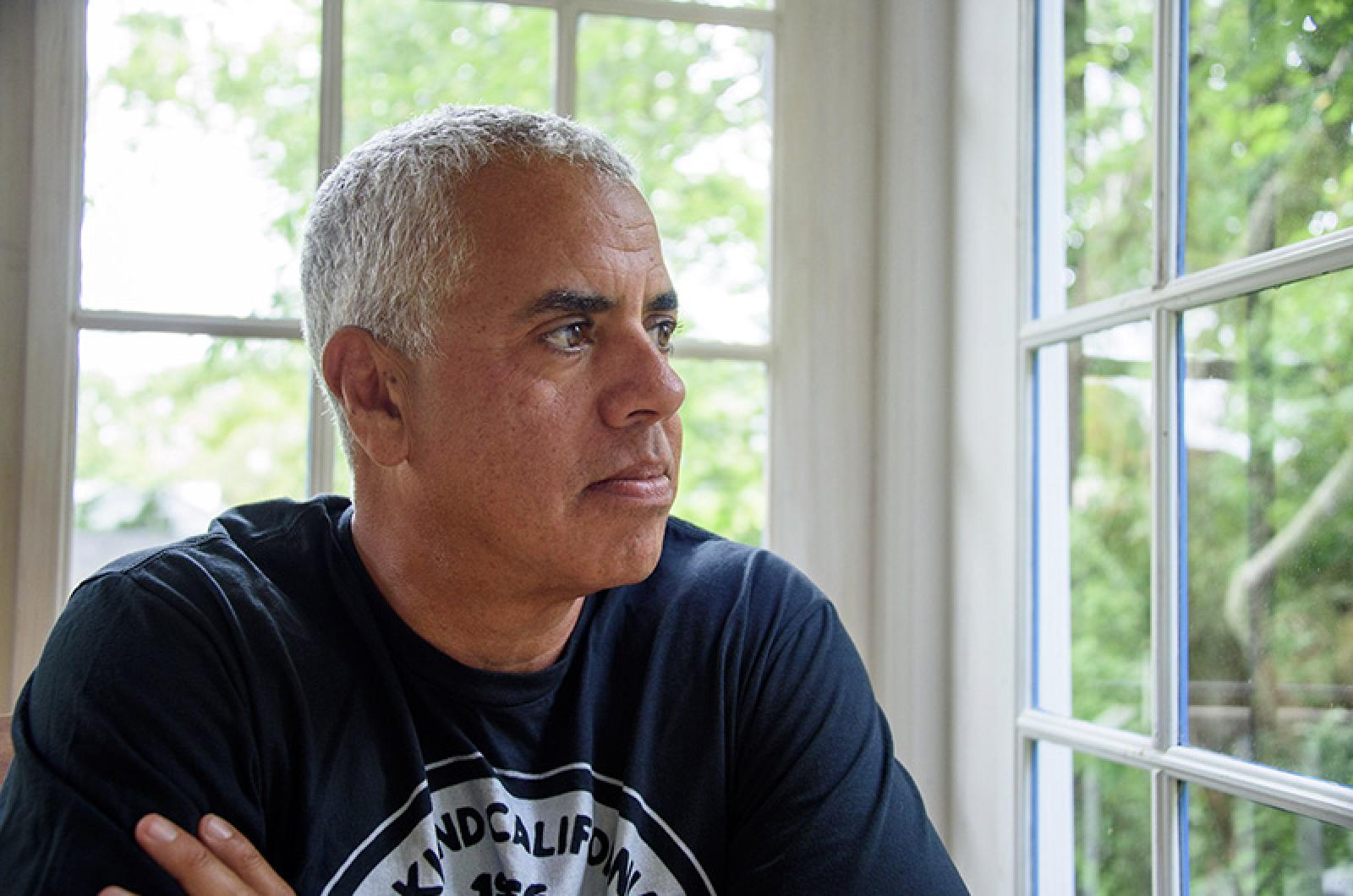
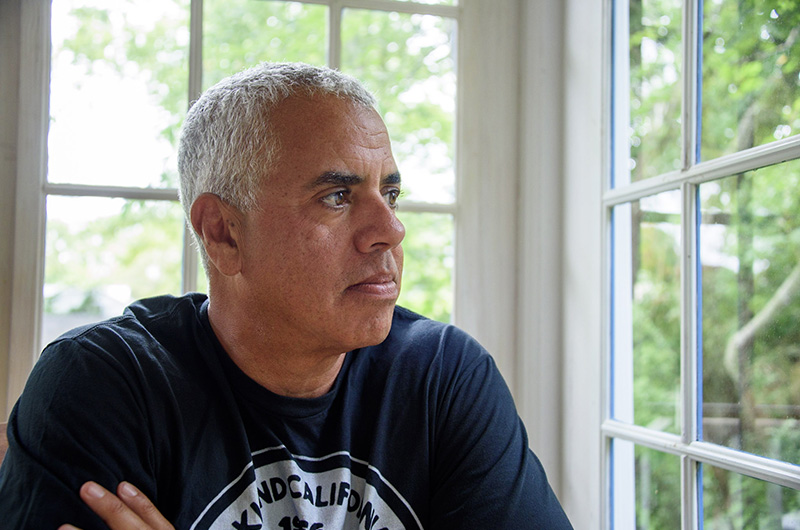
Shed host Eric Adams shapes each discussion through the lens of his profession, working with couples and people suffering from addiction issues. He likens racism to a social illness.
Eric Adams always considered himself a bystander, someone who felt strongly about causes but preferred to be the guy watching and listening rather than the one speaking up.
That all changed last summer after the murder of George Floyd and the subsequent vigils and marches around the country.
“When George Floyd happened, it was like something cracked inside me,” he said in a recent interview at his home in Vineyard Haven. “It really kind of screwed me up. I watched that video too many times. Then someone mentioned there was a rally going on at Waban Park so I went to that and I got moved to speak which is so unlike me. I’m usually kind of hanging in the back and, you know, clapping loud but that’s it.”
A practicing therapist specializing in marriage and couples counseling and substance use disorder issues, Mr. Adams was following the stages of change he talks to his clients about, moving from awareness and contemplation to action. He began attending the kneeling vigils taking place every morning last summer at Beetlebung corner, where people would gather and kneel for nine minutes and 29 seconds, the exact amount of time Derek Chauvin kept his knee on George Floyd’s neck. He traveled off-Island for marches, including one where he grew up in Horsham, Pa., as one of the few students of color in his class.
“Out of the 340 kids in my graduating class, there might have been like eight kids that weren’t white,” he said. “So I thought maybe there would be like 100 people but there was like close to 1,000 people there.”
He also began interviewing people on the Island, talking to them about how race had affected their lives and what they thought could be done to help facilitate change. Those interviews make up the new Gazette podcast called Shed, hosted by Mr. Adams and produced by Chris Fischer and Amy Schumer. The nine-part series begins today and continues through the summer.

A practicing therapist and housepainter — Mr. Adams wears many hats.
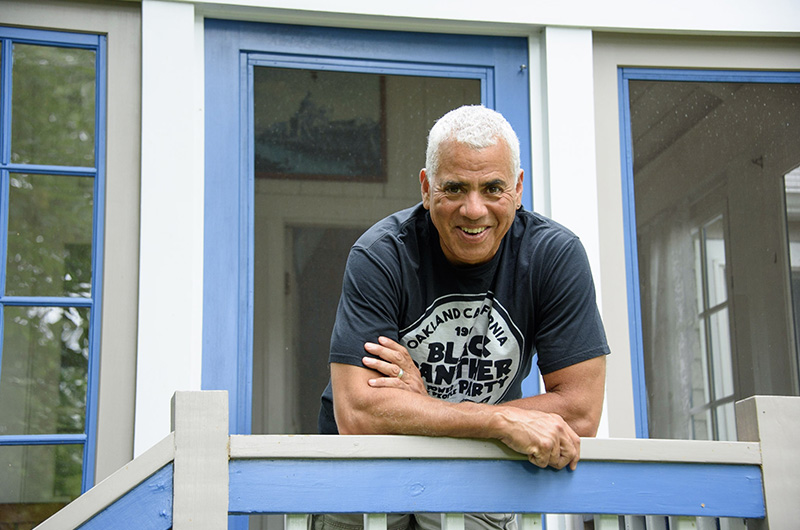
A practicing therapist and housepainter — Mr. Adams wears many hats.
Mr. Adams shapes each episode and discussion through the lens of his profession, working with couples and people suffering from addiction issues. He likens racism to a social illness.
“People aren’t born racist,” he said. “A lot of this is learned. There’s social influences, peer influences, maybe traumatic experiences people have had or things they witnessed, or they have been kind of brainwashed by what they see in the media. So maybe there can be some sort of a treatment we could offer.”
A model he uses in his therapy practices is called the stages of change.
“The first stage is pre-contemplation, where I don’t really know that there’s a problem,” he explained. “Like with addiction, I don’t really realize that my alcohol use is causing a problem. Contemplation is the next stage. We are starting to think about it. Maybe reading some articles, watching something, having some conversations. The next stage is awareness, where I really kind of get it, that something needs to change. The next stage is preparation, where we start to prepare, and then action where we really do some things, and then maintenance.” He added:
“The idea is to help people locate themselves in the spectrum and help them move in a direction of change.”
As host of the podcast, Mr. Adams also talks about his own journey, from awareness to action, from bystander to, in his words, an unlikely host of a podcast about race. He admits the first few episodes were hard for him due to this new role and the difficult nature of the conversations.
“I think the first two episodes, I sweated profusely the entire time,” he said. “It was warm inside but I was also nervous because I’m not really comfortable in that arena. I’m much more comfortable listening.”
But he said he was fueled by the stories he would hear each morning at Beetlebung Corner.
“We felt like we were being healed by being together there every day,” he said. “As hard as it was to hear all the stories there was something healing about being together during all this.”
In addition to being a therapist, Mr. Adams runs a house-painting business, two professions that at first seem far apart, but that he says actually work in tandem, almost like therapeutic shoulders to lean on in his daily life.
“The truth is, doing either one of them full time would be hard for me,” he said. “If it’s just the painting, there’s no real intellectual or emotional and spiritual stimulation. And the therapy can be really hard, dealing with people’s suffering. It’s easy to get burned out.”
Mr. Adams began painting as a teenager and over the years has used the steady income to help finance helping others.
“The money in painting is decent, and the money in the helping professions isn’t great,” he said. “So it started to seem like a way I could earn a living and not have to depend so much on making money through helping people. And so that’s kind of worked because I can have a sliding scale for helping people and do stuff for nothing when people are struggling.”
In college, while volunteering at a homeless shelter, he started a job training program for kids, teaching them how to paint. When he moved to the Vineyard in 2008 (he first began coming to the Island in 1976), he created a program to bring inner city kids from Philadelphia to stay in Oak Bluffs for a few weeks during the summer.
“They talked about walking down the street and at first feeling really uncomfortable when people from their porches would wave at them,” he recalled. “And then at the end, they really enjoyed waving to people and having these little conversations. They never knew how quiet it could be. And by the end of the week, and these were some pretty tough kids, they were like little kids. It just took all the hard edges off. They felt safe, they felt accepted.”
The experience echoes Mr. Adams’s own feelings about the Vineyard, and many of his podcast guests, including Stanley Nelson, whose family roots in Oak Bluffs date to the 1950s.
“The Vineyard has been a rock, I’ve been coming here since I was six years old,” Mr. Nelson says at the beginning of the first episode. “It’s a place where we have a real community, where black folks, and some white folks, wave hello and have your back and expect you to succeed. It’s a place of love where you see other successful black folks.”
The podcast producers said Shed aims to do the same, to create a sense of community around a topic that is in the news but is often lacking around the dinner table or among neighbors. It takes as a starting point that having conversations is the first step to bringing about change.
Mr. Adams said he is looking forward to seeing how the series develops now that it is on the air.
“If we can move some people who were in pre-contemplation to contemplation, that’s a really good thing,” he said. “If people who were in contemplation get moved to awareness, or if people who were in awareness got moved into preparation or action, that’s really good. And if a podcast can assist a little bit in some way, then it’s time well spent.”
Comments
You are the right man for
Kevin McFarland West TisburyYou are the right man for this situation. Best to you and family.
Very cool Eric, your dad
R Scott Patterson EdgartownVery cool Eric, your dad would love this! Proud of you.
Eric is as solid a man as I
Tom Engley West TisburyEric is as solid a man as I have ever known. He’s very committed and sincere. I look forward to this series.
well done. look forward to
tuni deignan Vineyard Havenwell done. look forward to the podcast!
Congratulations Eric! You
Val FrancisCongratulations Eric! You are an inspiration to others! Thank you!
…and he’s an outstanding
Peter B Oak Bluffs…and he’s an outstanding house painter. Professional, thorough and dependable.
The coming of Eric. Good man!
Riley Martin West TisburyThe coming of Eric. Good man!
All power to the people, Big
Brian M. Oak BluffsAll power to the people, Big E!
Congratulations Eric!!
Janet Airis Oak BluffsCongratulations Eric!!
Enjoyed reading this article
Ellen H Oak BluffsEnjoyed reading this article and hearing about your work helping folks at the Vineyard and also the podcast. Your Dad was so helpful to me in the 80’s in Philly and introduced me to the Vineyard where I now live half the year. Best of luck with your podcast.
Best of Luck Eric! Looking
Lisa T Doylestown, PaBest of Luck Eric! Looking forward to listening to the podcast!
You fine Eric. Keep it up.
Safanda Cox O.B. and N.J.You fine Eric. Keep it up.
Kia ora koe Eric, Great to
Pauline Allan-Downs Whangarei New ZealandKia ora koe Eric, Great to hear your story. We visited the Island a few years back and were shocked that the people we talked to didn't even know about the indigenous tribe the Wompanoag. My husband great grandfather was from there and we came to connect with them. We are of Maori decent and we also feel that R..... word. Blessings
Great to meet you last week
Rob Dobson Bedford, MAGreat to meet you last week at the kneel-in vigil, Eric. (We talked afterward about Summer of Soul.) I got on the listserve and just yesterday listened to your GREAT interview/conversation with Stanley Nelson. You're so good at it!! Looking forward to more.
Brilliant to kick off
Olivia Steele Vineyard HavenBrilliant to kick off discussion with always incisive and award winning filmmaker, Stanley Nelson!
Your success is something you
Richard Clee Horsham Pa.Your success is something you have earned through hard work and din of effort. I’m sincerely happy for you and for those you help since they will benefit.
Wonderful to learn of Eric's
Nancy Bruce Blue Bell, PAWonderful to learn of Eric's professions, activities, and see his picture. I knew Eric as
a boy when I substitute taught him in Horsham, and played bridge with his mom, Jean, who I
admired very much!
I went to school with Eric
Joseph B Thomas Winston-SalemI went to school with Eric and many people looked up to him. Proud to call him a teammate and life long friend.
Add new comment