


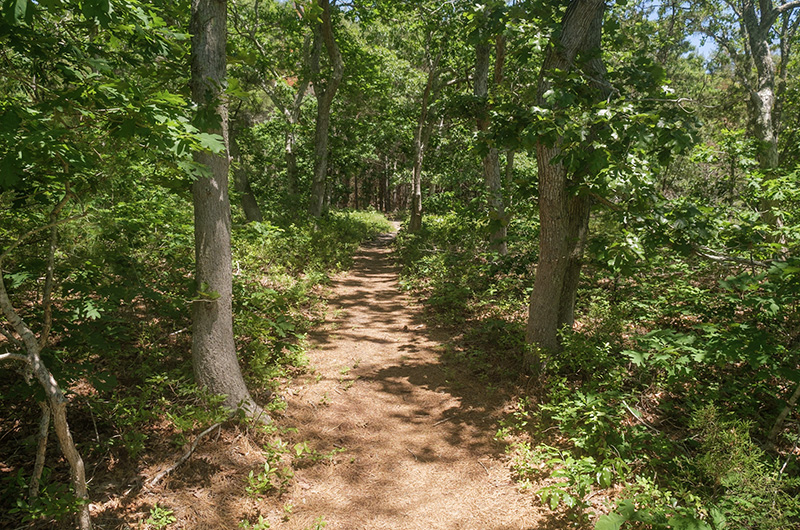
Sheriff’s Meadow Foundation and the state Department of Conservation and Recreation have finalized an agreement to close and restore more than 25 miles of trails that were illegally cut.
Capping a protracted, year-long review process, Sheriff’s Meadow Foundation and the state Department of Conservation and Recreation have finalized an agreement to close and restore more than 25 miles of trails that were illegally cut over the course of two years in the Manuel F. Correllus State Forest.
Announced in a press release from DCR that went out Monday, the final restoration plan comes almost exactly one year after the state Natural Heritage Program sent SMF board member Michael Berwind a noncompliance letter for the trail cutting work, which began in 2018 and was done without proper state permitting or review.
The trails cut through more than 32 acres of priority pitch pine and scrub oak growth that span the reaches of the 5,000-acre state forest, according to state DCR officials and a project narrative created by Sheriff’s Meadow in the aftermath of the citation. Trails were illegally cut through priority habitat for buck moths, migrating warblers, eastern whippoorwills and other rare or endangered species.
After months of investigation and analysis from both Sheriff’s Meadow Foundation staff and DCR, a public information session regarding the plan and two weeks of public comment, the two sides have now formally agreed to close most of the 25 miles of trails and restore them to their natural habitat. They have also signed a legally-binding 14-page memorandum of understanding regarding the restoration work that runs until May 2026.
The five-year restoration plan also looks to close 3.5 miles of preexisting trails that the state determined to be poorly sited. An additional 4.5 miles of illegally cut trails will remain open under the restoration plan to enhance connectivity, pending a retroactive permitting process with Natural Heritage, according to DCR and SMF.
Reached by phone Wednesday, Sheriff’s Meadow Foundation executive director Adam Moore expressed enthusiasm about the outcome after more than a year of back and forth with the state.
“I’m very pleased to have reached this agreement,” Mr. Moore said. “We are working with valued partners at DCR and at Natural Heritage and we’ve enjoyed a good working relationship together, even while trying to resolve this difficult issue,” he said.
In the press release, DCR commissioner Jim Montgomery was even more exuberant. “DCR is thrilled to begin restoration work of the forest’s trail system in partnership with the Sheriff’s Meadow Foundation,” he said.
According to a copy of the agreement provided to the Gazette, the work will be done jointly by Sheriff’s Meadow staff and DCR, with a goal of restoring portions the unauthorized trails as closely to their prior condition as possible. Specifically, 90 per cent of native vegetative cover must be restored to the trail areas and there must be observable evidence of no recreational use on the trails at least one year after their closure, as spelled out in the agreement.
The entire restoration process is expected to take about five years, with work due to begin next week with the installation of closure signs on trails. Mr. Moore said the bulk of the work will take place this summer.
Sheriff’s Meadow is awaiting a final return of a compliance letter from Natural Heritage before beginning work. “I’m expecting it any time now,” Mr. Moore said.
According to the agreement, Sheriff’s Meadow is responsible for the cost of the trail restoration and monitoring program. Mr. Moore declined to provide an exact cost estimate, but said it would take approximately 400 hours of staff time this year.
The process will include both passive and active restoration techniques, according to the plan. A small number of the trails were created with minimal or no soil and root stock disturbance and will be left to regrow, while others will require more involved restoration efforts, including soil scouring, seeding and brushing in with native plants.
“There’s some [trails] that we think will just naturally regrow, there wasn’t much disturbance or impact to the ground. There are others where it might need a little bit more work and those require raking a certain amount of the trail and then covering it up with a duff layer,” said Mr. Moore.
Trails to be passively restored include Bermuda and Reverie in the forest’s western area, 3 Loops in the central forest and Aviator and Zip Tie in the eastern area. Trails requiring active restoration will include Sidewinder, Gateway and Fantasy in the western area, Tranquility Derailleur and Barn Owl in the center and Twisty, Explorer, Logjam and Tunnel in the eastern area.
Portions of the Twisty trail in the northeastern section of the forest and Fantasy in the central and western forest will
remain open, while DCR plans to close a redundant portion of previously sited trail in the northern section of the forest.
“The restoration process is going to be work on the ground, posting closure signs on trails that will be closed. And restoration activities, which would be putting brush and duff on the trail so that the first 25 feet of a trail are blocked,” said Mr. Moore.
He said SMF has begun an invasive species monitoring program in the forest as well.
Sheriff’s Meadow, DCR and Natural Heritage are required under the agreement to meet once a year on site to review progress throughout the restoration process, the agreement says, and Sheriff’s Meadow and DCR will produce a progress report for Natural Heritage at the close of each year.
After restoration, SMF will be required to monitor trails no less than once a month, the agreement states. Natural Heritage will also retain the right to extend the restoration and monitoring activities up to five years past the initially mandated five-year period.
SMF board members will not be involved in the restoration or monitoring work, Mr. Moore said. “It’s going to be just staff members,” he said.
In 2018, Sheriff’s Meadow entered into a voluntary stewardship agreement in the Correllus forest that was centered mainly around assistance with trail-related activities.
But in the spring of 2020, the state Natural Heritage Program was made aware of an unpermitted trail cutting program led by Mr. Berwind. The letter of non-compliance followed on June 11, 2020, requiring all trail work to cease immediately.
Mr. Berwind resigned from the SMF board in October 2020, according to Mr. Moore. No civil or criminal penalties were issued for the MESA violations.
More than 90 per cent of the state forest is home to priority species habitat, making it one of the most biodiverse forests in the state.
A comprehensive review process of the trail network has been underway since the citation last summer, including a public meeting hosted by DCR to announce the finding of its review. The final restoration plan has been adapted to reflect public comment, the press release said.
A spokesman for DCR was not immediately available for comment this week.
The restoration plan went into effect June 14, according to the release. The MOA between the two agencies was signed on June 3.
According to Mr. Moore, no signs have been installed yet on the closed trails, although they were removed from the state trails map and the TrailsMV app.
“If [the state] says they’re closed, they’re closed. But what we’re talking about is not just saying they’re closed in writing. It’s doing some physical work to keep them that way, and to help them to regrow where DCR wants to close them,” said Mr. Moore.
Comments
Seems to be a waste of time
Bob EdgartownSeems to be a waste of time and money as nature would take it back soon enough. But that is what we like to do
It would be nice if the
Kathryn EdgartowmIt would be nice if the forest could reclaim the damaged areas without help. Sadly, if they aren’t blocked off and restored with help , the trails will be enlarged and eroded more with continued use. I don’t think we should have to wait to fix this when people spent 2 years ruining it.
I agree Bob a waste of money!
Jm VHI agree Bob a waste of money!! I liked the trails!
Those trails were illegally
Jessie ChilmarkThose trails were illegally constructed and never intended for your use. What part of a preserved forest don't you understand?
Glad to see it’s closing
T Bone Oak BluffsGlad to see it’s closing positive.
I don't know how or why this
Forest neighbor west tisburyI don't know how or why this tragic, shocking destruction of habitat came about. But I am glad it seems to be resolved. I hope this outcome stands as a lesson for any additional invasions of our precious island natural resources.
So glad to see this situation
Tess W.T.So glad to see this situation resolved in such a positive manner. I noticed in the DCR’s announcement that the “Student Conservation Association”(SCA), a National organization with chapters in each state, would be involved in the restoration work from time to time. Wouldn’t it be nice if the MVRHS’s environmental group could be involved with the restoration efforts for our island?
I would argue that the
Alex Friedman EdgartownI would argue that the multiple illegal campsites within the State Forest present a greater ecological threat than the trails.
I enjoyed those trails. I'm
BCS Oak BluffsI enjoyed those trails. I'm curious if there was an uproar when the wide fire lanes were originally cut through the forest. I'm sure there was no uproar because we didn't have so many nature fakers and snowflakes back then.
Not even a slap on the hand
Unbelievable VHNot even a slap on the hand for the illegal acts. There is a lesson in that alone.
ah, this explains the large
august west edgartownah, this explains the large pine trees cut down by the airport; to block the trails off from walking, running and biking. Ludicrous series of events. Only on Martha’s Vineyard do we want more control and less trails with no rhyme, reason or coherent explanations for the decisions being made. any other community anywhere would like more trails, but not here. priceless. the bureaucrats can hardly contain their excitement and the locals lose.
I’m all for requiring rule
Jim T EdgartownI’m all for requiring rule-following, but it seems to me that if the true goal is preservation, putting all this time/money/effort into stopping even a single new house from being built along our salt pond habitats would have a net greater effect in protecting the island’s biodiversity.
Add new comment